You’ve probably been seeing articles about soil health in the farm media or heard it talked about on farm radio. You may have attended a field tour or farmer meeting where soil health was discussed. It’s almost impossible to avoid hearing about soil health, and when the discussion is about soil health, cover crops are sure to be part of the conversation. Why is this such a hot topic now?
Sometimes I hear people say, “There’s nothing new about cover crops.” It’s certainly true that cover crops have been used for centuries. In fact, before the rise of synthetic fertilizers following World War II, there were really only two common ways to replace the soil nutrients removed by crops: either apply manure to the field or grow a green manure legume crop in the rotation, like alfalfa for hay or a clover cover crop. In the Dust Bowl era, cover crops were widely promoted to address soil erosion, which remains a strong reason to use cover crops to this day.
However, we now know through a much greater understanding of soil biology that cover crops do far more than simply benefit soil fertility or prevent erosion–when we provide living roots to the soil for a greater portion of the year, the soil ecosystem provides all kinds of other benefits to us. In addition to our much greater understanding of soil biology, another thing that has changed in recent years is the number of cover crop species available to grow and improved management techniques. Cover crops are more diverse and the ways of using them are much more advanced than they were decades ago when the only choice seemed to be to plow them into the soil.
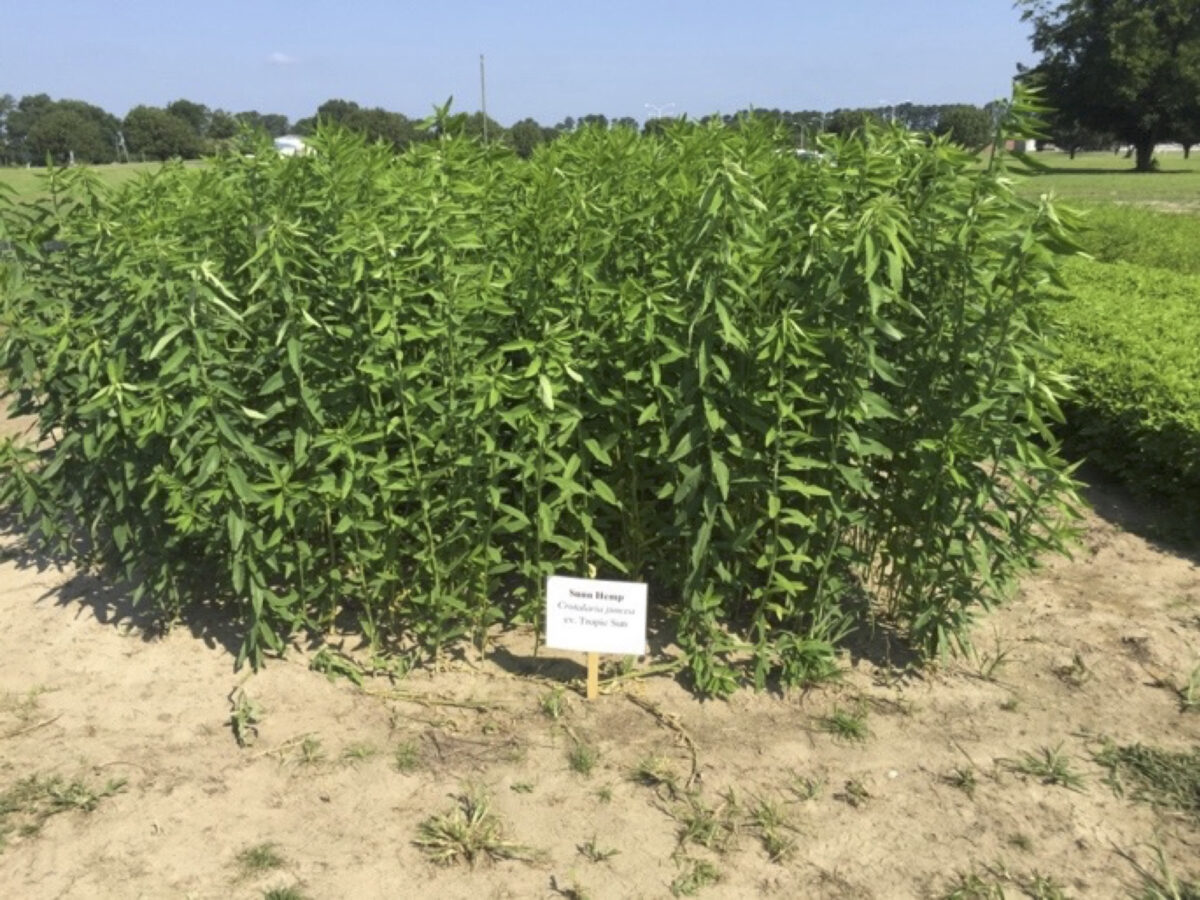
We now have plant species available to use as covers that were not used in the past for that purpose, like radishes or balansa clover in the fall and sunn hemp in the summer. Instead of plowing cover crops to terminate them, we can use herbicides or roller crimpers, or use winter-kill cover crops like the previously mentioned radishes. We also have much better planters for planting into cover crop residue. The use of no-till, strip-till, or other minimum-till techniques is more viable than ever before due to modern herbicides, precision-farming, GPS, and other management techniques, and these conservation tillage approaches work very well in combination with cover crops.
All of these factors have played a role in bringing cover crops back to the forefront, and the fact that cover crops have been part of agriculture for so many centuries should certainly be one additional reason to consider using them once again. More importantly, our new understanding of soil biology is worth exploring further when considering whether cover crops are right for your situation.
The Natural Resources Conservation Service (NRCS) has identified four main principles for soil health:
- Keep the soil covered as much as possible
- Disturb the soil as little as possible
- Keep plants growing throughout the year to feed the soil
- Diversify crop rotations as much as possible, including with cover crops
Cover crops contribute to all four of these soil health goals, but they are the only way to achieve the third goal of feeding the soil year-round when growing annual commodity crops. The living roots provided by cover crops play a huge role in maintaining and building soil health. This chapter will take a deeper look at the following aspects of soil health related to cover crops:
- Managing soil nutrients
- Building soil organic matter and strengthening the soil
- Keeping the soil covered
- Managing soil moisture
- Contributing to biodiversity
Managing soil nutrients
It used to be common practice to look at soil fertility as an input-out-put sort of model, particularly for nitrogen: put on 150 pounds of nitrogen fertilizer per acre and get 150 bushels of corn; add another 30 pounds of nitrogen and get another 30 bushels to the acre. In fact, in many areas, farmers were encouraged simply to set a yield goal–say 220 bushels an acre–and fertilize according to that number, putting aside considerations such as soil organic matter, texture class, profile, and weather.
We now understand that a diverse community of soil organisms plays an invaluable role in plant nutrition, and particularly in creating a healthy soil. This role is a complex one; it has impacts in relation to weather conditions and both short-term and long-term soil changes that affect how soil nutrients are cycled and whether they are available in the root zone to the cash crop being grown.
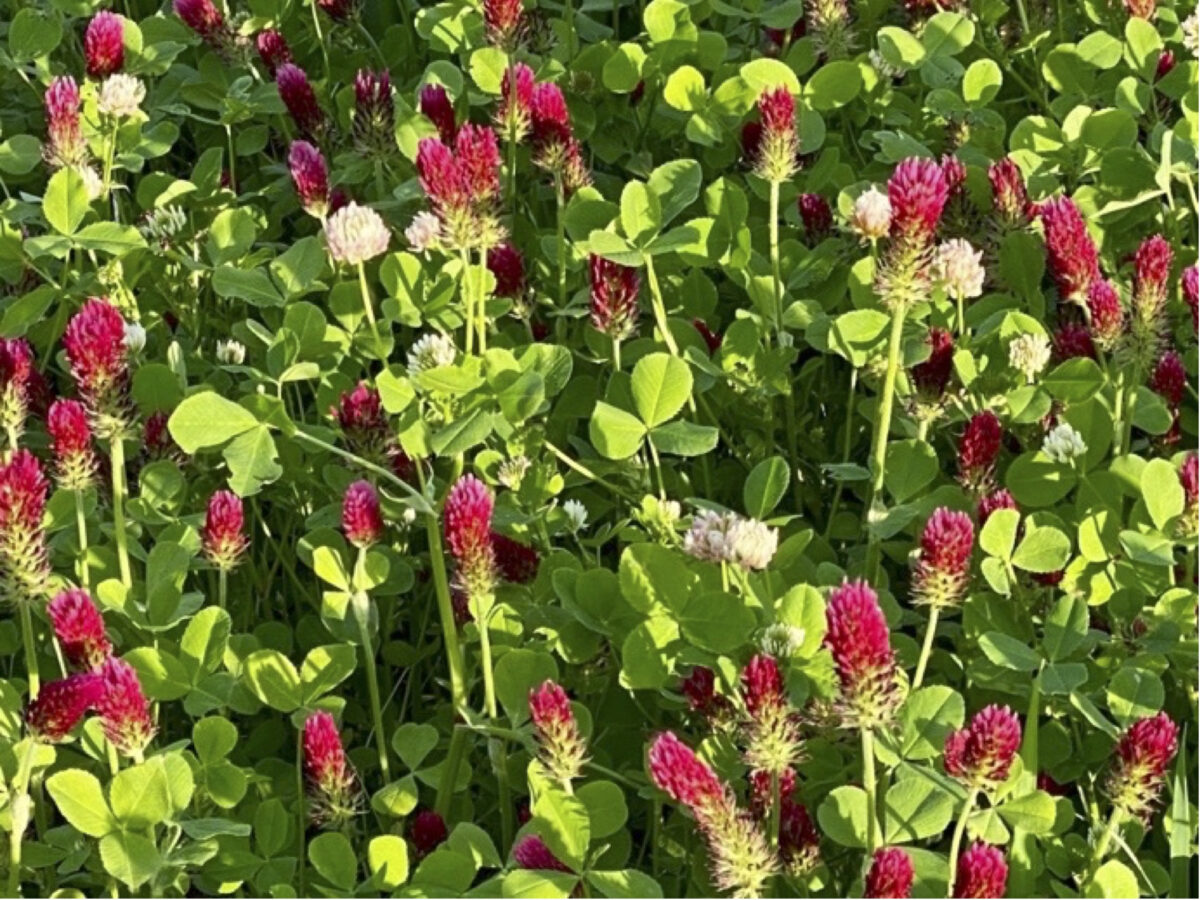
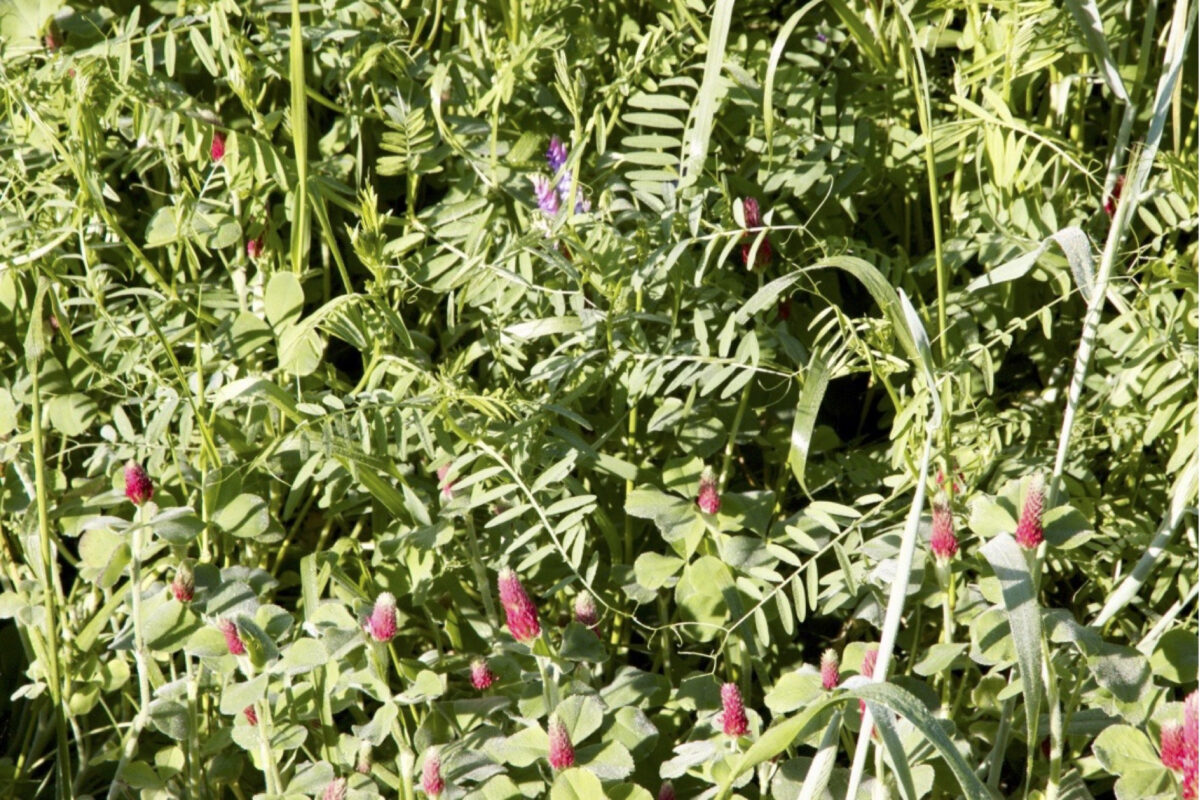
Balansa clover (pinkish white flowers) mixed with crimson clover – both are cool season clovers typically planted in the fall.
The easiest part of the soil biology to observe and understand is the action of earthworms. As earthworms tunnel, they leave nutrient-rich castings behind that attract both microbes and crop roots that are seeking nutrients. The tunnels also move rainfall deeper into the soil and allow roots to grow deeper, tapping into nutrients in lower parts of the soil profile (see a more in-depth discussion on earthworms in Chapter 5).
While earthworms and their tunneling are easily visible, the unseen microbial world of soil organisms has just as big of an impact on soil fertility for crop growth. Mycorrhizal fungi are a group of beneficial soil organisms that play a significant role in helping crop roots access more soil nutrients. The fungal hyphae–long, branching structures–are particularly beneficial for crops because they create better access to phosphorus in the soil, and they can also provide other nutrients to crop roots in return for the sugars and other carbohydrates the crop roots exude.
Other soil organisms also impact nutrient availability in the soil. In the short-term, as they break down the roots and residue of previous plants in the field, they release a certain amount of nutrients to the following crop. Farmers have noted that healthier soils seem to recycle crop residues more quickly than overly disturbed, worn-out soils. In the long term, these soil microbes become part of the fabric of soil organic matter that builds soil aggregates and gives soil improved structure. The more expansive root growth of the crops is critical to accessing as much soil fertility as possible. Thus, the hidden, microscopic life in soil is helping corn grow green and tall as much as earthworms do. (Additional details on soil fungi and other microbes are in Chapter 5.)
Legume cover crops
Legumes are believed to have the longest history of use as cover crops, in large part because of their ability to fix nitrogen, and thus provide a key soil nutrient to other crops. Before the advent of modern synthetic nitrogen fertilizer manufacturing, application of livestock manure to fields and green manuring with legume cover crops were the most common methods of adding nitrogen to crop fields. The benefits of green manuring with legumes dates back at least to the ancient Romans, and early American farmers such as George Washington and Thomas Jefferson recommended use of green manures to their fellow farmers (during their era of farming, the more common practice was to farm the land with corn, tobacco, or small grains until the natural soil fertility was depleted and then move farther west, rather than make use of soil-improving legumes).
Today, there are a large number of legumes available to use as cover crops, many of which are detailed in Chapter 7. Rather than going through the pros and cons of each legume species in this section, I’ll focus on the role of legumes in soil health and fertility. Of course, the nitrogen-fixing ability of legumes is the trait that stands out most, and some legume species can produce a remarkable amount of nitrogen if given sufficient time to grow. Some of the top nitrogen-fixing cover crops include:
- Winter annuals such as crimson clover, balansa clover, hairy vetch, and winter pea
- Summer annuals such as cowpeas and sunn hemp
- Biennials such as yellow sweet clover and white sweet clover
- Perennials such as red clover and alfalfa
Under ideal conditions, many of these legumes can fix 100 or more pounds of nitrogen per acre, greatly reducing or eliminating the need for nitrogen fertilizer. This makes legume cover crops popular for everyone from small gardeners to big farmers, and particularly for organic farmers who are limited in their nitrogen options.
Legumes’ contributions to soil health go beyond just nitrogen fixation, however. Legumes have a low carbon-to-nitrogen (C:N) ratio, so they are quickly recycled by soil microbes into the organic fraction of the soil. Whether tilled in or allowed to be incorporated into the soil by earthworms and soil microbes, legumes are a good tool for building soil organic matter, particularly when used with higher-biomass cover crops such as winter cereals or fast-growing summer grasses (e.g., sorghum-sudan or pearl millet). Use of legumes as cover crops also adds to the biodiversity of crop rotations, and many legumes provide an extended flowering period that is conducive to attracting pollinators and other beneficial insects.
Scavenging nutrients
No discussion of cover crops and nutrients is complete without mentioning the ability of cover crops to take up or scavenge leftover soil nutrients at the end of a growing season. It has been documented that nitrogen in particular is very mobile in the soil, and much of the available nitrogen left in the root zone after harvesting crops like corn or cotton is prone to leach away, especially in higher-rainfall areas. Some cover crops appear to be better than others at taking up the leftover nitrogen and other nutrients, but any cover crop is better than none in this regard.
Radishes in particular have been cited for their ability to grow quickly (if planted in early fall) and root deeply enough to grab leftover nitrogen and other nutrients. The question not entirely answered by research is: What happens to the nitrogen that radishes take up in the fall? With exact timing dependent upon latitude and weather, radish roots and top growth decompose as winter nears its end. At that point, the nitrogen held in the radish tubers, roots, and leaves is released. Some may go off into the atmosphere, and some is undoubtedly recycled by soil organisms, but conflicting information has come out of research on radishes and their impact on nitrogen cycling. There is concern by researchers that radishes grown alone may release the nitrogen more quickly in spring than it can be used by a crop such as corn. To reduce the loss of nitrogen from radishes, I recommend using them with other cover crops in mixes, particularly with a winter cereal crop that can help pick up and hold nitrogen for longer in the spring.
Cereal rye residues, on the other hand, may hold nitrogen for too long. Rye is the most studied cover crop in terms of nitrogen impact, helped along by many years of work by scientists such as Tom Kasper in Iowa and others. When cereal rye is allowed to grow past flowering, it ends up with a relatively high C:N ratio. This makes it more difficult for soil microbes to break down the rye residue, leading to a longer recycling time for the nutrients, including nitrogen, from the rye into the soil. Studies to date have indicated that the majority of nitrogen available from post-anthesis (post-flowering) cereal rye may not be available in the soil until late summer, which is past the time when corn or other summer crops could most benefit from that recycled nitrogen.
There are two approaches to speeding up the bioavailability of nitrogen from rye. One is to terminate the rye earlier, while it is still vegetative (before seed heads appear). At this stage, the rye has a C:N ratio more in line with what soil microbes need, speeding up their decomposition of rye residue. Another approach is to complement cereal rye with other cover crops that have a lower C:N ratio, particularly legumes. Hairy vetch may have the best ability to grow vigorously when mixed with rye, but other legumes can work if the rye population is kept thin enough, allowing the legume a chance to grow effectively. If a sufficient amount of legume biomass exists alongside the rye at termination, then the C:N ratio will be more favorable and rye residue will break down more quickly.
Building soil organic matter and strengthening the soil
Ask any farmer about soil organic matter and they will tell you it’s important, but many are less familiar with how to build organic matter or what exactly it can do to improve profitability. The figure below, created by Ray Weil for his popular textbook The Nature and Property of Soils, depicts at a glance what has happened to our soil organic matter on farmed fields, and how it can be rebuilt. It shows some of the different fractions of soil carbon that make up soil organic matter and how, on average, we’ve lost about half of the soil organic matter we had from the time agriculture by European colonists started in the U.S. When I first became aware of this fact several years ago, I can’t say I was surprised, but it was still a dispiriting moment. However, the optimist in me looks at the graph below and sees the opportunity to rebuild our soil organic matter–we know the soils can hold a lot more carbon than they are now!
Why is it important to rebuild soil organic matter? To me, it’s like having a set of well-maintained and powerful tractors to use in the farming operation; everything else becomes easier if there is plenty of reliable power to pull planters and grain carts and do other farm work. Or you could equate it to having a good supply of electric power in the farm shop – many of the other tasks in that farm shop get easier with reliable electric power.
How does organic matter power our fields? It’s been described as the sponge, the reservoir, the glue, and the storehouse of nutrients. If you’ve been to a recent soil health meeting, you’ve probably heard it said that if you could boost your soil organic matter by just one percentage point, such as from 2% to 3%, your field could store approximately 27,000 additional gallons of water per acre. However, it’s not simply a matter of storing that water; it’s also a matter of holding on to it for longer, rather than it quickly draining out of the root zone. The organic matter, in combination with clay soil particles, creates more area for surface tension to hold the water in place. This keeps the water available for crops to use for a longer period of time.
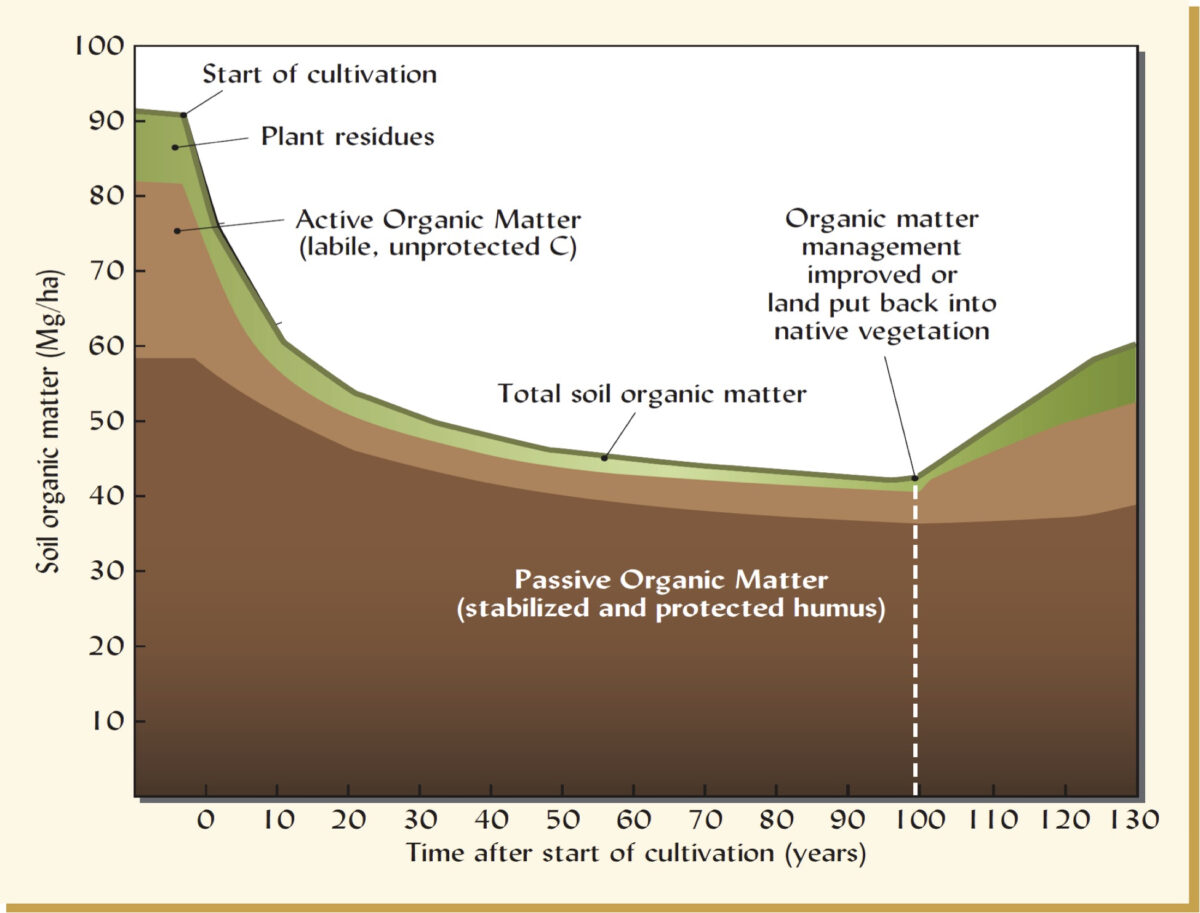
The exact contribution of increased organic matter to crop nutrition is harder to pin down, but without question, a higher-organic-matter soil has a higher level of inherent fertility, leading to potential savings on fertilizer each year. Organic matter, particularly the active carbon fraction, is positively correlated with soil health–so the more active carbon a soil contains, the healthier the soil is and the more conducive it is to crop growth.
Increased soil carbon also allows soil organisms to generate more glomalin, which is the glue that holds soil particles together and builds better soil aggregates. These aggregates are the building blocks of soil structure, creating surface area for microbes to live on. Better soil aggregation also provides more pore spaces for air and water in the soil and gives the soil strength to resist compaction from field operations.
Research at Ohio State University over a several-year period showed that compaction caused by a 20-ton grain cart was more effectively remedied by cover crops than by subsoiling. While subsoiling equipment can provide some temporary relief to compaction, clay soils often swell back together quickly where the subsoiling knife or shank has traveled. Earthworms stimulated by cover crops and cover crop roots, along with gradual soil organic matter increases, do a better job of not only repairing compaction but also reducing the soil’s susceptibility to future compaction.
Keeping the soil covered
Cover cropping, if done in combination with no-till or very minimal tillage, can do a great job of keeping the soil covered. Maintaining soil coverage year-round is one of the core NRCS soil health principles. Living cover crops, if planted in a dense stand, are particularly effective at covering the soil while alive, of course; but what about after they are terminated? Even then, the residue left behind by cover crops can persist for several weeks, and sometimes for months, depending on the C:N ratio of the cover crop residue and how biologically active the soil is in breaking down surface residue.
Cereal rye in particular is noted for providing a beneficial mat of residue after termination. The rye can be made into a surface mat with a roller crimper or simply by being knocked down by a cash crop planter. The rye mulch, if thick enough, can do a great job of reducing weed seed germination and emergence.
Soil cover is helpful in ways beyond just weed suppression. Protection against both water and wind erosion is one key benefit. Water erosion starts when a raindrop splashes against the ground and dislodges soil particles; living cover crop leaves and stems or residue intercept raindrops and prevent soil from being dislodged. Cover crop roots also anchor the soil and reduce water and wind erosion, and the residue traps windblown soil particles. Overall, cover crops have been documented to reduce erosion by 90% or more.
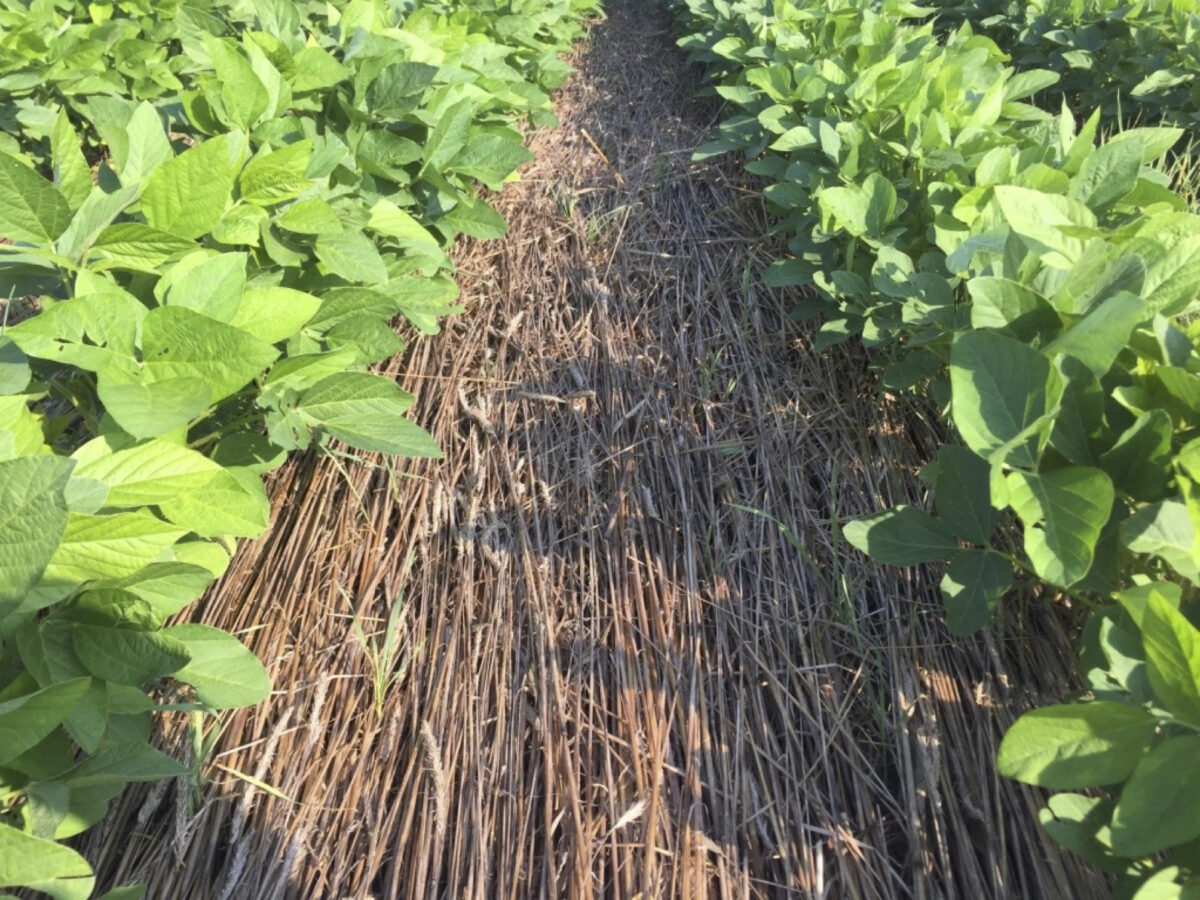
Soil temperature is also impacted by the cover of plants and residue. Both living cover crops and dried residue after a cover crop is terminated can keep the soil cooler, which is helpful since the heat of early summer sunshine tends to elevate soil temperatures until the cash crop can completely shade the soil. In fact, on a hot June day, temperatures of bare soil between crop rows may be 20°F-30°F higher than soil under a cover crop residue blanket. Soil microbes function best at temperatures in the 70s, so hotter soil temperatures reduce soil functioning as well as stress crop roots and accelerate soil evaporation of needed moisture.
Some farmers worry that cover crops and no-till practices may lead to colder, wetter soils that delay planting, but it’s important to remember that a living cover crop creates significant biological activity and soil conditions that are often no cooler than a conventional field in early spring. Even with a winter-kill cover crop in a no-till operation, the soil temperature may be relatively unaffected.
Ryan Stockwell, who farms in north-central Wisconsin and works for Indigo Ag, did a comparison of soil temperatures at 4-inch depth on a tilled field, a no-till field with winter-killed cover crops (no live cover crops), and his lawn in 2014 and got the following results:
| Week | Date/Time | Lawn (average temp in °F from 4 samples) | No-till with winter killed cover crop | Fall-tilled |
| 1 | April 22 @ 11:15am | 42.85 | 44.45 | 45.75 |
| 2 | May 2 @ 7:30am | 41.98 | 41.4 | 40.93 |
| 3 | May 6 @ 8:50am | 45.13 | 44.88 | 43.43 |
| 4 | May 13 @ 8:35am | 54.2 | 53.68 | 53.07 |
| 4b | May 13 @ 7:10pm | 53.03 | 52.96 | 52.63 |
| 5 | May 19 @ 10:50am | 51.83 | 52.58 | 52.45 |
| 6 | May 26 @ 11:40am | 61.97 | 68.45 | 69.17 |
Conventional thinking would be that the fall tilled soil would always be the warmest, but in the case above, there was generally no advantage compared to a winter kill cover crop in no-till. Interestingly, the sodded lawn was often about the same temp, although it was slightly cooler on the very first reading of the spring and kept the soil cooler at the end of May when air temps were starting to really rise. Keep in mind different depths in the soil will respond differently, and the top inch will heat up faster than the four-inch depth that Ryan tested.
Managing soil moisture
Soil staying excessively dry or excessively wet (anaerobic) for prolonged periods leads not only to dead or dormant soil organisms, but also improper functioning of crop roots. In a very dry soil, crop roots simply won’t continue growing. I’ve dug up crop roots in sandy soils that turned and grew at right angles when they hit a dry zone of the soil. With limited roots and little access to soil moisture, the top part of the plant inevitably wilts and grows poorly, if at all. A field of corn or cotton that’s been hammered by drought is not a pretty sight.
A water-logged soil can be just as problematic for crops and even more likely to lead to premature crop death. Without access to air in the soil, crop roots stop functioning and plant death follows. Where conditions are not totally saturated but still too wet, root growth is impaired. Crop diseases become an issue as well, not only because some plant pathogens thrive in high moisture, but also because the crop is weakened and more easily invaded by the pathogens.
None of this is news to any farmer, so the question is how to build soil health to the point where moisture extremes are moderated by the buffering ability of a resilient soil. Drainage tile can certainly help with excess moisture on some soil types. Developing better internal soil drainage through improved macropores and soil structure can also be helpful for both wet and dry conditions. In a tilled soil, heavy rainfall can quickly seal up the soil surface, leading much of the rain to run off of fields or “pond” in low spots of fields. By minimizing disturbance and maximizing creation of macropores from earthworms and root channels, water moves not only more easily from the surface into the soil profile, but also throughout the profile, leading to a greater volume of the profile storing moisture.
If we compare soil structure to human transportation infrastructure, macropores are like the interstate highways of soil that move large volumes of resources (water) and allow long-distance travel (propagation of roots), but soil aggregates are like all the neighborhood blocks with side streets that allow people to travel to their homes, stores, and businesses. In the case of the rootzone, when well- aggregated soil provides plenty of side streets in terms of where water and roots can travel, the roots can access more moisture and more nutrients. The well-structured soil also holds up better to field traffic, allowing wider windows for planting and harvest and reducing the likelihood of compaction. Avoiding compaction is absolutely critical to prevent conditions in which root growth is restricted and there is limited soil volume to hold rainfall.
Cover crops build soil structure by supporting mycorrhizal fungi that in turn form glomalin. The glomalin serves as the glue to build soil structure, similar to mortar helping build a cement block foundation.
As mentioned above, minimizing soil disturbance while using cover crops is key to taking maximum advantage of the benefits they provide, including building soil structure and organic matter. There are many other ways that cover crops improve soil moisture. To summarize the key ways that cover crops help in a dry year:
- Residue blanket. Cover crop residue left after spring termination provides a residue blanket that reduces evaporation from the soil.
- Rooting depth. Deep-rooted cover crops (winter cereals, annual ryegrass, radishes, sunflowers, etc.) open up a deeper volume of soil for crop roots to access, since the crop roots often follow previous root channels. The extra 6-12 inches of rooting depth a cover crop may foster can make a big difference in a dry year. Some cover crops can also improve growth into restricted root zones in the soil, whether those zones are from compaction or natural soil conditions.
- Efficient moisture extraction. Mycorrhizal fungi occur at higher levels in cover-cropped soils, particularly those with minimal disturbance, and the fungi effectively expand the soil volume that can be tapped for soil moisture as well as nutrients.
- Rainfall infiltration. Stimulation of earthworm tunnels and creation of root channels moves rainfall from the surface into and throughout the rootzone. This is particularly valuable during intense rainstorms when much of the rainfall might otherwise run off.
- Water storage in the rootzone. By building soil structure and soil organic matter and reducing compaction, cover crops create a soil with less bulk density and greater capacity to hold water.
- Healthier plants. Healthier soil leads to healthier plants that grow more vigorously. Crops benefit from less pressure from some pests and a more continual supply of nutrients, allowing them to grow more vigorously. In turn, they produce more root growth early in the cropping season, growing roots deep down before weather turns dry and soil moisture becomes deficient in the upper soil profile.
When cover crop use first started taking off in the U.S., there were some scientists and producers who lacked experience with covers and just assumed that cover crops would dry out the soil too much. After all, a cover crop does transpire moisture out of the soil. Indeed, in a dry spring a cover crop should be terminated early to avoid drying out the soil too much.
However, farmer experience and subsequent research have shown that multi-year use of cover crops, particularly with no-till, generally leads to the improvements outlined earlier. Some of these changes happen in the first year of cover crop use, such as increased earthworms and mycorrhizal fungi, a residue blanket, and better rooting potential of the cash crop following a deep-rooted cover crop. For example, during the major drought of 2012, even first-year cover crop users reported significant yield savings. Hopefully, future crop insurance policies will reflect the benefits that cover crops provide in reducing yield losses during weather extremes, particularly dry weather.
Contributing to biodiversity
Why is biodiversity important for a successful cropping system? After all, when we look at a field of corn, cotton, soybeans, or wheat, isn’t it all just one species growing out there?
One oft-cited phrase from Aristotle is that “nature abhors a vacuum.” Where only one species of plant is growing, such as soybeans, nature wants to add many other plant species in the form of weeds. Of course, natural plant communities are normally highly diverse, whether we think of prairies or forests. A few years ago, I was part of a group touring a native tall-grass prairie in central Missouri. The prairie biologist leading our tour identified over 50 species of plants growing in the prairie, illustrating the direction nature tends to go with plant diversity.
Cultivating more plant biodiversity in our cropping system doesn’t mean we have to grow multiple cash crops interplanted. We can increase biodiversity by adding additional cash crops to the rotation, such as adding a small grain or alfalfa into a corn-soybean rotation. Cover crops are a great way to add plant biodiversity, because they not only lead to more than one plant species growing in a field during the course of a year, but also because cover crop mixes can be used with multiple plant species.
Fully appreciating the benefits of biodiversity for farming requires looking beyond only the plants in a field. We can consider other changes in species populations we can see, such as greater plant diversity contributing to greater diversity of songbirds and other wildlife, and greater diversity of insects, including pollinators and other beneficial insects. We can also consider the species we can’t see – microbes like soil mycorrhizal fungi and beneficial bacteria – which are doing so much work in the soil that benefits our farm goals.
The more diverse the soil microbial community is, the more resilient it is in the face of disruption from weather extremes. A diverse, healthy soil ecosystem does a better job of recycling soil nutrients and building organic matter (see more on this in the next chapter). Crop roots are more likely to grow well in a healthy soil ecosystem, leading to healthier crop plants overall.
Put into simple terms, think of a community slammed by a tornado: would that community rebuild faster with a diverse set of people with wide-ranging expertise, such as plumbers, electricians, carpenters, architects, engineers, finance and medical experts, etc., or would it rebuild faster with only one type of person with one skill set? If we have an overly disturbed soil with no living cover and reduced soil diversity, often favoring short-lived bacteria, that soil will not be resilient and will not contribute to healthy crop growth. If we pour on fertilizers, we can partly and temporarily overcome these deficiencies, but we may find ourselves needing to add other external inputs like pesticides and fungicides to the system as well, trying to rebalance the system with chemical inputs rather than benefitting from a biologically balanced system.