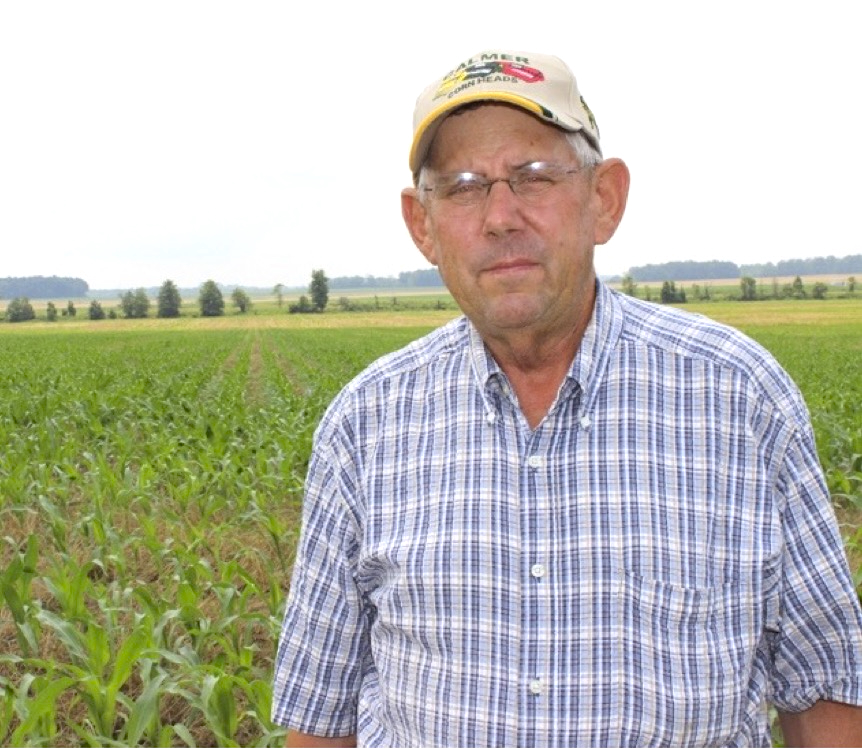
At the time of this interview, Ralph “Junior” Upton farmed about 1,300 acres in southern Illinois (he retired from farming after the fall 2022 harvest). He started farming in 1964 and used cover crops on at least some fields throughout his farming career. Initially, he focused on using clover cover crops. He would overseed red, sweet, or ladino clover into winter wheat in February. The clover would become established in the spring, staying small under the wheat crop until the wheat was harvested in mid-summer. After wheat harvest, the clover would take off and grow through the fall. He’d normally try to cut the clover for hay in the fall, and sometimes get a seed harvest on the clover the next spring.
He first started no-tilling in about 1973. That transition was made possible when John Deere came out with double disk openers on their planters. Junior felt that previous planters wouldn’t work for no-till.
In the 1980s, he started to hear a little bit more about the sustainability advantages of cover crops, so he started experimenting with more cover crop options. His farm’s income was low during that period, so he focused on cover crop options that were affordable, trying buckwheat, hairy vetch, and cereal rye, primarily for weed control. The hairy vetch also had the advantage of providing some nitrogen fixation.
Buckwheat would be planted after wheat harvest in early July. If he had a market for the buckwheat, he would also consider harvesting it for seed. Some years, the buckwheat made a profit comparable to double crop soybeans, but eventually the market for buckwheat went away, so he stopped using it.
Junior then started planting cereal rye and hairy vetch together. For several years, he seeded the mix using a broadcast spreader. Then, when seed got more expensive, he started using a drill to economize on seeding rate and ensure that a higher percentage of the seed would establish. He harvested and kept his own rye and vetch seed, or occasionally bought rye from a neighbor.
Junior noted that his first use of cover crops was on ground he owned, and as he started to see the benefits over time, he gradually added cover crops on rented ground. He was initially a little reluctant to spend money on cover crop seed on rented ground, but now feels that the benefits are well worth it.
In recent years, his cover crop program has been to use cover crop mixes before both corn and soybeans. Before soybeans, he typically does a three-way mix of cereal rye (40 pounds per acre), annual ryegrass (4-6 pounds per acre), and rapeseed (2 pounds per acre). Before corn, he uses a three- to five-way mix, always including cereal rye (40 pounds per acre), annual ryegrass (4-6 pounds per acre), and hairy vetch (14 pounds per acre). If he can plant the mix early enough, he adds some rapeseed (2 pounds per acre) and spring oats (8 pounds per acre). He feels the cereal rye is important for good erosion control. He likes annual ryegrass for its deep roots and ability to help address soil compaction. On wetter fields, annual ryegrass does well, even better than cereal rye. The oats provide quick fall growth.
He no longer routinely grows winter wheat for grain, in part because he doesn’t like growing double crop beans, commenting that on hilly ground, soybean residue tends to float away, and gullies form after rainstorms. He feels the double crop beans don’t leave enough time for a soil-protecting cover crop to become established in the fall.
On the occasions when he does plant some winter wheat, he plants a diverse cover crop mix following wheat harvest to improve the soil, finding that it substantially helps his corn crop the next year.
Junior has been a 100% no-till farmer for 15 years and tries to plant cover crops on all his fields, but for quite a few years he has done strip trials with and without cover crops in 80-foot strips. The cover crop strips have yielded better than the strips without cover crops every year, which he attributes to the better soil health from the cover crops.
Cover crop seeding method
Junior has tried a variety of broadcast seeding methods for cover crops, including helicopters and fertilizer spreaders. He hasn’t been satisfied with broadcast seeding compared to using a drill because he doesn’t see as good of establishment from the broadcast seeding. He noted that he has a lot of crop residue and it’s hard to ensure good seed-to-soil contact when broadcast seeding. Ideally, he would like to overseed cover crops in early September with aerial seeding, but observed that aerial seeding costs more money than drilling it himself; plus, he can keep seeding rates lower with the drill and sees good establishment with the drill.
Cover crop termination method
Prior to corn planting, Junior applies a grass herbicide to terminate the cereal rye and annual ryegrass early, but lets the hairy vetch keep growing (in some years the annual ryegrass may not completely die, but hairy vetch seems to choke it out). Ideally, he lets the cover crops turn green and start growing before spraying, once they are over about “shoe-top” high. He terminates the grass cover crops early before corn because he doesn’t want the cereal rye to tie up nitrogen.
He does delay his corn planting a little compared to neighbors in order to allow more time for the hairy vetch to fix nitrogen. His goal is to let the hairy vetch grow long enough to contribute about 70 pounds of nitrogen per acre, so he lets it grow through early May and tries to plant corn around May 10. He finds that the hairy vetch is easy to plant into until it starts blooming, but then it gets viny and harder to plant into, though it can still be done with the right planting equipment. He terminates the vetch with a mix of 2,4-D and glyphosate shortly after corn planting. He uses some starter fertilizer with corn to help it sprout.
His approach with soybean planting is to plant green into the still-living cover crops and then spray terminate the covers after soybean planting. He does monitor the cover crop height and prefers not to let it get too tall. He has his ag retailer spray glyphosate to terminate the covers (a mix of cereal rye, annual ryegrass, and rapeseed).
Impacts of the cover crops
Many of Junior’s fields, like his neighbors’ in southern Illinois, suffer from fragipans, which are dense subsoil layers that restrict root growth and water penetration. The existence of fragipans can greatly reduce crop yields because crops like corn and soybeans have less soil moisture and can’t grow roots as deep. Soil scientists doing research on Junior’s farm found that multi-year use of annual ryegrass and other cover crops seemed to be causing his fragipan soil restrictions to disappear, leading to dramatic yield gains–as much as 40 bushels or more with corn. Follow-up research by a group of University of Kentucky soil scientists found annual ryegrass releases chemicals from deep-growing roots that are effective in breaking up fragipans.
In the past, the only tool that could be used with fragipans was a deep soil ripper, but that provided limited and only short-term benefits, whereas Junior said the cover crops have been a much more effective and long-lasting solution.
Junior commented that cover crops can be deceptive, growing roots much deeper than one would expect from looking at their above-ground growth. Working with former University of Illinois agronomist Mike Plumer, Junior found that annual ryegrass had roots 70 inches deep in February while above ground growth was only four inches tall. The following August, they dug soil pits for a field tour on the farm and found the corn roots going down that deep following the cover crop root channels instead of being restricted to the upper soil horizon, as would have been the case on conventionally farmed ground.
Collaborating agronomists working with Junior have documented that soil organic matter on his first cover crop research project was at 0.8% and has now climbed to 3.5% through the long-term combination of no-till and diverse cover crop mixes.
Between the deeper cash crop rooting and higher moisture-holding capacity from higher soil organic matter, Junior said over crops have really helped in dry weather: “No doubt about it!” He commented that corn fields that, in the past, would get very moisture-stressed in 10 days can now go 4-5 weeks without rain.
After using his no-till cover crop system for a number of years, Junior said he can see very noticeable changes to the soil compared to newly rented fields or neighbors’ farms. He has significantly better soil structure, more earthworms, and darker soil color. He recently had a company come in to do some drainage tile work, and the tile installer commented on how much darker his soils were than nearby fields where they had put in tile.
Some tips that Junior had for farmers considering using cover crops:
- Erosion control is the most important benefit, and you’ll see it right away.
- Weed control benefits also show up pretty quickly.
- You can get some nitrogen from legumes, but other fertility benefits can take some time as soil health gets better.
- Benefits in dry weather are also significant, but improve over time as soil gets better.
- Think about your rotation and how best to fit in the cover crops.
- Be sure to figure out adjustments to planting equipment for planting into cover crop residue, or consider getting a different planter.
- Experiment with strips of different cover crops to see what works best for you.
When asked about how cover crops had impacted profitability, Junior said the farm probably wouldn’t have been able to stay afloat financially without the cover crop and no-till system due to poor profits in conventional fields. In his experience, the cover crops have paid for themselves with improved yields and improved profitability.