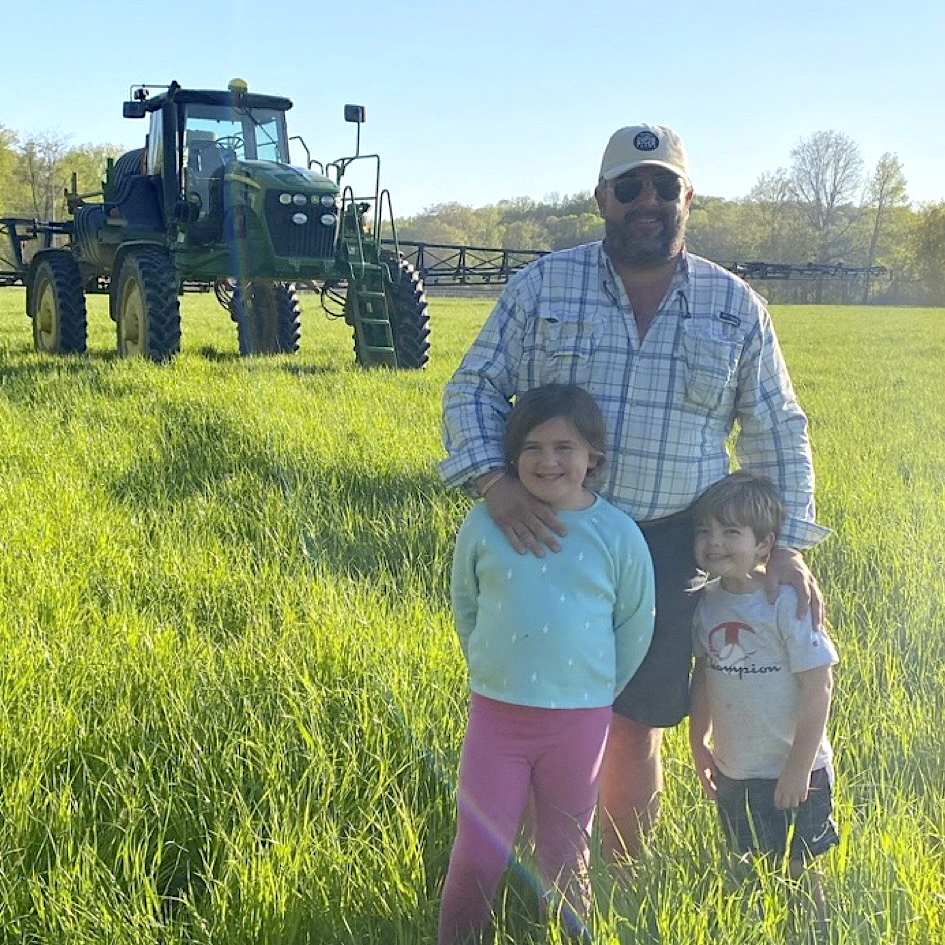
Johnny Hunter farms on flat alluvial soils in the Mississippi River Upper Delta area of Southeast Missouri, an area referred to as the Missouri Bootheel. His family farm is called Castor River Farms. He’s farmed with a variety of crops over time, but at this point is mainly focused on soybeans and rice, with about 1,700 acres of soybeans and 800 acres of rice, mostly irrigated. Depending on the year, he may have some dryland corn or sorghum rotated with dryland soybeans.
Johnny first became motivated to try cover crops in 2013, because 2012 had been a bad drought year on his farm (and throughout much of the central and western U.S.). The crop failures he experienced in 2012 got him asking how he could improve the health and resiliency of his soil.
At that time, he had already reduced some tillage, but was still doing regular tillage every year to rehip planting beds (a practice of shaping the ground for irrigation furrows), often in combination with disking and use of a land plane to grade the fields. As part of his move to a more resilient farming system, he now has a near no-till system, with the only soil disturbance being to carve out a small water furrow approximately eight inches wide and 6-8 inches deep on 40-inch centers. The rest of the soil is undisturbed.
His change in land management also led him away from the traditional flood-irrigation method for rice production–an approach still used for the majority of rice production in the Missouri Bootheel. Johnny feels the combination of cover crops, no-till, and keeping furrow irrigation small has been effective in building soil health.
When he first started with cover crops almost a decade ago, he was primarily using a three-way mix of cereal rye, crimson clover, and radish. Now, depending on the season and goals for each field, he generally uses a more diverse mix–typically cereal rye with black-seeded oats, hairy vetch, crimson clover, dwarf Essex rapeseed, and radish. On heavier soils, he sometimes uses annual ryegrass with crimson clover and radish for the benefits of the extensive root system of the ryegrass. He characterizes his soil type as having primarily silty clay loam on about 70% of his fields, with the remainder being a heavier clay.
Cover crop planting and termination
All his cover crops are fall-seeded: either drilled right after harvest, or flown on into still-standing soybeans before harvest. When drilling the cover crop mix, he uses a 40-foot John Deere air-seeder drill, which is the same planter he uses for planting soybeans and rice.
Termination of cover crops is done through herbicide application using a broadcast sprayer. He sometimes plants soybeans into still-living cover crops, then sprays after planting. Otherwise, he tries to spray-terminate the cover crops about two weeks before expected planting.
Johnny said for planting green into crops, he pays attention to the growth stage of the cover crop, but also the soil temperature, air temperature, rainfall, and weed pressure. In his area, he also has to take into account whether black cutworms are showing up. He’s seen cutworms in all types of field situations: where there are no cover crops, with early-terminated cover crops, and with late-terminated cover crops. He avoids using preventative insecticides and instead scouts for cutworms, applying insecticides only as needed. He feels that when cover crop growth is more robust, there is less cutworm pressure. When he has had a poor stand of cover crops is usually when he’s had more cutworm pressure. He speculates that good cover crop growth may increase the number of predator insects that can suppress cutworms.
He has planted green into cover crops of varying sizes, including cereal rye up to six feet tall, but suggests to new growers that they terminate cover crops earlier. He commented that you need to encourage active soil biology to help break down a high-biomass cover crop before letting it grow too much.
For him, the benefits of planting green are weed control, keeping living roots in the soil as much as possible, and helping build a population of beneficial insects.
When seeding soybeans and rice with his John Deere drill, he hasn’t had to make any adjustments for cover crop residue. Interestingly, he’s found that his drill can still plant effectively down into the shallow irrigation furrows, providing some soil anchoring when water is running through the furrows.
Although Johnny does not have livestock, he recognizes the value of animal manure for the soil and tries to use 2-3 tons of chicken manure per acre on most of his fields on a rotating basis. In the future, he’s interested in working with neighbors to set up some custom grazing on some of his fields.
Changes in fertility and weed management
When asked about how cover crops have impacted his fertilizer management, he reports having been able to reduce his phosphorus and potassium applications. In most fields, he can meet his phosphorus and potassium needs with chicken manure and has generally been able to build his fertility levels.
Cover crops have allowed him to reduce his nitrogen fertilizer applications on rice somewhat, depending on the cover crop growth. He evaluates that annually, doing some nitrate sampling in early spring. Generally, he finds the cover crops contribute about 30-70 units of nitrogen per acre, allowing him to reduce his applied nitrogen fertilizer by an equivalent amount.
Johnny has observed that cover crops have really helped with weed control. Herbicide-resistant types of pigweed are now common in his farming region, but no-till and cover cropping with rye has dramatically reduced that weed on his farm. In fields where he’s had at least three years in a row of rye, he particularly notices much lower populations of herbicide-resistant pigweeds.
He commented that soils are used to supporting a diversity of plants, and so weeds happen to fill that shortage of diversity in monocultures. By having cover crop diversity, there is less opportunity for weeds to invade.
Use of cover crops has allowed him to be more strategic with herbicide application. He pays attention to the weeds in a field and adjusts to what’s needed for control while keeping herbicide costs in check. If his residual herbicide is working well, he finds that about a third of the time he can skip doing a second post-emergence herbicide application, saving $25-$30 per acre when factoring in the cost of the herbicide, labor, fuel, and equipment costs.
He has also gone to using residual herbicides with shorter soil life. He wants products that break down before fall to avoid injury to his cover crop mix, and feels these shorter residual herbicides are easier on the soil biology as well. Another benefit is that the residual herbicides he is using, such as metolachlor, are less expensive than some of the longer-lasting herbicides now on the market.
Changes in soil moisture and irrigation
With multiple years of cover cropping combined with no-till, Johnny has found his soils are now more resilient in the face of drought, as they have developed a much greater water holding capacity. He’s been steadily building soil organic matter, which is adding to the water holding capacity of his soil.
For his irrigated fields, he measures soil moisture at 4-, 8-, and 24-inch depths. He’s found that rain or irrigation water soaks in faster than it used to, detecting soil water at 24 inches deep after one inch of rain.
With the better moisture-holding capacity of the soil and other soil health changes, he estimates they now use about one-third less irrigation water, which saves about $30 an acre (and even more than that now with higher fuel costs).
Summary thoughts
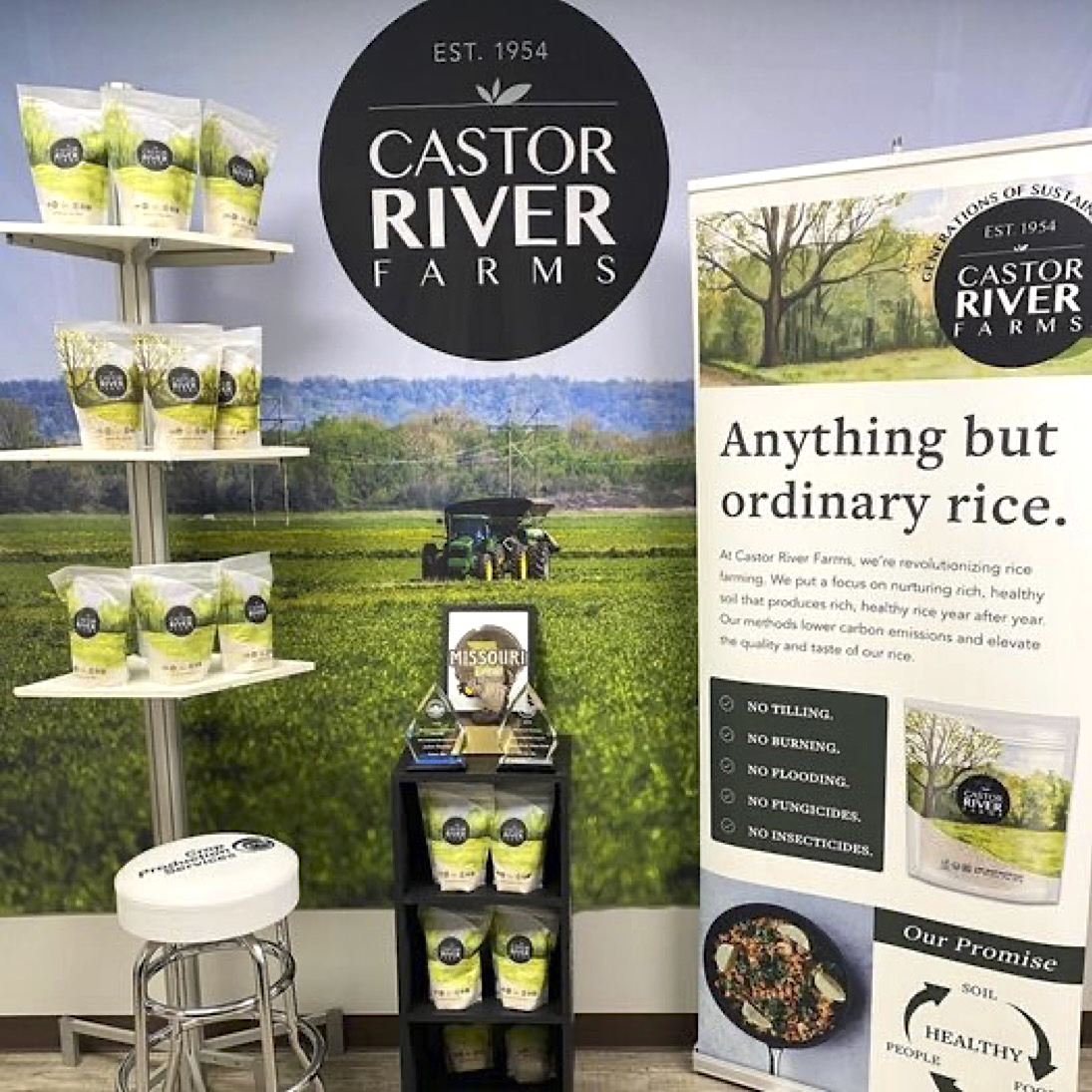
Overall, cover crops are saving Johnny money on herbicides, fertilizers, and irrigation costs, so he feels they are definitely improving his profitability. More than that, he feels the cover crops and no-till are making his farm more resilient to drought and weather extremes. Johnny has developed an impressive program of direct sales with cleaned and packaged food-grade rice, marketed under the Castor River Farms label. Having a sustainable production system contributes greatly to the marketability of his rice products. For more information on his rice and farm, see https://castorriverfarms.com
Johnny said, “Cover crops are one of the most important tools in our toolbox for our sustainability goals. And the next generation is very much on my mind–making sure the farm will be in good shape in 30, 40, 50 years.” Johnny hopes his young son and daughter will be involved with the farm when they grow up. He understandably wants to leave the land and farm operation in good shape for them.
Asked about what he would say to farmers new to cover crops, Johnny said, “Be curious about healthy soils, and realize cover crops are a pathway to that. You need to take a holistic approach.” He added that it’s good to understand “your why”–why you are using cover crops. If you are just using cover crops to get a check, you’ll be less likely to be successful with them. It’s better to use cover crops with the goal of improving your soil resources. Surround yourself with people who know how to do it; that will help you reduce mistakes and achieve success sooner.