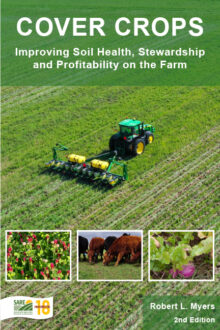
Planting green is a term referring to planting a cash crop directly into a still-living, green cover crop. In planting green approaches, the cover crop is normally terminated either in the same tractor pass as planting or soon after planting the cash crop. In the most recent SARE/CTIC National Cover Crop Survey, over half of the farmers reported using this approach on at least some of their fields.
I first heard about the idea of planting into a still-living cover crop in a presentation by Jeff Moyer at a 2008 SARE conference in Kansas City. At that time, Jeff was the farm director at the Rodale Research Institute in Pennsylvania. He and Steve Groff, a Pennsylvania farmer, were probably the first two people to extensively test roller crimpers for cover crop termination. At the conference, Jeff showed videos of planting corn into a still-living cover crop, with a roller crimper mounted to the front of a tractor and planter towed behind. I don’t recall hearing the term planting green until later, and I’m not sure who coined the term, but I got firsthand experience with planting green a few years later in 2013 when we tested the approach at the University of Missouri Bradford Farm.
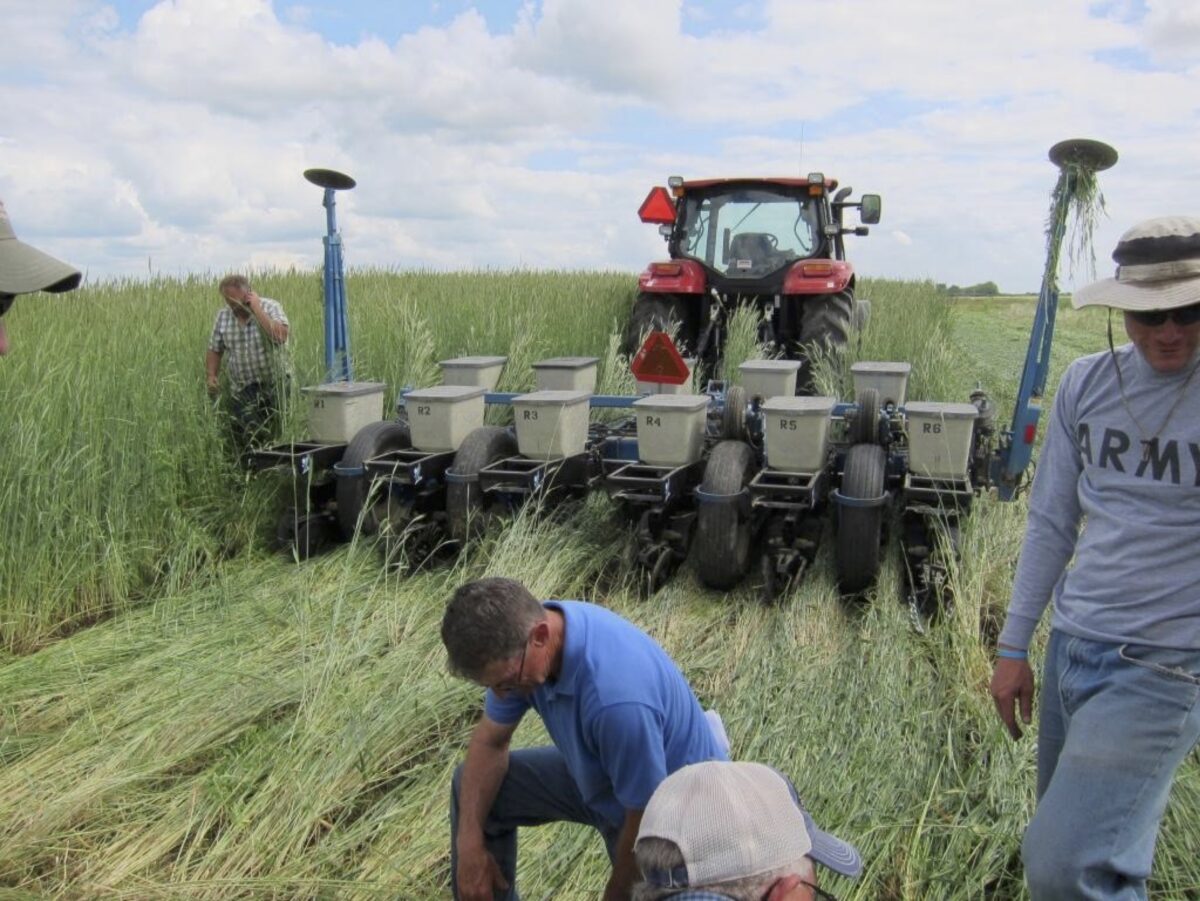
Tim Reinbott, the then-superintendent of Bradford Farm, organized a group of us to come out and experiment with several planter setups and roller crimper methods while planting soybeans into cereal rye that was already 5 to 6 feet tall. Planting into such big cereal rye represents one extreme of planting green. At the other end of the spectrum, one can plant into still-small cover crops that are only a few inches tall. I often tell audiences that as an agronomist I would never have believed you could successfully plant soybeans into 5- or 6-foot-tall cereal rye until I experienced it myself, but now I’ve heard success stories from many farmers who have done it.
In the 2013 trial at Bradford Farm, it quickly became apparent that planter setup really matters for successfully planting green. It also became obvious that leaving the cover crop plants upright to plant into can be very beneficial. This was a change in thinking from the earlier Rodale approach of rolling the cover crop in front of the planter; I think that model works in some situations, but not always as well as leaving the cover crop upright.
The advantage of leaving the cover crop standing at the time of planting is that there is much less of a problem with “hair-pinning” the cover crop residue into the cash crop seed furrow. If the cover crop is already rolled–something we were experimenting with in 2013–there’s a greater chance of pushing some of the cover crop stems and leaves down into the furrow. If this hair-pinning occurs, the compressed stems and leaves can act to wick moisture out of the furrow, drying out some of the seed. A rainfall after planting can resolve that problem, but we can’t always count on receiving timely rain after planting, of course.
The original Rodale approach was to roll the cover crop in the same direction the planter was moving, which helps reduce some of the hair-pinning problem. This approach also seems to work better when the cover crop is smaller and would probably work better with a legume that has fragile stems compared to a fairly mature winter annual grass with tougher stems like cereal rye. In the Rodale organic farming system, a legume or legume mix is usually employed before corn to provide some nitrogen fixation.
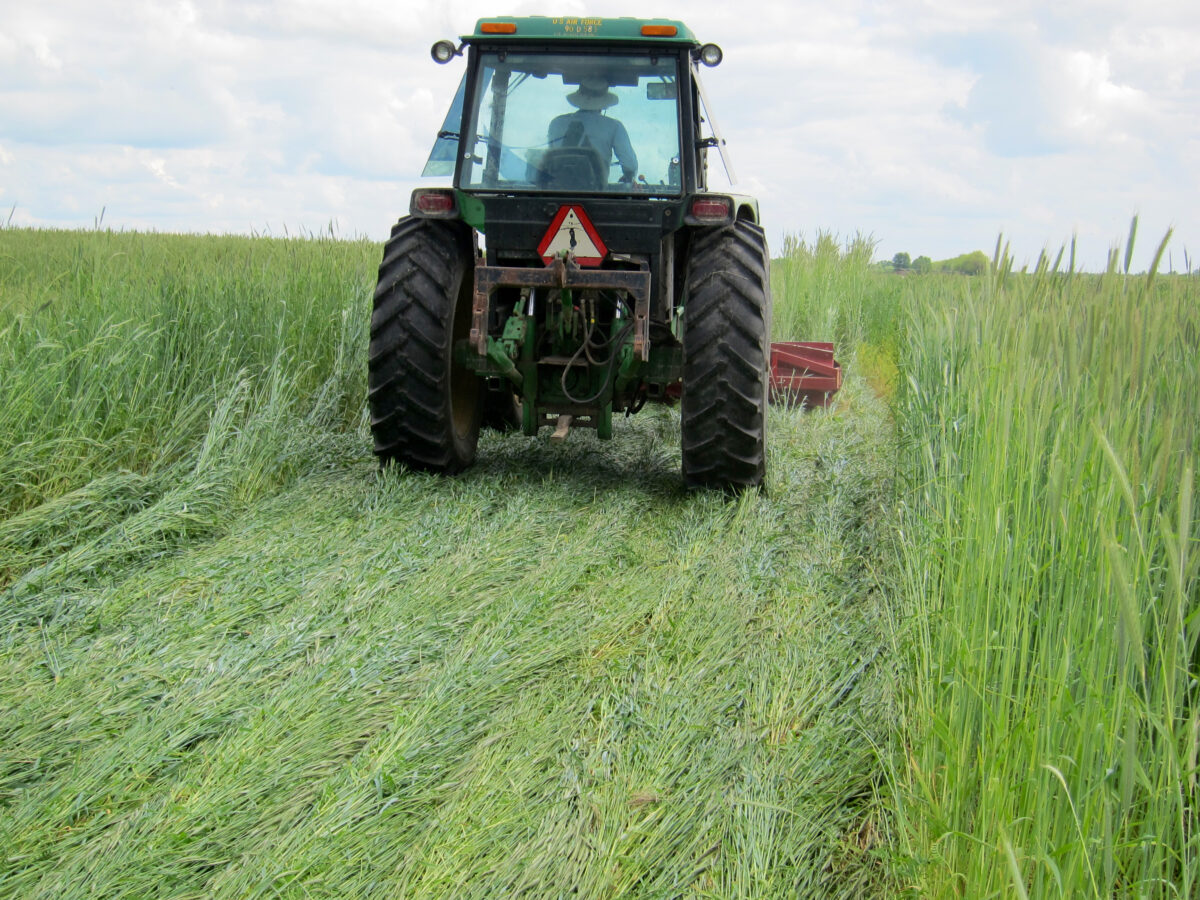
rye.
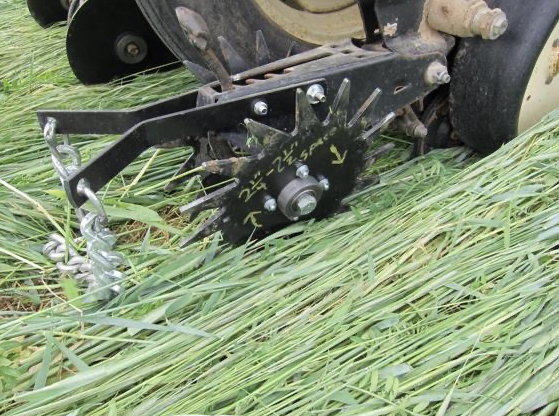
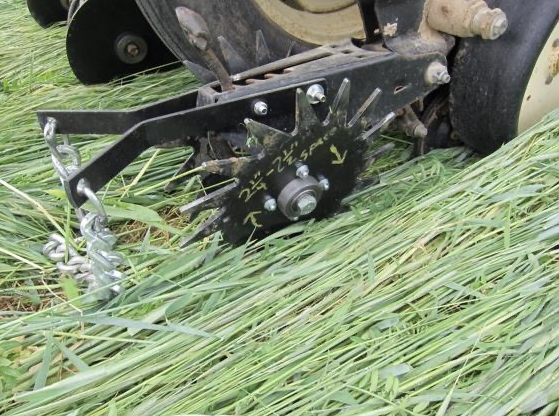
I mentioned that planter setup is also important–in the 2013 planting green trial, we evaluated several different closing wheel setups (see photos). In that situation, spiked closing wheels did a better job of closing the seed furrow by helping break down the furrow wall compared to more traditional smooth-edged closing wheels, regardless of being steel or rubber. We also saw that removing trash cleaners from the planter helped, because those tended to get tangled with the big cereal rye residue, especially if hairy vetch was growing with the rye. Finally, it didn’t seem to help much to use a no-till coulter in front of the planter row unit–something that surprised me.
I’ve since learned that many farmers who plant green in no-till situations end up removing their no-till coulters from their row crop planters. Paul Jasa, a no-till and cover crop expert at the University of Nebraska, has pointed out that coulters reduce the total amount of down pressure a planter can place on the furrow openers. Effective planting into no-till cover-cropped fields may involve obtaining plenty of down-pressure on the furrow openers in finer-textured soils. As soil health and soil structure improve, the soil will become more mellow and furrow opening and closing easier, but Jasa says no-till transition success revolves around furrow openers successfully slicing into firm ground.
Planter settings for planting green can also be affected by the depth of seeding. Cotton farmers who need to plant shallow at one-half inch may need a different approach than someone planting corn two inches deep.
In the rest of this chapter, I’ll take you through some of the main reasons planting green can be an effective strategy. While I always tell farmers just starting out with cover crops to be careful about jumping right into planting green, it’s an approach to seriously consider as you gain experience. Here’s an outline of some points I’ll address on the benefits that can come from planting green. At the end of the chapter, I’ll share a few cautions for planting green and provide a suggestion for how to test out the technique.
- Why planting green works
- Soil moisture management
- Keeping cover crop stems upright instead of matted down
- Weed control improvements
- Pest pros (and cons)
- Pollinators and beneficial insects
- Erosion stopped cold
- Soil biology enhanced
- Faster soil organic matter and soil carbon buildup
- More opportunity for spring grazing
Why planting green works
I’ve been intrigued by how many farmers have found that planting green works well for them, but it’s certainly not all farmers. In the 2019-2020 SARE/CTIC survey that I managed, we received the following responses when we asked about farmers’ experience with planting green: only 5% found planting green so difficult that they were giving up on it, but another 10% were still testing and trying to decide whether to continue; almost 85% were planning to stick with planting green, finding that it either made management easier or, at least, the benefits were worth any extra management effort.
So why does it work for farmers? I think in most cases it’s a combination of factors, with several of the benefits outlined below. In my view, the two biggest benefits are better weed control and managing soil moisture in a way that leads to more timely cash crop planting. Many farmers who have been planting green for at least a few years have told me their overall motivation is to fully maximize their cover crop benefits. In some fields, that key benefit may be better management of soil moisture; in other fields, it may be weed control. Other fields may benefit from addressing compaction or supporting pollinators by growing the cover crop longer until it starts flowering. Some farmers cite the particular goal of building up their soil organic matter and wanting to increase total cover crop growth to more quickly achieve that aim.
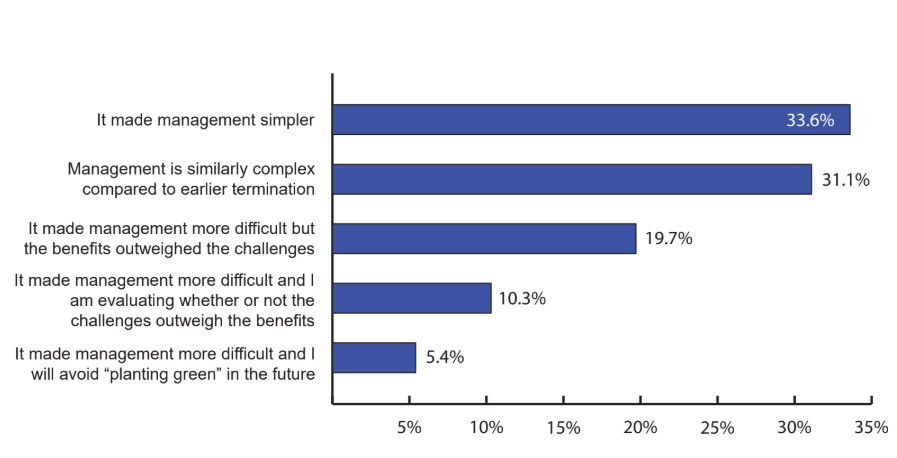
The bottom line is that planting green seems to work well for many experienced cover crop users. All of the ways in which cover crops contribute to cropping system resiliency and better soil health are maximized when we can let the cover crop grow for an extra 3-6 weeks in the spring. For more specifics on why planting green is beneficial, read on!
Soil moisture management
When cover crops started to become popular about a decade ago, some Risk Management Agency (federal crop insurance) staff were concerned that cover crops would use up too much moisture before the cash crop was planted and impact eventual yields. That fear proved to be overblown, although there are certainly situations where a cover crop can dry out soil too much from a short-term planting and establishment standpoint. That’s why, when using overwintering cover crops, it’s important to pay attention to soil moisture and monitor 10- to 14-day forecasts. If things are trending dry, it’s usually a good idea to consider terminating cover crops early. Farmers in western areas may find in most years it pays to terminate early.
For farmers in higher-rainfall areas, including most of the Corn Belt, spring conditions are often too wet than too dry. In fact, a number of Midwest climatologists say much of the Corn Belt region is trending towards wetter springs. In a wet spring, planting green can really pay dividends, as was seen in 2019 when tens of millions of acres had delayed planting. That year, 68% of the farmers surveyed said that planting green helped with soil moisture management, versus only 7% who said the practice dried out the soil too much. Of the remainder, 20% said soil moisture when planting green was about the same as when terminating earlier, and only 5% said the practice left the soil too wet.
Planting green helps with too-wet soils because the actively growing cover crops continue to transpire moisture from the soil, gradually drawing down the soil moisture. The living roots also anchor the soil, making it easier to get equipment into the field for planting. This better field access is not unlike being able to walk easily across a sodded lawn after a big rain, whereas venturing onto a recently-tilled garden plot could have you sinking up to your ankles in mud.
Keeping cover crop stems upright instead of matted down
In the opening section of this chapter, I talked about our Bradford Farm evaluation of planting into an already-rolled cover crop versus a standing cover crop. There’s no question that row crop planters will operate more easily through a cover crop that is alive and standing upright than a same-sized cover crop that is dying and flopping over several days after spraying. Part of the advantage comes from the lack of planter disk openers needing to slice through residue to open furrows, and part comes from avoiding the aforementioned problem of hair-pinning residue into furrows.
Some farmers have commented on how they think a standing cover crop provides a good microenvironment for establishing cash crop seedlings, protecting them from the worst of the wind and encouraging them to gain height quickly. This can help soybeans, for example, produce pods higher off the ground, so the combine header may not need to be run as close to the ground. However, the impact on pod height can vary and higher podding may not always occur. It depends on cover crop height and density, soybean variety, weather, etc.
If you’ve wondered whether the cover crop needs to be rolled or knocked down after planting green, the answer is no, unless it’s being terminated with a roller crimper. Most planters will at least partially knock down a tall cover crop, and in any case, the cover crop stems will eventually flatten down after they die and have been hit by a few rounds of rain and wind, not to mention microbes decaying the bases of the stems.
Weed control improvements
In this era of herbicide-resistant weeds, which are an expanding problem every year, any tool that can help with weed control is a major plus. Cover crops have long been known by organic and horticulture producers as a valuable tool for weed control, and now that value is becoming clearer for commodity farmers as well. Regardless of the cropping system, allowing cover crops to grow longer helps with weed suppression.
While living, the cover crop suppresses weeds best if it is growing vigorously and shading the ground completely. Also, the more biomass a cover crop accumulates during its life cycle, the more beneficial, weed-suppressing mulch it will create after termination. This residue mat is especially helpful during the initial weeks of cash crop growth, when the crop is particularly susceptible to weed competition. Most weed seed germination is suppressed when light is blocked by residue or heavy foliage, so the more cover crop growth there is, the fewer weeds there will be.
Pest pros (and cons)
Since the practice of planting green is relatively new, we are still learning about how the practice impacts crop pests in both positive and negative ways. “Chapter 11: Potential Issues” reviews details of what is currently known about cover crops and slugs, voles, and other pests, including references to using planting green to combat certain pest issues like slugs. Here, I’ll briefly summarize the current thinking about planting green and pests.
With slugs and voles, planting green seems to help in the majority of cases, although not every case. Basically, the green cover crop provides a sizable food source for the voles and slugs so that they are less likely to bother the cash crop seeds and seedlings.
Planting green may also allow the cover crop to serve as an alternative food source for insect pests that would otherwise attack an emerging cash crop. This sounds good in theory, but it’s all about timing and the pest involved. For example, if the cover crop is terminated the same day as the cash crop is planted, the cover crop might be mostly dead (turning brown) within a week, which is likely right around the time when the cash crop is emerging. This can be a problem if all the insects that had been eating the green cover crop move from the now-dead cover crop onto green, emerging cash crop seedlings. This is sometimes referred to as a “green bridge” situation, where the insect is crossing over from the green cover crop to the green cash crop seedling.
The solution is to either delay termination of the cover crop by several days (assuming the cash crop is resistant to the herbicide being sprayed or the cover crop is being terminated by roller crimper) or terminate earlier. In sum, it’s hard to say that planting green will “always” help or hurt with insect pests. The evidence so far leans to the positive side, but there have been some fields planted green that ended up with insect pest pressure. Scouting is a good idea in any crop field after planting the cash crop and definitely when planting green.
The dynamics between crop diseases and planting green are even less understood than with insects. Research to better evaluate whether planting green will increase or decrease diseases of crop seedlings is underway. From what I’ve read and heard to date, I think planting green is most likely to have risk of crop disease when conditions are cool and wet. Of course, cool and wet conditions are always a challenge for emerging cash crops, regardless of tillage system or cover crop use.
The greatest risk of a cover crop introducing a disease to a cash crop occurs when both types of plants are members of the same plant family, such as a grass cover crop used before corn, or certain legume cover crops before soybeans. Such planting sequences often grow successfully, but they are worth monitoring for possible disease issues. In some cases, like with insect pests, it comes down to how the timing of cover crop termination and senescence correlate with cash crop emergence. It’s best if there is not a lot of dead cover crop residue right next to the emerging cash crop, especially when it’s cold and wet. The goal is to keep fungal decomposing organisms or pathogens on dying cover crop plants from crossing over to the emerging cash crop.
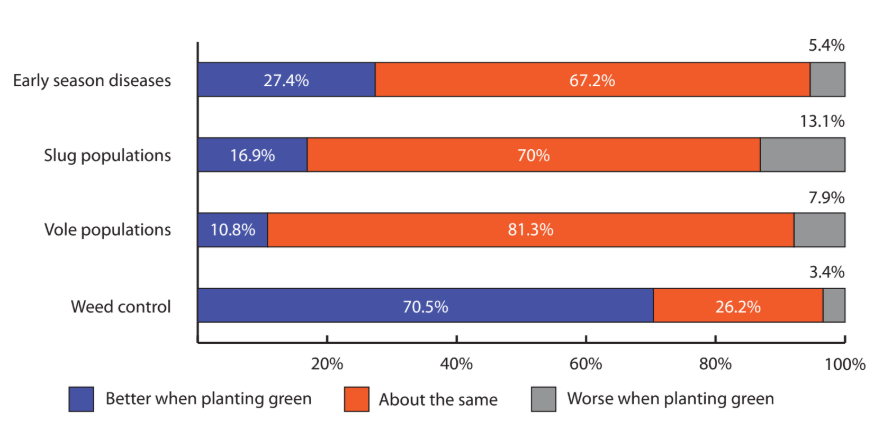
Overall, I think the relationship between pests and planting green bears watching and farmers need to be prepared to tweak management, including the termination approach. Enough farmers are having success with planting green that I don’t expect pests to be a major issue in most locations and most years, but they certainly could be an occasional problem that requires management action.
Pollinators and beneficial insects
Early-terminated cover crops that are only a few inches tall may provide a little bit of habitat for certain pollinators and beneficial insects, but much more pollinator habitat is created by allowing cover crops to reach the flowering stage, particularly with broadleaf cover crops such as clovers, vetches, peas, and rapeseed/canola. Many of the broadleaf cover crops flower relatively early in the spring, at a time when there may be few other nectar sources for pollinators. Other beneficial insects are also supported by allowing cover crops to grow for longer. The longer period of cover crop growth allows the beneficial insect populations to increase so that a sufficient number are around to help control pest insects later in the crop season.
Erosion stopped cold
Perhaps the most susceptible time for erosion in most fields is in very early spring: freeze-thaw action has loosened the soil, residue has started to decay or may have blown clear in spots, and spring rainstorms can be some of the most prolonged and intense. While an early-terminated cover crop can still reduce erosion considerably compared to having no cover crop, there’s no question that the longer the cover crop grows in spring, the more it stops erosion.
When planting green, a good cover crop stand will stop almost all erosion through termination time and somewhat beyond. By the time the erosion control effectiveness of the cover crop starts to fade, the cash crop should be growing vigorously and anchoring the soil. Also, unlike in a conventional system, where rainstorms can cause gullies and erosion down the middle of crop rows in early season, the residue from a well-grown cover crop can prevent erosion between rows for the first month or more of the cash crop season.
Soil biology enhanced
One of the less-visible impacts of planting green is on soil biology. We’ve learned in recent years that healthy soil ecosystems are highly dependent on living roots. If we terminate a cover crop in early spring, say April 1, and then don’t plant a cash crop for several weeks, it may be over two months before an active root system develops from the cash crop. If we instead keep an actively growing cover crop rooting deeply into the soil through April and potentially into May, the microbial community, including mycorrhizal fungi, will more actively provide nutrients to the young cash crop. Moreover, the much greater amount of cover crop biomass from planting green will provide more food for soil microbes during the first part of summer, again improving the health of the soil and aiding nutrient availability over the course of the season.
Faster soil organic matter and soil carbon buildup
The longer we allow a cover crop to grow before termination, the more biomass will be created. The aboveground part of the biomass is easy to see accumulating, but the belowground part–the roots–is even more important to soil organic matter buildup. Only a portion of the above-ground biomass becomes part of the soil organic matter, while most of the roots turn into active soil carbon, and some of that will later become part of the soil humus.
When planting green, especially with later-planted crops like soybeans, sorghum, or sunflowers, the amount of cover crop biomass accumulated can be several times higher than it would be with early termination. More research is needed to understand how much extra soil carbon is provided, but we know enough to say it is greater with late termination versus early. Given the importance of sequestering more carbon in the soil, the value of soil organic matter to cropping system resiliency, and the availability of soil carbon payments, it makes sense to maximize soil organic matter and carbon provided there are no significant impacts on crop profitability.
I must add that the potential of cover crops to build soil organic matter depends on soil type and climate. In hot areas with light-textured sandy soils, like the southeastern U.S. coastal plains, it can be hard to build soil organic matter, though I’ve heard farmers from those states say their cover crops are improving soil function in other ways.
More opportunity for spring grazing
Winter annual cover crops generally provide two windows for effective grazing: one in late fall, such as the November-December period, and one in mid-spring, after cover crop growth has resumed. If a cover crop is terminated early, when it is just a few inches high, there will be little opportunity for spring grazing. By contrast, a cover crop allowed to grow for another month can provide at least a few weeks of excellent spring forage. The grazing animals can also contribute to the success of a planting green approach by eating some of the spring cover crop biomass, making it even easier to establish the cash crop if the planter is set appropriately. Additionally, the manure, urine, and saliva from the grazing animals will stimulate soil biology.
How much cover crop growth is optimal?
While longer cover crop growth is often better, there are plenty of times where it makes sense to terminate early, particularly to plant a cash crop at the optimal time for that species and variety. On the other hand, sometimes cash crop planting can be reasonably delayed by two to four weeks to allow more cover crop growth without taking a yield loss. Such extra growth may be particularly desirable for weed control reasons or due to a combination of benefits that accrue from extra growth. If I had to generalize, I’d say letting the cover crop grow until it is starting reproductive growth (flowering) is often ideal, assuming it’s not a late-flowering species. Another approach is to evaluate how much cover crop biomass is needed for the desired weed control or to provide an adequate surface mulch. For example, a meta-analysis of several cereal rye studies by Andrea Basche with the University of Nebraska found that having 3,300-3,600 pounds per acre of above-ground dry matter provided 90% weed control.
Cautions on planting green
If you are just starting out with cover crops, I’d suggest waiting a year or two before trying planting green. Or, if you are doing multiple fields of cover crops, try planting green with just one of them to gain some experience. It’s important to have a plan with planting green, including the termination strategy, and be prepared to experiment with planter settings.
When planting corn into green cereal rye, it is particularly important to make management adjustments. Such an approach will likely require some modification to nitrogen fertilizer strategy to avoid having the rye tie up too much nitrogen as it decomposes, especially if the rye is turning reproductive.
Herbicide plans may need to be adjusted when planting green. The larger amount of cover crop biomass has the potential to reduce the effectiveness of some types of residual herbicides that need substantial soil contact. It may be that the cover crop can be burned down, such as with glyphosate, and then a month or so later the residual herbicide can be applied, when the cover crop has started to decompose and there is some bare soil showing. That can be better timing to address late emerging weeds in any case, as the heavy cover crop residue will likely suppress most early season weeds.
It’s also critical to be able to focus on termination of the cover crop shortly after planting. Trying to rush and plant a crop field ahead of rain, and then having the field become so wet that it cannot be sprayed for cover crop termination, can lead to a potential disaster, especially if the crop is not herbicide-tolerant.
Issues can occasionally occur when planting green into tall winter cereals that are heavily pollinating: an excessive amount of pollen can accumulate on a tractor radiator screen, and if the screen is not cleaned often enough, the tractor might overheat. Reverse blowers can be installed to clear the radiator, but otherwise, it may be necessary to simply stop the tractor occasionally and brush off or blow off the radiator to prevent the tractor from overheating. Carrying a compact battery-powered leaf blower in the tractor cab is one way to quickly remove the pollen (some eye protection may be helpful in those situations).
The most important area of caution, as mentioned earlier, is monitoring soil moisture closely. If the soil is drying out and not much rain is forecast, go ahead and terminate early, even if you had hoped to plant green. Having the cover crop dry the soil out too much could really set the cash crop back in an unusually dry spring or in arid regions of the west that get less-frequent rain.
Where to use planting green and getting started
For corn and soybean farmers, I recommend making your first planting green field a field with soybeans planted green into cereal rye or another winter cereal. For this first attempt, try to plant the beans while the rye is moderately-sized–say 1-2 feet rather than 5-6 feet tall. This will allow you a chance to experience the planting green approach without having to deal with large amounts of biomass, excessive soil moisture draw down, or pollen clouds. Just be aware that rye can gain height quickly in late spring, so prioritize getting into those cover crop fields over conventional ones.
If you are farming with other crops, you may want to experiment with a few types of cover crops to see what works well for you when planting green. Try a few strips of different cover crop species in your field and see what’s easy for you to plant into. There will be differences. For example, among the legume cover crops, I’ve found crimson clover or Austrian winter peas easier to run a planter through compared to hairy vetch, but any of them can work with the right planter setup.
Again, be ready to experiment with different options, and start with a modest, manageable amount of acreage rather than jumping into planting green on the whole farm all at once. Be ready to adjust planter settings and consider buying a few different types of closing wheels to test, including the spiked type. As you gain experience, you should find that planting green is an approach that can maximize cover crop benefits for some of your fields.