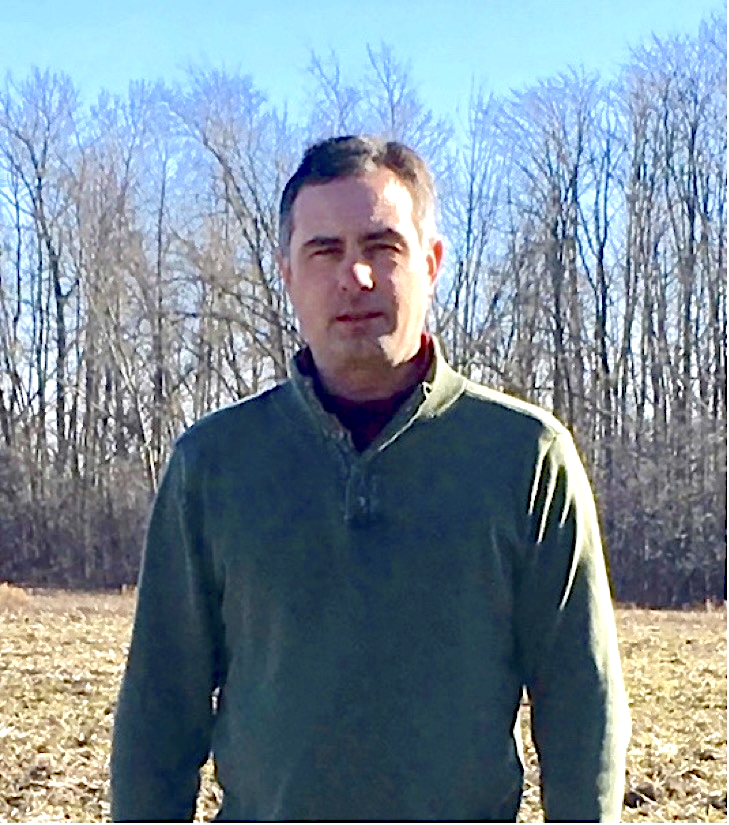
John Burk farms 4,300 acres in central Michigan. The majority of his acres are in corn and soybeans, but he also averages about 500 acres of wheat, 400 acres of dry beans (usually navy beans) and grows some sugar beets. With all these crops to deal with, he does not have livestock.
He and his father got started with cover crops in 1999 because they were having a problem with nematodes in sugar beets, and had heard that using oilseed radish as a cover crop after winter wheat and before the sugar beets could help reduce the nematode problem. In that process, they observed that growing a cover crop boosted earthworm numbers and loosened the soil.
The farm generally has heavy clay loam soils, but in some fields it is more of a sandy loam, especially close to Saginaw Bay. John has fields spread out over about a 35-mile area, so there is a range of soil types.
Growing radishes after wheat was their main cover crop approach for about four years, but they started feeling like they needed something else to help deal with soil compaction caused by sugar beets, so they tried growing cereal rye after beets. They broadcast the rye seed and lightly tilled it in, liked the results, and have continued to use that approach over the years.
Then someone suggested radishes would do better with some additional nitrogen, so John started adding Austrian winter peas to the radish seed. In his area, he's found that sometimes the peas winter-kill after having grown only 5-6 inches in the fall, but if the peas do overwinter, they can gain two feet of growth in the spring, which really mellows the ground. He continues to use a mix of radishes and peas, and now broadcasts them with potash fertilizer in the fall, followed by disking to ensure some seed-to-soil contact.
If the peas get too big and ropey (viney) in the spring, he may use a turbo till or speed till disk to chop them up; he's tried a few tillage approaches. The peas provide more nitrogen when they overwinter, in which case John may adjust nitrogen fertilizer, but it just depends on the year.
When he uses rye after beets, he'll typically go to soybeans next, or occasionally to dry beans. After soybean harvest, he will often do winter wheat planting in the fall.
Where corn is in the rotation, it sometimes comes after soybeans; a cereal cover crop is then used after the soybean harvest. He uses cereal rye the most often, but sometimes he uses winter barley or spring barley.
After sugar beet harvest, he grows spring barley, although he s grown cereal rye instead at times. He likes the extra fall growth of the spring barley; sometimes it will head out before being winter-killed. He feels the barley leaves the ground very mellow and doesn't have as big of root clumps as some of the winter cereals, which primes the ground for planting to seed corn or, sometimes, back to beets.
If it's too late to use spring barley, which for him is a cutoff of around September 20, he switches to winter barley through October 10, at which point he starts using cereal rye for the late-fall plantings.
He has noticed deer eating the radishes and peas after the first snow, but they seem to leave the cover crops alone prior to this time of year.
John has occasionally planted some no-till soybeans, but in his area, he and most farmers till the ground in the spring to warm up the soil. He has tried a little no-till corn seeded into a rye cover crop on sandy fields, and feels the rye helps the corn in these light soils, providing a beneficial mulch over the field and retaining soil moisture.
Unlike many farmers who terminate all their overwintering cover crops with herbicides, John sometimes uses only tillage to terminate the cover crop. His rule of thumb is that if the cover crop is under knee-high, he'll till it to terminate it, then plant his cash crop. If the cover crop is taller than knee-high, he'll spray it, then till and plant.
He uses a variety of planters, depending on the cash crop. For corn and sugar beets, his set-up is a John Deere 1795, using a single fluted no-till coulter in front of each row unit. He also uses a Keeton seed firmer to make sure the seed travels all the way down into the furrow. He uses standard round, rubber closing wheels.
For soybeans and wheat, he runs a big air seeder, drilling into narrow rows. The wheat is normally no-till planted unless there are ruts in the field he needs to address through tillage.
Cover crop seeding methods
John has used a variety of methods for cover crop seeding. Most commonly, the seed is fall broadcast and then lightly tilled for incorporation. For a cover crop like rye, he might do heavier tillage after broadcasting if it s part of his rotation; for example, after soybeans he will spread the rye and chisel the ground.
In recent years, John has tried to plant at least 50% of his fields to cover crops every year - however many acres he has time to plant.
Benefits of cover crops
John feels the cover crops are definitely helping with weed control. With Austrian winter peas, he feels he additionally gets the added benefit of more nitrogen. Since he does a split nitrogen application on corn, with 30% before planting and 70% side-dress, he can adjust the nitrogen fertilizer rate at side-dress time for what is needed then.
Another cover crop benefit has been mellower ground. If he does run a subsoiler, he has noticed it s easier to pull through ground that has been cover cropped, and the subsoiler doesn't throw up big chunks of soil like it used to.
He has gained about 1.5% soil organic matter since 1999 when his fields were generally 1%-2% organic matter a big soil health change. Note that this is even with some tillage, though less than they used to do. The rainfall infiltration rate is also much better; they don't have nearly as many ponds in the fields after a big rain as they used to. He feels their soil structure is definitely better following cover crop use.
As far as profitability goes, John feels the main advantage is having better yields. He feels cover crops are helping his soybeans yield about 10 bushels more per acre than before, and his corn yields are about 20 bushels more per acre than the county average due to overall management, including cover crops. Sugar beets are also yielding better; recently he achieved 43 tons per acre, whereas he used to have yields in the mid-20s or low 30s. Wheat yields have stayed more stagnant at around 80 bushels per acre.
When asked what he would tell farmers in his area who are considering cover crops, John said to look at cover crops as a way to increase soil health. He commented that simply adding fertilizer doesn't keep the soils biological activity going like cover crops do, and that you need to keep living material (roots) in the soil. It's all the things you can't see the microbes that are important for the soil.
He suggests starting small when trying cover crops "Don't plant 1,000 acres of rye [the] first time out and start out" - and with one or two fields. He observed that first-time users of cover crops could start by trying a winterkill cover crop like radishes, or maybe something less aggressive than cereal rye like winter barley or winter wheat. However, he feels that eventually planting rye is better for the soil. Overall, he's glad to be using cover crops and receiving the benefits.