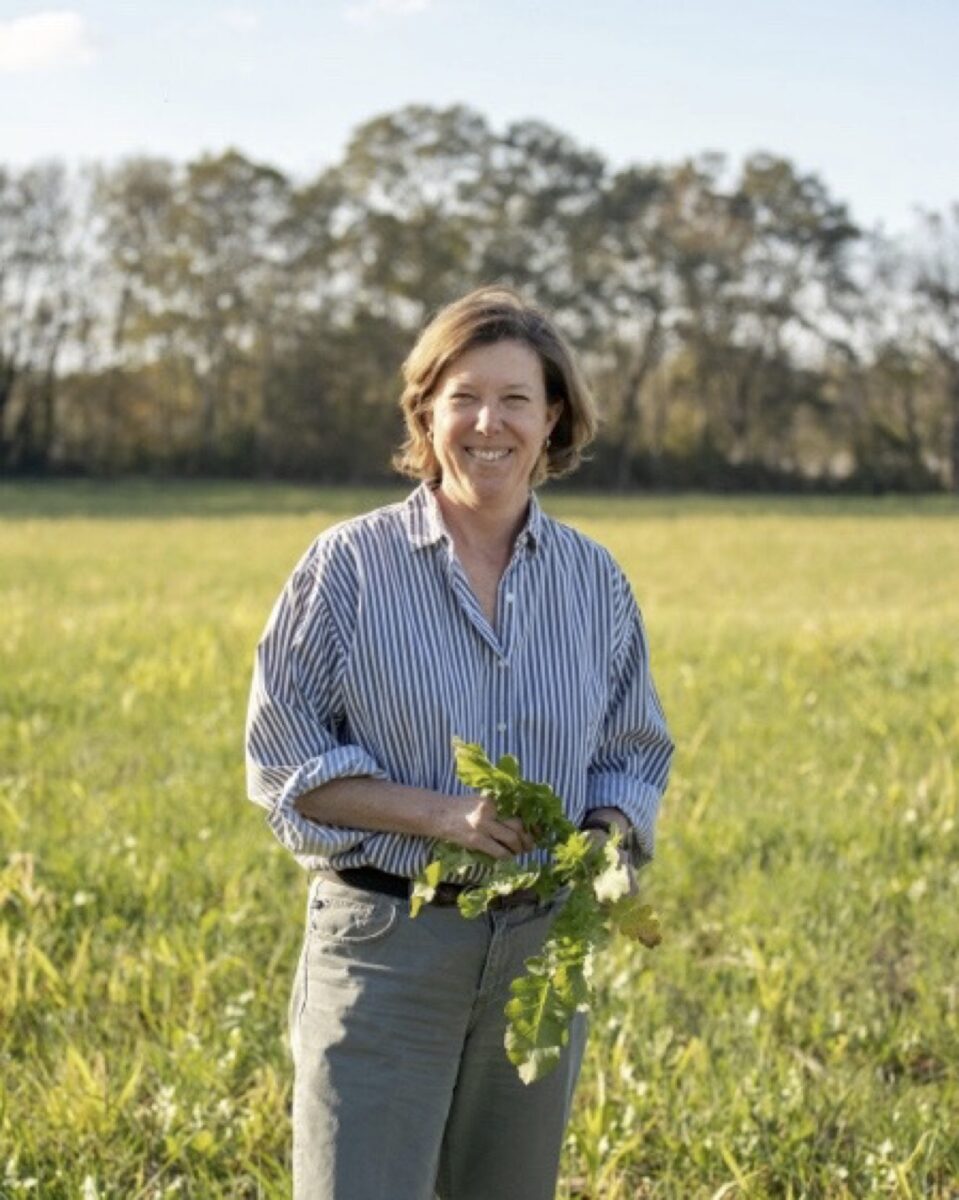
Larkin Martin is a seventh-generation farmer in northern Alabama near the Tennessee river. Her family’s farm operation is mostly on upland soils, with about 70%-80% of the fields being considered highly erodible. She also has some sandy, light-textured creek bottom ground. The total land area is about 7,000 acres, and she grows a diversity of crops–primarily cotton, soybeans, corn, and wheat. She has also experimented with smaller acreages of other crops, including canola, sesame, sorghum, and peanuts.
Larkin said she got serious about using cover crops on the farm in 2017, although she had tried growing a little cereal rye in previous years. She’s been doing minimum tillage since 1993, with some fields in rotational no-till.
There were several reasons she decided she should start using cover crops. She wanted to:
- Control erosion in the months between fall harvest and spring planting
- Build organic matter (their soils are low organic matter)
- Provide a cover crop mulch layer in spring and summer to help with moisture retention–she doesn’t have irrigation despite having droughty soils, so maintaining soil moisture is critical
- Condition the soil to reduce compaction from no-till
Improve rainfall infiltration - She’s still evaluating whether the cover crops are helping with weed control, but thinks they may be in some cases.
Early on, rye was difficult to buy in her area, so they grew a three- to four-way mix recommended by the USDA-NRCS. The mixes included legume, grass, and Brassica cover species. She has used both the Environmental Quality Incentives Program (EQIP) and the Conservation Stewardship Program (CSP) to obtain financial support for cover crops. As she has observed the performance of the cover crop mixes, she’s found that she likes growing more than one species at a time since different benefits are provided by different root systems and plant types.
Specific mixes she has used include:
- Oats, radish, and clover
- Cereal rye, radish, and clover
- Oats, cereal rye, radish, and clover
Crimson clover is usually her clover species of choice, but she’s also tried berseem clover and white clover. She has also experimented with other mixes.
Nearly all of her corn fields go to a cover crop and then to cotton the next year. Corn is harvested in August or early September in their area, so she has plenty of time to establish a fall cover crop.
She has found that it’s often beneficial to move cotton planting back about 7-10 days and have more growth on the cover crop. However, if cereal rye is in the mix, she tries to terminate it in a timely fashion; she prefers not to let it head out before planting. There have been some situations in which the rye got tall and then started lying down, making planting more difficult.
Cover crop seeding and termination
She normally spreads the cover crops with a big fertilizer spreader, mostly into corn stubble. After broadcasting the cover crop seed, she often incorporates it with a Phillips (Thompson) harrow to get better seed-to-soil contact.
One interesting approach she uses for termination in some fields is to spray a grass-killing herbicide (clethodim) that terminates the grass cover crop but allows the clover cover crop to keep growing and fix more nitrogen. Normally they put about 90 pounds of nitrogen fertilizer per acre on cotton, but she’s been able to cut back in places to 70 pounds per acre. Radishes have sometimes winter-killed and in other years overwintered, so she has to factor that into the spring termination approach.
While cover crops have mostly had positive impacts on her farm, she has at times had a problem with slugs in her cotton fields, particularly affecting early-season cotton seedlings. In a few cases, she’s had to replant an entire cotton field that was badly damaged by slugs during emergence.
Despite the occasional setbacks with slugs, Larkin said the merits of cover crops are strong enough to keep using them.
Benefits from the cover crops
Larkin commented on several benefits she’s observed from cover crops. First of all, she commented on how fields that are no-till but not using cover crops can tend to have soil compaction; after adding cover crops to the no-till fields, she isn’t seeing as much of a compaction problem. The covers have also helped noticeably in fields that have hardpans (dense soil layers restricting root growth) and tend to suffer from drought effects due to poor rooting. In the past, the cotton roots in those hardpan soils would turn sideways when they hit the hardpan layer, leading to what she termed a “J-hook” in the root. With the cover crops, she doesn’t see that nearly as much.
She feels that she is gradually building soil organic matter, which is really important in her sandy loam or sandy clay, both of which are often very low in soil organic matter (1% or less). One field that has been cover cropped for five straight years has already improved from 0.8% to 2.2% organic matter based on soil tests.
Asked what she would tell farmers not yet using covers, Larkin said, “The most important resource you have is the soil in your fields–cover crops will hold and improve the soil and are well worth the trouble.”