Cover crops have long been an essential tool in organic crop production systems, particularly for helping combat weeds and boosting soil fertility. Organic farmers of all sizes, ranging from small urban vegetable farms on a quarter acre, up to multi-thousand acre organic row crop farms, are using cover crops. Most organic certifiers recommend cover crops as a tool to achieve greater diversity in the crop rotation.
This chapter addresses some of the unique aspects of using cover crops in organic systems versus how they are managed in conventional crop production. Management of cover crop termination, species selection, cash crop planting methods (including planting green), and procuring organic cover crop seed are all discussed here.
One of the biggest differences for using cover crops in organic versus conventional systems is the method of termination. Especially with row crops, a high percentage of conventional producers rely on chemical termination of any over-wintering cover crops. With organic production, finding the right termination approach is important to successful cover crop use. Method of termination definitely depends on scale of operation and whether tillage is an option for termination.
Options for termination
Winter kill termination. Some new users of cover crops in organic systems will gain familiarity with them by starting with species that are killed by cold conditions. This can include summer cover crops like buckwheat or millet that are killed by the first fall frost, or fall-planted covers like oats or radishes that will be killed by temperatures in the low to mid-20s F. (Keep in mind that in southern latitudes these species may overwinter.) Use of winter-kill cover crop species prevents the need for any spring action to terminate an overwintering cover crop, but has the downside of less erosion control, a shorter period of root growth to feed soil biology, and less control of spring-emerging weeds. It's best suited for situations where spring cash crops are early planted, typically ahead of emergence of summer weeds. However, for overwintering cover crops, plans for cover crop termination are needed, as discussed below.
Roller crimper termination. These devices have become a popular option for some organic farmers to terminate overwintering cover crops. As described in the equipment chapter of this book (Chapter 9), roller crimping involves using a roller with fluted metal edges that can crimp the stems of living cover crops, breaking the vascular tissue in the stems (the xylem and phloem). Roller crimpers are now available in a variety of sizes, with the most common being 8-10 foot wide units that mount to the three-point hitch of a tractor. Larger folding units that can cover more ground are available. Smaller roller crimpers are available for small tractors or for walk-behind units like BCS tillers. Walk-behind roller crimpers have even been used in high tunnel systems.
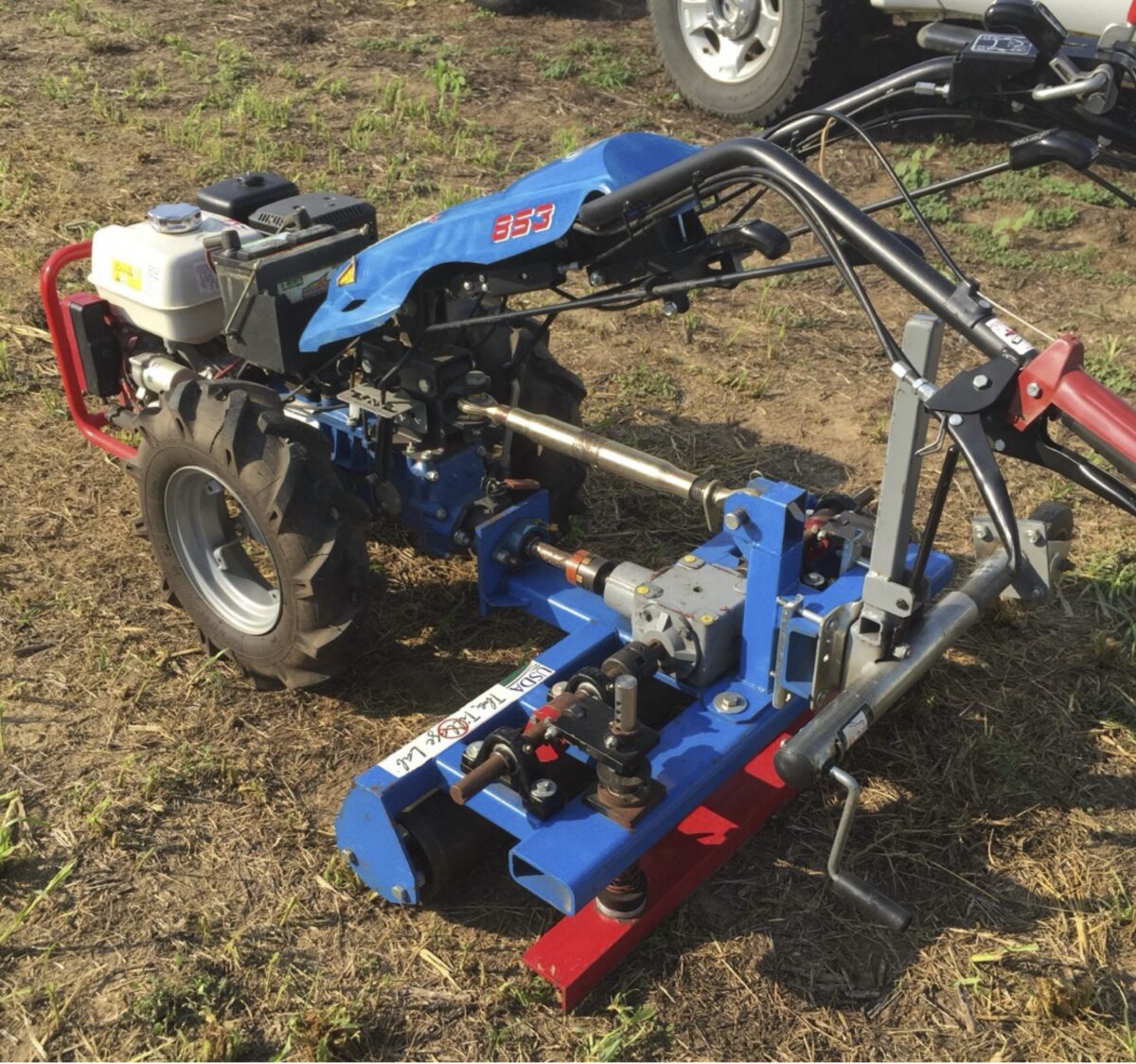
The use of roller crimpers provides a relatively effective way to terminate covers without chemicals and without disturbing the soil. The rollers can also aid weed control by creating a thick mat of cover crop residue on the soil surface that can reduce weed emergence, keep the soil cooler, and prevent soil erosion. Some farmers have tried using rollers alone and this can work in some situations, typically with winter cereals that have headed out, but the action of the crimping metal edges usually improves kill of the cover crop plants.
It's important to note that successful use of roller crimpers requires some planning and being prepared to adapt to cover crop growth stage and weather. If the ground is soft from recent rain, it may be necessary to wait on using the roller crimper until the ground is firmer, which improves the crimping action of the roller. The stage of growth of the cover crop can make a significant difference. Usually, the more mature the cover crop is, the easier it is to terminate with a roller crimper. For example, cereal rye that is only a few inches tall would be difficult to kill by roller crimping, but bigger rye plants, especially after pollination starts, are much easier to roller crimp successfully.
Other challenges can involve having an excessively thick growth of cover crops where the crimper kills only the upper layer of plants while plants lower in the rolled layer survive. This can happen when the crimping edges don t come in direct contact with some of the stems. In those cases, a second pass of the roller crimper may be needed and/or more weight added to the roller crimper unit. Most roller crimpers have the option of adding fluid to the roller to give it more weight, such as water or an antifreeze solution. The advantage of antifreeze is that it is less likely to expand in cold temperatures and crack the roller; water used for weight should be drained from the roller before freezing temperatures occur. Concrete blocks or other heavy objects can potentially be added to the roller crimper frame to give additional weight if needed.
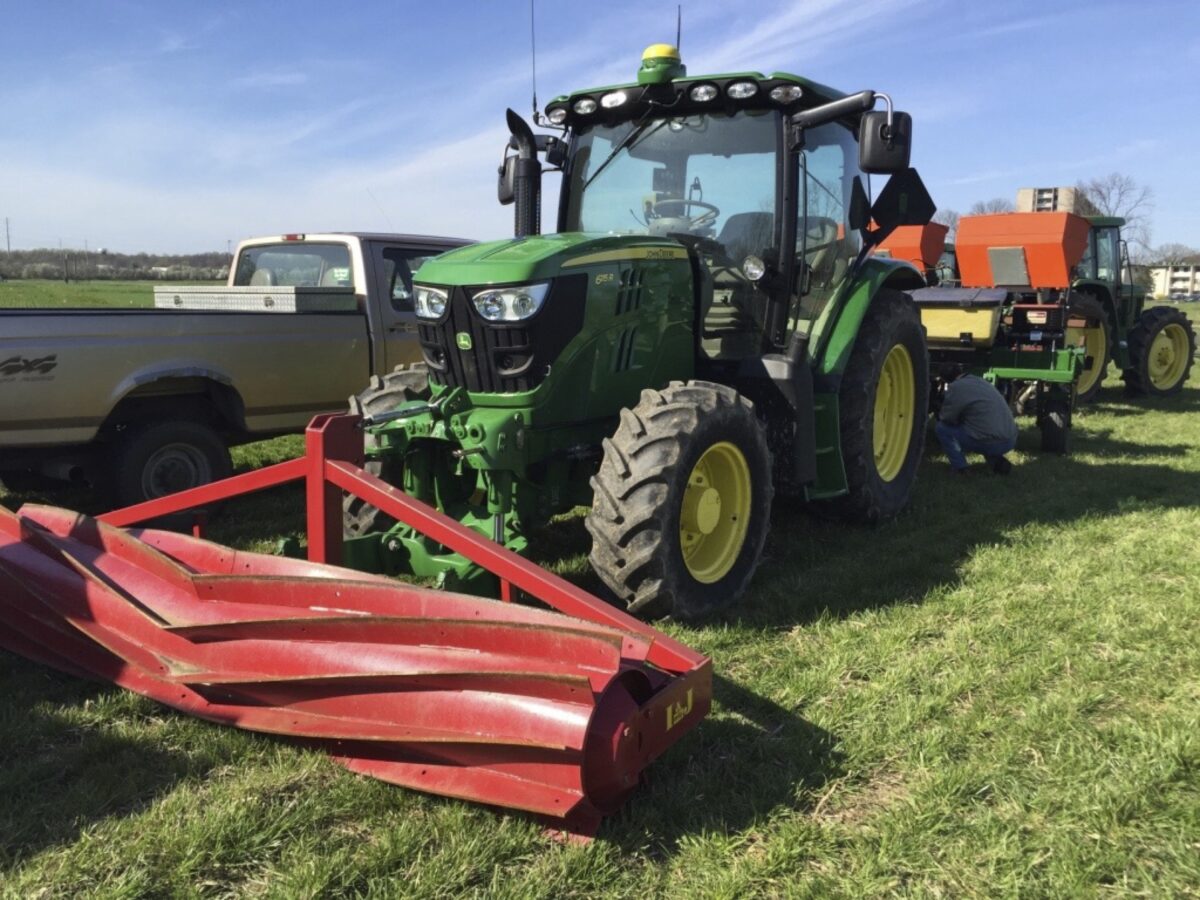
It s important to plant cash crops in the same direction as the roller crimping action. Early advocates of roller crimping preferred front-mounted tractor units, and that does have some advantage, particularly being able to have the planter unit mounted after the tractor and do both the roller crimping and planting all in one tractor pass. (Similarly, some companies sell smaller roller crimpers that can mount right onto a planter frame.) However, it is more common today to see roller crimper units behind the tractor, and the roller-crimper termination is done with a separate tractor pass after cash crop planting is done. More and more, farmers are planting their cash crop into a still-standing cover crop, called planting green. Among other benefits, planting into a standing cover crop reduces the amount of cover crop stems that get pushed into the planting furrow.
As farmers and researchers have experimented with roller crimpers in organic systems, the timing of planting versus using the roller crimper has become a frequent source of discussion. Erin Silva, an organic farming specialist with University of Wisconsin, is among the leading researchers evaluating whether roller crimping can be done even after the cash crop has emerged, with a particular focus on soybeans. She has found there can be an advantage to planting organic soybeans into cereal rye in Wisconsin that is at the boot stage and then waiting two to three weeks before running the roller crimper, typically when the rye is past anthesis (pollination stage). This allows the rye to provide greater biomass and more effective weed control, and the soybean seedlings seem tolerant of the roller crimper if they are still at the V1 to V3 leaf stage.
Organic vegetable producers have additional considerations for when to plant in relation to roller crimper action. If using a mechanical planter pulled by a tractor, the planting green approach followed by roller crimping may work effectively. If using a transplanter, usually the cover crop is rolled down first. Hand planting or using a walk-behind push planter can be challenging when cover crop residue is heavy, so some method of mechanical residue clearing might be required to ease planting.
Another option for reducing cover crop residue in the planting zone of a vegetable crop is to use alternating rows of a fall cover crop species, such as radish, that winter kills and leaves behind bare strips in the spring (called biological strip-till ). The radish can be alternated with a winter cereal, and the winter cereal will provide some continued living roots and soil erosion prevention for months after the radishes die.
Mower termination. As noted in the equipment chapter, termination of cover crops by mowing can be done but requires careful planning and timing. It is almost always ineffective if the cover crop is still in the vegetative stages, as mowing at that point is like mowing a lawn the cover crop will just grow back. However, most cover crops can be killed by a mower if they are far enough along in reproductive development and the mowing is done at a low enough height. Just be aware that even winter cereals that have started pollinating may bounce back if mowed too high and given a favorable rain after mowing. It is best to mow cover crops that are well into reproductive growth and as close to the ground as possible to get a successful mechanical kill.
Besides the issue of getting complete termination, mowing cover crops can have the challenge of leaving behind lumpy piles of residue. Rotary brush hog type mowers are generally the worst in terms of leaving uneven residue. A flail mower or sickle bar mower will do a more even job of laying down the residue. A good sickle bar mower can approximate the appearance of a field that has been roller crimped, but may leave an uneven distribution of biomass if the cover crop has extensive growth. Flail mowers are usually the best mower option for even distribution of residue but have a higher horsepower requirement per foot of row and are more expensive to buy than other mower options and roller crimpers.
Mowing is most likely to be used when a roller crimper is not available and the area of cover crops to be controlled is relatively small. As with using a roller crimper, mower termination does have the advantage of avoiding soil disturbance, unlike tillage termination.
Tillage termination. In past decades and centuries, cover crops were terminated through tillage. Green manure cover crops like clovers were typically plowed into the soil, burying most of the cover crop residue and leaving a relatively bare soil surface that could easily be planted with the cash crop. This system provided some biological fertility to the soil, especially the nitrogen provided by legumes, but left the soil subject to erosion during the weeks between plowing and cash crop establishment. In the current era, moldboard plowing of cover crops is uncommon, and indeed few moldboard plows are still found on farms, including organic ones. When tillage termination is used, mulching methods that leave a fair amount of cover crop residue on the surface are more common. Examples include using a disk, vertical tillage tool, rototiller, or other slicing type of tillage instrument.
As with mowing and roller crimper use, the timing of the mechanical termination action can be important. For many cover crop species, aggressive tillage such as rototilling can typically terminate the cover crop effectively when the cover crop is at an early growth stage. If a lighter tillage action is preferred, such as a light disking, it may require a couple of tillage passes or waiting until the cover crop is bigger, even in a reproductive stage, to get successful termination. However, disking a fairly sizable cover crop can in turn lead to a problem where a lumpy field occurs with large root balls from the mature cover crops, not to mention potential mounding of cover crop surface residue. Many first-time users of cover crops who have tried tillage termination of mature cover crops have been unhappy with the results. As with other methods, it is important to experiment, plan carefully, and adjust to conditions to make tillage termination work reliably and still have a good seedbed for planting.
Organic weed control spray products for termination. There is a big need in organic farming for National Organic Program-approved herbicides that can provide broad-spectrum control of annual plants, including cover crops. Concentrated vinegar is probably the most commonly used spray product at this time, but it is generally only effective when the weeds or cover crops are very small, and even then may not provide a 100% kill. Research is underway on additional organic herbicides that may be helpful, but it is difficult at this time to recommend an organic spray product that will provide consistent termination of cover crops, particularly if they are more than a couple of inches in size.
Flame termination. Conventional farmers sometimes talk of using a spring herbicide to burn down weeds or a cover crop. When organic farmers talk about burning down some plants, they are more likely to be talking about propane-powered flame weeder units. Flame weeding has its place in organic crop production, providing a way to desiccate undesired plants in a field without needing to do tillage. Of course, if the cash crop is already growing, the challenge is to avoid overheating or burning it. Usually, this is achieved by metal shielding that protects the rows of cash crop plants. However, for cover crop termination, the goal is generally to terminate all of the cover crop plants, meaning that the flaming needs to be done before the cash crop is planted, or at least before it has emerged. There are situations where this can be done, but the risk of igniting leftover crop residue from the previous year in a no-till situation is a real concern that greatly limits the use of this approach on a large scale.
Grazing termination. Keith Berns, a Nebraska farmer and co-owner of Green Cover, a cover crop seed company, has talked about the use of grazing to terminate cover crops as the holy grail of cover crop termination. If livestock are part of the organic system, this could be an approach to experiment with as a means of organic termination of cover crops. The idea is to take advantage of both soil health improvements from the grazing animals and the profit from the grazing, while getting the grazing livestock to do the work of termination. It sounds easy enough, but in reality, it s much like trying to use a mower to terminate, except the livestock may not be as consistent in mowing everything down as a machine might be. Just as with mechanical mowing, the cover crop needs to be reproductive to have the best chance of killing it with grazing. However, if the cover crop gets too mature, lignin builds up, palatability declines, and the livestock are usually much less interested in eating it. The way to potentially overcome this is to graze as intensively as possible, with a high stocking rate in a small area. Virtual fencing may be a tool that helps make this intensive grazing more feasible from a labor standpoint. As with other approaches here, experimentation on a smaller scale is recommended before attempting to use grazing for large-scale termination of cover crops.
Small scale termination. Horticulture producers on small acreage have used cover crops for years, but have typically had to rely on mechanical methods for termination, particularly mowing and/or rototilling. Rototillers work great to incorporate small or modest amounts of cover crop residue, but the tillage action can also spur weed growth, and is negative for soil health. On a really small scale, such as urban farms or high tunnels, it may not be viable to invest in a roller crimper or other mechanical control methods that allow no-till production (though a used push mower can be an inexpensive option). An emerging no-till alternative for termination of cover crops in these settings is to use a removable, light-blocking fabric such as tarps, black plastic ground covers, recycled billboard vinyl, or even cardboard on really small plots. The ground layer is left in place for 2-3 weeks until the cover crop is completely dead. In some cases, it may help to water the cover crop before or during coverage to make sure it s growing enough to get completely terminated by the light-blocking fabric. This approach can be particularly helpful in vegetable operations when various strips need termination at different times. However, there is growing awareness of the harm that plastics create in the environment, so carefully consider how to manage the plastics appropriately, or better yet, the use of alternatives.
Does planting green work for organic systems?
The approach of planting into a cover crop that is still green and alive has become significantly more popular among conventional farmers. As many as half of these farmers have tried planting green in some fields. As noted earlier, some organic soybean farmers are also planting green, usually into a winter cereal such as cereal rye, to get extra weed control benefits and maximize soil health benefits from letting the cover crop grow for longer. Cotton and certain other cash crops could be handled in a similar way for planting green.
Corn is somewhat more of a challenge for planting green in an organic system, especially for cereal rye or other winter cereals. The issue to overcome is potential nitrogen tie up from the winter cereal. Conventional row crop farmers have the option of planting corn while the winter cereal is still small and then immediately spray terminating, but at that cover crop growth stage a roller crimper or any other mechanical control method is not effective. Waiting for the winter cereal to get big enough for mechanical termination then creates a situation where soil nitrogen is being tied up, and some extra source of nitrogen at corn planting is needed. That could come from fish emulsion or other liquid organic nitrogen that is added near the corn row. Alternatively, the cover crop can be planted in the biostrip till approach described above, such as using radishes that winter kill where the corn row will be planted, alternating the rows of radishes with rows of winter cereal cover crop. Planting into those winter-killed strips is not quite a true planting green approach but it still allows for some green cover in between the rows that can then be terminated with a roller crimper.
Vegetable crops are perhaps even more challenging to plant green, but for certain species of vegetables the approach might work. The type of vegetables that will be more likely to work with planting green are larger seeded vegetables with vigorous early growth that can be seeded an inch or so deep with a planter (e.g., green beans). Experimenting on a small scale is advised before attempting any larger scale methods of planting green with any cash crop, including vegetables.
Selection of species
With over 40 species of cover crops for sale, there is much for an organic producer to consider in choosing which ones to use. Without a doubt, cereal rye is the most popular cover crop for both organic and conventional producers, given its winter hardiness, ability to be planted late, and extra weed control ability. However, organic producers have reason to consider a variety of cover crops for different situations, including cover crop mixes. Legumes in particular have great importance for organic producers, given their ability to provide biological nitrogen fixation. To get full advantage of legumes nitrogen fixation, they need to be allowed to grow well into reproductive growth, which can mean delaying planting of some cash crops like corn.
Among the legumes, the big three for cool-season cover crop use on organic farms are hairy vetch, crimson clover, and Austrian winter peas. Hairy vetch provides good spring weed control and can be used farther north than the other two species, but with hard seed that can lead to volunteer plants in future years, hairy vetch has limited appeal for some organic growers. On the positive side, new varieties of hairy vetch with soft seed are on the horizon, and buying year-old hairy vetch seed can greatly lessen the hard seed fraction. In the southern half of the U.S., crimson clover is the most popular cool-season legume cover crop. For summer legumes, cowpeas and sunn hemp are frequently used to help provide nitrogen, such as after small grains, potatoes, or other early season vegetables.
Using mixes of cover crops that include legumes will provide some nitrogen fixation, but not as much as a pure stand of legumes. To optimize nitrogen production in cover crop mixes, be sure to favor the legume fraction of the seed mix, as too much in the way of grass cover crops can suppress legume growth.
Another species selection factor for cover crops in organic systems is the potential of certain cover crops to provide a disease to a following cash crop. While this is not a common problem, it can occur, and an organic grower may not have as many fungicide options for dealing with that disease as a conventional producer. It helps to have a rotation of cover crops and cash crops that alternates the plant family being used. For example, if planting corn, it is best to avoid using only grass cover crops, or if planting a Brassica cash crop, preferably avoid using a Brassica cover right beforehand.
It may be difficult to completely avoid having the same plant family planted back-to-back, but having a long-term crop rotation that uses multiple plant families and occasionally uses cover crop mixes instead of only single species can be a good overall strategy. Organic farming guidelines usually require diverse rotations in any case, which helps with reducing potential for disease buildup in fields.
Finding organic cover crop seed
As cover crop acreage has increased in the U.S., the supply of cover crop seed has also improved, and more species of cover crops are now available as organic seed. However, many of the less common cover crop species may be hard to find in organic form, and particular varieties of even common cover crops may not be readily available in organic form. Ordering seed early and reviewing offerings from multiple seed companies is a good way to ensure the desired seed can be obtained in organic form. If purchasing cover crop seed from another farm, make sure they have appropriate documentation of organic production methods.
If a particular species of cover crop is needed and is not available in organic form, check with the farm s organic certifying organization to confirm that non-organic seed can be used in that situation. Such use of non-organic cover crop seed may be allowed if no organic version of the species is available, but it s best to get that approved ahead of time to avoid having issues with maintaining organic certification for a field.
Where legumes are being used, be sure to obtain appropriate inoculum for mixing with the cover crop seed in order to achieve nitrogen fixation, especially in fields where that particular legume and inoculum have not been used recently. Most seed companies that sell cover crops can provide inoculum for legumes.
Planting organic cash crops into cover crops
From an equipment standpoint, seeding row crops into cover crops is largely the same for organic and conventional systems, keeping in mind caveats for termination such as terminating early when conditions are dry and avoiding nitrogen tie up with cereal rye and other winter cereals. The one notable difference is that while a conventional farmer can focus on making a seed furrow without being overly concerned about triggering weed emergence, it is of greater concern for the organic producer. While one might get great weed control from cover crops between the rows, this might be offset by significant weed growth that is triggered by furrow creation. The action of soil disturbance when creating a furrow exposes some weed seed to light and can create a race between the cash crop and weed seeds to see which will establish faster and cause competition for the loser. Ideally, organic row crop planting happens with minimal soil disturbance and most cover crop residue left in place. That s why planting soybeans green into cereal rye is a popular approach, because the rye helps suppress any weeds that might come up from the furrow disturbance.