What are potential issues with cover crops to be aware of?
Several years ago, when cover crops were just starting to become more popular, I gave a short talk on cover crops to a group of Missouri Extension staff. As soon as I finished, the questions started pouring in – what about problems with voles, slugs, cover crop weediness, etc.? There is an understandable concern from those who have only heard a little about cover crops that they may be a headache to manage. This chapter is an attempt to lay out some of the potential problems with cover crops, how likely they are to occur, and how you can deal with these problems. While it’s somewhat unlikely that you personally will see one of these problems on your farm, it’s good to be aware of the potential issues. The issues I will address are:
- Voles
- Slugs
- Insect pests and diseases
- Weed problems from cover crops
- Cover crop seed quality issues
- Termination and cash crop planting issues
- Crop insurance
Voles
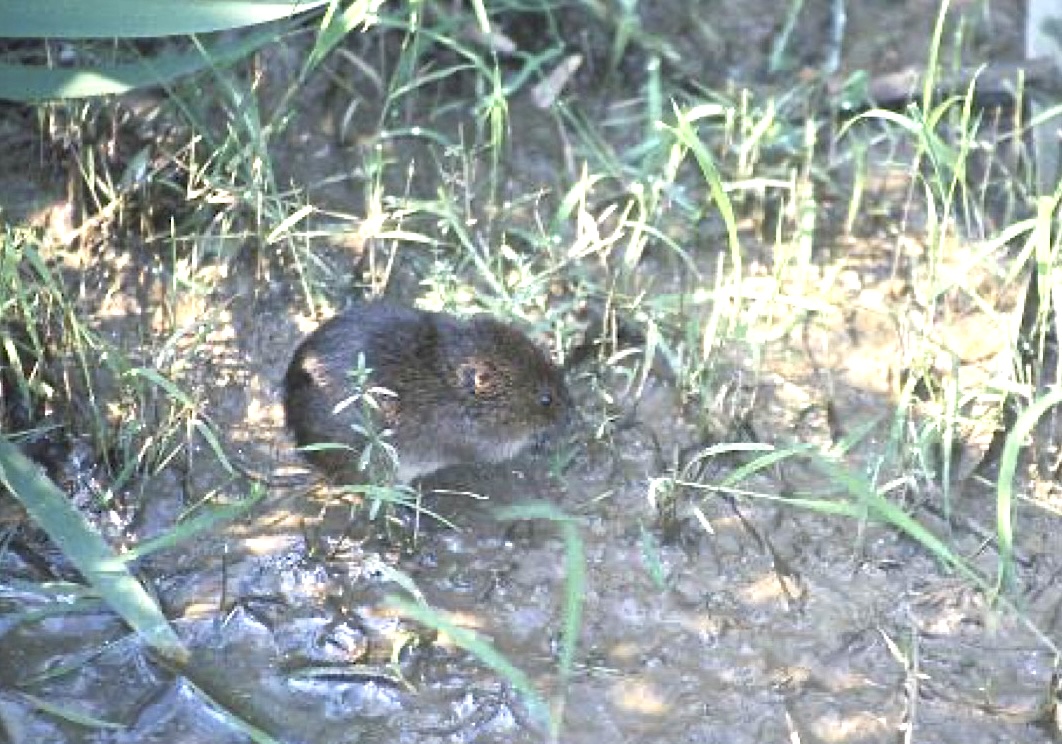
Most cover crop users have never experienced a significant problem with voles, but for those who have, these small mammals can be quite a nuisance. Voles, as pictured below, appear similar to mice but are stockier, with smaller ears and shorter tales. They thrive on residue cover in certain regions of the country (see the maps below). Even without cover crops, they can show up in force in no-till fields. Cover crops don’t necessarily increase the likelihood of voles compared to no-tilling without cover crops, but voles can reproduce rapidly wherever they have protective cover and a food source.
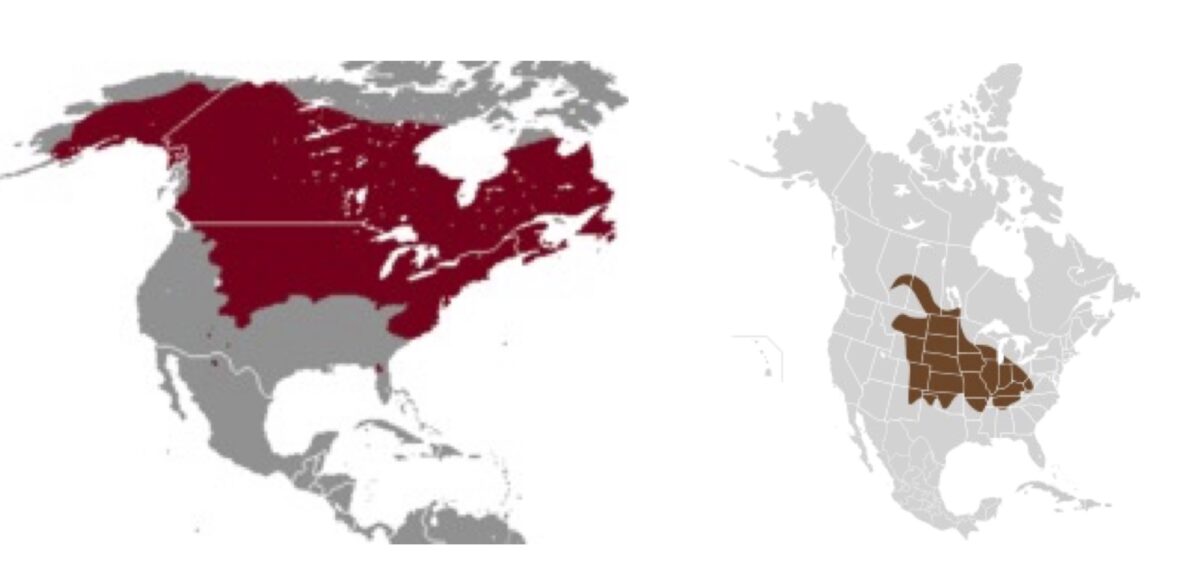
In the U.S., there are several species of voles, but the two most likely to show up in crop fields are meadow voles (Microtus pennsylvanicus) and prairie voles (Microtus ochrogaster). The two species look similar and can be found on the same farm in the central U.S., but meadow voles tend to favor wetter areas and prairie voles tend to favor drier areas. As shown in the distribution map, meadow voles have a larger geographic range. Both types of voles like to eat a variety of vegetation, including clovers and vetches, but prairie voles are more likely to eat grasses than meadow voles. Both live in tunnel networks, but meadow voles tend to tunnel just under residue along the soil surface, while prairie voles may dig deeper tunnels.
Voles are short-lived animals, usually living for one to one and a half years, assuming predators don’t catch them sooner. Their populations in a field can cycle up and down rapidly. They may be a major pest problem in a field for a year and then nearly disappear for a few years. Population peaks can occur in two- to five-year cycles. This is part of what makes control challenging, because after seeing them one year, the temptation is to treat the field with baits or other control methods the next year, when natural circumstances may have already caused the local population of voles to plummet.
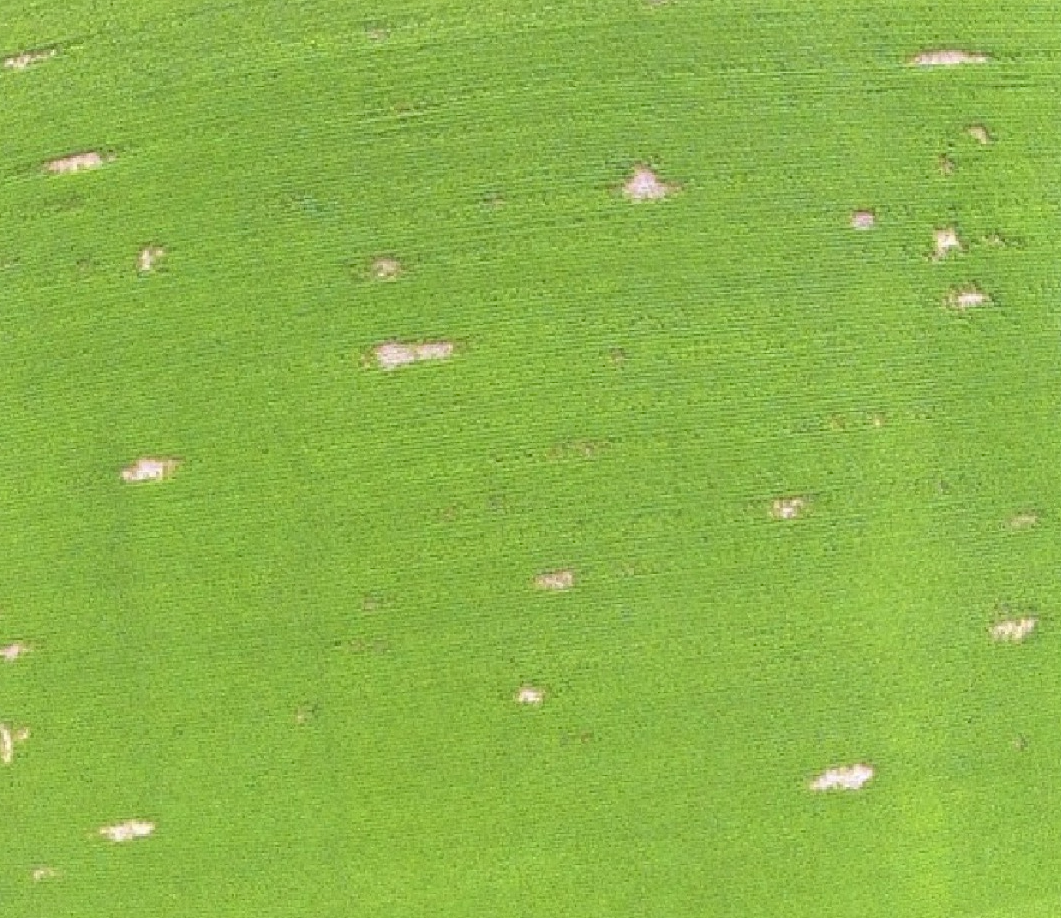
There are a variety of control methods that can be employed with voles. None are foolproof but, used appropriately, they can lessen the chance of economic losses from voles. Voles eating some cover crop plants and residue isn’t really a concern; the problem occurs when the vole population grows to the point where they start eating cash crop seeds or seedlings. Voles are somewhat more likely to be a problem in soybean fields versus corn or small grain fields. Sometimes, fields will be noticeably damaged with a patchy appearance, as shown in the aerial photo below.
A long-term control method is to encourage the presence of predators, such as building raptor perches for hawks and owls at a few points around the edge of a field and allowing foxes or coyotes to frequent the area. If a large vole population is noticed in a no-till/cover crop field at the end of the winter, light tillage can be done in the affected areas prior to cash crop planting to destroy their tunnels and reduce cover, killing some of the voles in the process of tillage. Poison baits are available for voles, but should be a last resort, both because the baits can harm non-target animals and because they tend to degrade in rainfall, making them ineffective (some products may be slightly more water-resistant than others). Non-toxic baits such as excess corn or soybean seeds can be used as a distraction to direct smaller numbers of voles away from the planted crop.
The type of cover crop used may also have an impact on vole populations. It’s been reported that voles particularly like vetch cover crops and that they also like clovers, whereas Brassica cover crops such as radishes, turnips, and rapeseed/canola seem to discourage vole populations. Where cover crop mixes are used, it may help to add a Brassica cover crop to the mix to reduce vole numbers, although more research on this is needed.
The amount of cover crop biomass may make a difference. Using a lower seeding rate of cover crops or including some winter-kill cover crops in the mix may reduce the stand of covers in the spring to the point where the voles have less shelter and are more easily killed by raptors; the lack of cover may also prompt voles to move to grassy field borders or other areas instead.
If converting a pasture or hay field to row crops, there is a higher risk for voles; scout for them in the months following conversion. Voles can also migrate out of grassy field borders into crop fields and are often worse around the edge of a field than in the center.
Scouting for voles is best done in early spring before cash crop planting, and signs may be easier to spot after a snowfall has melted. If five or more active burrows per acre are found, control measures may be warranted. As noted earlier, there are many areas of the country where voles are never or seldom seen, but they can occasionally be a problem in some fields every few years if management adjustments are not made. If you are looking for a silver lining, voles do eat weed seeds and can eat slugs and insect pests.
Slugs
Some of the same conditions that allow voles to prosper – namely high-residue cover either from no-till or cover crops – can also lead to slug problems. Slugs do better in moist than dry conditions. Various slug species are distributed widely in the U.S. and can affect many types of cash crops. They are seldom a threat to a mature field crop but can damage cash crop seeds and especially affect early seedling growth, either nipping off small seedlings entirely or chewing holes in the leaves of larger seedlings. If a cash crop can get past the initial seedling stage without significant slug damage, some leaf feeding during later crop growth will usually be inconsequential to harvested yields. The first few weeks of cash crop growth is the period when crops are most susceptible to slugs.
In the Midwest, the most common slug is the gray garden slug (Deroceras reticulatum), which typically emerges from eggs in mid-spring. An early-planted corn crop may manage to get a good jump on growth before these slugs emerge, and subsequently avoid any real damage. Severe slug damage can sometimes occur in late-emerging cash crops, most often during a cool, wet spring.
Slugs are less of a concern for the cover crop itself, although they have occasionally affected fall establishment of certain cover crops, especially when cover crop seed is broadcast (they eat the seeds lying on the soil surface). If slugs are a potential risk during the fall, drilling the cover crop seed can reduce or eliminate slug damage to the seeds.
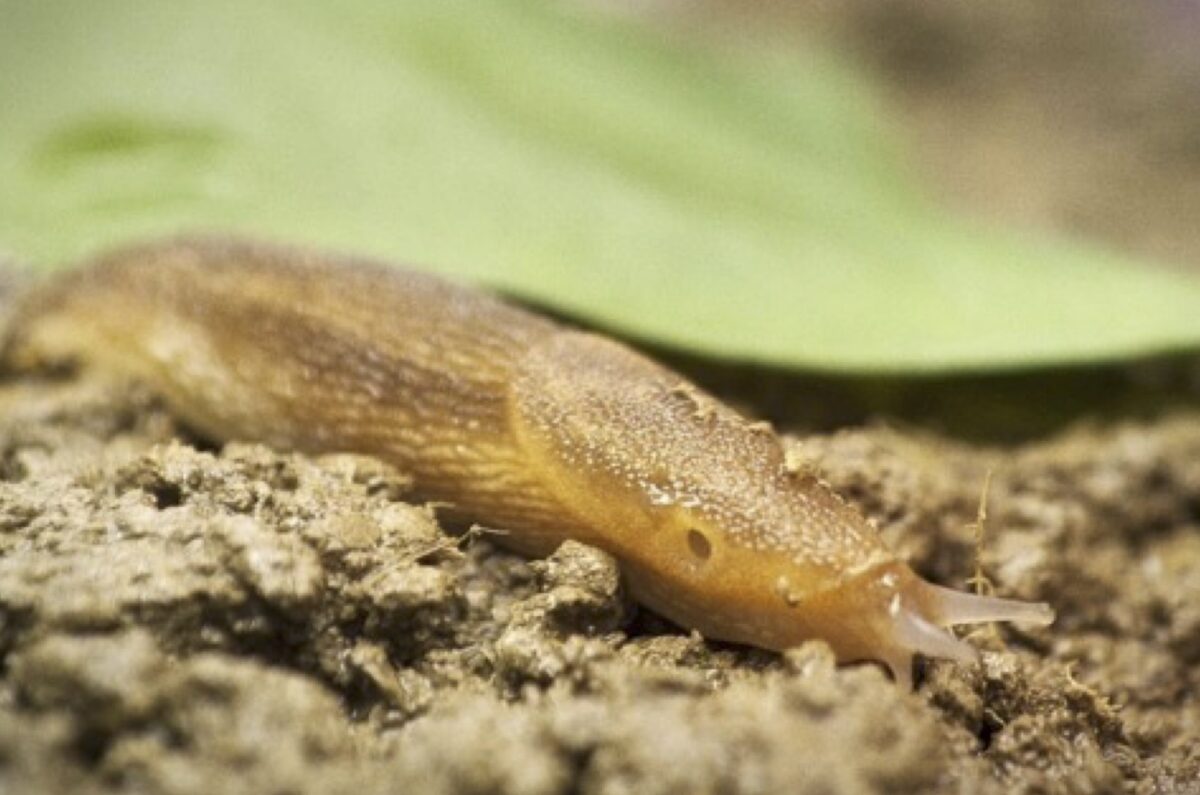
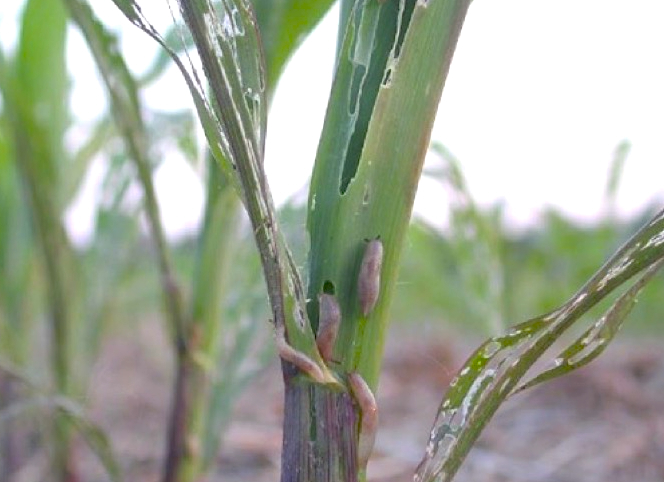
A key thing to know is that slugs are not insects; they are soft-bodied mollusks, similar to snails but without the shell. Thus, regular insecticides have no effect on them. However, there are molluscicides that can sometimes provide a degree of control. Iron phosphate baits are perhaps the most commonly used type of slug baits for field settings.
As with voles, a non-toxic control method is using tillage to terminate the cover crop and reduce cover available to the emerging slugs in mid-spring. This approach, however, is counterproductive to maintaining soil health and preventing erosion from heavy spring rains.
John Tooker at Pennsylvania State University is an entomologist who has spent a significant amount of time studying slugs in no-till and cover crop situations. He feels the best long-term approach is to encourage natural predators of the slugs, particularly ground beetles. To do that, broad-spectrum insecticide use must be curtailed in relevant fields. This includes obtaining cash crop seeds that are not treated with insecticide, which may necessitate a few phone calls to find insecticide-free seed from dealers or at least ordering the insecticide-free seed well in advance of the growing season. Insecticide-coated crop seeds have been found to greatly reduce the ability of ground beetles to control slugs, because they can cause impaired hunting ability or death. The slug slime can absorb the insecticide, with beetles that feed on the slugs accumulating toxic amounts of the insecticide, preventing them from preying on additional slugs. As stated earlier, insecticide-coated seeds and broadcast insecticides have no impact on slugs and don’t provide any control of slugs.
Some other crop management tips for dealing with slugs:
- Close the seed slot so slugs can’t access the cash crop seed
- Drill/plant deeper, again to keep the slugs away from the seed
- Diversify crop rotation because slugs may attack only one crop
- Plant corn earlier in the southern U.S. before slug emergence, or possibly later in the northern U.S. to encourage fast growth
- Use a pop-up fertilizer to boost early growth of corn or other nitrogen-responsive crops
Certain changes to cover crop management can also help reduce slug damage. When selecting cover crops to plant, avoid planting radishes and, to a lesser extent, other Brassicas, including in mixes; slugs seem to particularly like eating Brassicas. The amount of cover crop spring biomass can be reduced by cutting the cover crop seeding rate or mixing in more winter-kill cover crops. Planting green may help, as the slugs will keep eating the cover crop instead of the emerging cash crop; they will even eat the decaying leaves of a recently-terminated cover crop as the cash crop emerges.
Insect pests and diseases
Questions have arisen among plant pathologists, entomologists, and farmers about whether cover crops allowed to grow a long time in the spring will have a negative disease or insect impact on the following cash crops. A significant amount of research on this topic is underway and we are still learning about this topic, but I’ll try to summarize what is known to date.
First of all, in most areas insect or disease issues are infrequent from using an overwintering cover crop before cash crops like cotton, corn, soybeans, sorghum, and sunflowers. If the cover crop is terminated early in the spring, pest and disease issues are particularly unlikely to occur. In some locations and in some years, there have been situations where certain insect pests such as armyworms have been worse following a cover crop. As with slugs, a planting green strategy might help because the armyworm will likely continue eating the much more voluminous cover crop biomass as opposed to the emerging cash crop seedling. There have been some exceptions to this in which the armyworms left the terminated cover crop and attacked the seedling cash crop. When armyworms are present in the cover crop, they should be periodically scouted and control remedies should be considered.
I want to emphasize that insect problems can potentially occur following cover crops, so field scouting is generally worthwhile. However, based on farmer experiences to date, overall insect pressure on cash crops following cover crops is not likely to be worse than conventional management on the majority of fields. With cover crops there can be specific insect pests that pop up in some places in some years but not others.
Another potential management issue is one that some scientists have described using the “green bridge” hypothesis, in which particular diseases or insects may move from the still-living green cover crop onto the emerging cash crop seedling. How much the green bridge issue happens with insects needs more study but is likely highly variable depending on the insect species and the year, based on factors noted above. With diseases, the green bridge problem is most likely if conditions are cold and wet; it’s not yet clear how often this happens, but it seems to be a minority of cases, affecting corn more than soybeans. Observations to date suggest such disease incidence will be highly dependent on the weather that year and the timing of cover crop termination and death. If the cover crop is terminated, say, a week or so before the cash crop is planted, it’s possible a certain insect pest or disease pathogen could move off the dead or dying cover crop leaves and start infesting the fresh, green cash crop seedling.
Overall, we have a lot more to learn about which insects and diseases might be worse following cover crops, when those problems are most likely, and how best to manage those situations. Some of the research currently underway at a number of locations in the U.S. should provide more guidance on this topic in the next few years.
Scouting fields shortly before and after planting cash crops is always a good idea. Scouting can be done in a time-efficient fashion and can allow a potential problem to be caught before there is a major economic impact. In southern or western areas where slugs are not a potential issue, a seed insecticide may help reduce any insect issues since there would be less concern about affecting ground beetle populations. In all areas, early termination of the cover crop is an option to reduce the chance of any disease or insect pests carrying over to the cash crops.
Weed problems from cover crops
One worry about cover crops I hear less than I used to is that planting cover crops will lead to a weed problem. The risk of a cover crop itself becoming a weed is very low. This is primarily because all of the 30-plus species of cover crops commonly available are domesticated annual plants that can be readily killed by a variety of herbicide, tillage, and other methods. The two biggest exceptions are hairy vetch and annual ryegrass.
The issue with hairy vetch is that a significant portion of the seed normally has a hard seed coat, and these hard seeds don’t germinate right away. Some may germinate a year or two after planting, and others may not germinate until several years after planting, when weathering conditions have broken down the hard seed layer. Efforts are underway to breed new varieties of hairy vetch that don’t have hard seed, so that may be a solution in the future.
Another issue with hairy vetch is not directly a weed issue but relates to the size of the hairy vetch seed. Hairy vetch seed is of a similar size to wheat seed, so any hairy vetch that happens to grow (volunteer) with the wheat will not be separated during combining and will end up in the truckload of wheat going to the market. This can lead to a financial penalty (docking) when the wheat seed is delivered or, if bad enough, may cause a truckload of wheat to be rejected, with the only alternative being to feed it to livestock. Thus, it’s a good idea to avoid planting hairy vetch in fields where wheat will be planted for harvest in the coming years.
Annual ryegrass has a different issue. It’s more challenging to terminate than other cover crops and carries the risk of developing into a glyphosate-resistant weed population in a field. This is unfortunate, because annual ryegrass (a completely different species and genus of plant than cereal rye), has many excellent cover crop attributes such as easy establishment, deep rooting, erosion protection, and good forage quality. I generally suggest farmers avoid annual ryegrass unless they’re willing to pay particular attention to their termination strategy. Effective chemical termination of annual ryegrass involves spraying early in the afternoon on a sunny day when air temperature is above 55°F and soil temperature is above 45°F, and while the ryegrass is actively growing. A good guide with details on how to manage annual ryegrass as a cover crop, including termination strategy, is Annual Ryegrass as a Cover Crop in Midwest Corn and Soybean Production. That publication is available for free online and can be found by searching for that title in an internet search engine.
The real issue with weeds related to cover crops is not the cover crops themselves, but weed seed that may be in the cover crop seed supply. Reputable seed dealers of cover crops do a thorough job of cleaning their cover crop seed, just as is done with cash crop seed. However, some farmer-to-farmer sales of cover crops have contained excessive amounts of weed seed due to inadequate cleaning of the seed; this is particularly problematic if noxious or herbicide-resistant weeds are found in the cover crop seed purchased. It’s always a good idea to review the seed tag on the cover crop seed to verify that it has been cleaned to a high standard; if no seed tag is available, that’s a warning sign that the seed should not be purchased.
Cover crop seed quality issues
Much like the previous discussion on weed seed in cover crop seed supply, it’s important to review a seed tag for germination percentage. Generally, a germination percentage of 85% or greater should be expected for the cover crop seed, and foreign material should be minimal. There have been cases in which a farmer ended up with a truckload of poor-quality seed that did not germinate well, perhaps because they went with the cheapest source of seed or were ordering late, when good-quality seed had all been sold and only low-quality bin-run seed was left.
Another issue to be aware of related to seed purchase is Variety Not Stated (VNS) cover crop seed versus buying a named variety. It’s an unfortunate reality that much of the cover crop seed currently sold in the U.S. is sold as VNS. The problem here is that a Minnesota farmer might end up with a type of cereal rye best adapted to the south, and a Florida farmer might end up with rye that’s better for the north. Often, VNS seed is a mixture of varieties, which can lead to inconsistencies in cover crop performance and development, potentially complicating termination timing. My hope, similar to many seed industry leaders, is that we soon see a shift away from VNS cover crop seed. We need to transition to using only named varieties of cover crops that are adapted to the region, just like is done with cash crop seed.
Termination and cash crop planting issues
Detailed management suggestions for cover crop termination and how to plant a cash crop into cover crops were addressed in Chapters 6 and 8. The following section is just a short review of some particular issues to avoid.
The two main issues regarding termination are the timing and completeness of the termination process. With timing, the biggest factor is the amount of soil moisture at the time of termination. In the case of spring-terminated cover crops, a wet spring is a reason to let the cover crop grow longer and continue drawing down the soil moisture in advance of cash crop planting. However, there have been cases in which farmers terminated cereal rye that was 2 to 3 feet tall about 10 to 14 days ahead of desired corn/soybean planting, and then the weather turned rainy and the cover crop created a wet mat that further delayed cash crop planting. By leaving the cover crop alive until planting time, that situation can be avoided. Just keep in mind that if the spring is trending dry, that’s a good situation in which to terminate early, such as when the cover crop is still less than a foot tall.
Completeness of termination refers to achieving 100% kill on the cover crop so that none of the cover crop plants bounce back and interfere with cash crop growth. Most of the common cover crops are easily controlled by herbicides if the proper spray rate and products are used. Potential problem situations include spraying when it’s too cold, and the cover crop doesn’t actively translocate the herbicide or having a thick mat of cover crop that’s been knocked down by rain and wind, so that it’s difficult to achieve direct contact with all the cover crop plants when spraying.
If mechanical control methods such as roller crimper or mowing are used, it’s best to wait until the cover crop has turned reproductive (started flowering) and then roll or mow. If rolled or mowed while still vegetative, the cover crop may bounce back and continue to grow. If using a mower, cut the cover crop as close to the ground as is feasible. Termination by tillage can be done at any time of cover crop growth, vegetative or reproductive; dislodging the cover crop roots is usually the key to complete control. By contrast, merely slicing up some cover crop top growth with a disk may inadvertently allow cover crop regrowth unless repeated tillage passes are made.
When planting a cash crop into the cover crop, there are two general approaches to pursue. For a first-time cover crop user, especially someone who has just one or two fields of cover crops, it’s usually best to terminate early so that there is little cover crop biomass and planter modifications are minimal. However, for full value of the cover crop, as experience is gained with cover crops, you should plan to experiment with later termination and adjusting planter settings. Getting good furrow closure should be a high priority, and that may require changing out closing wheels. In finer-textured soils, it may be helpful to have one or both of the closing wheels on each planting unit be a spiked-type wheel that can help break down the firm sidewalls of the seed furrow. More traditional round closing wheels, whether rubber or steel, may not provide full furrow closure in a no-till cover crop system.
Having sharp furrow openers can be helpful in some cases to slide through residue and open the furrow. However, trash-clearers on planters are often unnecessary with cover crops and may in fact get tangled with cover crop biomass. I’ve heard quite a few farmers say they ended up taking trash-clearers off their planter because of the tangling issue (cotton farmers may be more likely to use row-cleaners given the shallow planting needs with cotton). No-till coulters may or may not be helpful in cover crop situations. A reason not to use no-till coulters is that it’s best to have maximum down-pressure from the planter weight on the furrow openers, and if a coulter is present, part of the planter weight is going onto the coulter instead. Again, experimentation is the key. Taking some time at the beginning of planting a cover cropped field to adjust cash crop planter settings can really pay off in achieving a good stand of the cash crop.
Crop insurance
I’ve been in dozens of meetings and conference calls on crop insurance related to cover crops, mainly because crop insurance was an early barrier to some farmers using cover crops. Many of those meetings over time have contributed to significant improvements in crop insurance policies for cover crop users. There are still misperceptions out there that planting cover crops will somehow mess up crop insurance eligibility. Fortunately, current federal crop insurance policies are much more conducive to using cover crops and cover crops only rarely impact eligibility for cash crop insurance.
Here’s where things stand at the time of writing: there are no restrictions on planting cover crops after cash crop harvest or overseeding cover crops shortly before cash crop harvest. Fall cover crop planting has no impact on crop insurance eligibility for the next cash crop. However, termination of the cover crop should be done according to what insurance people call “Good Farming Practices (GFP).” The GFP guidance applies to many agronomic practices beyond just cover crops. For example, you can’t mistakenly spray a grass herbicide on wheat or corn, injuring the crop, and expect to collect a crop insurance payment. In that situation, GFPs weren’t observed. Likewise, a farmer can’t skip cover crop termination, letting the cover crop grow so long that it prevents good establishment of the cash crop and still expect to file for a full crop insurance payment.
After considerable debate on how to handle cover crop termination in relation to crop insurance, we currently have a system where farmers can refer to local experts, regional cover crop council guidance, or cover crop termination guidelines posted on the NRCS website. You don’t have to follow the recommendations of any one particular group, but you do need to have one of these kinds of reference points. Use of such local/regional expertise provides a defense in case a crop insurance payment is questioned regarding whether GFPs were followed. Letters from local cover crop experts, such as Extension agronomists, can also be used to help clarify whether regionally appropriate practices were used for termination.
The other potential insurance issue with cover crops and crop insurance is interseeding a cover crop early in the growing season of the cash crop. Some farmers have experimented with planting a cover crop at the same time they plant the cash crop. Others have interseeded partway through the growing season, such as using a high-clearance grain drill to seed a cover crop into knee-high corn. Still others have tried planting cover crops early into extra-wide corn row spacings, such as 60-inch corn rows. Because these are non-standard practices, it’s possible that a crop insurance payment request might be questioned. As with termination, getting letters from local cover crop experts or finding regionally published guidelines on the validity of the method can help resolve any such crop insurance disputes.
A special circumstance that became a major issue in 2019 was the 19 million acres of cash crops that were declared “prevented planting,” meaning that they could not be planted to crops such as corn and soybeans within the accepted time window for reasonable yields. At first, there was substantial confusion about whether farmers could immediately go in and plant a cover crop, especially if they intended to harvest that cover crop for hay. Since then, the Risk Management Agency (RMA) has put out clarifications that a cover crop can be planted at any time after prevented planting is declared without payment implications, provided the cover crop is not harvested for seed. Specifically, on July 6, 2021, RMA published on their website the following language: “A cover crop planted on acreage claimed as prevented from being planted can be hayed, grazed, or cut for silage, haylage, or baleage at any time without a reduction to the prevented planting payment, provided the insured meets all other policy provisions. However, a cover crop harvested for grain or seed at any time will result in a prevented planting payment reduction in accordance with section 15(f)(2) of the CCIP Basic Provisions.”
The bottom line is that a farmer using commonly accepted cover crop management for their region has no reason to fear losing crop insurance. You do need to be aware of particular restrictions on harvesting the cover crop for seed and then planting a cash crop – that will typically mean any crop insurance payout for the cash crop will be evaluated at a lower “double crop” yield rate since the cover crop seed harvest is viewed as the first crop in the cropping year. Growing a cover crop for hay harvest prior to cash crop planting can also potentially impact cash crop insurance payout amounts, depending on the time of haying and particulars of the situation (policies on haying continue to evolve, so check for the latest).
Federal policies on crop insurance are regularly revised. While the crop insurance information in this section reflects policies as of early 2023, it may be worth checking on the latest policies posted on RMA’s website if you have any question about crop insurance eligibility in relation to cover crops. This is particularly true if you are trying some uncommon practices with cover crop management.