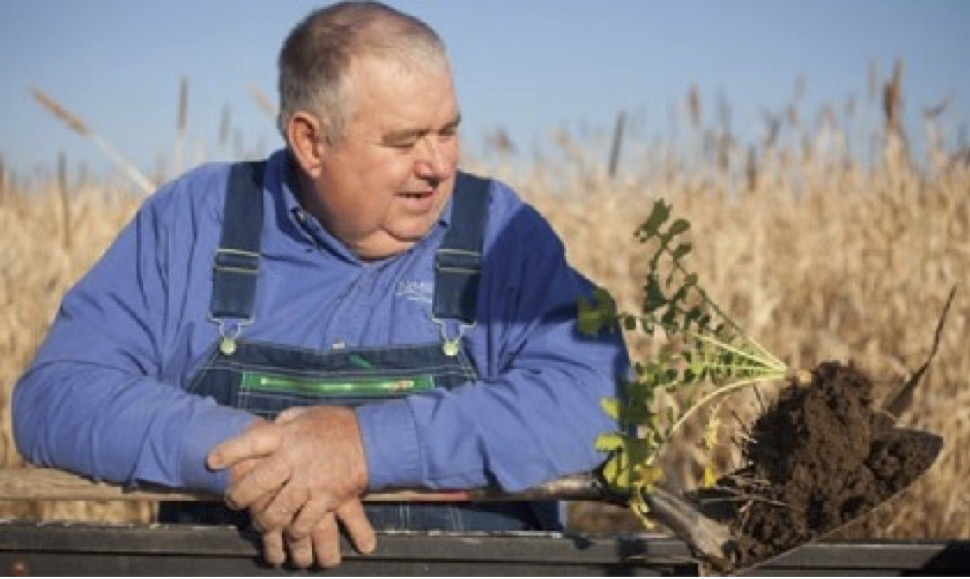
*In May 2023, after this profile was written but before the book went to press, David Brandt was in a traffic accident and died as a result of his injuries. His passing was a huge loss to the conservation movement in the U.S. I hope sharing his story will help his efforts live on, as they have through many other stories and articles about him. Without question, he had a huge impact on the adoption of cover crops and the soil health movement in the U.S.
Dave Brandt farmed row crops on about 1,000 acres in Ohio, southeast of Columbus. He was primarily a corn, soybean, and wheat producer over the years. In recent years, he also grew various small grains for the cover crop seed market. His family farm has been oriented toward conservation for many decades, implementing their first no-till fields in 1969 and, within a few years of that, converting to 100% no-till.
During 1979, one of his early years of farming, he noticed corn yields were declining and thought legume cover crops could help, so he tried them and found they did help bring his soil back to life. He used hairy vetch at first, then later used yellow sweet clover on fields going into that era’s USDA “set-aside acres” program. He tried various clovers in the 1980s, and started using radishes and winter peas in the late 1990s.
Dave was widely known as being one of the first farmers to make extensive use of cover crop mixes, being an early advocate of diverse “cover crop cocktails” after winter wheat harvest. Dave said he had found that a diverse, high-biomass summer cover crop mix really helps improve the soil because the cover crops planted mid-summer have a long window to grow. He also noted that some of the species in his summer cover crop mix, such as sunn hemp, cowpeas, and sunflowers, can get deep roots. He saw roots five feet deep in the fall from those mixes.
Using a small grain followed by summer cover crop mixes as part of a rotation with corn and soybeans lead to faster soil improvement, in Dave’s experience. He observed that it can take up to three times longer to see equivalent soil health improvement when doing only a corn-soybean rotation with covers.
Although he continued to tweak his approach, his three-year crop rotation and cover crop strategy at the time of his interview for this book is outlined below.
After corn harvest, he planted cereal rye, often with balansa clover and rapeseed or radishes. If he was seeding the covers fairly early after corn harvest, he added radishes. If seeding later in the fall, he switched out the radishes and used rapeseed instead.
The next spring, he planted soybeans and then, after soybean harvest, a winter-hardy small grain. In years past that was usually winter wheat, but in more recent years he had started growing a greater diversity of small grains, including some artisan wheats. For the cover crop seed market, he also used spelt, cereal rye, or sometimes winter wheat, grown as single species that was harvested mid-summer. Then, after harvesting the small grain (winter cereal), he planted an 8- to 12-way cover crop cocktail mix, drilling into the cereal residue.
His summer cover crop cocktail mixes included both warm-season and cool-season species. Typical warm-season species were sunn hemp, cowpea, sunflower, buckwheat, and sudan, or sorghum-sudan. The cool-season species were typically crimson clover, hairy vetch, winter pea, cereal rye, barley, flax, and Brassicas. The warm-season species grew vigorously in summer and early fall, assuming adequate soil moisture was present. The cool-season species emerged in the summer but stayed small under the canopy until fall, then grew more vigorously in the cool weather of fall and early spring. While the warm-season species died with the first frost, the cool season species could keep growing for weeks longer, sometimes until temperatures were as low as 20°F, depending on the species.
Normally he planted 100% of his corn and soybean fields to cover crops, but he said that about every one year out of four, weather prevented him from being able to plant all acres to cover crops.
Cover crop seeding method
Dave was a big advocate of using a drill to plant cover crop seed. To get over more acres in less time, he invested in a 30-foot KUHN Krause drill, which he found to be very effective for no-till seeding. It allowed him to plant quickly, and he usually had time to do some cover crop seeding for neighbors.
When doing mixes, Dave didn’t have too much trouble with seed segregation, but occasionally noticed some seed segregation if the seed had been mixed for a long time. He noted that sunflower seeds in particular would sometimes come to the surface and need to be stirred back in.
Over the years, Dave learned that keeping his cereal rye seeding rate relatively low at about 20 pounds per acre allowed for more growth on the legumes in the mixture.
Termination and spring planting of cash crops
With soybeans, Dave normally used a planting green approach, drilling the soybeans into the still-living cover crop. After planting, he used a roller crimper to terminate the covers. Ideally, he rolled the cover crops to terminate them when the cereal rye was about two-thirds in bloom and rapeseed/canola was producing seed pods. He tried to use the roller crimper before the soybeans emerged. He tried rolling when beans are already up, but found that if the beans were in the second leaf stage, the roller could break some of the soybean seedlings. He found that he could roll soybeans in the first leaf stage and achieve satisfactory results.
One reason he sometimes waited on roller crimper termination was if it was a wet spring, in order to let the cover crops pull down more soil moisture. When planting green, he found the living cover crops helped keep insects away from soybean seedlings.
About 70% of the time, his planting green approach worked well to manage weeds, and in the other 30% of cases, he did a post-emerge application to handle the weeds. Normally, he did not apply a residual herbicide or any pre-plant herbicides. He commented that his beans and corn were non-GMO, which gave him a market premium.
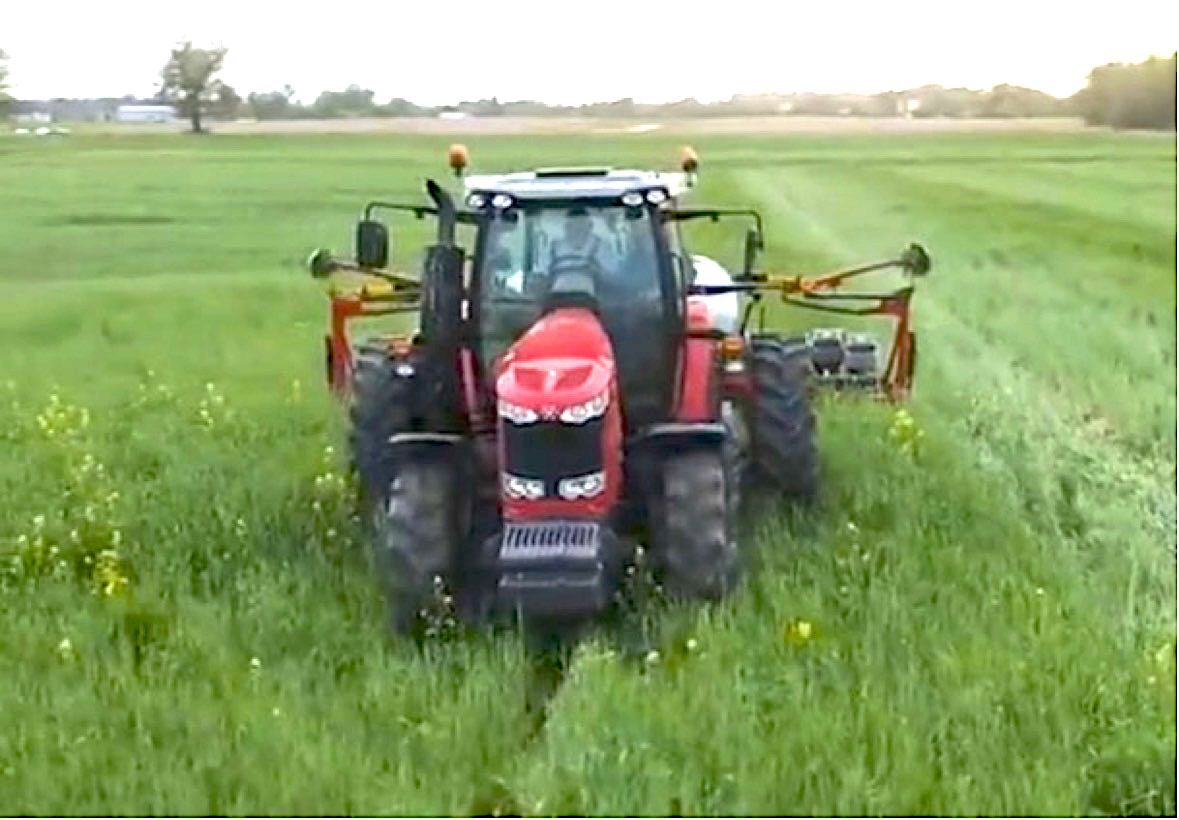
Dave wanted to maximize cover crop benefits for corn, so he planted corn later than most of his neighbors. He typically waited to do corn planting until around May 20, letting the soil warm up. He felt he had less insect pressure, in part because the corn pops up fast in the warmer soil. That fast corn seedling growth helped him reduce potential problems with slugs. He found some slugs in his fields, but the corn grew fast enough to escape major damage, and many of the slugs focused on eating the green cover until it was dead from termination. After corn (and soybean) planting he normally used his 20-foot I&J roller, and tried to do so quickly if conditions were dry. If the soil was damp, he might wait 4-5 days to let the cover crop help dry out the soil, which improved roller performance.
Another aspect of his spring corn management was that he used liquid starter fertilizer at planting time to give a little nitrogen boost to the corn. When the corn was knee-high, he applied a modest amount of additional nitrogen, adjusting based on the amount of legume growth.
Dave said he liked to let his cover crops reach the flowering stage in spring, in part because of all the beneficial insects attracted by the flowering cover crops. He noticed a lot of carabid (ground) beetles eating slugs and armyworm larvae, which he felt had helped reduce problems from those pests.
He discontinued purchasing commodity seed with insecticide treatments in about 2016 (unless it was a variety comparison test plot that had some treated seed). He also avoided buying seed that is fungicide-coated, preferring to avoid impacting the soil fungi. Planting his corn and beans later helped reduce the need for seed treatments.
Dave transitioned to using types of corn and soybeans that took less time to mature, which allowed him to plant his cover crops earlier in the fall. The shorter-season varieties he used were still yielding well, and allowed him to harvest soybeans 7-10 days earlier and corn 4-5 days earlier, despite planting relatively late in the spring.
Observed changes in soil health
Dave indicated that, after many years of no-till and cover cropping, he had significantly built up his soil organic matter, going from 1%-2% on rented ground up to 4%. His home farm, where he’d done these practices for decades, was even higher in organic matter–up to 8% in some locations.
The greater amount of organic matter and improved soil biology allowed him to cut back on the amount of fertilizers he used. He found he could get by without needing to apply phosphorus or potassium to small grains, and applied only a modest top-dress application of 30 pounds of nitrogen per acre on small grains in the spring. He also reduced phosphorus and potassium applications for soybeans and corn. His nitrogen program for corn varied based on legume cover crop growth, but he indicated that he generally used under half the nitrogen that his neighbors did to get a satisfactory corn crop. He liked to use the Haney test to help him determine his NPK rates.
Over the years, Dave noticed more soil organisms that were visible, like earthworms and soil insects, and also saw lab test results show more microbial activity.
A big benefit Dave cited was improved rainfall infiltration rates of up to 6.5 inches per hour. He mentioned how ground he rented that had been conventionally farmed would puddle for 4-5 days after a sizable rain; once those rented acres underwent his three-year, cover-crop-intensive rotation, that puddling started to disappear pretty quickly as rainfall infiltration increases substantially.
Soils on his farm were relatively high in clay content and had relatively shallow topsoil compared to other parts of the Midwest. Most of his fields, eroded from decades of previous conventional farming, had only 4-5 inches of topsoil. On fields where he had done decades of no-till and cover crops, not only was the A horizon darker in color, but he also had better soil structure with highly aggregated soil particles. The improved soils didn’t have compaction issues, and he mentioned how easy it was to put a soil penetrometer in the ground.
In the exceptionally wet spring of 2019, Dave said he was able to plant his farm on his normal schedule in mid-May, whereas most of his neighbors were delayed on planting until June and many of them had to declare some fields prevent-plant (meaning they couldn’t be planted due to prolonged wet weather, so they filed for crop insurance and left the fields idle that year).
Interestingly, Dave said that with the improved soil health on his home farm he hadn’t needed to apply lime since the 1970s, with most fields testing at about 6.9 pH. He felt the cover crops elevate calcium, maybe in part because deep rooting helped pull up calcium from deeper parts of the soil. He was also putting on significantly less nitrogen, which avoided some of the pH-lowering impacts of common forms of nitrogen fertilizer.
Other impacts of his cover crop system
Dave documented that cover crops drastically improved his profitability. He summarized that his system has increased return on investment by 62%-65%. In 2018, he did a careful analysis and found it would take him only 107 bushels of corn per acre to break even due to his modest input costs (including the no-till benefit of having reduced machinery, fuel, and labor costs). He had a very profitable return that year from his corn crop of 192 bushels per acre. That same year, he calculated that his soybeans would only need to make 28 bushels per acre to break even, and his average soybean yield was 72 bushels per acre that year (this was on ground that Dave owns).
In dry years, cover crops really shined on Dave’s farm, providing significantly more soil moisture. In the major drought year of 2012, when many neighbors had very poor yields, he still achieved 185 bushels per acre of corn.
Dave collaborated with university researchers who had used surface runoff flumes to determine that his no-till cover crop approach has greatly reduced loss of nitrogen and other fertilizers from his fields compared to a nearby conventional field.
He also worked with Rafiq Islam, a researcher at Ohio State University, to test the nutrient content of his grain versus that of conventionally produced grain. A number of nutrients tested higher in Dave’s grain, which Islam attributed to the much greater soil health on his farm. They documented higher levels of protein in Dave’s corn and soybeans, allowing him to get a premium from a nearby hog operation using his grain as feed.
When asked for tips he would give farmers who haven’t started using covers, Dave said, “Start out by trying cereal rye seeded after corn harvest, and then plant soybeans the next year. You’ll see a big reduction in erosion and also capture nutrients you would otherwise lose from the field.” Dave added that he found the soybeans yields increased by 5-7 bushels per acre, easily paying the cost of cover crop seed. He believed most farmers could gradually reduce their fertilizer costs as well, cutting back on fertilizer rates by maybe 25% after a few years of cover cropping, depending on their soils and system. He also said farmers using rye will find that their soil tilth improves to the point where the planter will pull more easily through the field. Starting with cover crops can be a good way to transition to no-till, which can provide big savings on diesel fuel, labor, and equipment costs.