Showing 71-80 of 123 results

Farmers: Share Your Thoughts on Cover Crops in the National Cover Crop Survey!

Farmers are invited to share their thoughts on cover crops in an online survey at bit.ly/CoverCrop23. Why do you plant cover crops...or why don't you? What do you want to know? Your insight will help guide research, communications, seed development, and more.

This National Cover Crop Survey is the seventh since 2012 conducted by the USDA-NIFA Sustainable Agriculture Research and Education (SARE) program, Conservation Technology Information Center (CTIC) and the American Seed Trade Association (ASTA), with the help of Informa/Farm Progress.

"Since 2012, the National Cover Crop Survey has been extremely valuable in helping guide research priorities, direct communications and education efforts, provide data to researchers, and illustrate the effects of policy on cover crop use and adoption," says Dr. Rob Myers, regional director of extension programs for North Central SARE and director of the University of Missouri Center for Regenerative Agriculture. "Data from previous surveys have been used in scientific papers, business planning, extension efforts, media coverage of cover crops, and even included in testimony to Congress."

Please take a few minutes to contribute your voice at bit.ly/CoverCrop23. After completing the questionnaire, you may enter a drawing for one of three $100 Visa gift cards.

Posted in 1

The Biggest Asset Is You

Utah State University (USU) Extension professor Josh Dallin had just wrapped up a presentation about livestock before an audience of farmers and ranchers, and he asked if there was any other information his listeners needed. The response was surprisingly out of the ordinary. “One of our largest cattle producers raised his hand and said, ‘I’m worried about my friends and their mental health,’” Dallin recalls. The producer had heard several ranching friends say they had thought about suicide.

The cattle producer’s insights into the personal lives of his friends and neighbors showed the USU Extension staff the need for wider mental health outreach in their county. “We jumped into action,” says Dallin. In the ensuing months they applied for and received a grant from Western SARE’s Professional Development Program. The funds helped them conduct a mental health needs assessment across the state. Informed by the survey results, the Extension staff formed an Ag Wellness Team. Also supported by the grant, the team soon developed a mental health training titled “The Biggest Asset is You.”

The most important asset on your farm or ranch is you. For more information on agriculture and mental health, watch "The Biggest Asset Is You." USU Extension's Ag Wellness website, created in partnership with the Utah Department of Agriculture and Food, provides additional mental health resources for farmers.  

This story is part of a series highlighting SARE projects using innovative strategies to help farmers and ranchers manage rural stress. Visit https://www.sare.org/resources/managing-stress/ for more information.

If you or someone you know is in crisis, please contact the 988 Suicide & Crisis Lifeline.

Posted in 1

Sustaining the Human Spirit in Farm Country

A course in skills-based suicide alertness prepared Ruth Linkenmeyer-Meirick for a desperate call from a friend. “She was going through a divorce, and she was so overcome by grief and sadness it was hard to talk with her,” says Meirick. “Had I not taken the course, I wouldn’t have known what to do.” Meirick was able to ask her friend a difficult but important question: “You’re not thinking about death by suicide, are you?” Her friend replied that she was not, and from there, Meirick listened and offered crisis-intervention suggestions.

Meirick understood how to help her friend because she had recently attended the skills-based suicide-prevention training called safeTALK. The training sessions were adapted to address the unique characteristics of agricultural communities. Through her work as the foundation director of the Minnesota Farm Bureau, Meirick has helped to make similar workshops available to Farm Bureau agents and others throughout the state.

The adapted trainings, called safeTALK: Preventing Suicide in Agricultural Communities, resulted from a multi-pronged Minnesota project titled Trying Times: Tools to Understand and Alleviate Farm Stress. The USDA Sustainable Agriculture Research and Education (SARE) program funded the two-year project. The Minnesota Department of Agriculture (MDA) managed the grant, which involved multiple partners in the public sector and nonprofit community.

The SARE funding permitted project organizers to refine a previously developed workshop called Down on the Farm: Supporting Farmers in Stressful Times. They collaborated with AgCentric, which is part of the Minnesota State college system, to create a curriculum enabling people in and beyond Minnesota to adapt and deliver it themselves.

The refined curriculum is available for download at mnfarmstress.com at no cost, and the MDA encourages users to adapt for their own state, region and audience.

This story is part of a series highlighting SARE projects using innovative strategies to help farmers and ranchers manage stress. Visit https://www.sare.org/resources/managing-stress/ for more information.

Posted in 1

New SARE Video: Managing Weeds in Organic Row Crops

Farmers have long relied on herbicides to control weeds in row cropping systems. But as consumer preferences change, many farmers are seeking to eliminate or reduce their use of synthetic herbicides where possible. Managing weeds without herbicides can be daunting, and it requires producers to understand the biology and behavior of problem weeds in order to develop control strategies that exploit their weaknesses.

In two new videos from SARE, Charlie Johnson shares how he and his family control weeds on 1,600 acres of organic corn and soybeans in Madison S.D. Ecological Weed Management at Johnson Farms and Managing Weeds in Organic Corn and Soybeans are the first in a series of new SARE videos featuring farmers who use various strategies to control weeds without herbicides. 

In Ecological Weed Management at Johnson Farms, Johnson explains how late planting, patience, diversity and a six year crop rotation all play a role in managing weeds on his farm. “There is no such thing as a weed-free organic field, and there’s no such thing as a weed-free farm,” says Johnson. But using alfalfa as a smother crop has largely eliminated Canada thistle, and planting later in the season has allowed him to control early flushes of weeds and to encourage quick emergence that helps corn and beans outcompete weeds.

Managing Weeds in Organic Corn and Soybeans illustrates how a custom rotation leverages diversity to manage weeds. 1,600 acres of corn, soybeans, oats and alfalfa are divided into six equal portions. Oats are planted as a nurse crop, followed by two years of alfalfa hay. Row crops follow, with a year of soybeans followed by corn and then a final year of soybeans. Cover crops, pre- and post-emergence tillage and manual field monitoring helps control weeds throughout the cycle.

All videos in this series may be used with attribution for fair use purposes. Other producers featured in the series include:

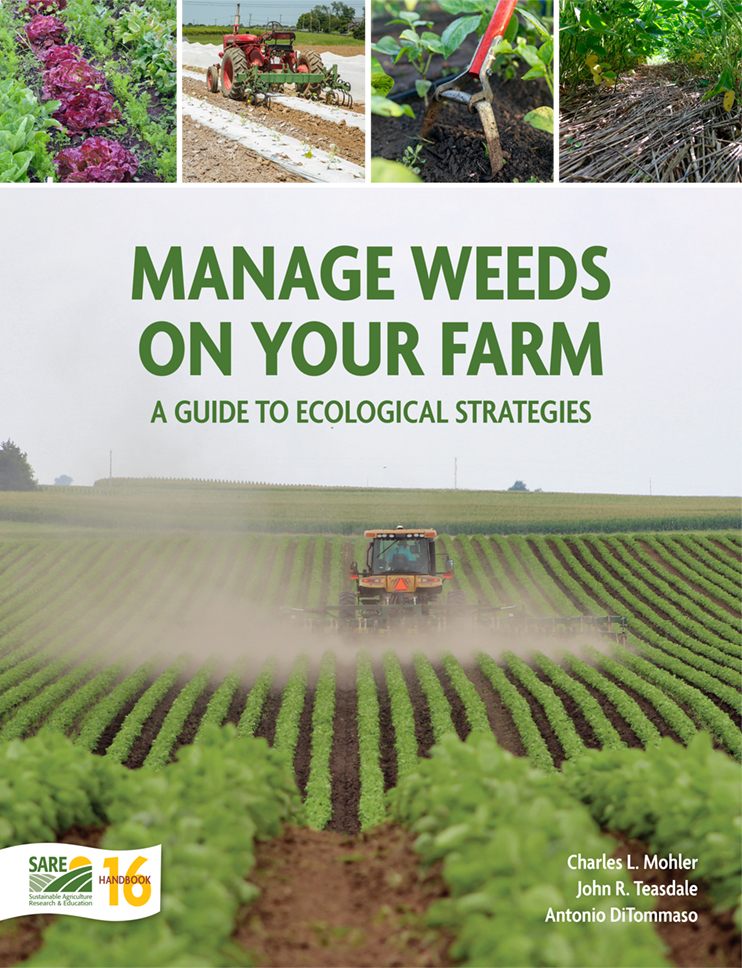
Cover of Manage Weeds on Your Farm featuring a tractor in a field.

The Manage Weeds on Your Farm Video Series is a companion to SARE’s Manage Weeds on Your Farm, a definitive guide to understanding agricultural weeds and how to manage them efficiently, effectively and ecologically. Manage Weeds on Your Farm shows you how to outsmart your weeds by identifying the right tactic for the right weed at the right time, which will reduce as much as possible the labor required, while ensuring your weeds don’t impact crop yields.

Posted in 1

New SARE Bulletin: Transitioning to Organic Production

Since the 1990 Organic Foods Production Act passed, the market for organic products has steadily risen. In 2020, organic sales skyrocketed to an all-time high, motivating many farmers to consider transitioning their farms to organic production. While organic production can help farmers gain access to new markets, improve soil and increase profits, the transition process can be both challenging and risky.

SARE’s newest bulletin, Transitioning to Organic Production, explains how many farmers adopt organic production to increase profits while improving the resilience and environmental impact of their production systems. Long-term success requires patience, flexibility, good record-keeping and a commitment to stewardship. 

Transitioning to Organic Production lays out basic transition strategies for livestock, field crop and horticultural systems, including a summary of the certification process and the National Organic Program standards. Practices common to all organic systems are also addressed, including:

  • crop rotation
  • cover cropping
  • addition of organic fertility sources
  • disease prevention
  • integrated pest and weed management
  • conservation tillage

Transitioning to Organic Production also outlines how these research-based practices, paired with sound transition strategies such as flexible timelines, using alternative labels and coordinating with NRCS programs, can help farmers successfully navigate the transition process. Download or order your free print copy of Transitioning to Organic Production at https://www.sare.org/transition-to-organic or by calling (301) 779–1007. Transitioning to Organic Production is available in quantity for free to educators for use in educational workshops, classes or tours.

Posted in 1

Scaling Up Your Vegetable Farm for Wholesale Markets

With the popularity of local foods spreading to the largest retailers in the country, many producers now see an opportunity to grow their farms by scaling up and expanding to wholesale markets. Selling to the wholesale market can help smaller-scale farmers to connect with more customers to increase brand recognition and profitability.

SARE’s newest bulletin, Scaling Up Your Vegetable Farm for Wholesale Markets, provides a variety of strategies and tools to help owners of small- to mid-scale operations branch out into wholesale markets. 

Scaling Up Your Vegetable Farm for Wholesale Markets features a range of effective strategies for business planning, working with wholesale buyers and increasing production capacity. Producers Shakera and Juan Raygoza of Terra Preta Farm in Edinburg, Texas, share how they scaled up from 1.5 acres of diversified vegetables to growing 15 acres of organic radishes for local wholesale markets. Raygoza says that transitioning to wholesale markets was a “game changer” for the farm and for the surrounding community. 

Specialized crop production, combined with smart investments in equipment, appropriate marketing strategies and improved postharvest handling, can help farmers to scale up to sell their products more efficiently and consistently. In some cases, working together can give producers the opportunity to expand by overcoming barriers that have previously limited access to profitable wholesale markets. 

Download or order your free print copy of Scaling Up Your Vegetable Farm for Wholesale Markets at www.sare.org/wholesale-marketing or by calling (301) 779–1007. Scaling Up Your Vegetable Farm for Wholesale Markets is also available in quantity for free to educators for use in educational workshops, classes or tours.

Posted in 1

The Value of Farming with Community

Shakera and Juan Raygoza talk about why their bonds with local consumers, families, schools, agricultural educators and other farmers are beneficial for both them and for the community where they live and farm. They operate Terra Preta Farm on 15 acres in Edinburg, Texas, where they grow organic radishes for wholesale markets and run a small vegetable CSA. They make an effort to connect with their community through their CSA and farmers' market customers, and by allowing families to visit on weekends, hosting grade school field trips, and collaborating with the local university on a beginning farmer training program.

Posted in 1

SARE Fellows Examine Sustainable Range Management

After a two-year hiatus due to the COVID-19 pandemic, SARE Fellows recently reconvened to examine sustainable practices used in five crop and livestock production systems in Wyoming’s Bighorn Mountains. Guided by Caitlin Youngquist and Jenna Meeks of the Western SARE Professional Development Program (WSARE PDP) team at the University of Wyoming, SARE Fellows examined how Wyoming ranchers use innovative approaches to produce beef, small grains, corn, vegetables and more on Wyoming’s arid landscape.

The first stop located in the red soria hills outside of Buffalo, WY on the eastern side of the Bighorn range, was Merlin Ranch, owned by Mark and Jennie Gordon. There, ranch manager Kevin Rodriguez shared a variety of strategies Merlin Ranch uses to produce high-quality cattle in an environmentally sound manner, including carefully planned rotations and monitoring of range and water resources to help maintain the long-term productivity of the ranch’s  range and forage systems. Merlin’s Black Angus/Hereford cattle herd is continually improved by focusing on  a breeding program that selects for beef production as well as disposition. They also use a short-season sandhills calving strategy to ensure that new calves are born on clean ground to suppress disease and improve health.

After a brisk picnic lunch, Fellows visited Brewster Ranch to conduct the daylong “Reading the Farm” activity where they examined, in depth, the challenges of managing cattle on widely dispersed rangelands on the western slopes of the Bighorn Mountains. Brewster Ranch’s herd of 265 Black Baldy cattle is bred to thrive in rangeland conditions with minimal input. However, low rainfall and poor soil conditions still present the ranchers with challenges. In the fall and winter, the herd is kept  on the ranch on the bottomlands of the Nowood River. When spring arrives, the herd is turned out to higher elevations onto a nearby lease of public range before being trucked 50 miles to spend the summer on privately leased mountain pastures. When snow comes and prevents grazing at higher altitudes, the entire herd is trailed back home to the Nowood River. Following the tour, along with the ranchers, Fellows discussed strategies for managing integrated crop and grazing lands, including the use of goats to reclaim range and using various marketing strategies to diversify income streams.

The next day, Fellows lent a hand weeding and planting at the Worland Community Gardens before heading to Ondo Farms to discuss the challenges those farmers face as they transition to no-till production in sugar beet and corn fields. A short stop at Baker Farms in Thermopolis, Wyoming, illustrated a successful transition to no-till grain production systems despite ongoing pressures from weeds brought onto the farm via irrigation waters.

The last day of the tour featured a stop at Legend Rocks Petroglyphs Site followed by a visit to the Arapaho Ranch, a 300,000-acre grassfed beef operation on the Wind River Reservation. There, Fellows learned about the tribe’s efforts to establish a high-quality, sustainable ranch management program within the context of Native American values and experiences. During a reflection period at the conclusion of the tour, one Fellow remarked: “I really appreciated the opportunity to visit and then break bread with our hosts. It really provided an opportunity to ask questions and learn in a more comfortable setting.”

The SARE Fellows program enhances understanding of sustainable agriculture through broad-based training and immersive educational experience to successful and unique sustainable agriculture operations. SARE Fellows receive support to participate in a two-year experiential training program that highlights innovative production systems nationwide. Interested in becoming a SARE Fellow? Visit https://www.sare.org/fellows for more information.
Posted in 1

Reaching Women in Agriculture: A Guide to Virtual Engagement

With the increasing number of women farmland owners and operators, many extension professionals and agriculture service providers have come to recognize the value of offering women-centered outreach and networking. Women-focused events establish a comfortable space that helps many woman-identifying individuals access resources, information and networking in the agricultural services world that they may not have ready access to otherwise.

SARE’s newest bulletin, Reaching Women in Agriculture: A Guide to Virtual Engagement, outlines a range of strategies and tools to help educators who have prior experience conducting in-person educational activities adapt their programming for online and hybrid spaces.

Reaching Women in Agriculture features a number of effective strategies for planning, hosting and evaluating online events. Created in partnership with the American Farmland Trust (AFT) and University of Vermont Extension, the bulletin “was born out of AFT’s Women for the Land initiative and the Learning Circle model, which arose out of early partnerships with the Women Food and Agriculture Network,” said Gabrielle Roesch-McNally, PhD, guide author and AFT Women for the Land director. 

Experienced presenters, paired with well managed learning circles, breakout sessions, videos, chat and polling can help educators better capture and hold learners’ attentions. Encouraging participants to work together to solve real-life problems can assist learners in developing practical skills that can be applied in their own operations. The guide also encourages educators to use an equity lens to overcome barriers associated with online learning that may exclude some farmers and ranchers from participation.

Download or order your free print copy of Reaching Women in Agriculture: A Guide to Virtual Engagement at https://www.sare.org/reaching-women or by calling (301) 779–1007. Reaching Women in Agriculture: A Guide to Virtual Engagement is available in quantity for free to educators for use in educational workshops, classes or tours.

Posted in 1

Farmer-Focused Innovations Funded by SARE

“Institutionalized food is the forgotten part of the food revolution,” says Ann Swanson, talking about the lack of fresh produce available from local institutions in her community of Champaign–Urbana, IL. Inspired, Swanson used a SARE Farmer/Rancher grant to create new opportunities for local farmers, launch a series of educational classes and expand institutional capacity to serve healthier food.

SARE’s 2021–2022 Report from the Field shows how Ann Swanson and other SARE grantees are shaping the future of American agriculture.

Swanson is farm director at Hendrick House, a business that provides catering services for the University of Illinois Urbana-Champaign. Through her work, she identified a lack of knowledge about healthy food systems as a barrier to institutional use of locally sourced produce. 

Teaming up with local nonprofits and schools, Swanson used her SARE grant to launch a series of classes to teach local youth where their food comes from and how to make healthy food choices. Swanson also held workshops for food service staff highlighting how to use, store, and prepare local and seasonal foods.

The grant allowed Swanson to make significant strides to improve the access of healthy and local food in her community. Hendrick House has doubled its food purchases from local farms and expanded service to a community college and medical center. “We hope to make a change in institutionalized food that will be ongoing beyond the scope of this grant,” says Swanson.

Other stories in Report from the Field that demonstrate how SARE grantees are improving the sustainability of U.S. agriculture include:

Download or order your free print copy of 2021–2022 Report from the Field at https://sare.org/report or by calling (301) 779-1007. 2021–2022 Report from the Field is available in quantity for free to educators for use in educational workshops, classes or tours.

Posted in 1