Showing 1-10 of 119 results

New Video: Learn And Adapt As You Go 

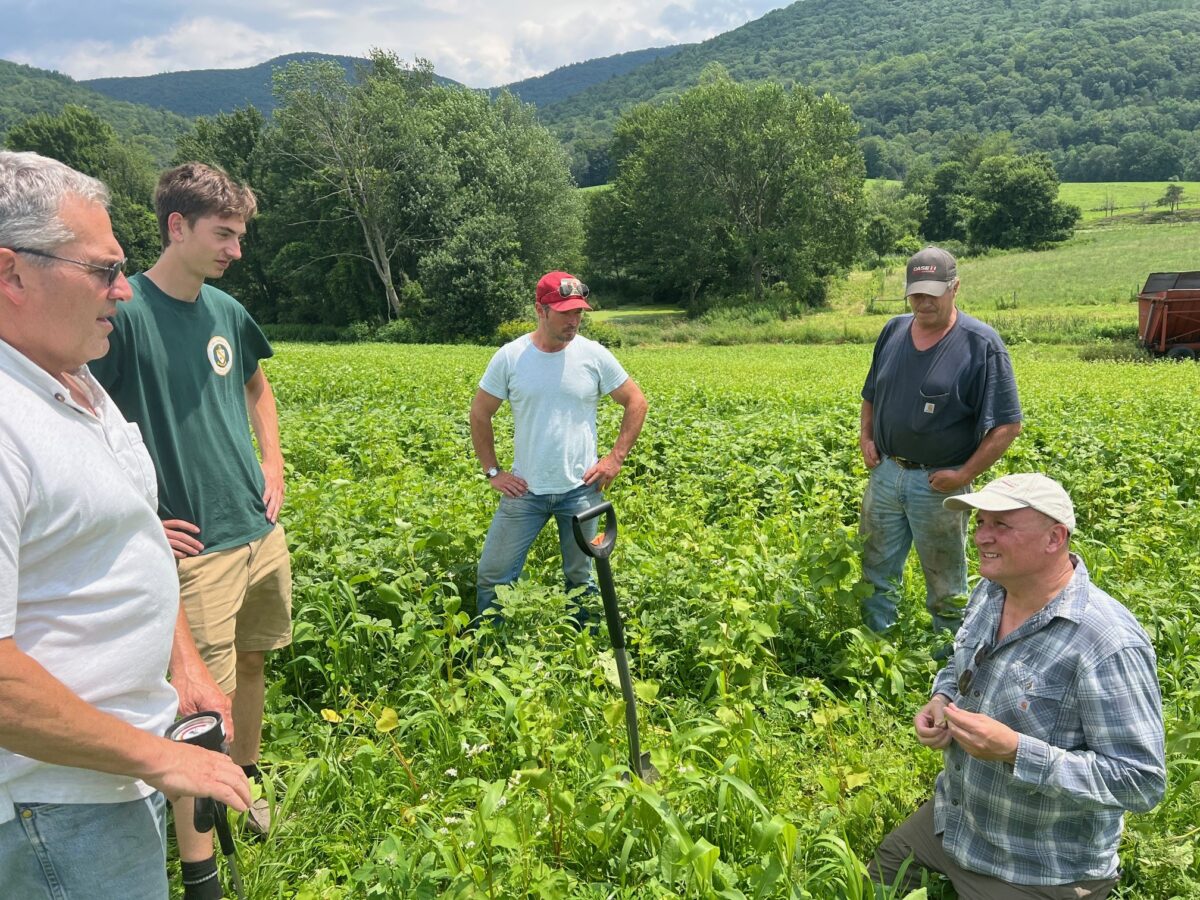
Heather and Alby Brandon know that raising nearly 20 acres of mixed fruit and vegetable crops requires constant experimentation and evolution. On their family farm in West Kingston, R.I., the Brandons have learned to adapt year after year to grow their business successfully.

Over time, they’ve found that starting small and scaling up carefully helps them manage risk and respond to what works best in their fields. “It’s just trial and error. You have to try different things,” says Heather. “It’s an ongoing process,” adds Alby. “Every year feels easier. We get more done, it feels like we’re more on top of the weeds, the harvests, and everything else.”

Every year brings something new – changing weather, evolving pests, and other unexpected challenges. That’s why the Brandons value connecting with other nearby farmers and working together to share equipment and production strategies. 

They advise younger farmers to work with more experienced growers to learn the ins and outs of the business, because taking advice from other farmers is much more efficient than figuring everything out on your own. “I think it’s very important that you work…at least five to 10 years with a much more experienced grower,” says Alby. 

This video is one in a series produced by SARE titled Practical Tips for Beginning Farmers. Based on their own experiences when starting out, farmers from across the country share advice about common challenges facing beginning farmers in today's agriculture. To view the entire series, visit www.sare.org/resources/practical-tips-for-beginning-farmers/.

For information on grants and resources available from SARE, visit www.sare.org.

Posted in 1

New SARE Video: Build Strong Networks 

At HKJ Ranch in Cobbtown, Ga., fourth-generation cattle farmer Handy Kennedy knows firsthand how critical it is to reach out for support, especially in today’s complex and rapidly changing agricultural landscape.

“If I had one piece of advice for beginning farmers it would be, do not try to go at this alone,” says Kennedy.

Facing the challenge of raising lower-risk, value-added cattle, Kennedy turned to Fort Valley State University Extension and University of Georgia Extension. With help from their livestock specialists, Kennedy developed a stronger herd using better forage, genetic, and risk management strategies—allowing his ranch to demand more from its cattle and stay competitive.

Kennedy also sought guidance from the USDA Natural Resources Conservation Service and the USDA Farm Service Agency. “There is help out there and you must tap into that help,” he says. “That is the only way you can stay sustainable and comfortable in today’s agriculture world.”

HKJ Ranch now pays it forward by mentoring beginning farmers, helping them create business plans and refine marketing strategies to turn their visions into demand-driven, profitable operations. 

This video is one in a series produced by SARE titled Practical Tips for Beginning Farmers. Based on their own experiences when starting out, farmers from across the country share advice about common challenges facing beginning farmers in today's agriculture. To view the entire series, visit www.sare.org/resources/practical-tips-for-beginning-farmers/.

For information on grants and resources available from SARE, visit www.sare.org.

Posted in 1

Biofumigants for Sustainable Soilborne Disease Management in Nursery Production

In Tennessee, innovative research into biofumigant cover cropping practices has provided nursery producers with new options for managing diseases while reducing workers’ exposure to chemicals.

Fulya Baysal-Gurel of Tennessee State University (TSU) led the study at the Otis Floyd Nursery Research Center, working in partnership with nursery producers and graduate students. With support from a Southern SARE Partnership Grant, the project investigated the efficacy of using brassica cover crops as a biofumigant to suppress Phytophthora root and crown rot in boxwood production. The team conducted research both in controlled university settings and in on-farm trials, where the biofumigation practice successfully reduced disease severity in treated plots compared to untreated areas.

“We conducted on-farm trials in two nursery growers’ fields where they had the problem in their production. We inserted this rotation program into 10-acre areas, and at the end of our study, we were able to suppress soilborne disease severity by over 50% on the treated plots compared to non-use areas,” said Baysal-Gurel.

TSU’s outreach efforts extended the results to nursery industry associations, peer-reviewed publications, and sustainable agriculture conferences. These engagements strengthened networks between researchers and producers, fostering further collaboration on sustainability initiatives.

The project demonstrated great promise for having major impacts on environmental, economic and social sustainability. Adoption of biofumigant cover cropping by Tennessee nursery growers has the potential to reduce their reliance on chemical fungicides and improve soil health, but additional research is needed first.

“We are seeing the impact on the disease severity, but many questions come with that,” said Baysal-Gurel. “Growers see the efficacy but are questioning me about the economic cost and compatibility with their production practices.”

Visit https://www.sare.org/sare-impacts-OS18-112 for more information on this project's impact.

For more information, see “Biofumigation: Opportunities and Challenges for Control of Soilborne Diseases in Nursery Production.

Biofumigants for Sustainable Soil-borne Disease Management in Nursery Production is part of a series produced by Insight for Action as part of a post-project evaluation of SARE's regional grant programs. For more information visit https://www.sare.org/sare-impacts.

For information on grants and resources available from SARE, visit www.sare.org.

Posted in 1

Fish in the Fields: Increasing the Sustainability of Rice Farming Practices

University of Arkansas researchers are partnering with rice farmers in Arkansas to explore whether co-cultivating fish in flooded rice fields can reduce methane emissions and create an additional income source for growers. Supported by a $30,000 On-Farm Research Grant from Southern SARE, the three-year project tests whether adding fish to flooded rice fields during the winter fallow period can improve environmental and economic outcomes.

The project builds on work by the Resource Renewal Institute (RRI) in California, where initial “fish in the fields” trials demonstrated that integrating fish into rice paddies has the potential to reduce methane emissions by up to two-thirds. The University of Arkansas research team, led by bioengineer Benjamin Runkle, examined the use of the practice on large-scale rice systems in the largest rice producing state in the United States, introducing golden shiners as the test species.

While most research has focused on methane released during the summer growing season, winter emissions remain less studied. In Arkansas, nearly 30 percent of rice acreage remains flooded in the winter for ecological benefits, such as supporting migratory waterfowl. However, according to Sam Carroll, a graduate student who participated in the project, these flooded conditions can increase methane emissions by as much as 45 percent compared to non-flooded fields.

Researchers hope that introducing fish will lower emissions by disrupting the methane-producing cycle in flooded soils. Early results indicate that winter-flooded rice fields have the capacity to produce healthy fish biomass and may decrease methane emissions during the flooded period. But more work needs to be done to attribute those changes to the presence of the fish. Fish mortality, variable field conditions, and limited replication made it challenging to isolate the effect of fish presence. Nonetheless, overall methane levels during the winter period were significantly lower than during the summer, and lower than those recorded in comparable studies.

For more information, see Fish in the Fields Program Implementation Guide.

Posted in 1

New Video: Navigate Multigenerational Farming With Communication

Working a farm with family can be a gift, and ownership transfer to successive generations requires intentional communication and understanding. At Flat Rock Dairy in Paulding, Ohio, dairy farmer Gretl Schlatter knows just how rewarding and complicated it can be to effectively manage a family business.

“Farming is a great blessing and full of challenges,” says Schlatter, who returned to her family’s farm in 2009 and now manages it with her father and siblings. Like many farmers, she grew up on the farm and knew from a young age she wanted to continue to be part of it. But working across generations means striking a balance between wisdom with enthusiasm.

Schlatter encourages young farmers to respect the invaluable experience of older family members and not to get discouraged or give up if new ideas aren’t immediately accepted. She says it’s important for older generations to feel proud of what they’ve built and the opportunity they've provided for others without feeling threatened by change. Success, she’s learned, comes from treating family like business partners. "If you do need to bring in a mediator or third party to help you through that, your business is worth fighting for," says Schlatter.

This video is one in a series produced by SARE titled Practical Tips for Beginning Farmers. Based on their own experiences when starting out, farmers from across the country share advice about common challenges facing beginning farmers in today's agriculture. To view the entire series, visit www.sare.org/resources/practical-tips-for-beginning-farmers/.

For information on grants and resources available from SARE, visit www.sare.org.

Posted in 1

New Video: Leverage Public Programs for Land and Support

Many beginning farmers find buying land a challenge when they first start their business. At Brandon Family Farm in West Kingston, R.I., Alby and Heather Brandon discuss how public programs and creative partnerships can help grow a thriving business.

“You definitely don’t need to own land to start a farm business,” says Alby Brandon, who began by leasing fields before taking the leap into ownership. With farmland scarce and expensive in Rhode Island, the Brandons reached out to a local land trust, which connected them with a hobby farming couple willing to share fields and equipment. “They helped me prepare the land the first year I started the farm,” Alby recalls about the partnership that helped them grow from one acre to three, then 10.

As the farm expanded, the Brandons turned to the Rhode Island Department of Environmental Management’s Farmland Access Program to buy their own land through a “buy, protect, sell” model that made ownership affordable. They also took advantage of Farm Service Agency microloans and Natural Resources Conservation Service programs, including high tunnel cost shares and cover cropping incentives to start and maintain their business. They encourage other farmers to do the same. “There’s a lot of opportunities out there for access to capital and to…build a farm business,” says Alby. “It’s waiting there for you.”

This video is one in a series produced by SARE titled Practical Tips for Beginning Farmers. Based on their own experiences when starting out, farmers from across the country share advice about common challenges facing beginning farmers in today's agriculture. To view the entire series, visit www.sare.org/resources/practical-tips-for-beginning-farmers/.

For information on grants and resources available from SARE, visit www.sare.org.

Posted in 1

New from SARE: Farmer-to-Farmer Manuals on Specialty Crop Production, Harvest and Storage in the Northeast

Farmers know that producing and marketing high-quality crops requires careful attention to detail, from planting through storage. Now available from SARE, the Northeast Crop Production Manual  and Northeast Harvest Manual are user-friendly guides offering step-by-step information on growing, harvesting and handling dozens of specialty crops, from arugula to watermelons. Developed by farmers themselves, these guides are ideal reference materials for beginning farmers, apprentices and crews based on years of on-the-ground experience. 

The Northeast Crop Production Manual covers soil preparation, planting and transplanting, pest management, and more. The Northeast Harvest Manual addresses harvest timing, best practices for picking, and post-harvest handling and storage guidelines.

These guides were originally written by New York farmer Jean-Paul Courtens to provide instructions to his own crews and apprentices on how to grow and handle crops on his farm. Seeing the popularity of the manuals with his peers, he used a Northeast SARE grant in 2020 to refine and broaden the information in them by incorporating insights from 60 other growers in the Northeast and Midwest, plus vegetable specialists from Cornell Cooperative Extension. (Learn more about the history of the guides in the letter from the author.)

To increase access to these valuable farmer-to-farmer resources, SARE is now pleased to make them available in both online and PDF formats on our website. Download or browse both the Northeast Crop Production Manual and Northeast Harvest Manual at https://www.sare.org/resources/northeast-crop-production-harvest-manual/.

Posted in 1

New SARE Video: Use Data to Drive Decision Making

For Handy Kennedy of HKJ Ranch in Cobbtown, Ga., sound data management was key to generational succession on his 200-head cattle operation. After taking over his family’s pasture-based operation after his father’s death, Kennedy set out to modernize their business by using data to make decisions about the efficiency and profitability of new technologies.

At first, bringing new ideas into a legacy family operation wasn’t easy. But Kennedy began small—testing pasture nutrient management strategies on limited acreage to better understand their impact on input costs.

He advises beginning farmers to experiment with new technologies and examine the resulting data to make informed business decisions. “Data-driven decisions will give you the competitive edge,” says Kennedy.

That gradual, practical approach has paid off on his own farm. Over time, his family has adopted many new tools and methods, enabling the ranch to operate more sustainably and efficiently. He also urges new farmers to be ready to adapt. “Yesterday’s best is today’s average,” he says. “We have to continue to get better.” 

This video is one in a series produced by SARE titled Practical Tips for Beginning Farmers. Based on their own experiences when starting out, farmers from across the country share advice about common challenges facing beginning farmers in today's agriculture. To view the entire series, visit www.sare.org/resources/practical-tips-for-beginning-farmers/.

For information on grants and resources available from SARE, visit www.sare.org.

Posted in 1

New Video: Create a Business Plan and Grow Intentionally 

Running a farm isn’t just about getting through the day—it’s about building a business model that can adapt and thrive for decades. At Flat Rock Dairy in Paulding, Ohio, Gretl Schlatter has seen her operation grow from 80 cows to 350. But she’s quick to point out that growth alone isn’t the goal. She emphasizes the importance of calculated growth and smart technology adoption to provide her operation with the resilience it needs to remain competitive as the industry evolves.

Each phase of farming brings unique challenges that require flexibility and a long-term perspective. “I don’t know that it was harder during the early years than it is today,” says Schlatter. In the beginning, farmers learn to adapt to the disappointment of interrupted plans due to unexpected market shifts—and those skills remain essential as the farm grows.

When deciding whether to scale up, or how, by making appropriate investments in labor, technology or facilities, Schlatter encourages farmers to ask hard questions about sustainability, relevance, and the expected return on chosen investment. Through training offered by Ohio State University Extension, she’s found valuable opportunities that helped her and others make decisions that strengthen their operations and weather tough seasons.

With thoughtful planning, responsible financial management, and a willingness to grow with intention, farmers can position their businesses to succeed for years to come.

This video is one in a series produced by SARE titled Practical Tips for Beginning Farmers. Based on their own experiences when starting out, farmers from across the country share advice about common challenges facing beginning farmers in today's agriculture. To view the entire series, visit www.sare.org/resources/practical-tips-for-beginning-farmers/.

For information on grants and resources available from SARE, visit www.sare.org.

Posted in 1

Advancing Walnut Syrup Production for Increased Profitability and Farm Income Diversification

In West Virginia, pioneering research into black walnut syrup production is creating new opportunities for landowners, strengthening community networks, and expanding the syrup industry by exploring new value-added agricultural products for forested rural economies.

Researchers at Future Generations University (FGU), led by Michael Rechlin and Sarah Collins-Simmons, collaborated with landowners and technical partners to develop innovations that improve the efficiency and feasibility of walnut syrup production. With support from a Northeast SARE Partnership Grant, the team refined walnut sap collection methods, enhanced sap flow using vacuum lines, and designed specialized tapping spouts to reduce tree impact. They also developed a small-scale sap evaporator to minimize barriers for new producers.

The project successfully increased the potential for environmental, economic, and social sustainability impacts in West Virginia’s agriculture, as well as production efficiency. The advancements from this research team encouraged landowners to explore black walnut syrup as a profitable non-timber product, opening opportunities for boosting rural incomes and providing an alternative to traditional crops.

"Walnut syrup is truly a novel product commercially," said Collins-Simmons. "We feel that we were part of the initial wave of taking it to the next step, making a commercially viable product and assessing market value…with the partner producers we worked with."

A man standing in front of a tree holding the tree thunk that has different color wires attached to it
Mike Rechlin (FGU maple research professor) showing a tapped walnut tree with a pressure gauge on one tap as part of field testing. Credit: Thomas Vandevander,

FGU’s outreach efforts extended to connecting producers with state resources, offering technical consultations, and supporting agrotourism initiatives. These efforts helped strengthen a resilient network of producers who now serve as ambassadors for this emerging market.

Visit https://www.sare.org/sare-impacts-ONE19-347 for more information on this project's impact.

Advancing Walnut Syrup Production for Increased Profitability and Farm Income Diversification is part of a series produced by Insight for Action as part of a post-project evaluation of SARE's regional grant programs. For more information visit https://www.sare.org/sare-impacts.

For information on grants and resources available from SARE, visit www.sare.org.

Posted in 1