Showing 121-125 of 125 results

Cutting Edge Research: Helping Bees Help Themselves

Diseases, pests and the mysterious phenomenon of colony collapse disorder pose a dire threat to the U.S. beekeeping industry and, in turn, to the $20-billion-a-year crop industry that relies on insect pollination. Because of these increasing pressures, the ranks of managed bee colonies have plummeted in recent years: On average, beekeepers are losing 30 percent of their colonies every growing season.

While the exact cause of colony collapse disorder is unknown, researchers believe it to be the result of a combination of factors, one of which is the Varroa destructor (V. destructor) mite, a pest introduced to the country in the late 1980s. V. destructor, difficult to control because it has become pesticide resistant, attacks bees by sucking their blood, thus spreading viruses among colonies and weakening individual bees, making them susceptible to pesticides not intended to harm them.

Rather than relying on pesticides and antibiotics to control V. destructor and related diseases—a method that has become part of the problem—University of Minnesota Entomologist Marla Spivak is advancing effective strategies that help bees help themselves.

Spivak and her team have received six SARE grants since 1997 to support their work showing beekeepers how to identify and breed for hygienic bees—bees that are adept at spotting infected immature bees (larvae and pupae) and quickly removing them from the nest before a disease or pest can get out of control in a colony. “We mostly research ways for bees to keep themselves healthy, using their own natural defenses so we can avoid chemical inputs,” Spivak says.

Their research—now supported by a $500,000 MacArthur Foundation “genius” grant—has demonstrated that colonies bred for hygienic behavior have good resistance to chalkbrood and American foulbrood diseases, and partial resistance to V. destructor. Over time, the establishment of disease-resistant bees has the potential to save commercial-scale beekeepers thousands of dollars each year in treatment costs while reducing the environmental impact of pesticide use.

Spivak’s SARE-funded research also includes innovative sampling strategies for beekeepers to determine the extent of an infection in a colony, and therefore how much of a treatment might be needed.

After helping three commercial-scale beekeepers in Minnesota establish hygienic disease resistance in their colonies, Spivak and her team are now working closely with some of the country’s largest bee breeders to adopt the sustainable pest management strategies that make sense for them, including breeding and sampling strategies. Many of the breeders with whom they are collaborating sell queen bees throughout the country, giving Spivak’s team the opportunity to have widespread impact.

“We need genetically diverse bees,” Spivak says. “That is the impetus for me to work with bee breeders to help them select for hygienic behavior from among their genetically diverse, and tried-and-true lines of commercial bees.”

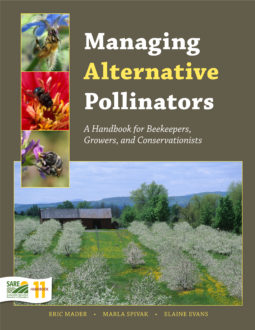
While much of Spivak’s research focuses on the European-imported honey bee—the primary victim of colony collapse disorder—she and her colleagues have also turned their attention to the wide range of native bee species that are also embattled, yet serve an important role in crop pollination. In 2010, Spivak co-authored and SARE published Managing Alternative Pollinators, a first-of-its-kind technical guide for rearing and managing key alternative species.

Posted in 1

The Lucrative Sweet Potato Takes Root

Small-scale tobacco farmers in eastern Kentucky who are looking for alternatives due to changes in the tobacco market are discovering that a relatively easy, often profitable transition lies in sweet potatoes. With relatively low input and capital costs and a short learning curve, they are able to earn gross returns of up to $7,000 per acre, mostly through local sales.

“Sweet potatoes are a pretty good alternative, at least for our growers, because a lot of the equipment they used for tobacco can be used for sweet potatoes, particularly the transplanters. So they don’t have to buy a lot of new equipment,” says University of Kentucky Extension Vegetable Specialist Tim Coolong. “Economically, it’s been very good for them.”

Coolong received a 2009 SARE grant to research and demonstrate sweet potato growing on several farms and has helped about 15 farmers—most, but not all former tobacco producers—grow the highly nutritious vegetable.

Meanwhile, in Mississippi—the country’s third largest producer of sweet potatoes—SARE-funded research helps the state’s growers adopt sustainable practices and cash in on organic sales by showing them how they can better manage their soil with cover crops and conservation tillage.

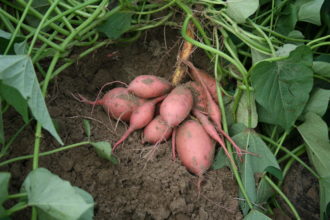
Harvested sweet potatoes on the ground

Only one grower in Mississippi currently produces organic sweet potatoes, yet organic can fetch a premium at fresh markets and through sales to processors, particularly for baby food, says Mississippi State University researcher Ramon Arancibia. “Companies like Gerber don’t want pesticides, or even a lot of fertilizers.”

Working with three farmers around Vardaman, Miss., and others in Arkansas, Arancibia’s trials found that an organically grown crop suffered far less pest damage than a conventionally grown one. In addition, he focused on showing the soil building qualities of cover crops. “Sweet potatoes are root vegetables, so they need a very healthy soil. Also, the soil structure needs to be very good so the potatoes can grow in a nice shape,” Arancibia says, referring to cover crops’ ability to improve organic matter and loosen hard-packed soils.

To help get the word out, Arancibia is sharing his findings with the 104-member Mississippi Sweet Potato Council, which represents nearly all the state’s growers. One farmer who collaborated with Arancibia is planning to plant a brassica cover crop on 50 acres next season, to see if it will combat nematodes.

Back in Kentucky, Coolong’s on-farm trials showed that aside from using pesticides to control wireworm damage, sweet potatoes require few inputs—and some growers are, in fact, pesticide free. Sweet potatoes have low nitrogen needs, and, in eastern Kentucky, do not require irrigation except in the case of extreme drought.

“There are a lot of nuances with sweet-potato production that this grant really allowed us to look at,” says Coolong, whose work translated into a detailed handbook and the formation of a regional grower’s association.

Two areas that require more work, he says, are establishing overwinter storage facilities and production of slips—the sprouts that come off a potato and turn into new plants. Slips are not grown locally and are expensive to buy from out of state, so showing local growers how to produce their own represents another opportunity.

Download Sweetpotato Production for Kentucky, a 16-page comprehensive guide on all aspects of growing and marketing sweet potatoes.

Posted in 1

Low-Till Forage Production

To fill their need for year-round, inexpensive forages, California dairy producers typically plant and harvest a series of forage crops: small grains, corn for silage, milo and sorghum sudan.

While this requires considerable tillage and seed-bed preparation ahead of each successive crop, the production systems lend themselves to conservation tillage approaches developed in other regions. Adopting these approaches could:

  • Reduce the time between the harvest of one crop and the planting of the next
  • Lower costs
  • Lessen dust by as much as two-thirds

To address these issues, Jeff Mitchell of the University of California Kearny Agricultural Center, was awarded a Western SARE Professional + Producer Grant for $9,400 to evaluate and refine strip-till and no-till planting systems for corn forage production and no-till drill winter forage planting at the San Joaquin Valley in terms of crop establishment, weed control and profitability (Conservation Tillage Forage Production in California‘s San Joaquin Valley, FW06-308).

The work, conducted on the Larry and Daniel Soares dairy in Hanford, also sought to determine whether conservation tillage practices could enhance the quality of life of dairy producers as measured by profitability and the easing of time and labor requirements.

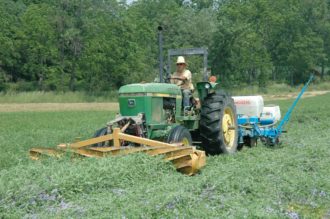
The project team evaluated strip-till silage corn production following wheat for-age at the 600-cow dairy. In 2006, the trials evaluated conventional, no-till and strip-till in replicated strips, each 10 acres, in an 80-acre field. After the 2005–06 winter wheat forage crop was chopped in April 2006, a 6-row 30-inch Case DMI Ecolo-Till strip-tiller was used to subsoil to 12 inches and clear soil for planting. The traditional tillage strips were disked and listed before planting.

In 2007, because of irrigation pump challenges, the demonstration was moved to two fields, where an 8-row 30-inch Schlagel strip-tiller was used for the strip-till comparison.

The results for 2006 were compromised by irrigation challenges, but in the 2007 demonstration, corn plant populations were higher in the strip-tilled fields, and weed populations and yields were roughly equal in both fields.

On the whole, said Mitchell, the results were positive and encouraging.

Indeed, since the project started in 2005, interest in conservation tillage has increased markedly in the San Joaquin Valley. Growers have learned that strip-tillage involves less intercrop tillage than normally employed following winter wheat chopping in preparation for spring corn silage planting.

By converting to strip-tillage, a typical dairy producer could eliminate four to five tractor passes. With high fuel costs, fewer passes across the field are better not only for the field but also for the dairy producer.

It has also been shown that strip-tillage and no-tillage for forage production can reduce particulate matter emissions by 50-90% compared with traditional tillage.

“We estimate a reduction in costs of $50 an acre by using strip-tillage instead of traditional tillage,” said Mitchell. “However, it is important to understand that strip-tillage may not work in all soil types; heavier soils may be more difficult than coarser soils.”

Mitchell offers these thoughts for producers considering strip-tillage:

  • When strip-tilling, having some moisture in the soil precludes bringing up large clods
  • Timely weed management is needed – time herbicide applications close to planting (within a week)
  • Using the same GPS system for both the strip-tilling and planting operations will keep the planter on the strip-tilled area

Improved strip-tilling could enable triple-cropping—the sequential growing of three crops in a year—which could help San Joaquin dairy producers manage manure nitrogen with minimal risk of losses. Mitchell is currently assessing this in a Western SARE Research and Education Grant, Triple-Cropping Dairy Forage Production Systems through Conservation Tillage in California‘s San Joaquin Valley (SW08-060).

Posted in 1

Rural Revitalization through Farm-Based Enterprise

The 10 U.S. counties with the greatest population losses between 2000 and 2003 are located in the western United States, and small towns are scrambling to save what is left of their communities. Like many other parts of the nation, western farmers are discovering that sustainably raised livestock and crops can help revitalize economies. And these farmers have an ally, John Allen, whose life's work is helping farmers develop the skills needed to build businesses that benefit the farm and also the surrounding community.

Allen, who works with the Western Rural Development Center at Utah State University, says the trick is to focus on farm-based businesses that produce and hire locally. "It's the multiplier effect. When I started in this business 20 years ago, if you spent one dollar in your community, it would get used two or three times around in the same town. But now, where everything is owned externally, the money goes straight to the shareholders, who live outside the community."

Allen founded the NebraskaEDGE program in 1993 at the University of Nebraska, Lincoln. The program has helped thousands of people explore business opportunities. In 2000, Allen and NebraskaEDGE Associate Director Marilyn Schlake - both SARE grant recipients - led a team effort to develop what is now considered one of the important national training programs for agricultural producers, Tilling the Soil of Opportunity: NxLeveL Guide for Agricultural Entrepreneurs. The course has been offered across 20 states at universities, small business development centers, and other educational facilities. More than 50 percent of the participants complete the course with a business plan.

Tim Nissen, born and raised in Cedar County, Neb., was one farmer who took the course. Industrial agriculture was squeezing his business and he needed to make changes. Tim enrolled in the 12-week intensive Tilling the Soil program, which opened his eyes to the potential of small-scale farming. In 2003, he turned his life around by opening a vineyard with his brother Dave in the grassy hills of Bow Valley.

Today, Westphalia Vineyards offers five varietals, one made with native wild plum. Nearly 60 percent of the customer base comes from outside the area.

Allen continues to find innovative ways to help rural communities, but now he is using SARE funds to develop workshops for western farmers and ranchers. By providing technical training in processing, packaging and labeling their products, along with Internet marketing strategies, Allen continues to help grow rural businesses and maintain rural communities.

"Our project draws upon SARE's historical values of matching farmers with educators. But this time we are moving into new territory by helping farmers break into the Internet and retail markets. That's the innovation."

Posted in 1

Farmer/Researcher Team Makes Organic Peanut Breakthrough

In 2007, Georgia organic grower Relinda Walker produced a historic crop of peanuts. The bounty—6,000 pounds grown on two acres—was significant because it represented the first crop of certified organic peanuts raised in the Southeast. Even though the Southeast produces 79 percent of the country’s peanuts, more than 99 percent of organic varieties are raised in Southwestern states.

Recognizing that Southeastern growers are missing out on a lucrative market, Mark Boudreau of Hebert Green Agroecology in Asheville, N.C., assembled a team of researchers and growers, including Walker, to focus on carving out an organic peanut industry for the region.

“The demand is high, and the price is premium,” says Boudreau, whose work has been funded by two SARE grants. “Most processers pay twice as much for organic peanuts, and I’ve seen it as high as five times as much.”

Since beginning their multi-state research in 2005, the team has made important strides toward overcoming the weed, disease and insect problems associated with organic peanuts. They are problems farmers do not generally face in the Southwest, where the climate is drier.

In its first three years of trials, the group found it could significantly reduce insect problems and post-emergence diseases. But weeds, seed rot and poor stand development have emerged as persistent problems, according to Boudreau. They are caused primarily by the region’s wet growing conditions, a short planting window and a lack of the right seeds. “If your peanuts aren’t up and running quickly, then they aren’t going to compete with the weeds,” he says.

Boudreau’s team is now focused on determining what organic seed treatments and planting conditions are ideal for rapid early growth and stand establishment, as well as outlining successful weed management strategies. The team includes agronomists, plant pathologists, weed scientists and others based in Georgia, North Carolina and South Carolina.

Along with building up a strong stand, cultivating with a tine weeder is emerging as the best weed-control strategy, according to Carroll Johnson, a USDA Agricultural Research Service weed scientist involved with the project.

Another major hurdle involves the lack of regional infrastructure to handle a large organic crop. For example, there are no organic peanut shellers in the Southeast.

When enough conventional and smallscale growers begin to appreciate the economic value of a local organic industry, then many infrastructure issues will get resolved, says Carroll. “I think there’s a lot interest in this. I think a lot of farmers want this to work.”

Boudreau admits that establishing an organic peanut industry in the Southeast will take more time, but he feels growers and researchers are on the right track. “We have a lot of information we can give farmers about what the problems are going to be and the best ways of tackling them.”

Posted in 1