Showing 1-10 of 90 results

Using an Alternative Feed to Bring Stability in the Face of Drought and Rising Costs

Since 1988, SARE has funded over 10,000 farmer-focused grants to improve the sustainability of U.S. agriculture. In the last five years alone, SARE grantees report that thousands of farmers and ranchers have participated in research funded by Southern SARE.

This producer leadership means every SARE grant focuses on innovations that help farmers and ranchers better manage production and market volatility while improving the resilience of American agriculture as a whole.

One of those farmers, Diana Padilla, produces vegetables and lamb in the Rio Grande Valley of Texas, where persistent drought and inflationary pressures have made it challenging to find cost-effective supplemental livestock feed. Hoping to stabilize her bottom line, Padilla secured a Producer Grant from Southern SARE to investigate whether farm-grown moringa oleifera, a rapidly growing, drought resistant tree native to India, could serve as a practical and sustainable feed substitute.

Padilla compared the cost of bringing lambs to market on a diet of pasture and alfalfa pellets with a diet of pasture supplemented with a range of alfalfa/moringa replacement rates. An examination of the costs of production revealed that the moringa supplements:

  • Required additional labor to produce and pelletize
  • Resulted in a comparable weight gain for lambs
  • Showed a slight cost advantage over the alfalfa pellets

Padilla’s initial experiments showed promising results and she plans to continue refining her approach to contribute to the long-term sustainability of her farm. “This study highlights moringa as a feasible, cost-effective alternative to alfalfa for lamb feed,” said Padilla. “If we had to purchase hay, it would be beneficial to grow the moringa because it saves at least one third of the cost of feed [with] no change in weight.” Taste testings were planned to share both the product and project results with potential customers and other producers. 

Visit Using an Alternative Feed to Bring Stability in the Face of Drought and Rising Costs for more information on this project. 

Using an Alternative Feed to Bring Stability in the Face of Drought and Rising Costs is just one of 12 stories featured in SARE’s 2025/2026 Report from the Field. Download or order your free print copy at https://sare.org/report or by calling (301) 779–1007. 2025/2026 Report from the Field is available in quantity for free to educators for use in educational workshops, classes or tours. 

For information on grants and resources available from SARE, visit www.sare.org.

Posted in 1

SARE Seeks Outreach Products to Advance Sustainable Agriculture

Do you have an idea for an outreach product or educational resource that could help farmers or ranchers improve their profitability, environmental stewardship or quality of life? Maybe a suggestion for filling an information gap that is preventing the adoption of sustainable agriculture practices? If so, we want to hear from you!

SARE Outreach is seeking recommendations for information products that we can develop to extend practical, research-based innovations to improve the sustainability of American agriculture. Please submit your ideas using the link below by June 15th.

SARE’s outreach resources should advance SARE-funded research or projects and help farmers solve their most pressing challenges. Based on a strong interest in the following topics by recent SARE grantees, we encourage ideas in these categories: 

  • Farm Business Management: Practices that expand domestic farm markets, especially those that include value-added processing, e-commerce, or development of facilities or new enterprises.
  • Crop Production: Water use strategies that relieve farming systems from stress like drought or flooding. Topics can also include efficient irrigation, precision technologies, or general conservation management. 
  • Pest Management: Integrated techniques to manage pests using low-input, full-system approaches in crops. 
  • Aquaculture: Marine or freshwater production of fish, shellfish or aquatic plants for food or other commercial purposes.

Submissions from these priority areas are preferred, but publishing ideas on other sustainable agriculture topics are welcome. Please submit any ideas that meet our broader criteria below. (Visit https://projects.sare.org to browse other topics funded by SARE.)

Proposed products should:

  • Support SARE’s mission to advance practical innovations that improve profitability, stewardship and quality of life
  • Extend SARE-funded research or projects
  • Address a critical gap in the information needs of farmers, ranchers and/or the educators who serve them
  • Illustrate principles of sustainable management that can be adapted for widespread practice

Previous SARE Outreach products have included manuals, bulletins, fact sheets and videos demonstrating sustainable practices at work.

Non-English Language Publishing Projects: We welcome submissions for projects that seek to develop educational materials in a language other than English. The target audience must be U.S. farmers, ranchers and/or educators that serve them. Due to our limited linguistic and cultural capacities, we recommend that any submission includes a bilingual partner (individual or organization) who is prepared to collaborate on developing and distributing the proposed materials. Submissions must be in English to be considered.

Note: This is not a competitive grants program. Submissions will be prioritized and selected by the SARE Outreach Steering Committee based on their alignment with SARE Outreach’s criteria and capacities. Submissions are intended to assess information needs and opportunities only, and do not constitute a request for funding. Submitting a project idea does not guarantee its selection. Ideas may be modified by SARE Outreach staff or its steering committee. While SARE Outreach often collaborates with the submitters of selected projects during development, we do not guarantee involvement in all cases. Competitive grant opportunities are offered regularly by the four SARE regional programs and may be better suited for project requests that involve direct participation. Information about regional SARE grants can be found at www.sare.org/grants

Posted in 1

Ranchers Turn to Compost to Improve Soils and Boost Forage Production

Founded in 1988, SARE recently celebrated the milestone of funding 10,000 farmer-focused grants to improve the sustainability of U.S. agriculture. Since 2021, over 98,600 producers have gained new knowledge and skills as a result of participating in a SARE grant. And over 29,400 producers have changed a production or marketing practice. 

The key to SARE’s success is simple: Every SARE grant requires engagement from local farmers and ranchers to ensure that it helps American producers solve their most pressing problems.

In the arid Southwest, degraded soil quality and irregular rainfall make it increasingly difficult for many ranchers to provide their herds with adequate and reliable supplies of forage. Zachary Withers, co-owner of Polk’s Folly Farm in Cedar Crest N.M., used a Western SARE Farmer/Rancher grant to examine whether applying compost could help his soil retain more rainfall, reduce erosion and improve forage production. Withers partnered with fellow rancher Emily Cornell of Sol Ranch and a team of technical advisors to compare the impact of different compost application rates on soil health and forage quality over the course of two years.

Two ranchers talking over a pen in a field.
Livestock producer Zachary Withers (right) worked with Emily Cornell (left) to study the positive effects of adding compost to rangeland. Photo by LD Productions

"I think the most consistent and positive results we got were in water infiltration,” Withers said. “The ability of the soil to absorb water dramatically increased." The SARE grant also enabled Withers to share his project findings with others. As part of his project, he hosted a field day which informed 32 other local ranchers and service providers about soil moisture management strategies.

Visit Ranchers Turn to Compost to Improve Soils and Boost Forage Production for more information on this project. 

Ranchers Turn to Compost to Improve Soils and Boost Forage Production is just one of 12 stories featured in SARE’s 2025/2026 Report from the Field. Download or order your free print copy at https://sare.org/report or by calling (301) 779–1007. 2025/2026 Report from the Field is available in quantity for free to educators for use in educational workshops, classes or tours. 

For information on grants and resources available from SARE, visit www.sare.org.

Posted in 1

Redefining Learner-Centered Education to Build High Impact IPM Partnerships

Extension professionals often spend years developing expertise in their field. But the impact of Extension programming can be limited without healthy engagement from producers. In response, Mary Halbleib of Oregon State University (OSU) piloted an educational framework that engages farmers as self-directed learners to improve the effectiveness of Extension training regarding the adoption of integrated pest management (IPM) practices.

With support from a Western SARE Professional Development Program grant, Halbleib provided Extension educators with training and an Adaptive Learner-Centered Education toolkit to help them partner with producers, better understand their needs and maximize learner engagement. Producers were enlisted as paid co-educators to identify the training's targeted outcomes, action categories and educational priorities. As a result, the training outputs included tools developed to meet the stated needs of participating producers, such as pesticide use and fact sheets specific to their locations and production systems. 

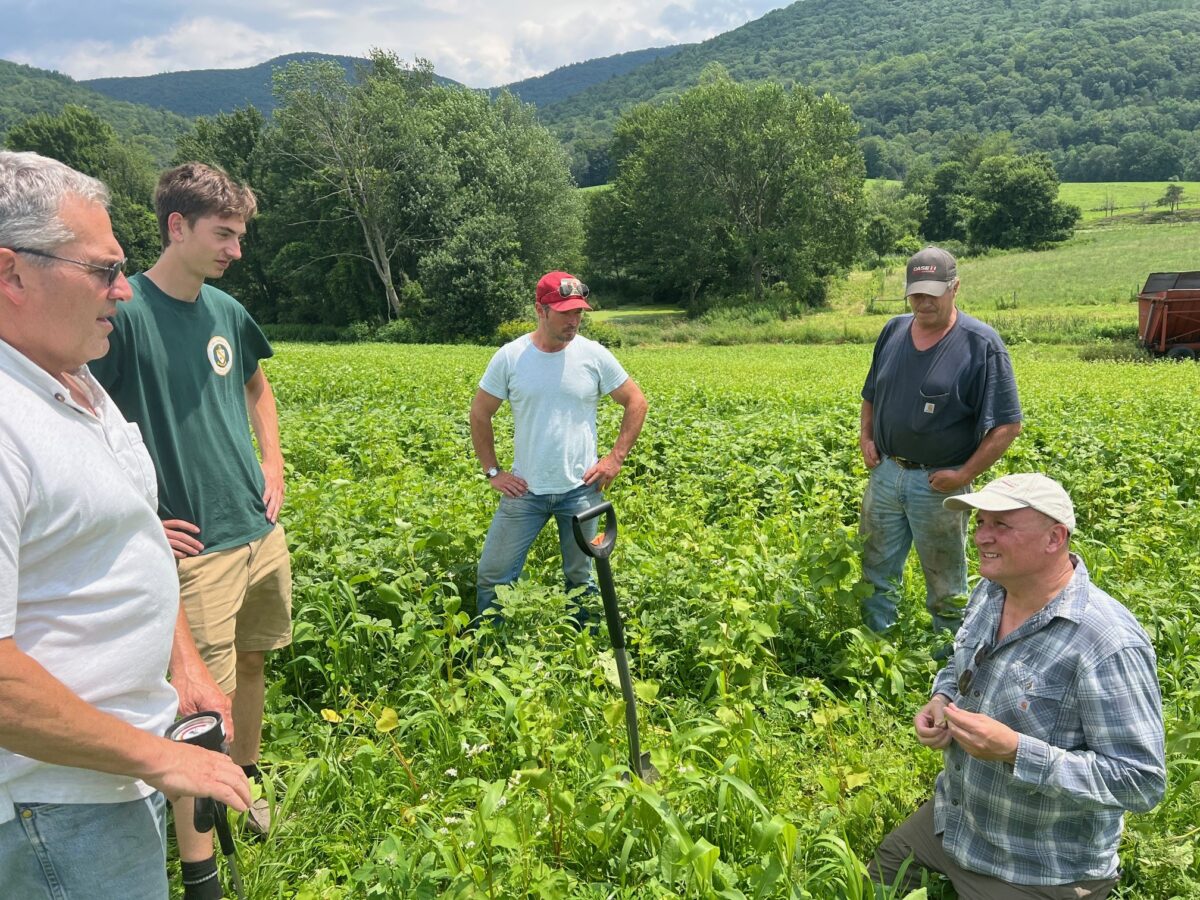
Farmers standing outside in a vast green field with mountains in the distance
Farmers sharing their innovative practices with others is a powerful way to support peer-to-peer learning and discovery. Credit: Berit Dinsdale

The project improved the environmental and economic sustainability on local farms by improving the capacity of engaged producers to make more informed decisions about their application practices to reduce the risks of drift and runoff.

A recent post-project evaluation of SARE projects awarded between 2016–2019 found that the engagement of farmers as co-educators was key to the project’s success. 

“The high level of grower involvement was a real surprise!” said OSU Extension Agronomist Darrin Walenta. “The growers were able to come together in agreement on several future outcomes they identified as important for their industry. Equally as important, the outcomes developed by the growers will provide critical guidance for developing future outreach programs that are in sync with stakeholder priorities.” 

Visit https://www.sare.org/sare-impacts-EW16-010 for more information on this project's impact.

Redefining Learner-Centered Education to Build High Impact IPM Partnerships  is part of a series produced by Insight for Action as part of a post-project evaluation of SARE's regional grant programs. For more information visit https://www.sare.org/sare-impacts.

For information on grants and resources available from SARE, visit www.sare.org.

Posted in 1

Promoting Soil Health for Cut Flower Production

Nearly 200 farms specialize in high-value cut flower production in Utah. But the state’s mountainous terrain and semi-arid climate can limit yields, and improper nutrient management risks increasing soil salinity. With support from a Western SARE Partnership grant, Melanie Stock of Utah State University partnered with cut flower farmers to explore sustainable fertilization practices for dahlia production.

Stock’s project initially aimed to determine optimal nitrogen fertilizer rates for dahlias but quickly evolved into a multifaceted study addressing soil fertility, disease management, and economic returns for small-scale flower farmers. The project provided six local producers with biannual soil testing and individualized nutrient recommendations. As a result, farmers successfully reduced nutrient overloading while maintaining soil fertility.

The project improved environmental, economic, and social sustainability of cut flower production in Utah by helping producers reduce production costs, manage diseases and avoid overuse of amendments, which increased yields and revenue as a result.

3 people using shovels on a farm between tarp coverings
After first frost, the harvest season is over. Because dahlias are not tolerant of cold, winter temperatures, the plants are dug, and the tubers are weighed and stored until the next growing season. Credit: Melanie Stock

A recent post-project evaluation of SARE projects awarded between 2016–2019 found that Stock’s collaboration with farmers was key to the project’s success.

“This project was prompted by a need I saw in the community,” said Stock. “Cut flowers were taking off in the state, and dahlia is the top crop for our farmers.”

Visit https://www.sare.org/sare-impacts-OW19-346 for more information on this project's impact.

Promoting Crop Diversification and Soil Health for Cut Flower Production is part of a series produced by Insight for Action as part of a post-project evaluation of SARE's regional grant programs. For more information visit https://www.sare.org/sare-impacts.

For information on grants and resources available from SARE, visit www.sare.org.

Posted in 1

Enterprise Budgets for Diversified Farms

Every farmer makes tough decisions about production practices within the constraints of the land, labor and capital they have available. Tracking profitability in diverse operations is particularly hard because multiple enterprises often share equipment, labor and other inputs. Without a clear understanding of production costs and returns, it can be difficult to evaluate enterprise performance, set prices or plan future investments.

SARE’s newest bulletin, Enterprise Budgets for Diversified Farms: Tools for Understanding Your Bottom Line provides guidance on using enterprise budgets, recordkeeping systems and partial budget analysis to evaluate management decisions for diversified farm operations.

Five case studies demonstrate how these tools can be applied in real-world situations:

  • Economic Profitability from a Cow-Calf Operation: A 50-head operation in western Washington appeared profitable based on cash flow, but a deeper analysis showed losses once long-term capital, labor and equipment costs were included.
  • Hay Production Budgets: Careful tracking of labor, machinery and input costs is used to examine how producing round bales of hay for on-farm use on a cow-calf operation compares to producing square bales for the retail market.
  • Bottom Line Profitability for Grassfed Steers: Data from the cow-calf and hay enterprises is used to compare the profitability of selling grassfed beef directly to consumers versus USDA-inspected boxed beef markets.
  • The Breakeven Price for an Alternative Crop: A winter wheat producer uses multi-year budgets to evaluate the economic impact of replacing summer fallow with spring canola in a rotation of winter wheat, spring barley, and summer fallow.
  • Measuring Perennial Crop Profitability: This case study uses strawberries as an example of how to amortize (or spread out) the establishment costs and changing annual yields of a perennial crop, providing a more complete and reliable estimate of annual returns of the perennial crop.

Diversified Farms: Tools for Understanding Your Bottom Line is available online at https://www.sare.org/enterprise-budgets-for-diversified-farms.

SARE » Archives for Sean McGovern

Posted in 1

2025/2026 National Cover Crop Survey Is Now Open for Farmer Input

Farmers across the United States—whether they use cover crops, formerly used them, or have never planted covers—are invited to share their insights on cover crops in the National Cover Crop Survey being conducted by the Conservation Technology Information Center (CTIC), SARE, and the American Seed Trade Association (ASTA). This is the 8th survey in the research series, which began in 2012.

The anonymous survey takes about 15 minutes to complete. Farmers who complete the survey can enter a drawing to win one of three $100 Visa gift cards.

Farmers: Take the survey now.

Data collected through the surveys has a powerful impact throughout agriculture, according to Rob Myers, a University of Missouri professor and regional director of the North Central Region SARE program. 

“The National Cover Crop Survey is a tool that helps policy makers, agribusiness, commodity organizations, cover crop advocates, farmers and others understand how farmers think about cover crops and make decisions around adopting the practice,” Myers explains. “Previous surveys have been used in Congressional testimony, cited in academic research, used by educators to help share information to help farmers succeed with cover crops, and more.”

For example, data from previous surveys informed SARE's report Cover Crop Economics, which addresses how and when cover crops improve profitability.

“This year, we're equally interested in not only hearing from farmers who actively use cover crops, but also from those who no longer use them and who have never planted them at all,” says Ryan Heiniger, CTIC executive director and a 4th generation Iowa farmer who uses cover crops. “Additionally and new this year, we’ve added more questions about grazing livestock on cover crops to explore return on investment and the practice’s potential as a contributing solution to help rebuild the nation’s cattle herds.”

Andy LaVigne, president and CEO of ASTA, adds that the CTIC/SARE/ASTA cover crop surveys help seed companies predict market demand for cover crop seed and spot trends in the use of various cover crop species. That helps seed growers supply the steadily evolving market for cover crop seed.

“Understanding the demand and opportunities in the field helps seed companies keep in step with the market,” LaVigne notes. “Over the years, we have seen new species and varieties of cover crops come into the market, and we have identified trends in how farmers have used various cover crops to achieve a wide range of benefits.”

The 2025-2026 National Cover Crop Survey is open until March 31. Visit the SARE website to view reports from past surveys.

Farmers: Take the survey now.

Posted in 1

Improving Cattle Production Efficiency and Health Through Breeding and Probiotics

Calf digestive issues can be a substantial hindrance to livestock health and productivity in the U.S dairy and beef industries. SARE-funded research conducted by Peixin Fan may provide insights on microbiome-guided strategies that offer beef and dairy farmers new options for improving livestock resilience and profitability.

Fan, then a PhD student at the University of Florida, examined a multi-breed Angus-Brahman beef cattle herd to better understand how the microbiomes of calves, influenced by genetic composition and diet, could reduce calf susceptibility to digestion concerns. With support from a Southern SARE Graduate Student grant, Fan studied the relationship between calf microbiomes and health, focusing on identifying beneficial bacteria that could combat harmful pathogens.

The results were promising and confirmed earlier findings that cattle with a higher Brahman genetic composition are more resistant to parasite diseases. The study also isolated bacteria strains associated with combatting diarrhea pathogens. By manipulating calf microbiomes through diet and strategic interbreeding, farmers may be able to reduce the incidence of loose stool with less reliance on costly antibiotics or other treatments.

A recent post-project evaluation of SARE projects awarded between 2016–2019 found that SARE’s unique support for graduate student research that helps farmers solve problems was key to the project’s success.

“Our intention with what we're calling a microbiome guided strategy is to use our research findings to enhance calves’ microbiomes by suggesting to farmers how they can breed and manipulate the animal diet to boost their economic outcomes,” said Fan.

Fan’s work was made possible with the support of her PhD advisor Kwang Cheol Jeong (University of Florida), Mauricio Elzo (University of Florida), and Miju Kim (Kyung Hee University).

Visit https://www.sare.org/sare-impacts-GS19-206 for more information on this project's impact.

Developing Efficient Probiotics for Microbiota of Diarrhea-Resistant Livestock is part of a series produced by Insight for Action as part of a post-project evaluation of SARE's regional grant programs. For more information visit https://www.sare.org/sare-impacts.

For information on grants and resources available from SARE, visit www.sare.org.

Posted in 1

Impacts of Silage Tarps on Soil Arthropods, Soil Properties and Crop Yields

Tilling and herbicides are two of many tools that farmers can use to manage weeds, but frequent use of either one can degrade soil health and life. As a result, many farmers are exploring the use of silage tarps as a way to suppress weeds while limiting the need to use tillage. Unfortunately, little is known about the impact of tarping on crop production or on the biodiversity of below-ground soil organisms.

In response, Eva Kinnebrew explored the impacts that using silage tarps may have on weed control, soil arthropod species, physical soil properties and crop yields. Funded by a Northeast SARE Graduate Student Grant, the project offers farmers a clearer understanding of the impacts of this increasingly popular weed management technique.

Kinnebrew, then a PhD student at the University of Vermont, collaborated with farmers to ensure that her research aligned with their needs. The findings? Tarps dramatically reduced weed cover (around 30% weed cover in tarped plots versus 90% in control plots) and doubled crop yields. The tarps’ negative impacts on soil life were less than anticipated too, resulting in an immediate decline in surface-active species, which quickly recovered after the tarps were removed. Impacts on soil-dwelling species like springtails and millipedes were more subtle, but indicated some evidence of a slow decline after the tarps were removed. 

Two people working on planing rows of crops outside
Collecting lettuce from plots to determine the effect of tarps on crop yields. Credit: Eva Kinnebrew

Kinnebrew's research provides farmers with an opportunity to improve the environmental, economic and production efficiency of their operations by providing new insights on a cost-effective, chemical-free method to control weeds and improve crop productivity without compromising soil quality or health.

A recent post-project evaluation of SARE projects awarded between 2016–2019 found that Kinnebrew's participatory approach was key to the project’s success.

“My project was really inspired by what the farmers were interested in,” says Kinnebrew. “A lot of knowledge points in my project were co-created with the farmers.”

Visit https://www.sare.org/sare-impacts-GNE19-205 for more information on this project's impact.

Impacts of Silage Tarps on Soil Arthropods, Soil Properties and Crop Yields is part of a series produced by Insight for Action as part of a post-project evaluation of SARE's regional grant programs. For more information visit https://www.sare.org/sare-impacts.

For information on grants and resources available from SARE, visit www.sare.org.

Posted in 1

Farmers and Ranchers Are at the Core of SARE’s Research Investments

SARE has been around for nearly 40 years. The impacts that our grant and outreach programs have had on the sustainability of U.S. agriculture are because of one simple thing: Farmers and ranchers are at the center of everything we do.

SARE provides grants directly to producers, which mitigates the financial risk of testing new ideas for making their operations more profitable, productive and sustainable. And all of SARE’s grant programs require producer engagement throughout their project activities. 

“SARE is a funding source for producers,” says SARE grant recipient Emily Cornell of Sol Ranch in Wagon Mound, N.M. “It’s designed for producers, and I think that’s really important.”

Now, SARE’s 2025/2026 Report from the Field highlights 12 innovative projects led by producers to help make their operations more profitable, productive and sustainable. A few examples include:

Download or order your free print copy of 2025/2026 Report from the Field at https://sare.org/report or by calling (301) 779–1007. 2025/2026 Report from the Field is available in quantity for free to educators for use in educational workshops, classes or tours.

Posted in 1