Showing 91-100 of 125 results

Updated Guide to USDA Programs Opens Door to Millions of Dollars of Available Funding

It can be difficult for farmers and ranchers to navigate the wide range of USDA resources and stay up to date with program changes after each Farm Bill. Thanks to the newly updated Building Sustainable Farms, Ranches and Communities, producers, researchers, nonprofits and landowners can easily find USDA programs that can help them achieve their goals. 

Download Building Sustainable Farms, Ranches and Communities

The 101-page guide covers 62 government programs and has been updated to include program updates from the 2018 Farm Bill. Each program listing provides a description of the program’s available resources, information on how to apply, and in some cases, examples of how the funding has been used. The guide also includes basic information on how to design sound projects, find appropriate programs and write grant applications.

“Farmers are hungry for resources to help them get started or answer specific questions. Building Sustainable Farms, Ranches and Communities provides a comprehensive, one-stop-shop to many helpful programs,” says Kerri Ebert, coordinator of the Kansas Center for Sustainable Agriculture and Alternative Crops. 

Building Sustainable Farms, Ranches and Communities is now available as a free download. Free print copies are also available from the National Center for Appropriate Technology’s ATTRA program. To order, email pubs@ncat.org with your request. Don’t forget to include your shipping address. Building Sustainable Farms, Ranches, and Communities was produced through the collaboration of SARE, the Michael Fields Agricultural Institute (MFAI), the National Center for Appropriate Technology (NCAT), and the National Sustainable Agriculture Coalition (NSAC). Funding was provided by SARE, the Agricultural Marketing Service (AMS) and the McKnight Foundation.

Posted in 1

New SARE Bulletin Addresses Ecological Approach to Managing Pests

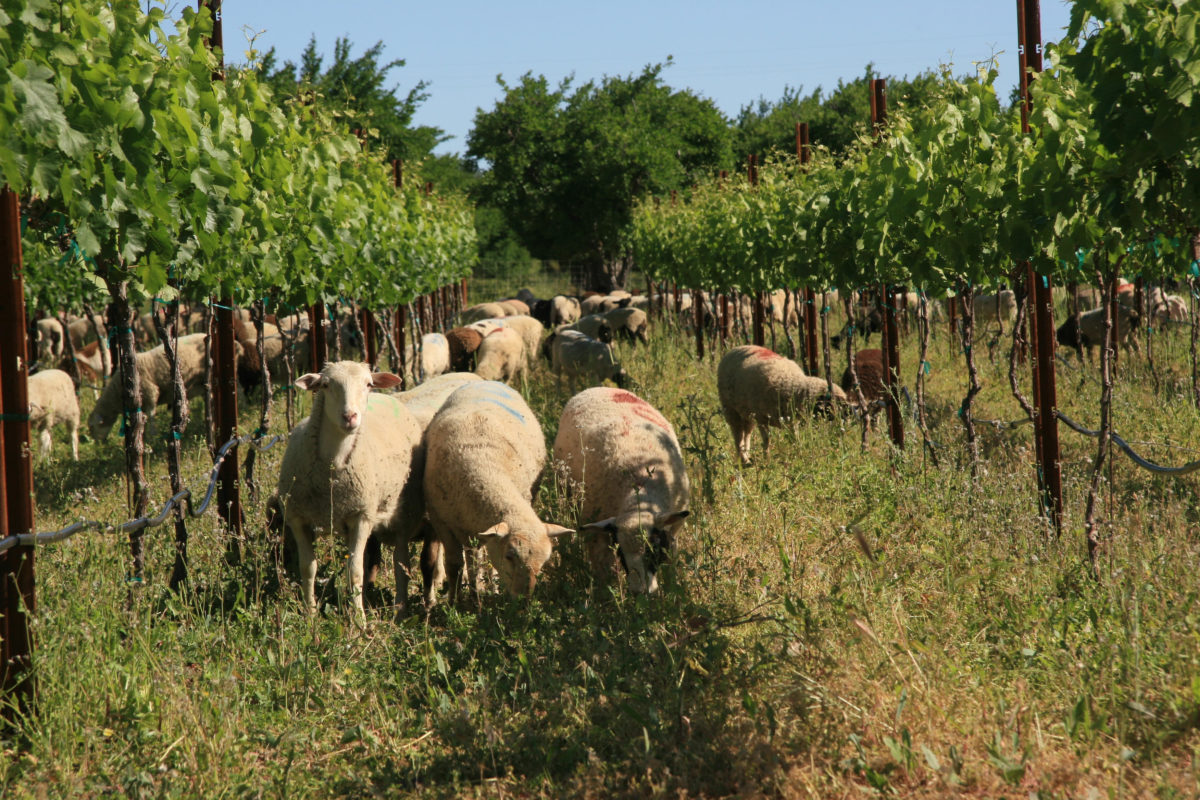
A flock of sheep is vital to the success of one particular vineyard in Winters, California. While many operations struggle to manage weeds, this vineyard used a SARE-funded grant to test grazing sheep as a pest management practice, and they are seeing many whole-farm benefits. The sheep were trained to avoid the grape crop’s leaves and to instead graze only on weeds and other cover crops. Rather than apply potentially harmful pesticides or do time-intensive mowing, the vineyard uses the sheep to manage its weeds. Producers using methods based on ecology to manage pests, like sheep grazing weeds in vineyards, are finding improvements and benefits across their farms. SARE's newly revised A Whole-Farm Approach to Managing Pests bulletin discusses ecological approaches to pest management and highlights cases in which farmers are using innovative methods to manage pests.

A Whole-Farm Approach to Managing Pests is available for free in print and for download, and is useful to farmers and educators alike. 

Sheep Grazing Vineyard
These sheep, at a vineyard in Winters, Calif., were trained to ignore grape leaves while grazing on vegetation such as weeds and cover crops. Photo courtesy University of California Extension

A Whole-Farm Approach to Managing Pests describes ecological pest management strategies that focus on strengthening natural relationships throughout the farm to reduce pest pressures. These holistic strategies emphasize knowledge of cropping systems, biodiversity and farm resource management. Practices that produce healthy crops and keep insects, weeds and diseases away focus on:

  • promoting biodiversity
  • creating healthy crop habitat
  • reducing disturbance to soil and non-crop vegetation , and
  • minimizing off-farm inputs.

This newly updated technical bulletin is broken down into two parts. Part one examines how biodiversity and biological control drive management practices that can boost the natural defenses of your farm. The second part puts those tools into practice by providing reliable and profitable strategies to successfully manage pests.

Focusing on the farming system rather than on each individual pest can make pest control across the whole farm more effective and sustainable. Ecological strategies can be adopted incrementally to meet the unique pest management needs of every operation while providing other benefits such as improved soil health and biodiversity maintenance.

Download or order your free print copy of A Whole-Farm Approach to Managing Pests at https://www.sare.org/resources/a-whole-farm-approach-to-managing-pests/ or by calling (301) 779-1007. A Whole-Farm Approach to Managing Pests is available in quantity for free to educators for use in educational workshops, classes or tours.

Posted in 1

National Farmer Survey Documents a Wide Range of Cover Crop Benefits as Acreage Continues to Expand

Despite the crippling rainfall that significantly delayed planting across much of the country in 2019, more than 90% of farmers participating in a national cover crop survey reported that cover crops allowed them to plant earlier or at the same time as non-cover-cropped fields. Among those who had "planted green," seeding cash crops into growing cover crops, 54% said the practice helped them plant earlier than on other fields.

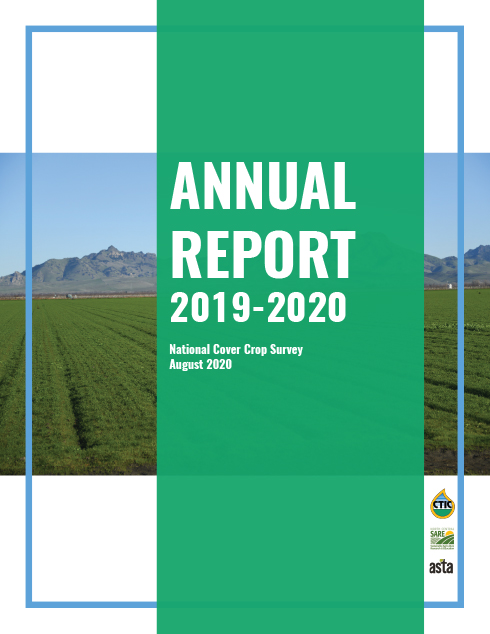
Those findings were among several new insights from the 2019-2020 National Cover Crop Survey, conducted by the nonprofit Conservation Technology Information Center (CTIC), with financial support from SARE and the American Seed Trade Association (ASTA). These organizations have worked together on several past national cover crop surveys, with the first survey dating back to the 2012 crop year.

The 2019-2020 survey, which included perspectives from 1,172 farmers representing every state, was the first by SARE, CTIC and ASTA to include detailed exploration of planting green—a tactic employed by 52% of the respondents—as well as crop insurance use among cover croppers and the impact of cover crops on the profitability of horticultural operations.

"Many U.S. farmers have turned to cover crops as part of their strategy to improve soil health while reducing input costs and maintaining yields," stated Mike Smith, who managed the national survey for CTIC. Survey participants averaged 465 acres in cover crops in 2019, an increase of 38% in four years. The USDA Census of Agriculture found a 50% increase in cover crop acreage over the five-year period between 2012 and 2017.

 “Farmers are using cover crops for a variety of reasons and many have tried new approaches to cover cropping,” Smith said. "This year's survey also indicated that some of the concerns that many growers have had about the effects of cover crops on planting dates in a wet year turned out not to be true—in fact, in many cases, cover crops helped farmers plant earlier in the very wet spring of 2019."

According to Rob Myers, Regional Director of Extension Programs for North Central SARE, “many farmers are finding that cover crops improve the resiliency of their soil, and the longer they use cover crops, the greater the yield increases and cost savings that are reported by producers.”

“We are pleased to see farmers appreciate the expertise of cover crop seed companies with 46% saying they buy from them and another 42% buying from retailers,” said Jane DeMarchi, VP Government & Regulatory Affairs, ASTA. “Professionally produced cover crop seed is grown for seed from the start and has been selected, harvested, cleaned and tested for performance. The study shows farmers are using a range of cover crop seed and mixes to address their individual needs with 46% paying $15 or under per acre.”

Among the 1,172 farmers who provided responses in the 2019-2020 National Cover Crop Survey, 81% were commodity producers (corn, soybeans, wheat, cotton, etc.) and 19% categorized themselves as horticultural producers.

Here are some highlights from the survey. Download the full report.

Yields

The previous five national cover crop surveys sponsored by SARE, CTIC and ASTA have all reported yield boosts from cover crops, most notably in the drought year of 2012 when soybean yields were 11.6% improved following cover crops and corn yields were 9.6% better. In 2019, when wet early conditions prevailed across much of the corn and soybean regions, yield gains were more modest but still statistically significant. Following the use of cover crops, soybean yields improved 5% and corn yields increased 2% on average, while spring wheat yields improved 2.6%.

Saving on farming costs

Many farmers reported economic benefits from cover crop beyond just yield improvements. Of farmers growing corn, soybeans, spring wheat, or cotton, the following percent had savings on production costs with fertilizers and/or herbicides:

  • Soybeans – 41% saved on herbicide costs and 41% on fertilizer costs
  • Corn – 39% saved on herbicide costs and 49% on fertilizer costs
  • Spring wheat – 32% saved on herbicide costs and 43% on fertilizer costs
  • Cotton – 71% saved on herbicide costs and 53% on fertilizer costs

While cover crop seed purchase and planting do represent an extra cost for farmers, it was notable that most producers are finding ways to economize on cover crop seed costs. Whereas earlier surveys from 2012 and 2013 reported on a median cover crop seed cost of $25 per acre, most farmers reported paying less in 2019. Of the responding farmers, 16% were paying only $6-10 per acre for cover crop seed, 27% were paying $11-15 per acre, 20% were paying $16-20 per acre, and 14% were paying $21-25 per acre. Only about one-fourth were paying $26 or more per acre.

Planting green

Planting green refers to planting a cash crop like corn, soybeans or cotton into a still-living cover crop, then terminating it soon after with herbicides, a roller-crimper, or other methods. In this year’s survey, 52% of farmers planted green into cover crops on at least some of their fields. (In the 2016-2017 report, the most recent prior survey by SARE, CTIC and ASTA, 39% of the respondents had planted green.)

  • Of the farmers planting green, 71% reported better weed control
  • 68% reported better soil moisture management, particularly valuable in a wet spring

Horticulture producers also benefit

For the first time, the survey queried horticulture producers about how cover crops have impacted their profit. Of the 184 horticulture producers responding to that question, 35% reported a moderate increase in net profit (defined as an increase of 5% or more), and another 23% reported a minor increase in net profit (2-4% increase). Even after factoring in the purchase and planting cost of cover crops seed, only 4% observed a minor (2-4%) reduction in net profit, and none reported a moderate loss in net profit.

Available online

"The 2019-2020 National Cover Crop Survey shows that an ever-growing number of farmers of all types and in all regions of the U.S. continue to find advantages to using cover crops," says Myers at SARE. "While the first survey in 2012 showed the benefits of cover crops in a drought year, this year’s survey showed that cover crops helped farmers in wet weather as well, with many of them being able to plant in wet spring weather when conventional neighbors couldn’t. The survey showed farmers are figuring out how to make cover crops work for them economically, while using them as a tool to address challenging issues such as herbicide-resistant weeds."

Download the full survey report.

For more information:

Rob Myers, SARE | myersrob@missouri.edu | (573) 882-1547

Mike Smith, CTIC | smith@ctic.org | (812) 661-2407

Kaitlin Crawford, ASTA | kcrawford@betterseed.org | (571) 431-7331
Posted in 1

SARE Funding in Your State

Since 1988, the Sustainable Agriculture Research and Education (SARE) program has helped farmers, ranchers, researchers and educators develop cutting edge innovations that improve farm profitability, protect water and land, and revitalize communities. Funded by the United States Department of Agriculture's National Institute for Food and Agriculture, SARE has awarded nearly $300 million to more than 7,300 projects that improve profitability, stewardship and quality of life by investing in groundbreaking research and education. Learn more about funded grants, project highlights and a breakdown of funding in your state using our newly updated portfolio summaries and grant lists.

SARE Grants Funded In Your State

Highlights of SARE-funded projects include:

Download the updated grants lists and portfolio summaries, and find links to state webpages at sare.org/Grants/Funded-Grants-in-Your-State. Search the SARE projects database to explore funded projects by topic, region, year or grant types.

Posted in 1

SARE Fellows Tour Sustainability in North Carolina

SARE Fellows Tour Sustainability in North Carolina

SARE Fellows 2019

RALEIGH, North Carolina – Organic sweet potatoes are in high demand in North Carolina, but growers face two major hurdles: weeds and wireworms. North Carolina State University researchers think cover crops might be a solution, and that would make third generation farmer Kelvin Bass a happy man.

“I’m tremendously concerned about soil health,” said Bass, owner of Bass Plant Farm in Nashville, N.C., who grows 80–100 acres of organic sweet potatoes. “It’s key to what we are trying to accomplish organically. Soil is very important.”

Bass expressed frustration over having to till his sweet potato fields to manage weeds and control wireworm, a pest that likes grass roots as a host. If NCSU research of a cereal rye/vetch mix incorporated with organic sweet potatoes is successful, Bass will have a means of curtailing tillage while boosting soil organic matter, which is historically low in eastern North Carolina.

Organic sweet potatoes are the most profitable crop on Bass’ farm. A group of county extension agents from across the country visited recently to learn more about the farm’s diverse production of tobacco, cut flowers, U-pick strawberries, vegetables, and organic crops such as soybeans, wheat and cucumbers. The visit was part of the Sustainable Agriculture Research & Education (SARE) Fellows Tour, a program hosted by SARE and the National Association of County Agricultural Agents (NACAA) to introduce county agents to sustainable agriculture practices outside their region.

low tunnels with people standing outside them

This year’s tour took the group to farms and NCSU and North Carolina A&T research stations across the state’s Eastern, Piedmont, and Mountain regions. NCSU SARE state coordinator Chris Reberg-Horton praised SARE for laying the foundation of sustainability in the state, which has been progressive in its sustainable practices for decades. “NCSU and NC A&T have a great history with SARE,” said Horton. “SARE has been transformative when it comes to where growers are at in terms of sustainable agriculture, our training programs, statewide conferences, and other activities, such as the Fellows Tour.”

For several days, tour participants got a glimpse of some of the diverse farms across the state, and what makes each so unique in the world of sustainable agriculture. Examples included:

  • Allied Organic Farms in Hurdle Mills, N.C.: A diverse vegetable and agritourism operation, whose owners Tom Savage and wife, Linda, pride themselves on community relationships. Their biggest event, a free-of-charge Christmas light show, draws several hundred residents. “We are not a giant moneymaker,” said Savage, “but I believe it’s a good way of life.”
  • Pangaea Plants in Lake Lure, N.C.: A biodynamic farm specializing in certified organic medicinal herbs. Nestle in the mountains of western North Carolina near Asheville, owner Gabriel Noard looks upon his farm as an ecosystem with the neighbors and environment around him.
  • Flying Cloud Farm, Fairview, N.C.: A diverse operation of vegetables, berries and cut flowers sold via direct marketing, through a CSA, or to local markets. Managers Isaiah and Annie Louise Perkinson are tuned in to the lifestyle of their community. Their biggest money maker is a self-serve farm stand that allows passersby to pay for their items via Paypal, accessible through the farm’s website.

“I thought that farm stand at Flying Cloud Farm was pretty innovative,” said Jessica Kelton, a farm and agribusiness management extension agent at Auburn University. “Flying Cloud Farm was one of the best stops. They seemed to grasp every aspect of sustainability and they were meeting the social demand through their CSA.”

medicinal herbs in a jar

Like the other SARE Fellows on the tour, Kelton hopes to apply what she learned on the tour in her own sustainable agriculture efforts.

“Learning to work with other Extension personnel with different specialties really helps to get a better overall picture of the sustainable agriculture efforts of a particular farm,” said Kelton. “Thanks to everyone who worked to make this trip a great experience.

Other SARE Fellows who participated included: Amanda Sears, horticulture agent with University of Kentucky; Anthony Bly, soils field specialist with South Dakota State University; FNU Naveen Kumar, assistant professor of horticulture and extension specialist with University of Maryland; Claire Strader, organic vegetable educator, University of Wisconsin; Kathleen Painter, assistant professor and agriculture extension educator, University of Idaho; Kurt Jones, 4-H county director, Colorado State University; and Nicole Santangelo, agronomy extension educator, Penn State University.

The next SARE Fellows Tour will take place in Kansas next year.

Posted in 1

Free Fact Sheets Identify Broad Benefits of Cover Crops

Along with cutting costs and increasing crop productivity, cover crops provide various ecosystem services that benefit the environment both on and off the farm. For instance, adding cover crops to a rotation can significantly increase the portion of the year when living roots are present for soil organisms to feed on, which can have a significant impact on carbon sequestration. They also support wildlife and beneficial insects, and protect water quality by playing an important role in nutrient management. SARE’s Ecosystem Services from Cover Crops fact sheets explore the many ways cover crops can maintain soil and benefit the farm ecosystem, including:

Check out the fact sheets now

These free, downloadable and printable fact sheets are an excellent resource for educators, Extension service providers, farmers hosting field days and others. A great overview fact sheet is the “10 Ways Cover Crops Enhance Soil Health,” which addresses the four basic principles for maintaining and improving soil—and how cover crops support those principles.

If you want to dig deeper into the economics and profitability of cover crops, SARE’s newest bulletin, Cover Crops Economics, explores the economics of cover crops in corn and soybean rotations to help farmers answer that big question: “When do cover crops pay?” Download the PDF, view the online version, or order complimentary copies.

Posted in 1

Cover Crop Economics Report Now Available in Print

Cover Crops Offer Options in Wet Soil

As more farmers across the nation begin to incorporate covers into their rotations, they find that this valuable conservation practice pays in more ways than one. Many farmers in states suffering from oversaturated fields that prevented or delayed planting are considering cover crops. To help farmers evaluate the benefits of incorporating cover crops into their production systems, USDA-SARE released an important new report that examines the big question: “When do cover crops pay?”   

Cover Crop Economics: Opportunities to Improve Your Bottom Line in Row Crops is now available for free in print and for download, and is great for farmers and educators alike. 

Download or order Cover Crop Economics now. 

Using data gathered from five years of national cover crop surveys, Cover Crop Economics addresses the economic returns that can be expected from cover crops under various management scenarios and as cover crops improve soil health over time. This report takes a comprehensive approach by identifying seven different management situations when cover crops pay off faster. They are when:

  • Herbicide-resistant weeds are a problem
  • Cover crops are grazed
  • Soil compaction is an issue
  • Cover crops are used to speed up and ease the transition to no-till
  • Soil moisture is at a deficit or irrigation is needed
  • Fertilizer costs are high or manure nutrients need to be sequestered
  • Incentive payments are received for using cover crops

Download or order your free print copy of Cover Crop Economics: Opportunities to Improve Your Bottom Line in Row Crops at sare.org/cover-crop-economics or by calling (301) 779-1007. Cover Crop Economics is available in quantity for free to educators for use in educational workshops, classes or tours.

Posted in 1

When Do Cover Crops Pay? New USDA-SARE Report Addresses the Question

Farmers around the country are planting cover crops on millions of acres to protect and improve the soil, and the more that farmers use cover crops, the more they value this conservation practice. Cover Crop Economics, a new report published by USDA-SARE looks at the economics of cover crops to help farmers answer that big question: "When do cover crops pay?"

The key, says North Dakota farmer Justin Zahradka, who has been planting cover crops since 2011, is to “look at cover crops as an investment rather than a cost.”

Download or order Cover Crop Economics now. 

Based primarily on yield and economic data gathered through five years of national cover crop surveys, Cover Crop Economics: Opportunities to Improve Your Bottom Line in Row Crops addresses the kinds of economic returns that can be expected from cover crops, both under various management scenarios and as cover crops improve soil health over time. The report is timely, as the latest Census of Agriculture revealed that national cover crop acreage increased by 50% from 2012 to 2017.  It’s also timely due to the interest in cover crops for planting on fields that were flooded or otherwise unplanted (prevent plant situations) this spring, in order to suppress weeds while protecting and improving the soil.

“The five years of national cover crop surveys showed us that cover crops do improve commodity yields over time as farmers gain experience with cover crops and the soil is improved,” says lead author Rob Myers, of the University of Missouri and North Central SARE. “We saw this pattern in all five years of the survey for both corn and soybeans.”

Because there is no one-size-fits-all answer to when cover crops start paying for themselves, Cover Crop Economics: Opportunities to Improve Your Bottom Line in Row Crops takes a holistic look at the question. It explores seven common management situations for commodity farmers that can affect how quickly they receive a positive net return from cover crops. In reviewing national survey data and information from other studies and farmers experiences, the publication describes a number of situations in which cover crops may increase profitability within a year or two.

Prime examples of fast returns include when drought occurs when herbicide-resistant weeds are a challenge, or when cover crops are grazed. Other management situations which can speed up positive returns from cover crops include when a farmer is dealing with compacted soils or is transitioning to no-till, or when cover crops are contributing to a commodity crop’s nutrient needs. Also, receiving federal or state incentive payments while transitioning to cover crop use can make a major contribution to a quick economic return.

Some key findings from the report include (see the full report for details on the calculations and assumptions underlying these conclusions):

  • When herbicide-resistant weeds are a significant problem, cover crops can be profitable in the first year of use
  • When cover crops are grazed, they can provide a profit in the first year of use if fencing and water are already available
  • When soil compaction occurs, cover crops can provide a profit by the second year of use

The findings in Cover Crop Economics: Opportunities to Improve Your Bottom Line in Row Crops are based on an analysis of five years of data from the National Cover Crop Survey, conducted by the Conservation Technology Information Center (CTIC) and SARE in the 2012-2016 growing seasons. This survey provides the largest multi-year data set on cover crop yield response that has ever been assembled, according to Myers, with about 500 farmers providing yield data in most years of the survey.

In 2015 and 2016, the survey captured more detailed data on yield response in a given field based on the number of years cover crops had been planted in it. In those years, average corn and soybean yield increases in response to covers were:

  • After one year of cover crop use, corn yields increased 0.5% and soybean yields 2.1%
  • After three years of cover crops, corn yields increased 1.8% and soybeans yields 3.5%
  • After five years of cover crops, corn yields increased 3% and soybean yields 5%

In the drought year of 2012, there was a significantly bigger yield boost from cover cropping on the majority of farms responding to the survey. Corn yields increased by 6% and soybeans by 11.4% after one year of cover crop use due to impacts on rainfall infiltration, reduced soil evaporation from cover crop residue, changes to soil biology such as increased mycorrhizal fungi, and potentially deeper rooting of cash crops.”

Other smaller studies on yield response to cover crops have found a variety of results, some showing modest yield increases and some showing no yield response. “I think yield response to covers depends on how the farmer or researcher manages the cover crop and the soil types they have, but clearly there have been a range of yield impacts reported,” says Myers. “As with other crop management practices, it takes planning to get the best results, and mistakes can lead to a yield loss, particularly if cereal rye is used before corn without adjustments to fertilizer practices or without appropriate termination timing.”

For this report, the authors used $25 per acre as the cost of cover crop seed and $12 per acre as the cost of seeding (when hired), for a total of $37 per acre to establish cover crops. These figures are based on median data from the surveys.

Experienced cover crop users often find ways to use them for less. One large Iowa farmer grows his own cereal rye seed and plants a bushel of rye per acre as a cover, according to Myers. He finds his cost for seed is $9 per acre and his cost of seeding is $5 per acre by using a high capacity fertilizer spreader to broadcast the rye seed, making a total of $14 per acre for seed and seeding. Others may keep the cost of seeding to a minimum by seeding cover crops with a vertical tillage tool they would be operating in any case. Some farmers have termination costs for cover crops, but many do not, as they are already applying a spring burn down herbicide.

Alan Weber, an ag economist who has used cover crops on his own farm and who co-authored Cover Crop Economics: Opportunities to Improve Your Bottom Line in Row Crops, says, “One of our key takeaways from the review we did of data and farmer approaches is that when farmers start to adopt cover crops, they frequently start to determine other ways to make their cropping system more economically efficient, finding they can save costs in certain areas such as fertility or weed control. For some farmers those cost savings from cover crops can be significant, particularly in certain situations with herbicide-resistant weeds. In other cases, those cost savings will be more minor, but the input savings generally increase over time. Some aspects of soil health respond quickly to cover crops, such as more earthworms and mycorrhiza, while other soil changes take longer.”

In the longer term, as aggregate soil structure starts to improve, cover crops in combination with no-till can allow farmers to get into the field a little earlier for planting or harvest in wet years, which can be another way that cover crops provide a positive economic impact. Several years of cover crop use can gradually start to improve soil organic matter, which can improve soil water-holding capacity and help improve the inherent fertility of the soil.

As a bottom line, Myers says, “Thousands of farmers are finding the profitability benefits of cover crops on their farm do improve over time. Depending on circumstances specific to each field and farm, cover crops may provide a relatively quick profit, such as from grazing, or may take 2-3 years to provide a return. It’s not unlike how applying ag lime can take 2-3 years to pay, or buying a new piece of equipment can take a few years to cash flow. However, if producers use cover crops to address problems specific to their farm, such as weeds, fertility, erosion, or compaction, they can quickly gain cost efficiencies with their commodity cash crops. The cover crops also provide a management tool to make soils more resilient to excessively dry or wet weather while building towards long-term improvements in profit.”

Download or order your free print copy of Cover Crop Economics: Opportunities to Improve Your Bottom Line in Row Crops at sare.org/cover-crop-economics or by calling (301) 779-1007. Cover Crop Economics is available in quantity for free to educators for use in educational workshops, classes or tours.

Posted in 1

New Video: Building a Local Food Movement

When Congress ended its tobacco support programs in 2000, thousands of tobacco growers in western North Carolina who depended on them were left without a viable way to make a living. “There wasn’t a real future for the farms in our region if we didn’t come up with something new,” says Charlie Jackson, the executive director of the Appalachian Sustainable Agriculture Project (ASAP).

In this new video, see how the agricultural landscape of western North Carolina is transforming from one dependent on tobacco to one that is self-sustaining. Hear from Jackson, who has worked with farmers and businesses to advance this change with support from SARE.

Dig Deeper into Sustainable Agriculture

Explore how farmers and ranchers are improving profitability, stewardship and quality of life using innovations in production and marketing. Check out What is Sustainable Agriculture?  a 12-page sampler of best practices in sustainable agriculture, including profiles of the men and women who are putting them into practice.

Posted in 1

New Video: Bringing Independent Farmers into the Marketplace

Access to profitable retail and wholesale markets is a challenge for small- to mid-scale family farmers. “The days of showing up with your cantaloupes in the back of the pickup are no longer a way to make a living,” says Diana Endicott of Kansas City, Mo. “So you have to be willing to make a change.” A SARE grant helped Endicott and other area farmers launch a marketing cooperative that secured access for their all-natural beef products in 19 local supermarkets. A second SARE grant explored consumer demand for natural beef at the retail level, contributing to a 33 percent increase in sales.

In this new video, learn how Good Natured Family Farms (GNFF) has grown into a network of more than 100 farms that sells a range of products through 30 area supermarkets and which generated $4.5 million in sales in 2015.

Dig Deeper into Local Foods

Visit the Farm to Table: Building Local and Regional Food Systems Topic Room to learn more about farmers, ranchers, ag professionals, community organizers who are reconfiguring the nation's food system to retain more value in food-producing communities.

Posted in 1