Think of all the energy that goes into a farm’s operation: fuel to run tractors, combines, and trucks; electricity to power shops and homes; and propane for heat and grain driers. All that energy pales in comparison to the amount of energy that hits our farms in sunlight.
We already harvest a good portion of that sunlight through the photosynthesis that feeds our crops. However, when we only grow cash crops for four to five months of the year, we fail to capture as much of this free resource as we could. By letting the sun fall on idle ground for the majority of the year, we miss out on fueling the underground carbon exchange–an economy of sorts that Nebraska farmer and seedsman Keith Berns has called “carbonomics.” The players in this underground carbon economy on our farms are earthworms, soil fungi, bacteria, arthropods, and other organisms, as well as the plant roots that catalyze the whole underground carbon exchange.
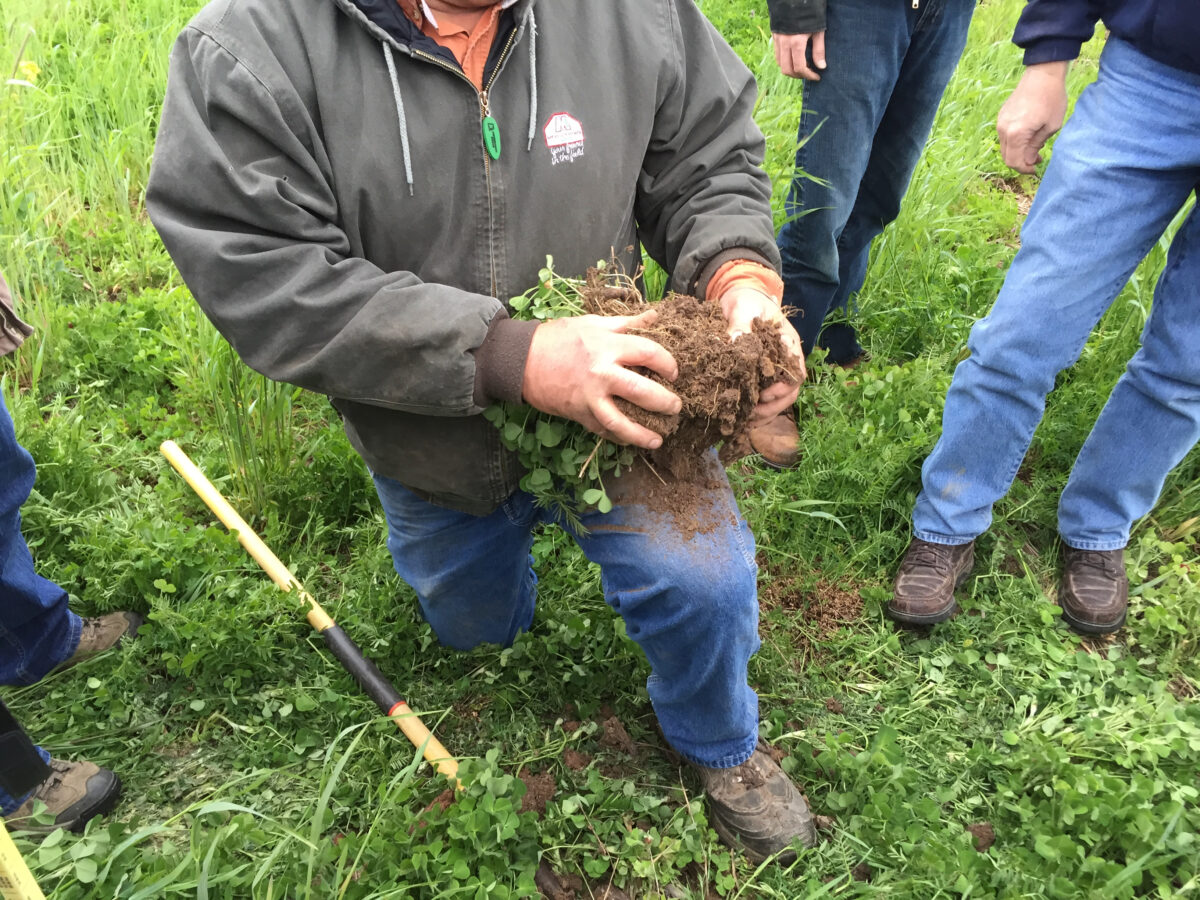
When powered by sunlight, plants such as cover crops can generate extra carbon in the form of carbohydrate exudates–typically sugars that they exude into the soil from their roots. The plant roots evolved to do this in order to gain nutrients, and sometimes water, back from fungi and bacteria in the soil. If we don’t have living roots in the soil, this carbon exchange grinds to a halt, which is why some farming approaches can lose soil carbon and soil organic matter.
It’s as if we had bought a herd of cattle in the summer, fed it for a few months until October, then forgot to feed those animals from fall to spring. We would be letting a valuable farm resource go to waste, and that’s what happens when our underground “livestock” herd isn’t being fed by sunlight and plant roots: the soil microbe herd starts to lose weight and its members begin to die off. When these soil critters are dead or dormant, they can’t do any work for us, such as building soil organic matter and recycling soil nutrients in a form that our cash crops can use.
Another relevant analogy is to think of the soil ecosystem like a finely tuned truck engine: if you take away the fuel from the engine–which in this case is the living roots needed for carbon exudates–the engine stops running. Or, if you damage the engine by overworking it–in this case over-tilling or compacting the soil–you will also prevent it from running efficiently. A poorly running truck engine makes it hard to get anywhere, and the same can be said of how soil health affects the economic success of the farm. We need the soil functioning at peak performance, and that means managing soil carbon and building soil health to an optimal level in each field.
The good news is that many farmers have been finding ways to increase their soil performance with cover crops. In this book, we’ll take a look at straightforward and simple ways of using cover crops in order to build soil health and farm wealth. We’ll examine how cover crops can impact a farm’s economic bottom line and help achieve farm goals, including leaving the farm in better shape for those who follow you.
While many readers of this book may already be familiar with common cover crops, a quick definition of what exactly cover crops are may perhaps be helpful. Cover crops are plants grown to protect and improve the soil, especially when no cash crop is being grown. Cereal rye is the most common cover crop, grown on about half of all cover crop fields either as the sole cover crop or as part of mixes with other cover crops, but over 40 species of cover crops are currently sold in the U.S. In addition to cereal rye, other common fall-planted cover crops include legumes such as crimson clover, hairy vetch, and Austrian winter peas; Brassicas such as radishes, turnips, and canola/rapeseed; and a variety of small grains such as oats, wheat, triticale, annual ryegrass, and barley. There are also a wide variety of summer cover crops, including millets, cowpeas, sunn hemp, and buckwheat.
Some specific topics covered in this book include:
- How to make money off of cover crops
- Ways to save time when using cover crops
- How cover crops will build soil health
- Simple steps for getting started with cover crops
- Equipment strategies and options for managing cover crops
- Combining cover crops with other practices to increase farming efficiency
- Potential issues with cover crops and how to avoid them
One part of this book sure to be of interest is the stories of a dozen farmers who are already using cover crops and how they have fit them into their farm operations. Farms from several parts of the U.S. are included, so hopefully you can find examples relevant to your area. Keep in mind that well over 150,000 farmers in the U.S. are currently using cover crops on at least part of their acreage; going to a field day on cover crops is a good way to meet other farmers in your area who are using them and connect with farm advisors interested in cover crops.
From talking with many farmers who are using cover crops, including those profiled in this book, I’ve learned that most had specific reasons for using them. For some farmers, cover crops are a way of managing weeds or improving soil fertility. For others, they are a way to address compaction or rectify a poorly-performing field. Some decide to give cover crops a try after hearing from a neighbor having success or learning about cost share support. Regardless of why they got started, most of these farmers say they will stick with cover crops for the rest of their farming days because they are seeing so many benefits.
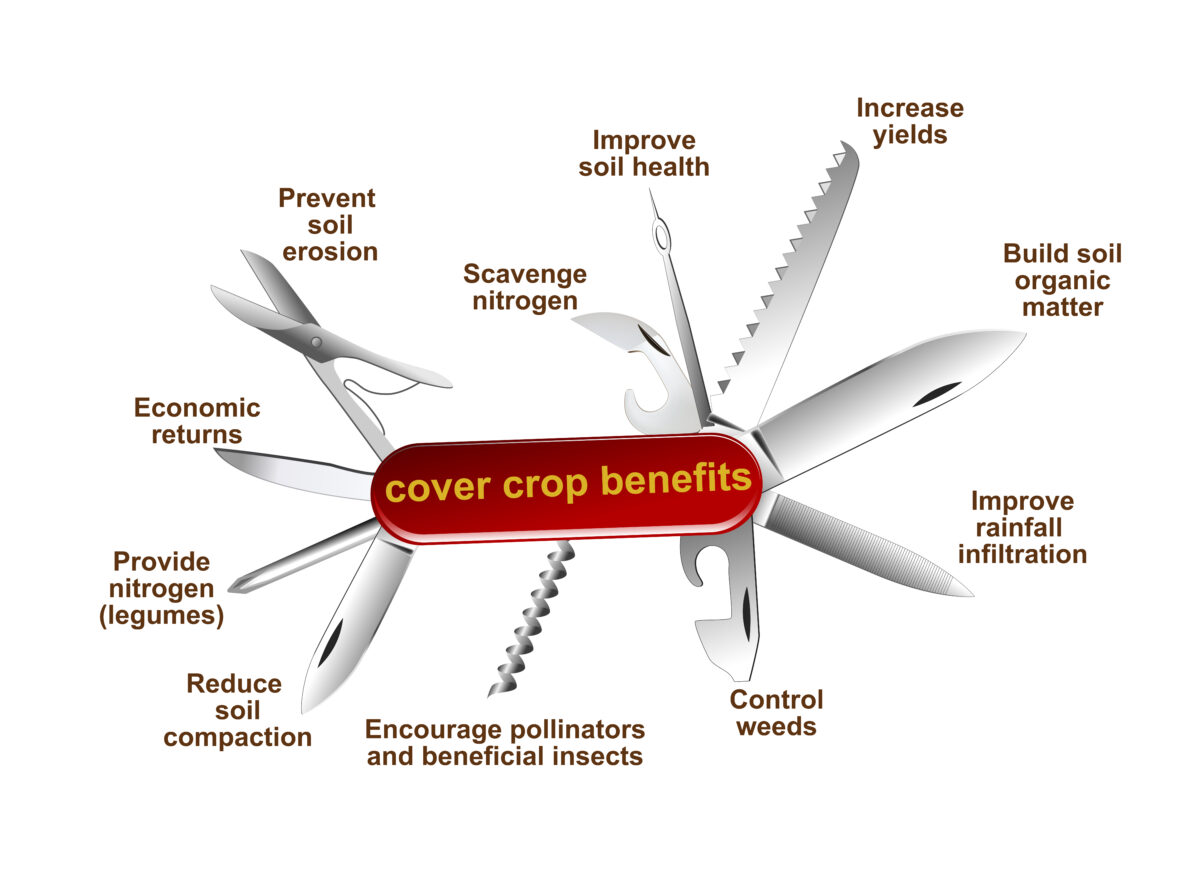
In thinking about the reasons cover crops are used, it struck me several years ago that cover crops are like a Swiss Army Knife because they are such a highly versatile tool. In fact, I can’t think of any other agronomic practice that can provide so many different benefits. We had the following illustration developed through the USDA Sustainable Agriculture Research and Education (SARE) program to point out all of the various benefits that cover crops can provide. Even if only one or two of these benefits seem particularly relevant to you, it can be worth giving cover crops a try on a field or two.
If you’re one of those people who have been hesitating to try cover crops, test them on a single field to start with. But give the practice a fair shot at success–follow some of the tips in Chapter 6, “Simple steps for getting started with cover crops.” You should be able to find an approach that’s easy for you to fit into your operation and helps you achieve particular field goals you have, such as managing herbicide-resistant weeds, dealing with compaction, or just improving the soil’s performance, especially in dry weather.
If you are just getting started with cover crops, even though your closest neighbors may not have tried them yet, rest assured that you are not alone. At the time of this book’s writing, cover crops were being used in every region of the country on over 20 million acres. Some farmers plant their whole farm to cover crops, and others are more targeted with where they use them, such as in poorer soils or more steeply sloping fields. Don’t feel like the whole farm has to be planted to cover crops right away; the main thing is just to get started. You know the saying: every journey begins with a single step!
What Farmers Are Saying
I want to end this first chapter with some direct quotes from farmers using cover crops. These comments were compiled from the National Cover Crop Survey (which is why they are anonymous), and include valuable insights from farmers who are making use of covers.
Some of these farmers own and some rent the land they farm. If you are renting farmland and want to discuss implementing cover crops with your landlord, it may be heartening to know that in the survey, a high percentage of respondents reported support from landowners in using cover crops on rented acres. In fact, some farmers have said they find it makes it easier to rent additional ground when they explain to landowners why they use cover crops and how they can improve the ground of that landowner. In a time of competition for land, being able to demonstrate that you are a stewardship-minded producer who works to build soil health can pay big dividends both on your own ground and with landowners you may be working with.
Here’s what some farmers using cover crops said they would like to tell their neighbors–I expect some of these ideas will resonate with you. I believe these reasons reflect why we have over 20 million acres of cover crops in the U.S. today, and why the adoption of cover crops has been steadily increasing.
“Cover crops will save and even rebuild your soil. There is a place for a cover crop in every operation, and the benefits will accumulate over time.”
“It is a systems approach based on a return to the way nature is intended to work, and therefore can be extremely successful.”
“Through use of cover crops, we are able to better meet the biological needs of our soil. Once our soil is in balance, nutrient uptake is easier for the plant and we are able to reduce disease in our crop. Ag is not only about managing our crop health, but also soil health.”
“Cover crops hold more moisture in the soil than they use.”
“Every day without live roots in the ground is a day wasted. The soil is alive and we must feed and protect it!”
“Soil health is key. Cover crops are better than steel.”
“The use of cover crops can reduce compaction without doing deep tillage.”
“Cover crops are a long-term investment in improving your soil biology.”
“You have to think longer-term about your rotations, not just look year-to-year. That is when you realize cover crops are integral to your crop rotations.”
“Our system captures carbon, increasing organic matter. We will produce more yield with less inputs.”
“There is a wide array of cover crops that can improve every rotation and soil with a little bit of planning.”
“Keeping the soil covered year-round provides food for the life in the soil, which in turn provides nutrients for your crops.”
“Cover crops mimic what Mother Nature was doing before man began farming, she always kept herself covered and always had some kind of live roots year-round. The closer we can mimic this, the better our soils will become over time.”
“By using cover crops, we will be able to recover the rich fertile living soils we once had, and we will be able to pass it on to future generations.”
“There is room on every farm for cover crops.”
“If you expect to be able to farm your land in 50 years, or have your child or grandchild farm it, then you need to use cover crops.”
“We must take better care of the soil we depend on.”
“Please use cover crops. They do work, and help in ways nothing else does.”