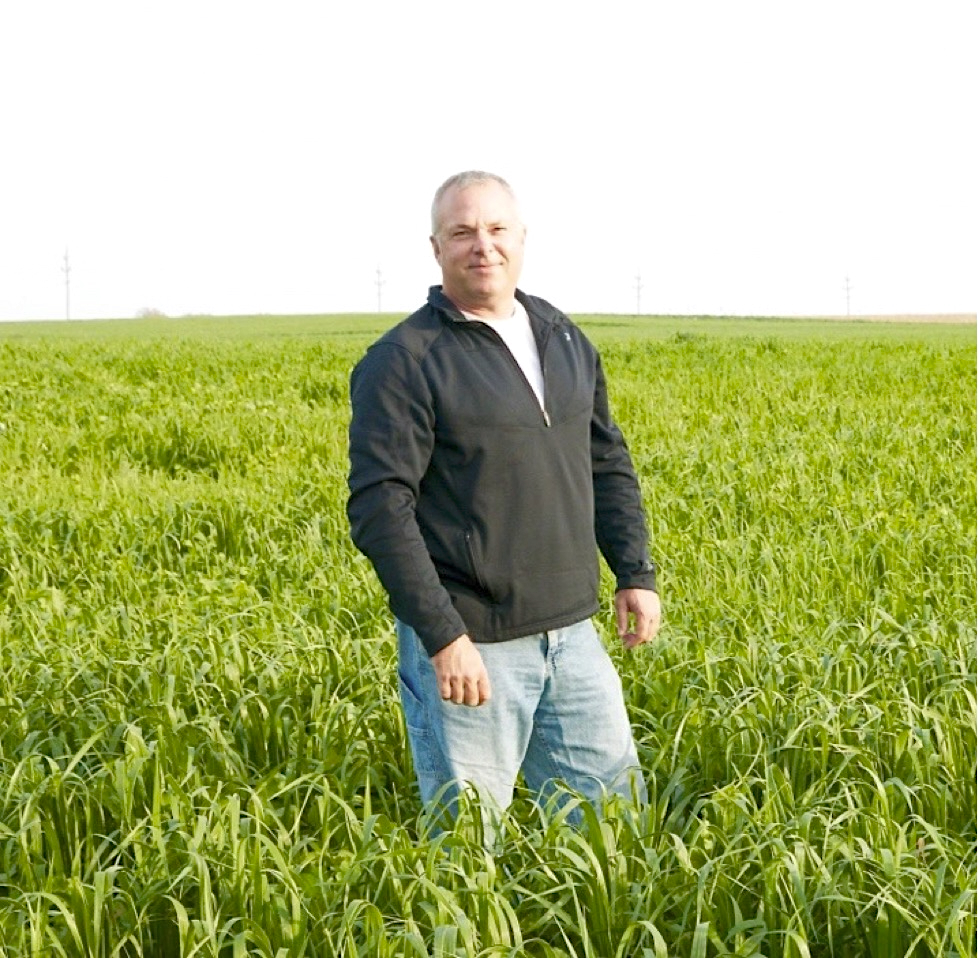
Dan DeSutter operates a 5,000-acre family farm in west central Indiana that for many years was focused on corn and soybeans. Over the last decade, he has gradually added a variety of other cash crops and integrated beef cattle into the operation. He first added small grains and then some alfalfa to the rotation to incorporate more diversity. Now, with the opportunity for cattle grazing present, he is growing a variety of annual grazing forages, usually as mixtures. They previously had a modest number of stocker grass-fed beef cattle on grass pasture, but have now converted to cover crop grazing with a cow-calf system, using diverse perennial pasture mixes when no cover crops are available to graze. No-till and cover crops are used on 100% of the non-pastured fields.
Dan got his start farming with his father. While his father is now retired, Dan has three sons in their 20s who have all joined the farming operation in the last few years. Dan’s motivations to diversify the enterprises on his farm are to achieve better soil health and also to create long-term farming opportunities for his three sons. His hope for the land is to restore the soil organic matter to near the level it used to be at when farming began on the prairie soils in his area. By attaining that amount of organic matter, Dan believes the farm will be more resilient to both weather and economic challenges and provide a more stable operating base for his sons in the future.
Dan made a major decision to transition the farm to organic starting in 2017, feeling that the higher prices would create more economic opportunity for his sons and fit better with the way he wanted to farm. At the time of writing, most fields have completed the three-year organic transition process and are now certified; others are in transition.
The farm went no-till in 1991, and Dan began growing cover crops in the late 1990s, initially as a favor to a Purdue professor who wanted to collect some data on cover crops. He originally wasn’t too excited about trying cover crops, but Dan says his aha moment came when he was digging a hole to repair a drainage tile line in one of his fields on an early spring day. He had planted annual ryegrass the previous fall that was not particularly tall–maybe 6 inches–so he was surprised to find ryegrass roots 4 feet deep where he was digging for the tile. That got him thinking about the root growth of cover crops and initiated a journey of learning more about what cover crops can do for the soil.
After primarily using annual ryegrass for several years, he started experimenting with other cover crops, trying oats, radishes, cereal rye, and crimson clover, among other species. His system has evolved to the point where he customizes the cover crops for each field based on the rotation and his goals for the cover crops in that field. He often custom-blends a mix of cover crops, with an overall goal of achieving as much diversity in his cover crop mix as he can afford and is appropriate to the time of year the mix is planted.
For many years, Dan farmed just corn and soybeans in a no-till system with cover crops. As he increasingly valued the benefits of plant diversity, he introduced additional cash crops to his field rotations. He now has a highly diverse rotation, both in the number of cash crops rotated and the diversity of the cover crop mixes used at every opportunity in the rotation. He feels winter cereals are a particularly valuable part of the overall rotation because they allow him to incorporate a cover crop cocktail of 8-12 species after early harvest, significantly boosting overall diversity.
Dan believes you can’t have healthy soils without plants, so his goal is to have something growing at all times on every acre. To further improve soil health and overall farm profitability, he made the decision about four years ago to start setting up a comprehensive beef cattle grazing system. This required several changes, starting with trading some fields with other owners to have as much land near his home place as possible and get rid of fields that were too far away to graze easily. Next, he and his sons worked diligently to equip their fields for cattle, installing several miles of perimeter fencing and extensive buried water lines.
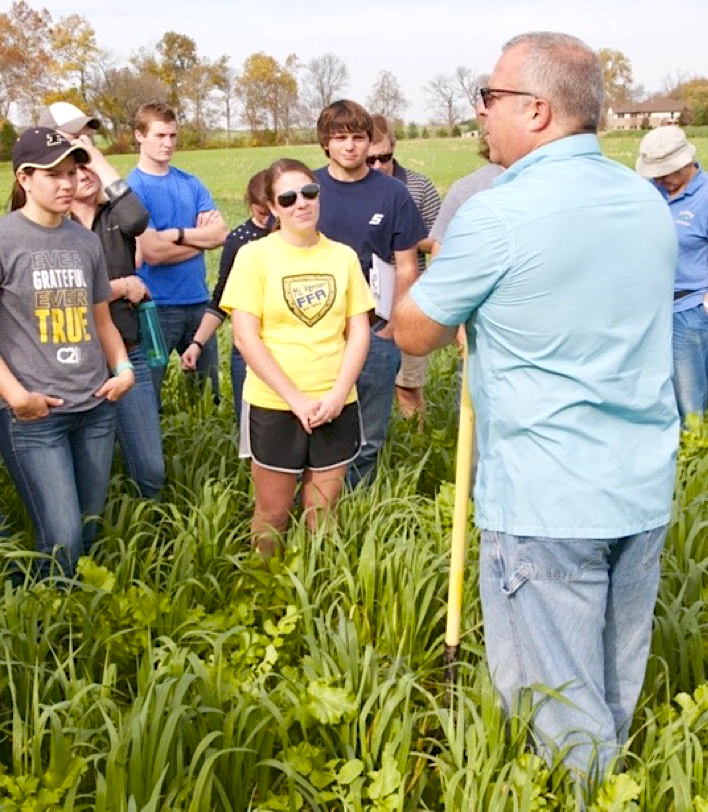
As far as the cattle themselves went, Dan and sons switched from having some stocker cows in dry lots to buying 180 mother cows and setting up intensive rotational grazing for the cow-calf system. The cows graze on cover crops as well as perennial plants in some fields. The beef is then marketed as grass-fed, as it is raised and finished on pasture.
Considering the large number of cover crop acres he had to seed, Dan invested in a 40-foot wide grain drill to seed most of his cover crop acres and allow him to plant quickly. He has also used a broadcast seeder integrated with a vertical tillage unit to seed cover crops. However, Dan prefers the seed-soil contact a drill gives him for establishing cover crops. The main reason he does a little vertical tillage on a few fields is as a follow-up in places where a contractor brings in hog manure and Dan needs to level the soil after manure spreading. The manure helps with his organic nitrogen needs as well as building soil organic matter.
In the past, Dan has used herbicides for termination of cover crops, but recently he has been shifting to using a custom-made 60-foot roller crimper, especially on all his soybeans planted green into cereal rye. Initially, he would roll the rye at the pollination stage; now he plants the soybeans while the rye is still in the boot stage if the timing works, then rolls the rye once the beans have emerged and are at the V2 growth stage. He likes that approach since it allows him to plant soybeans earlier. Dan said that with his transition to organic, he’s considering using light vertical tillage to help with termination of certain cover crops, though he wants to minimize soil disturbance. However, he commented that his priority is keeping living roots in the soil, even more than avoiding any type of tillage; he feels that to build and maintain soil health, he can’t get by without having plants in the soil year-round.
In a rotation before corn, Dan tries to avoid using cereal rye because of various potential issues, including army worms that they have seen regularly on the farm. Instead, he’s used a variety of approaches before corn. In some cases, he has planted earlier maturity beans the previous year, then planted a oat-radish-clover-hairy vetch cover crop mix, sometimes adding a little barley as well. His favorite approach before corn has been to grow winter wheat and then plant a diverse cocktail after wheat harvest. Now that he is doing more grazing of cover crops, he also has the opportunity to graze this cocktail.
Dan has also changed the way he does seed selection. About seven years ago, he started using GMO-free corn and soybean seed that was additionally free of insecticide and fungicide seed coatings. As a result of using corn seed that is free of seed coating treatments, he has adjusted his corn planting date to be a little later. His rule of thumb is to wait for corn planting until May 1 or later, also waiting until the soil temperature has reached 62°F or more at a depth of four inches under sod. He also looks at the projected temperature forecast for the week after his potential planting date. In some cases, he plants corn after alfalfa, and delays the planting date for the corn in order to allow the alfalfa to produce more spring nitrogen.
Another adjustment he has made to his operation in relation to cover crop use is to grow early-maturing corn, which gives him more time to drill cover crops after corn harvest. Planting the cereal rye cover crop before October 1 greatly enhances tillering and biomass, which is the key to achieving adequate weed control in no-till organic soybeans.
Looking ahead, Dan is hoping to identify a mix of covers that he can grow between his corn rows during the summer season, helping with weed suppression and biodiversity. If he could find a mix of perennials that would work and not have to be reseeded, that would be ideal to him. After his initial experimentation with in-season covers between corn rows, he has wondered if those covers help increase soil moisture in the form of providing extra surface area for dew to collect on and then drip into the soil.
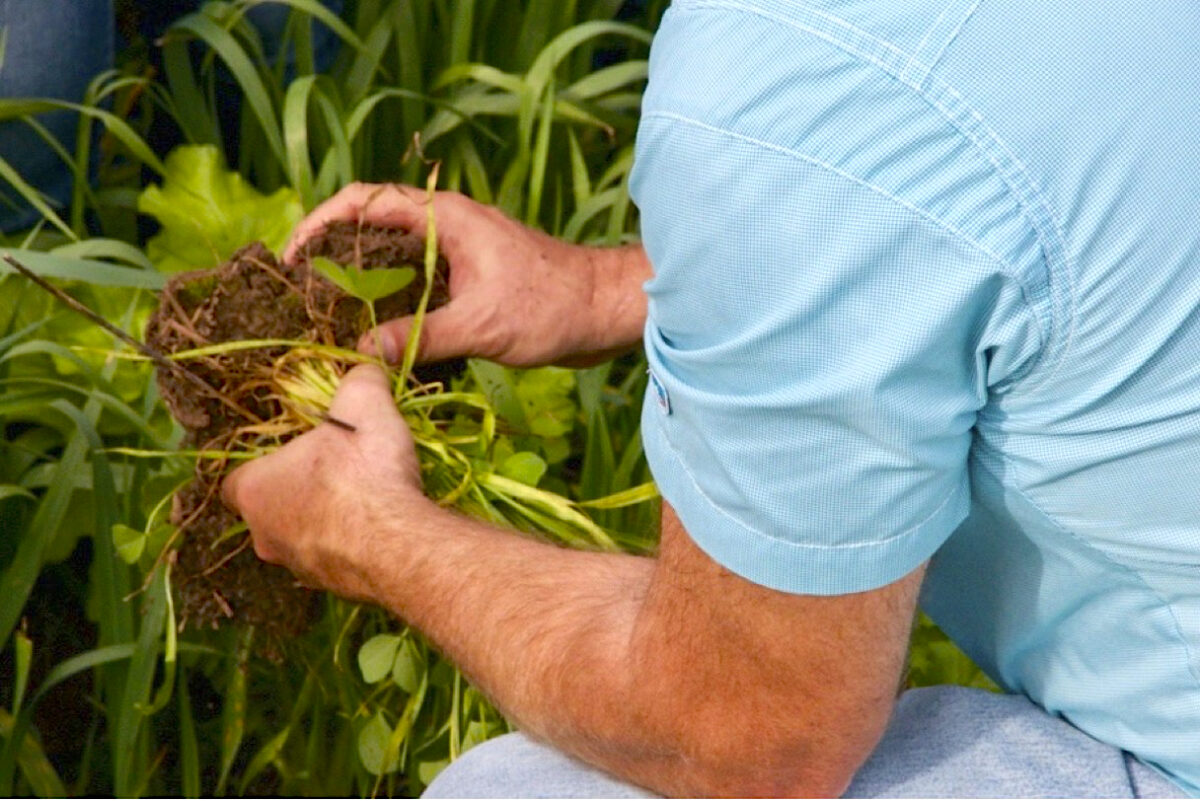
Dan has observed that his cover crops provide advantages in both wet and dry years. For example, in the drought of 2012, he had some fields with yields that were not much reduced compared to in wetter years, while his conventional neighbor saw some significant yield losses. Dan attributed that to better soil moisture retention in his long-term no-till and cover cropped fields. He also feels that cover crop residue helps minimize moisture loss and keep soil cooler.
In wet springs, the covers can be managed to help dry out the soil by letting them grow longer, which was helpful in the wet spring of 2019. However, proper termination timing is key to working with cover crops in both wet and dry springs.
In terms of profitability impacts of cover crops, Dan stated that you can’t have good soil health without living plants year-round, and improved soil health is, for him, an integral part of profitability. Before transitioning to organic, improved soil health from cover crops and no-till enabled him to use less fertilizer and other inputs and have more reliable production, resulting in a positive impact on profitability. The better soil health and increased profitability have not been at the expense of yields. In fact, in 2018 his crop insurance agent told him that his farm had the highest average production history (APH) yields of all the farms serviced by that agent in the region. Dan did comment that with his move to organic, his focus will be squarely on profitability rather than maximum yields, and he does expect corn yields to be somewhat lower than in the past, but higher prices and lower costs will more than offset the yield reduction. He is hoping that his organic soybean yields will be close to what he saw under his previous no-till and cover crop system.
Looking ahead, Dan is very motivated to keep using cover crops, because he has come to understand that healthy, functional soil requires living plant roots at all times. He shared that he hopes more farmers will come to recognize that the lack of living plants on conventionally farmed fields creates the need for a lot of expensive purchased inputs. He pointed out that farmers wanting independence from such high input costs should be thinking about how to make their soils more functional through increased use of living roots year-round, and other soil health practices.