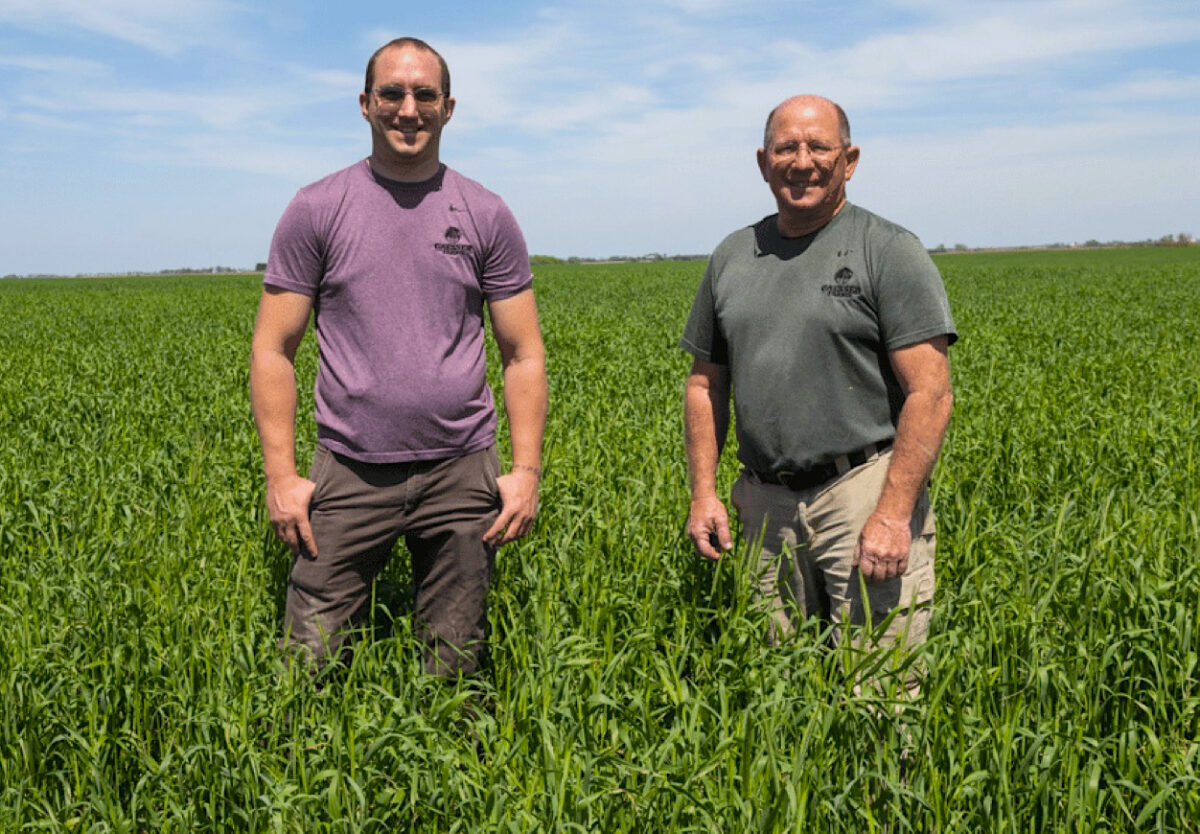
In May of 2010, Ray Gaesser and his son Chris watched with concern as an intense storm dumped over four inches of rain in less than an hour on their corn and soybean farm in southwest Iowa. Fields that were terraced and had been no-tilled for over 20 years still had damaging soil erosion, with some terraces breaking through from the heavy downpour. All their previous efforts at erosion control–the grassed waterways, terraces and no-till–just weren’t doing enough to protect their land and keep valuable topsoil from washing away. They started to think, what else can we do to protect our land? For them, the answer was to try cover crops, so they planted 200 acres of cereal rye that fall.
Pleased with the initial results from that first cover crop experience in 2010, they kept doubling the area of cover crops they planted for the next several years, concentrating at first on their most erosive hill ground. They were grateful for that cover crop protection of their soil, because for the next six years, every year they had at least one intense rainfall event of four or more inches of rain in an hour. By 2015, they were up to 2,500 acres of cover crops planted. From that point on, they have planted as many acres of cover crops as time permits each fall. In the fall of 2021, they managed to plant 3,400 acres of their 5,000 acres to cover crops.
Approach to seeding cover crops
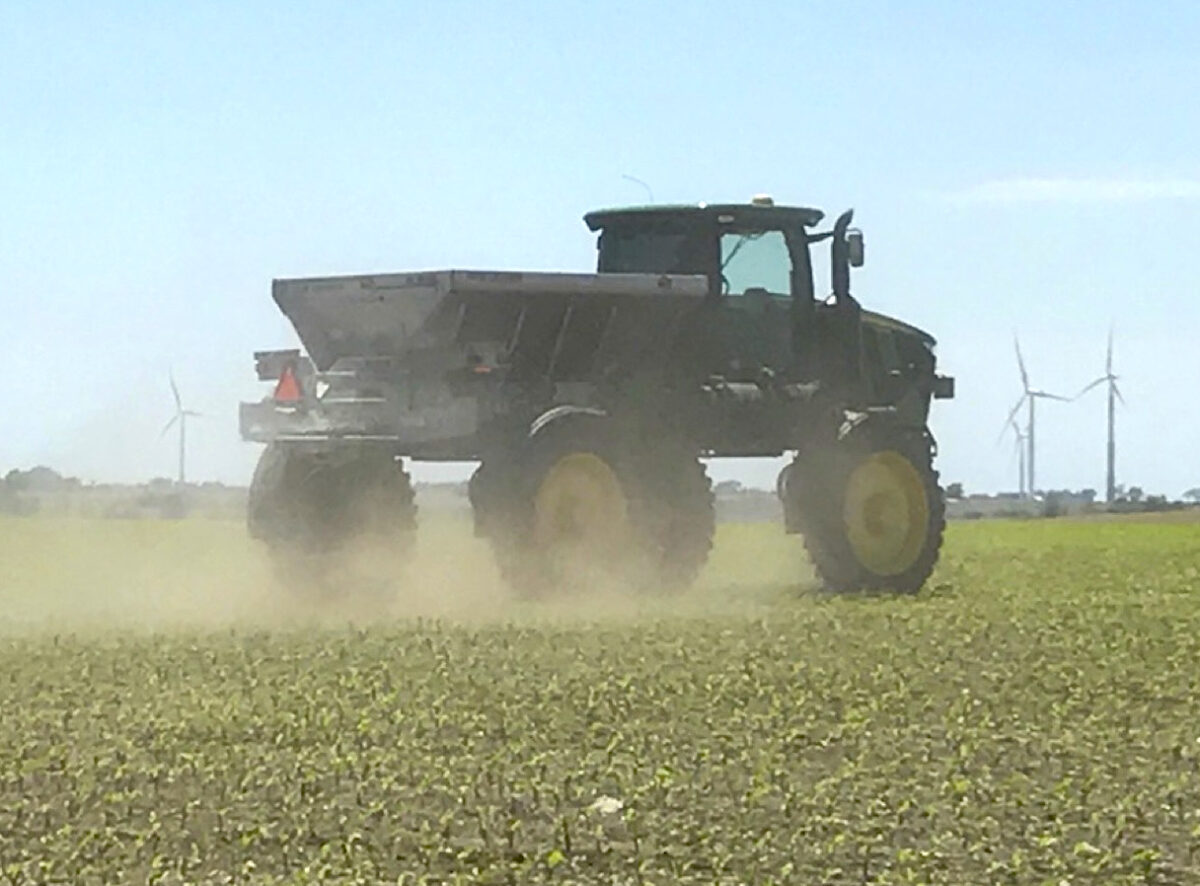
At first, all their cover crops were seeded with a grain drill. The grain drill was a reliable way to plant the cover crops and worked well with the cereal rye they were mainly using. However, the extensive cover crop planting was putting quite a bit of wear on their grain drill and they wanted to be able to plant more acres more quickly, so they started evaluating other options. They ended up switching most cover crop seeding to use of a John Deere R4030 high-clearance machine that they could spray chemicals with, switching out the spray tank to use a New Leader spreader box for both cover crop seed in fall and granular fertilizer for side-dress applications on corn in early summer–usually urea or ammonium sulfate applied at the V6 stage.
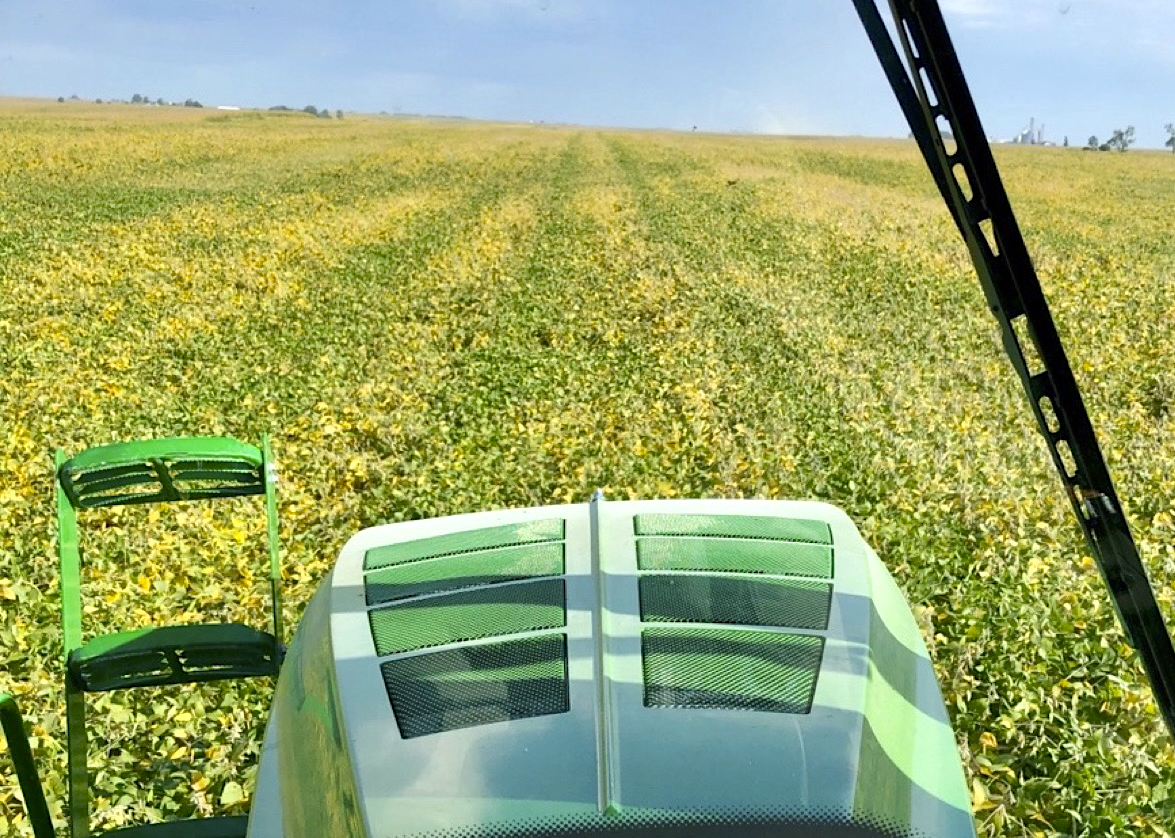
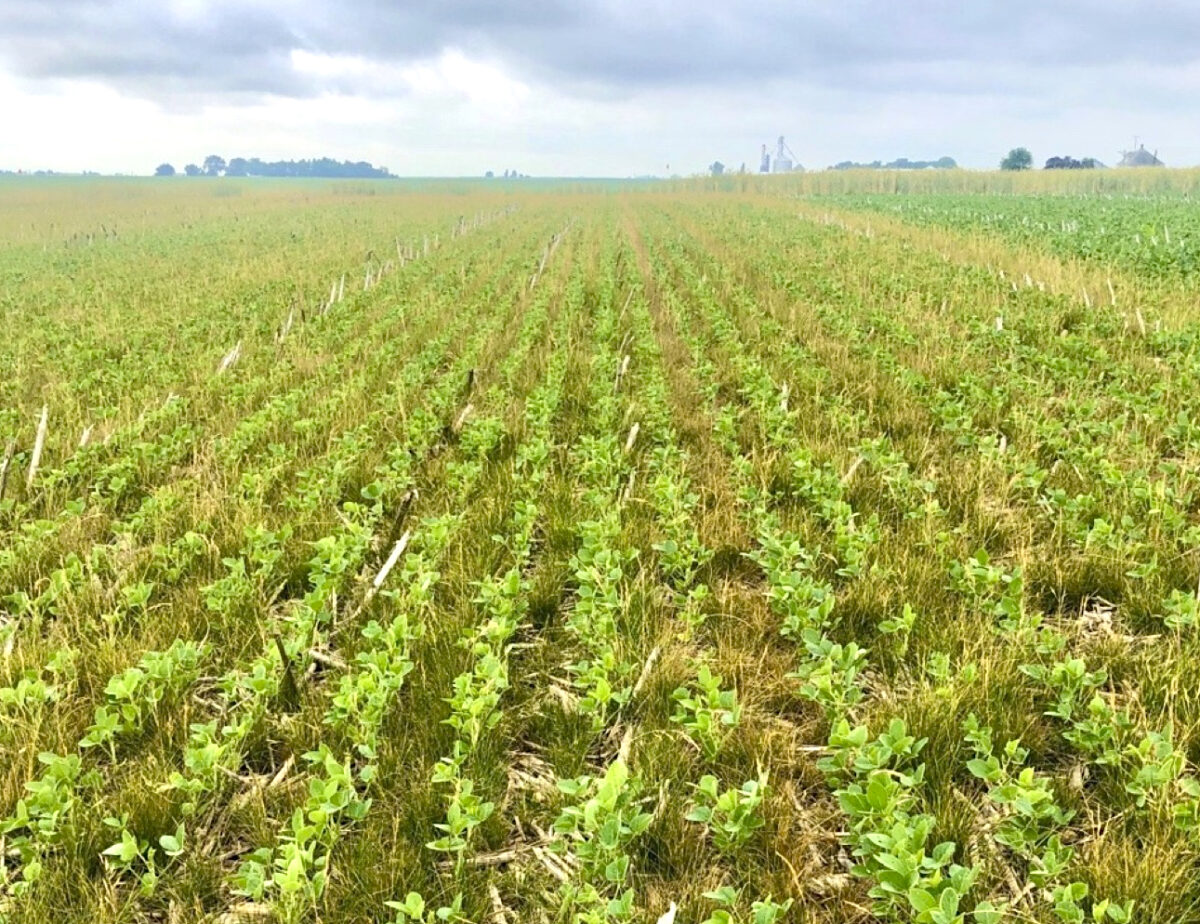
The broadcast spreader has allowed them to cover more ground for cover crop seeding, up to 100 acres per hour. It has also allowed them to change the timing of seeding in soybean fields. Starting in the fall of 2019, instead of drilling after soybean harvest, they now broadcast seed into the soybeans before harvest, following the same sprayer tracks used for herbicide spraying earlier in the season, on 100-foot intervals. The broadcast spreader will throw the cereal rye almost 100 feet wide, but they have to be careful about not doing it on really windy days because the broadcast pattern can be too affected by the wind.
Ray said timing of the broadcast spreading into standing soybeans is very important. They try to go out when the soybean leaves are just turning yellow and the first leaves are starting to fall. If they go any earlier, the still-green soybeans can shade out the rye, preventing it from becoming established. And if they go too late, when there is a thick layer of soybean leaves on the ground, that can leave the rye seed sitting on top of soybean leaves instead of in contact with the soil; adequate seed-to-soil contact is critical for germination and establishment. Ray did comment that a good rainfall makes everything simpler, because it will wash the rye seeds into better contact with the soil. If rain is forecast, they can seed even if there is already a moderate amount of soybean leaves down.
Doing a substantial amount of cover crop seeding prior to soybean harvest prevents time conflicts during the busiest stretch of fall harvesting and gives the cover crop more time to grow, which is good for the soil and creates more grazing opportunities.
Following corn, they use a different approach: they wait until right after the corn is harvested, then try to seed rye immediately within a day or two of corn harvest, or even the same day. Ray commented that they have found doing the rye broadcasting while the corn residue is still loose and fluffy on the ground allows the rye seed to pass down through the corn residue and into contact with the soil better than if they wait until after the corn residue has started to pack down.
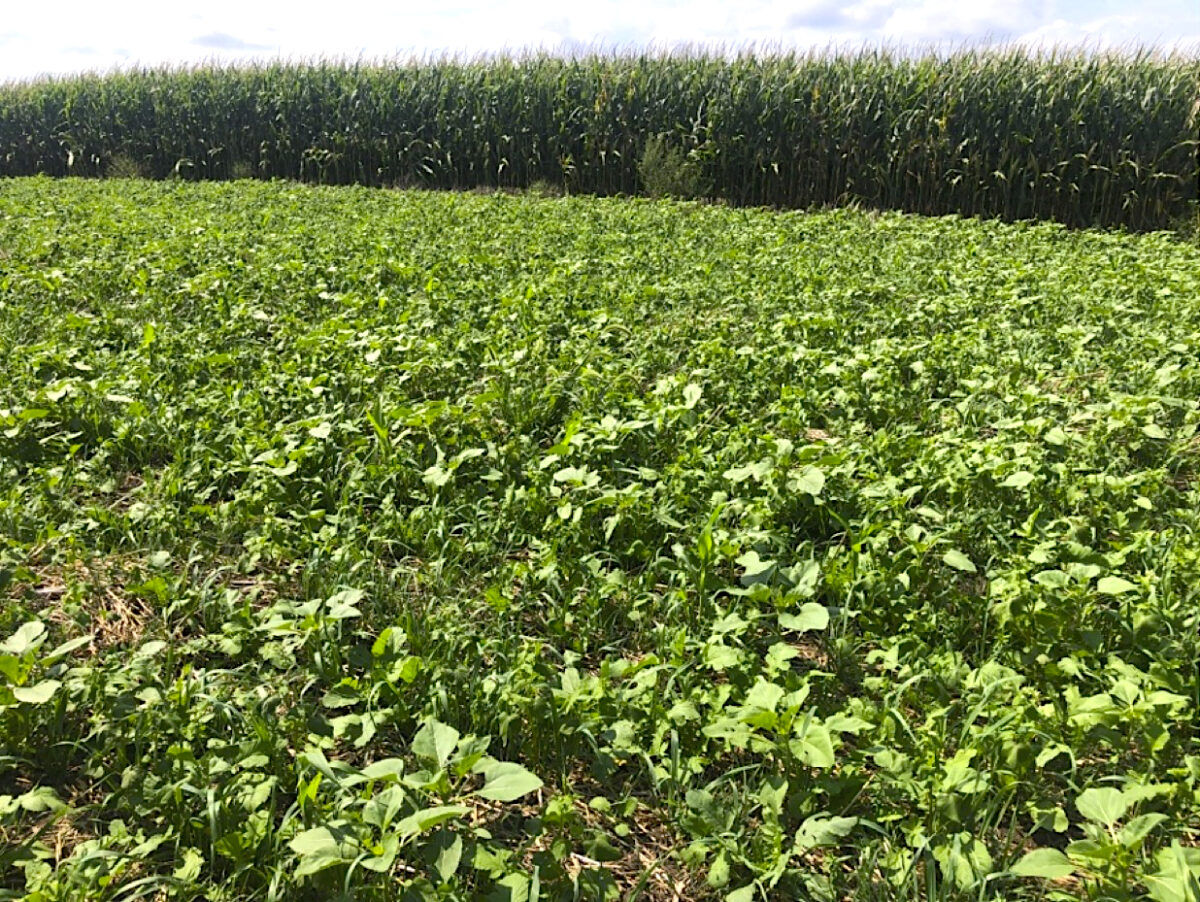
Most of their cover crop acres are cereal rye. However, they do plant a diverse cocktail mix of cover crops on fields where the rye was grown for harvest. Each year, they devote some land to growing their own cereal rye cover crop seed, and after harvesting that rye in early August, they drill in a mix of warm season and cool season cover crops, such as sunflowers millet, canola, mustard, and other Brassicas, and various legumes. When they can, they work with neighbors that have cattle to graze that cover crop mix.
They have also collaborated with neighbors on grazing some of their cereal rye cover crop. The neighbors will bring in cattle for about 30 days of grazing, using portable electric fencing and portable water supply. This provides extra income, and Ray feels that the grazing builds soil health and has gotten some of his neighbors interested in cover cropping. The rental rate for grazing the cover crop ground is based on the number of days of grazing and the number of cattle per acre.
When they are growing cereal rye for their own seed production, they drill it at the rate of 80 pounds per acre using a named variety. They buy fresh certified or registered seed every three years or so, otherwise using their own farm-produced rye for additional cover crop seed production.
For all their other acres of cereal rye cover crop seeding, they broadcast at a more moderate rate of about 50-55 pounds per acre. Ray said they value the seed they grow at about $10 a bushel, and since the seeding rate is about a bushel per acre, they have an affordable seed cost of $9-$10 per acre (a standard bushel of cereal rye is considered to be 56 pounds). Their cost of seeding is about $5-$6 per acre using their broadcast spreader, including cost of equipment, fuel, and labor. Thus, their total cost of seeding is currently $14-$16 per acre.
Ray said they’ve gotten better at producing cereal rye seed for their own use, and now typically get a yield of 50-60 bushels per acre. Given the low input costs for growing the rye for seed, it is a profitable part of their operation. He pointed out that cereal rye seed production is usually done on their poorer soils, which can be improved by using the rye production, followed by a diverse cover crop cocktail and often some grazing.
Ray and Chris are continuously trying to learn and innovate, so they are exploring additional cover crops and rotation options. For example, they have worked with Corteva researchers to try experimental plantings of yellow peas broadcast into soybeans in the fall. The peas are harvested the next August and a diverse mix of cover crops, including oats and sorghum, is planted afterwards.
They’ve also participated in a joint project with Iowa State University and Corteva researchers the last couple of years trying to establish Kentucky bluegrass as a permanent cover crop in trial plots. The bluegrass is seeded in the fall. Ray said they’ve found it easy to no-till soybeans into the Kentucky bluegrass the next spring; they apply some Liberty herbicide to the bluegrass before corn or soybean seeding to set the bluegrass back a bit (the herbicide temporarily browns the bluegrass for a couple of weeks while the corn or soybeans start to grow). Planting corn into the bluegrass has been a bit more challenging than with soybeans. Ray feels they may need to clear a narrow planting strip with trash-clearers or equivalent devices on the planter when doing future planting of corn into Kentucky bluegrass. In the couple of years of small trials to date, the bluegrass has survived beneath the growing soybeans pretty well, but it’s been more challenging to keep the bluegrass alive under corn and to figure out the best herbicide regimen. However, they continue to experiment!
Termination and cash crop planting
The Gaessers used to terminate their rye before soybean planting, but starting in 2019, they switched to planting most soybeans into still-living rye (planting green). They usually spray-terminate the rye within a day or two of soybean planting, or sometimes immediately before, depending on weather conditions.
This change to planting green was partly precipitated by weather conditions, because they had a very wet spring in 2019 and were not able to terminate their rye as early as usual; the plus side of this was that the rye cover crop fields were able to be planted sooner than the ones without cover crops.
Ideally, they like to plant the soybeans when the cereal rye is about 2-2.5 feet tall; they prefer not to let the rye head-out before planting. Ray said being able to use the rye as a soil moisture management tool in spring is a big reason for planting green, as it allows them to dry wet fields out a little and plant earlier compared to fields with no rye. He also likes maximizing the cover crop benefits by letting the rye grow a little longer, and said the bigger rye does a better job of holding corn residue in place when a big spring rain comes, rather than the residue washing away and piling up in big clumps downslope.
They are not yet comfortable planting green with corn, so they terminate the rye when it is about 6-12 inches tall and then plant the corn about 10 days later. Ray felt that if they were going to start planting corn into still-living rye, they would need to change their planter setup so they could apply nitrogen starter fertilizer.
Their overall corn nitrogen program, whether they use cereal rye or not, is to apply 120 units of nitrogen in late fall as anhydrous and then do a side-dress application of granular urea or ammonium sulfate nitrogen fertilizer into the corn when it is at about the V6 stage. They do the fertilizer application themselves and base the side-dress rate on charts that take into account rainfall, soil factors, and yield goal.
To plant soybeans, they use a John Deere air drill and 10-inch rows. Corn is planted on 30-inch rows with a no-till planter that is set up with no-till coulters, but not trash-cleaners. For closing wheels, they’ve found standard smooth wheels work well. They use a steel closing wheel on one side of the furrow paired with a rubber closing wheel on the other side.
When asked about any changes to their fertilizer or chemical program, Ray said they’ve pretty much stuck with their standard fertilizer rates, though they continue to evaluate that. However, they have been able to use less herbicide at times. If they produce a large-enough amount of rye biomass, they are often able to get by with one post-emerge herbicide spray application instead of the two post-emerge sprays they would more typically do.
Ray also commented that cereal rye has helped significantly with lambsquarter and waterhemp control, based on rye’s allelopathic ability to help suppress small-seeded broadleaf weeds. Another weed control impact is that marestail, which is a general problem in the region, has nearly disappeared on their farm, due to rye’s potent ability to prevent it from growing.
Soil health impacts
When asked about soil health impacts from cover crops, Ray shared that NRCS staff had come out to his farm the previous year for some staff trainings and did soil tests while there. He was particularly interested to see the results of the water infiltration tests on his fields. A field by his house that had been cover cropped for 10 consecutive years and underwent 30 years of no-till was tested for water infiltration in April after a dry spell. That field soaked in an inch of water in 2-3 seconds; when a second inch was added, it infiltrated in 30 seconds–still very quick. The NRCS staff then repeated the test on a field about a half-mile away that Ray had recently started renting, which had been conventionally farmed up to that point. For that field, the first inch took much longer at 7-8 minutes (compared to 2-3 seconds on the first field).
The rainfall infiltration test was repeated in late May on a second NRCS staff visit when the corn was about 6-8 inches tall. Unlike the previous occasion when the ground was dry, the soil was wet because it had rained 5.7 inches the previous week. Despite all the recent rain, the long-term cover crop and no-till field by Ray’s house still soaked up an inch of water in less than two minutes. When they repeated the infiltration test at the rented field that had been conventionally farmed, they tried the one-inch infiltration test for 15 minutes and then gave up, because the inch of water in the column had only partially soaked in.
NRCS staff also demonstrated that soil aggregate structure was much better on the long-term cover crop no-till field by using a slake test (putting a clod of soil from each field in a large tube of water). The soil from the field that was rented and previously conventionally managed had poor soil structure, with the soil clods breaking apart quickly in the water column, indicating that the field would be highly prone to erosion.
Ray commented regarding those two fields that when it got dry later that summer, the field by his house stayed green and healthy while the rented field a half-mile away was showing moisture stress, likely because some of the rain had run off of that field instead of soaking in.
Other observations by Ray from cover cropping are that his fields no longer have water ponding up in low areas, reflecting better drainage. Very importantly, he and Chris have been able to plant the cover-cropped no-till fields earlier than neighboring fields that have been conventionally tilled and have no cover crops.
In fields where the Gaessers have had long-term cover crops and done no-till, their yields are noticeably better than in fields they’ve recently rented that have been conventionally farmed.
Ray also mentioned that when contractors come to work on their waterways, terraces, or tile lines, the contractors routinely comment on how surprised they are by the lack of erosion on the farm and how easy the soil is to work with compared to conventionally managed fields on other farms.
I asked Ray what motivates them to keep using cover crops. His response:
“First thing is, it’s a long-term investment in the future, it’s a wise and morally right thing to do, it keeps the soil where it belongs, and keeps the water clean. Second, we’re more financially resilient with cover crops and no-till.”
When asked what he would tell farmers still considering whether to use cover crops, Ray said to start small and give yourself a chance to learn how to do it. Also, recognize that this is about protecting your investment (Chris really stresses that, too), and there are lots of good reasons to use cover crops. Understand that it can take time to see results, but they will come!