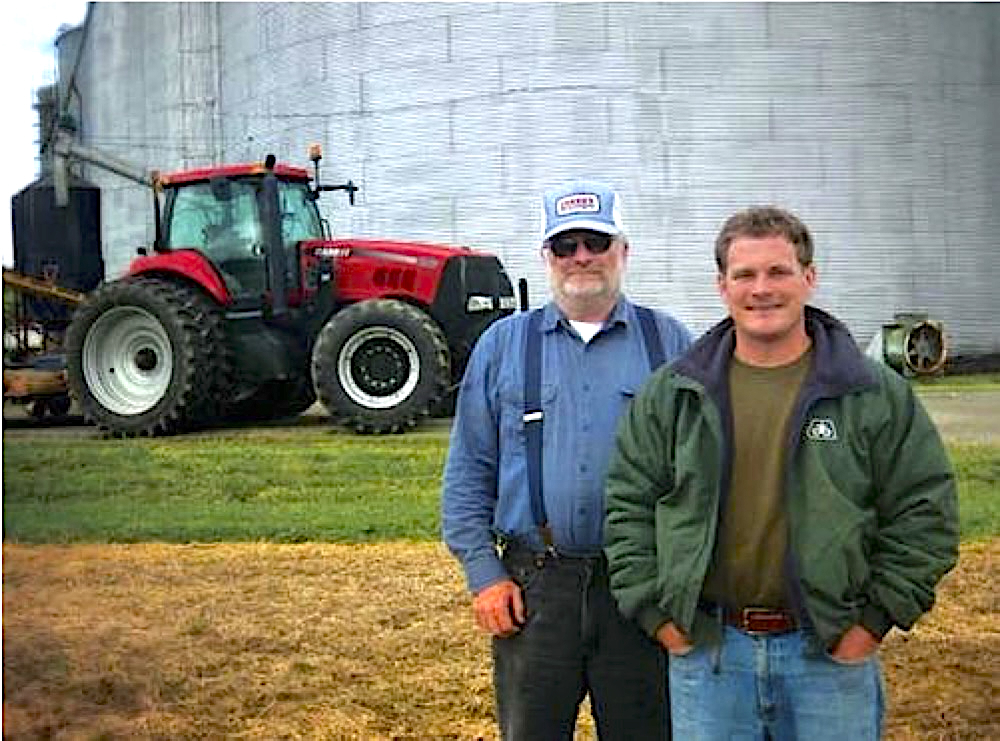
As reflected in the name of their operation, Harborview Farms, Trey Hill and his family live and farm very close to the Chesapeake Bay, America’s largest estuary and an important body of water for fishing, crabs, shipping, and recreation. He and his father first got started with cover crops in 1998, following efforts by the Maryland state government to start doing a better job of protecting the water quality of the Chesapeake Bay watershed. Trey farms in an area that consists largely of flat fields of corn and soybeans, not too dissimilar in appearance from the grain fields of the Midwest, except for the nearby seagulls and smell of saltwater. Trey’s initial interest in cover crops was motivated by payments offered for planting them, but he quickly came to see the inherent value of cover crops.
Over the nearly 25 years that have passed since they started using cover crops, Trey and his father have made a number of changes to their operation as they’ve gained a better appreciation for soil health management. Trey has experimented with a variety of cover crops, reduced tillage on his farm, and made use of small grains (primarily wheat) where feasible. Initially, his tillage system consisted of using a chisel plow on at least half his acres and frequently deep-ripping the soil. Spring planting preparation involved disking and running a field cultivator. He wanted to move towards no-till, but was seeing some decreases in yields when making the switch to no-till on a field. Then he found that using a cover crop first and then making the switch to no-till could alleviate much of that yield depression and make the transition to no-till easier.
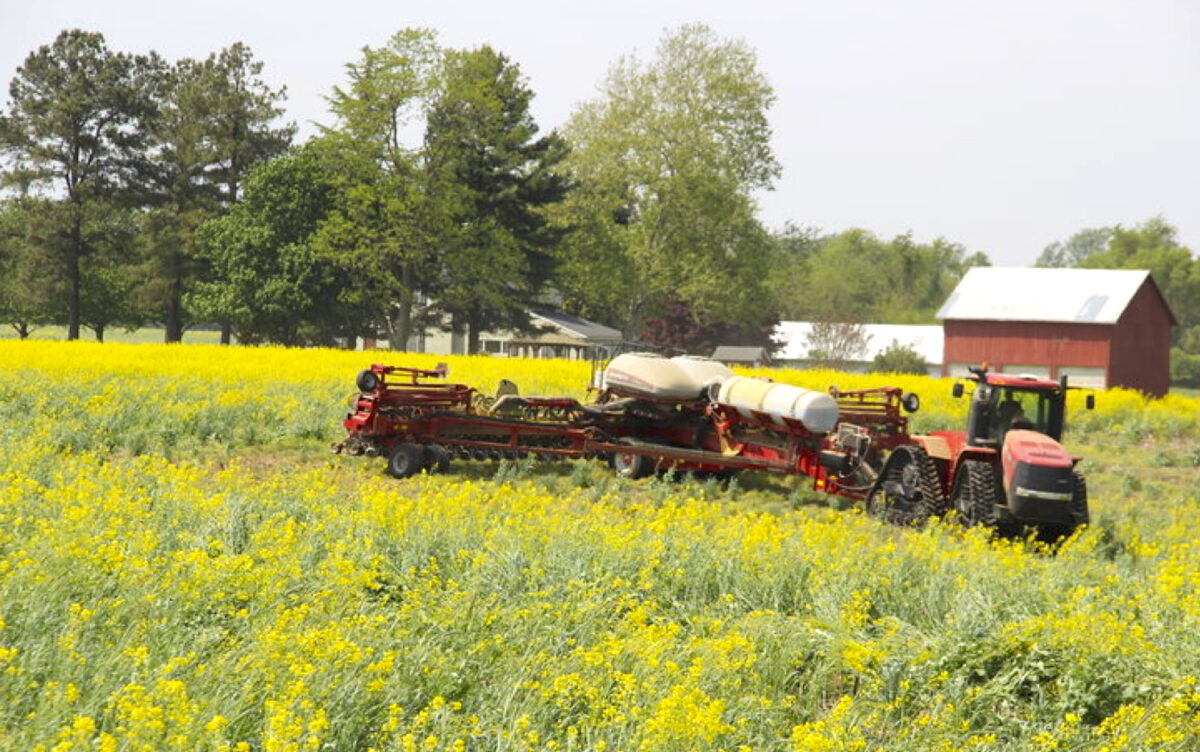
He now plants cover crops on all 13,000 of his row crop acres and uses no-till on most fields. His first cover crop was winter wheat, but over the years, he’s used crimson clover and hairy vetch as legumes; radishes and rapeseed from the Brassica group; and barley, cereal rye, and winter wheat as cereal covers. Since he doesn’t have livestock, the grazing value of the cover crop doesn’t factor in, but Trey does think about feeding the biology of the soil organisms and the value of having a variety of cover crops.
When planting cover crops, his preference is to drill them in for optimal seed-to-soil contact, which he does on about 75% of his acreage. Some are broadcast-overseeded into standing corn and soybeans to give them an earlier start, and to get some of the cover crop seeding out of the way earlier.
Over the years, Trey has moved from early termination of cover crops to allowing them to grow longer, and now tries to always plant green with his cash crops into still-living cover crops. For soybeans planted into living cereal rye, he sometimes uses a roller crimper for termination, but most of his cover crops are spray-terminated, usually soon after the corn and soybean planting. He has experimented with late termination, waiting as many as four weeks after cash crop planting to terminate a cover crop in order to gain some extra biomass. He is particularly likely to let the cover crop continue growing if the soil is cold and wet when planting his corn or soybeans.
While he has kept his nitrogen fertilizer rates the same as before he had cover crops in the system, he has adjusted the method of nitrogen application, particularly for high-biomass cover crops before corn. If there is quite a bit of cover crop growth, he applies extra starter nitrogen at corn planting time using a 2x2 applicator on the corn planter, which places nitrogen two inches to the side and two inches below the depth of the seed placement. He then applies 30-40 pounds of nitrogen as a sidedress application in the same equipment pass made for applying herbicide to the field, while the corn is emerging or still small. He usually does a later in-season sidedress application of 100 pounds of nitrogen per acre, too. He no longer does any fall nitrogen application, and believes timing the majority of nitrogen application to be when the corn is actively growing is the best strategy.
Trey indicated that he has been able to cut back on some herbicide costs. For example, he used to apply 6 pints of Lexar herbicide per acre, and now when he uses it he can get by with 4 pints per acre. Where he used to rely on residual herbicides with soybeans, he is now getting by with just a post-emerge application in many cases.
Trey shared the story of how the cover crops on one of his fields had excellent growth and achieved five tons of biomass per acre, leading to excellent weed control. In contrast, there was a check strip in that field that was tilled, and it was absolutely loaded with weeds.
Another benefit of cover crops has been the ability to plant earlier in many cases. He used to plant corn starting in mid-April and now finds that he can often start planting corn at the end of March, ahead of the corn planting in neighboring fields. Trey attributes this earlier start to the cover crops helping cold, wet soils reach planting condition faster, along with better soil structure and drainage in the cover-cropped fields.
Slugs have been an occasional problem with his cover crops, so Trey and his IPM consultant continue to fine-tune their approach to reduce the chance of slugs occurring. Otherwise, Trey has been very happy with the contributions from cover crops, as evidenced by the fact that he uses them on every acre of his farm. He has benefitted from cover crop payments through the Maryland Department of Agriculture and has appreciated participating in the state cover crop program, but feels that at this point he would continue even without the financial assistance. More recently, Trey was able to enroll some of his fields in a soil carbon program and receive extra payments for the soil carbon being sequestered by his cover crops and other management practices.
For farmers just getting started with cover crops, Trey recommends developing a plan and evaluating what goals they have for the cover crops. He feels he has benefitted from experimenting with a variety of approaches, so he recommends that other farmers be ready to test out a variety of cover crop methods and see what works for them.