Showing 81-90 of 123 results

Manage Weeds on Your Farm: An Ecological Approach

Sustainable weed management is essential for improving crop yield and increasing farm and ranch profitability. SARE’s newest book, Manage Weeds on Your Farm: A Guide to Ecological Strategies, examines the biology and behavior of common weeds and provides an integrated set of non-chemical control strategies that exploits their weaknesses. Manage Weeds on Your Farm will help organic and conventional farmers alike better understand and manage weeds efficiently, effectively and ecologically.

Manage Weeds on Your Farm features profiles of five farmers who use the physical, ecological and biological factors of common weeds to develop science-based management strategies appropriate for their operations. “In my opinion, this book has the best information on weed management that is available today,” says Klaas Martens of Lakeview Organic Grain of Penn Yan, N.Y. “Our understanding of weed control is still growing rapidly, and this book will certainly become an invaluable tool for every farmer who wants to control their weeds sustainably.” 

Manage Weeds on Your Farm: A Guide to Ecological Strategies is written by the late Charles L. Mohler, John R. Teasdale and Antonio DiTommaso; it is published by SARE. 

Manage Weeds on Your Farm: A Guide to Ecological Strategies is free to read online or to download as a PDF at www.sare.org/weeds. Print copies can be ordered online for $24 each, plus shipping and handling. Call (301) 779–1007 for telephone, tax-free, rush or purchase orders. Discounts apply for orders of 10 or more copies.

Posted in 1

SARE Welcomes New Associate Director Dr. Kristy Borrelli

The Sustainable Agriculture Research and Education (SARE) program is pleased to announce that Dr. Kristy Borrelli has been hired to serve as its new associate director. Borrelli will lead SARE’s National Reporting, Coordination and Communications Office at the University of Maryland effective November 1, 2021.

As SARE’s associate director, Borrelli will manage communication with regional SARE offices, assist with grant administration and reporting, and facilitate interaction with other programs. The associate director also leads SARE’s national communication team and coordinates the evaluation and communication of SARE’s national impact. She succeeds Dr. Kim Kroll, who is retiring after serving as SARE’s associate director since 1996.

Borrelli, a Penn State University Extension educator specializing in agronomy, currently serves as SARE’s Pennsylvania coordinator and previously served on the Northeast SARE Administrative Council. Prior to her time in Pennsylvania, she was an Extension specialist at the University of Idaho, where she collaborated with a multi-state, NIFA-funded project that examined approaches to climate change in the Pacific Northwest.

Borrelli grew up on a family farm in Upstate New York, received her bachelor’s in environmental biology from SUNY ESF, and her master’s and doctorate in soil science from Washington State University. Her main research and extension focus has been on soil organic matter dynamics in grain-based cropping systems, especially for specialty market crops. She has received multiple SARE grants examining the maintenance of agroecosystem functions, farmer engagement in sustainable agriculture research and service provider networking.

Posted in 1

Updated Building Soils for Better Crops Focuses on Soil Health Fundamentals

Now more than ever, it is abundantly clear that healthy soils play an essential role in productive agricultural systems. Soils are foundational to the food we eat and fundamental to life on earth. Focusing on sustainable soil management has shown to increase farm and ranch profitability, improve crop yield and provide other critical services related to water, air and climate. SARE’s newest book, the fourth edition of Building Soils for Better Crops, provides rich detail on ecologically sound practices for developing and maintaining healthy soils. It is a must-read for farmers, educators and students alike.

The new edition of this highly regarded book provides critical updates to reflect the new science and many new, exciting developments in soil health over the past 12 years. Building Soils for Better Crops includes detailed information on soil-improving practices as well as in-depth background, from what soil is to the importance of organic matter. Along with providing practical strategies for achieving agricultural sustainability with high-quality soil, the book presents readers with a holistic appreciation of the importance of soil health.

Building Soils for Better Crops is written by Fred Magdoff (University of Vermont emeritus professor of plant and soil science) and Harold van Es (Cornell University professor of soil science); it is published by the Sustainable Agriculture Research and Education (SARE) program. 

Building Soils for Better Crops is free to read online or to download as a PDF. Print copies can be ordered online for $23 each, plus shipping and handling. Call (301) 779-1007 for tax free, rush or purchase orders. Discounts for bulk orders apply.

Posted in 1

New SARE Bulletin Highlights Best Practices for Adult Learning

Studies show that farmers learn best through in-person, face-to-face educational programs. But learning opportunities often miss the mark due to content choice, disorganization or lack of understanding of participants' learning styles. Educators that use best adult learning practices have a greater effect on participants’ learning and retention, and empower farmers to make sustainable changes to their operations. 

SARE’s newest free bulletin, Sustainable Agriculture Through Sustainable Learning, presents five best practices educators can use to facilitate effective learning among farmers and thus improve agricultural sustainability. 

Incorporating effective learning practices before, during and after educational programs is crucial to encouraging learning among farmers. Educators can maximize the impact of learning opportunities by:

  • making the content relatable
  • engaging positive emotions
  • giving learners choice
  • identifying mental models and
  • providing opportunities for practice and application

Sustainable Agriculture Through Sustainable Learning examines the science behind each practice and examines how it aids in adult learning. The guide also provides strategies for incorporating best practices to improve educators' teaching or their own professional development outcomes.

Download or order your free print copy of Sustainable Agriculture Through Sustainable Learning at https://www.sare.org/resources/sustainable-agriculture-through-sustainable-learning/ or by calling (301) 779–1007. Sustainable Agriculture Through Sustainable Learning is available in quantity for free to educators for use in educational workshops, classes or tours.

Posted in 1

SARE Seeks Applications for Associate Director Position

The University of Maryland seeks an Associate Director for the National Reporting, Coordination and Communications Office (NRCCO) of the Sustainable Agriculture Research and Education (SARE) program. 

This Associate Director position is appropriate for both experienced and early career professionals. See https://ejobs.umd.edu/postings/82240 for a full job description, responsibilities, qualifications and application guidelines. Submit applications by the best consideration date of 05/14/2021.

The Associate Director for the NRCCO works directly with the SARE National Director to manage many aspects of SARE program coordination and communication. The Associate Director works with the regional offices to ensure project reports are completed and project information is publicly available. The NRCCO also works with national staff to aggregate, evaluate and communicate project results and programmatic impact for the national SARE program. Job responsibilities include communication with regional offices, assisting with grant administration, producing reports, representing SARE at local and national meetings, and facilitating interaction with other programs relevant to sustainable agriculture. The Associate Director also provides leadership for an experienced staff (content coordinator, outreach and promotions coordinator, IT coordinator, multimedia coordinator and a business manager). 

This is a 12-month, full-time professional staff position with a full benefits package provided by the University of Maryland with funding from the USDA. Questions regarding this position should be directed to kkroll@sare.org.

SARE is funded and administered at the national level by the USDA National Institute of Food and Agriculture (NIFA), headquartered in Kansas City, MO. NIFA works cooperatively with four universities that serve as competitively selected regional host institutions. These host institutions fund competitively selected sustainable agriculture research, education, and extension programs in their respective regions. NIFA also funds the competitively selected NRCCO through a cooperative agreement with the NRCCO’s host institution. This office serves a core role to help administer the SARE program, support research and educational functions, and perform program outreach. 

The University of Maryland, College Park, an equal opportunity/affirmative action employer, complies with all applicable federal and state laws and regulations regarding nondiscrimination and affirmative action; all qualified applicants will receive consideration for employment. The University is committed to a policy of equal opportunity for all persons and does not discriminate on the basis of race, color, religion, sex, national origin, physical or mental disability, protected veteran status, age, gender identity or expression, sexual orientation, creed, marital status, political affiliation, personal appearance, or on the basis of rights secured by the First Amendment, in all aspects of employment, educational programs and activities, and admissions.

Posted in 1

New "Conservation Tillage and Soil Health" Video from SARE

The newest episode of SARE’s “What is Sustainable Agriculture?” animation series illustrates how many producers are retiring conventional tillage equipment and turning to conservation tillage to improve soil health and productivity. “Conservation Tillage and Soil Health” provides a short, animated outline of the basic principles of conservation tillage that can be used to introduce or complement more detailed training materials.

Conservation tillage, including reduced and no-till systems, can help farmers protect the resilience of soil and yield numerous benefits:

  • Increased crop yields
  • Improved soil structure
  • Reduced erosion
  • Increased organic matter
  • Greater soil fertility

Conservation Tillage and Soil Health” is now available for viewing and sharing at www.sare.org and on YouTube. Farmers, ranchers, educators, and other agricultural professionals may download the video and/or embed it without modification into websites or other fair use educational presentations. This video series was produced through a collaboration of the Sustainable Agriculture Research and Education (SARE) Program and Pixeldust Studios.

Posted in 1

New “Cover Crops and Soil Health” Video from SARE

The newest episode of SARE’s "What is Sustainable Agriculture" animation series illustrates how producers can use cover crops to improve productivity and sustainability. In just a few short minutes, “Cover Crops and Soil Health” outlines how cover crops can build soil structure, protect water quality, suppress pests and improve a farm's bottom line.

Combining cover crops and reduced tillage can also help farmers:

  • Manage soil nutrients
  • Reduce erosion and compaction
  • Improve water holding capacity and infiltration
  • Reduce input costs
  • Increase yields

“Cover Crops and Soil Health” is now available for viewing and sharing at www.sare.org and on YouTube. Farmers, ranchers, educators and other agricultural professionals may download or embed the video without modification into websites or other noncommercial educational presentations. The entire "What is Sustainable Agriculture" series is also available on YouTube. This video series was produced through a collaboration of the Sustainable Agriculture Research and Education (SARE) program and Pixeldust Studios.

Posted in 1

Updated Guide to USDA Programs Opens Door to Millions of Dollars of Available Funding

It can be difficult for farmers and ranchers to navigate the wide range of USDA resources and stay up to date with program changes after each Farm Bill. Thanks to the newly updated Building Sustainable Farms, Ranches and Communities, producers, researchers, nonprofits and landowners can easily find USDA programs that can help them achieve their goals. 

Download Building Sustainable Farms, Ranches and Communities

The 101-page guide covers 62 government programs and has been updated to include program updates from the 2018 Farm Bill. Each program listing provides a description of the program’s available resources, information on how to apply, and in some cases, examples of how the funding has been used. The guide also includes basic information on how to design sound projects, find appropriate programs and write grant applications.

“Farmers are hungry for resources to help them get started or answer specific questions. Building Sustainable Farms, Ranches and Communities provides a comprehensive, one-stop-shop to many helpful programs,” says Kerri Ebert, coordinator of the Kansas Center for Sustainable Agriculture and Alternative Crops. 

Building Sustainable Farms, Ranches and Communities is now available as a free download. Free print copies are also available from the National Center for Appropriate Technology’s ATTRA program. To order, email pubs@ncat.org with your request. Don’t forget to include your shipping address. Building Sustainable Farms, Ranches, and Communities was produced through the collaboration of SARE, the Michael Fields Agricultural Institute (MFAI), the National Center for Appropriate Technology (NCAT), and the National Sustainable Agriculture Coalition (NSAC). Funding was provided by SARE, the Agricultural Marketing Service (AMS) and the McKnight Foundation.

Posted in 1

New SARE Bulletin Addresses Ecological Approach to Managing Pests

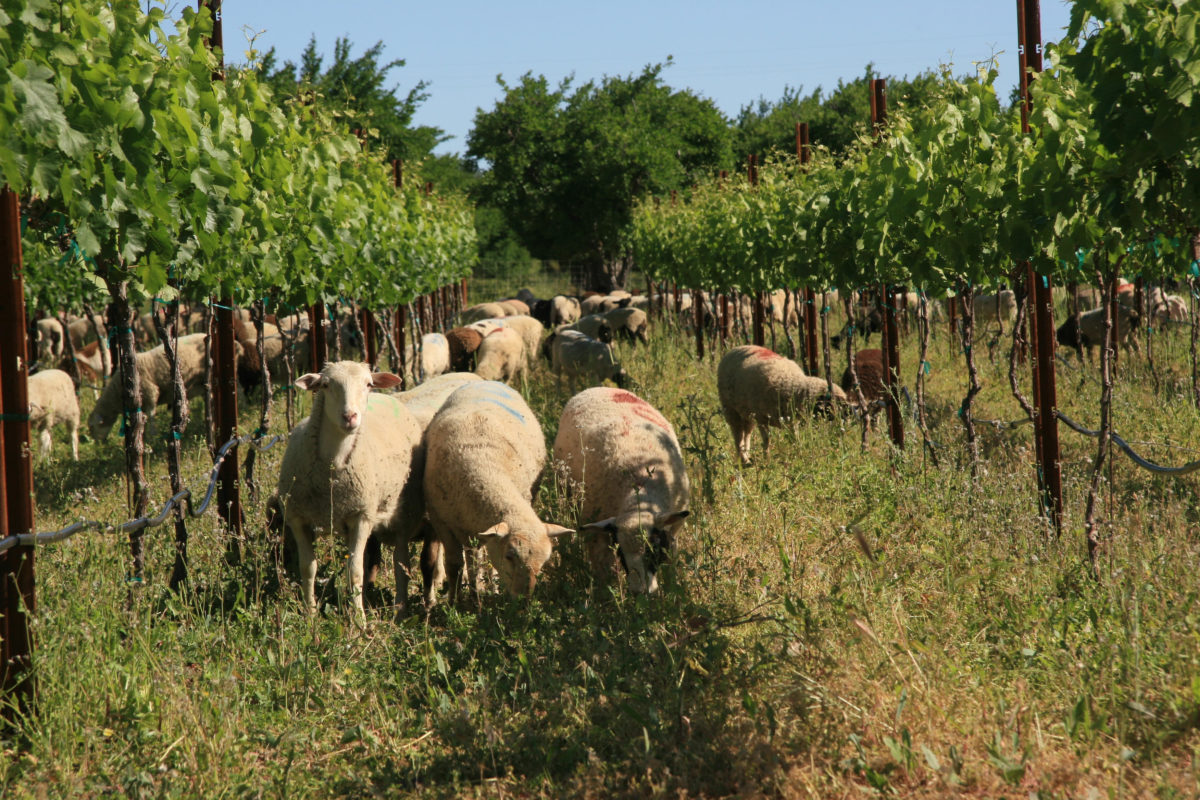
A flock of sheep is vital to the success of one particular vineyard in Winters, California. While many operations struggle to manage weeds, this vineyard used a SARE-funded grant to test grazing sheep as a pest management practice, and they are seeing many whole-farm benefits. The sheep were trained to avoid the grape crop’s leaves and to instead graze only on weeds and other cover crops. Rather than apply potentially harmful pesticides or do time-intensive mowing, the vineyard uses the sheep to manage its weeds. Producers using methods based on ecology to manage pests, like sheep grazing weeds in vineyards, are finding improvements and benefits across their farms. SARE's newly revised A Whole-Farm Approach to Managing Pests bulletin discusses ecological approaches to pest management and highlights cases in which farmers are using innovative methods to manage pests.

A Whole-Farm Approach to Managing Pests is available for free in print and for download, and is useful to farmers and educators alike. 

Sheep Grazing Vineyard
These sheep, at a vineyard in Winters, Calif., were trained to ignore grape leaves while grazing on vegetation such as weeds and cover crops. Photo courtesy University of California Extension

A Whole-Farm Approach to Managing Pests describes ecological pest management strategies that focus on strengthening natural relationships throughout the farm to reduce pest pressures. These holistic strategies emphasize knowledge of cropping systems, biodiversity and farm resource management. Practices that produce healthy crops and keep insects, weeds and diseases away focus on:

  • promoting biodiversity
  • creating healthy crop habitat
  • reducing disturbance to soil and non-crop vegetation , and
  • minimizing off-farm inputs.

This newly updated technical bulletin is broken down into two parts. Part one examines how biodiversity and biological control drive management practices that can boost the natural defenses of your farm. The second part puts those tools into practice by providing reliable and profitable strategies to successfully manage pests.

Focusing on the farming system rather than on each individual pest can make pest control across the whole farm more effective and sustainable. Ecological strategies can be adopted incrementally to meet the unique pest management needs of every operation while providing other benefits such as improved soil health and biodiversity maintenance.

Download or order your free print copy of A Whole-Farm Approach to Managing Pests at https://www.sare.org/resources/a-whole-farm-approach-to-managing-pests/ or by calling (301) 779-1007. A Whole-Farm Approach to Managing Pests is available in quantity for free to educators for use in educational workshops, classes or tours.

Posted in 1

National Farmer Survey Documents a Wide Range of Cover Crop Benefits as Acreage Continues to Expand

Despite the crippling rainfall that significantly delayed planting across much of the country in 2019, more than 90% of farmers participating in a national cover crop survey reported that cover crops allowed them to plant earlier or at the same time as non-cover-cropped fields. Among those who had "planted green," seeding cash crops into growing cover crops, 54% said the practice helped them plant earlier than on other fields.

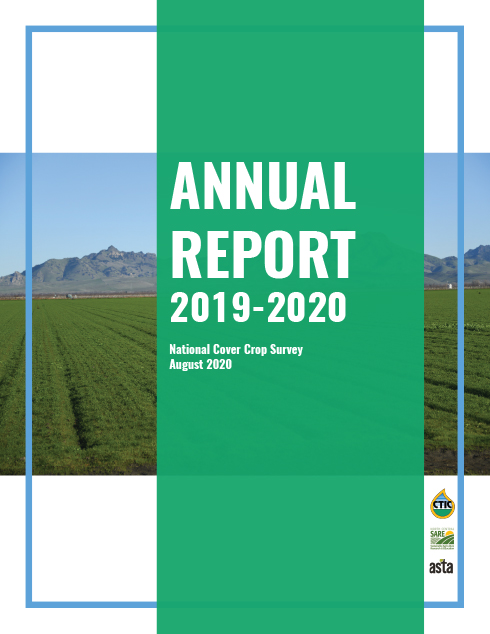
Those findings were among several new insights from the 2019-2020 National Cover Crop Survey, conducted by the nonprofit Conservation Technology Information Center (CTIC), with financial support from SARE and the American Seed Trade Association (ASTA). These organizations have worked together on several past national cover crop surveys, with the first survey dating back to the 2012 crop year.

The 2019-2020 survey, which included perspectives from 1,172 farmers representing every state, was the first by SARE, CTIC and ASTA to include detailed exploration of planting green—a tactic employed by 52% of the respondents—as well as crop insurance use among cover croppers and the impact of cover crops on the profitability of horticultural operations.

"Many U.S. farmers have turned to cover crops as part of their strategy to improve soil health while reducing input costs and maintaining yields," stated Mike Smith, who managed the national survey for CTIC. Survey participants averaged 465 acres in cover crops in 2019, an increase of 38% in four years. The USDA Census of Agriculture found a 50% increase in cover crop acreage over the five-year period between 2012 and 2017.

 “Farmers are using cover crops for a variety of reasons and many have tried new approaches to cover cropping,” Smith said. "This year's survey also indicated that some of the concerns that many growers have had about the effects of cover crops on planting dates in a wet year turned out not to be true—in fact, in many cases, cover crops helped farmers plant earlier in the very wet spring of 2019."

According to Rob Myers, Regional Director of Extension Programs for North Central SARE, “many farmers are finding that cover crops improve the resiliency of their soil, and the longer they use cover crops, the greater the yield increases and cost savings that are reported by producers.”

“We are pleased to see farmers appreciate the expertise of cover crop seed companies with 46% saying they buy from them and another 42% buying from retailers,” said Jane DeMarchi, VP Government & Regulatory Affairs, ASTA. “Professionally produced cover crop seed is grown for seed from the start and has been selected, harvested, cleaned and tested for performance. The study shows farmers are using a range of cover crop seed and mixes to address their individual needs with 46% paying $15 or under per acre.”

Among the 1,172 farmers who provided responses in the 2019-2020 National Cover Crop Survey, 81% were commodity producers (corn, soybeans, wheat, cotton, etc.) and 19% categorized themselves as horticultural producers.

Here are some highlights from the survey. Download the full report.

Yields

The previous five national cover crop surveys sponsored by SARE, CTIC and ASTA have all reported yield boosts from cover crops, most notably in the drought year of 2012 when soybean yields were 11.6% improved following cover crops and corn yields were 9.6% better. In 2019, when wet early conditions prevailed across much of the corn and soybean regions, yield gains were more modest but still statistically significant. Following the use of cover crops, soybean yields improved 5% and corn yields increased 2% on average, while spring wheat yields improved 2.6%.

Saving on farming costs

Many farmers reported economic benefits from cover crop beyond just yield improvements. Of farmers growing corn, soybeans, spring wheat, or cotton, the following percent had savings on production costs with fertilizers and/or herbicides:

  • Soybeans – 41% saved on herbicide costs and 41% on fertilizer costs
  • Corn – 39% saved on herbicide costs and 49% on fertilizer costs
  • Spring wheat – 32% saved on herbicide costs and 43% on fertilizer costs
  • Cotton – 71% saved on herbicide costs and 53% on fertilizer costs

While cover crop seed purchase and planting do represent an extra cost for farmers, it was notable that most producers are finding ways to economize on cover crop seed costs. Whereas earlier surveys from 2012 and 2013 reported on a median cover crop seed cost of $25 per acre, most farmers reported paying less in 2019. Of the responding farmers, 16% were paying only $6-10 per acre for cover crop seed, 27% were paying $11-15 per acre, 20% were paying $16-20 per acre, and 14% were paying $21-25 per acre. Only about one-fourth were paying $26 or more per acre.

Planting green

Planting green refers to planting a cash crop like corn, soybeans or cotton into a still-living cover crop, then terminating it soon after with herbicides, a roller-crimper, or other methods. In this year’s survey, 52% of farmers planted green into cover crops on at least some of their fields. (In the 2016-2017 report, the most recent prior survey by SARE, CTIC and ASTA, 39% of the respondents had planted green.)

  • Of the farmers planting green, 71% reported better weed control
  • 68% reported better soil moisture management, particularly valuable in a wet spring

Horticulture producers also benefit

For the first time, the survey queried horticulture producers about how cover crops have impacted their profit. Of the 184 horticulture producers responding to that question, 35% reported a moderate increase in net profit (defined as an increase of 5% or more), and another 23% reported a minor increase in net profit (2-4% increase). Even after factoring in the purchase and planting cost of cover crops seed, only 4% observed a minor (2-4%) reduction in net profit, and none reported a moderate loss in net profit.

Available online

"The 2019-2020 National Cover Crop Survey shows that an ever-growing number of farmers of all types and in all regions of the U.S. continue to find advantages to using cover crops," says Myers at SARE. "While the first survey in 2012 showed the benefits of cover crops in a drought year, this year’s survey showed that cover crops helped farmers in wet weather as well, with many of them being able to plant in wet spring weather when conventional neighbors couldn’t. The survey showed farmers are figuring out how to make cover crops work for them economically, while using them as a tool to address challenging issues such as herbicide-resistant weeds."

Download the full survey report.

For more information:

Rob Myers, SARE | myersrob@missouri.edu | (573) 882-1547

Mike Smith, CTIC | smith@ctic.org | (812) 661-2407

Kaitlin Crawford, ASTA | kcrawford@betterseed.org | (571) 431-7331
Posted in 1