Showing 101-110 of 123 results

SARE Fellows Visit Oregon

Every year since 2007, USDA’s Sustainable Agriculture Research and Extension program (SARE) and the National Association of County Agriculture Agents (NACAA) has offered a national Fellows program. The program is designed for Extension faculty who are interested in learning more about sustainable agriculture in different parts of the country. Eight Fellows, two from each of the four SARE regions, meet twice a year for a week at a time, for tours and workshops. In early June, the Fellows visited Oregon, visiting various farms and research sites with Small Farms Extension faculty Maud Powell and Heidi Noordijk. Additionally, Small Farms Extension Faculty Amy Garrett, who is one of the current Fellows, participated in the tour.

The goal of the program is to enhance understanding of sustainable agriculture through broad-based training and hands- on exposure to successful and unique sustainable agriculture programs. Participating Fellows are better able to create new programs that meet the needs of their local clientele upon returning to their home states.

SARE Fellows this year hail from New Hampshire, South Dakota, Maryland, Texas, Kentucky, Oregon, and Indiana. Additionally, SARE coordinators from Delaware and North Dakota attended.

The tour included visits to various sites in Oregon including Mt. Hood Organics outside of Mt. Hood, LaMancha Farm in Sweet Home and the Double J Jerseys Ranch in Monmouth. Fellows also toured many of the demonstration sites of the researchers at the North Willamette Research and Extension Center in Aurora, as well as one of Amy Garrett’s dry farm plots in Corvallis.

In the middle of the week, the Fellows spent half a day visiting Persephone Farm in Lebanon and taking a deeper dive into the farm’s sustainable agriculture practices. With the guidance of Oregon Tilth staff member Tanya Murry, they brainstormed ideas for increasing the profitability of certain crops. Finally, the Fellows visited Newport, where they took a “dock walk”, learned about OSU Extension’s Sea Grant program and got to try Dungeness crab. Over dinner on their final night, the Fellows remarked on Oregon’s beauty and the inspiring farmers and Extension faculty they had met over the course of the week.

Adapted from "SARE Fellows Visit Oregon!" Oregon State University Extension Service 

Posted in 1

Using Flowering Insectary Borders to Boost Natural Enemies

Beneficial insects play an important role in managing insect pests and pollinating crops, but they struggle to thrive in and around farms that have low plant diversity and rely mainly on tillage. Routine soil disturbances and low plant diversity can mean fewer prey, shelter and plant-based resources available to support natural enemies, especially early in the season when their food is scarce. “I like to remind producers that good bugs are more than just predators—they rely on plants for food and shelter as well. Without sufficient plant diversity on the farm, they can't thrive and do their jobs,” said entomologist Jermaine Hinds.

While pursuing a doctorate at Penn State University, Hinds joined an ongoing research project with his advisor Mary Barbercheck and a team of researchers who wanted to compare the benefits of growing more diverse cover crop mixtures in a wheat-corn-soy rotation. “We were excited to see if we could take advantage of the unique traits of different cover crops, especially in mixtures, in order to help build soil, manage weeds and regulate pests,” said Hinds.

When farmers plant cover crops, they often have to terminate it before it can reach peak bloom, thus losing the opportunity to provide natural enemies and pollinators with early-season nectar and pollen. While the research team was at first challenged by the idea of delaying termination of the cover crop to allow for bloom time, Hinds began to think of ways they could reintroduce floral diversity into the landscape without compromising management of the crop.

“We decided that we could partially terminate the cover crop and leave behind a border made up of diverse flowering cover crops that would reach peak bloom and would support beneficial insects later into the season.”

With support from a 2014 SARE Graduate Student grant, Hinds was able to further his research into using flowering cover crops to support natural enemies. Wanting to take advantage of the unique benefits offered by different cover crop species, he decided to test buckwheat and cowpeas to see how effectively they could support natural enemies in a nearby corn crop.

Through his research, Hinds found that important natural enemies, like the pink-spotted lady beetle and insidious flower bug, were more common in fields with a neighboring flowering cover crop. Although the research team could not reliably establish cowpeas due to wet spring field conditions, their laboratory studies also yielded some interesting results.

In the lab, they found that insidious flower bugs, which are important predators in many cropping systems, survive longer and lay more eggs when given plant nectar and pollen from either buckwheat or cowpeas. “When we raised insects on both plant species together, they survived even longer and laid even more eggs,” Hinds noted. “This kind of research can help us think about the particular plants we can use to bolster important natural enemies and about how to design cropping systems and rotations where we can take advantage of the services provided by beneficial insects.” The team shared their research with enthusiastic growers at farmer field days and garnered a lot of interest in flowering mixtures and how they can support natural enemies in different cropping systems.

“Looking back, I think it was great that Mary encouraged all of her students to apply for SARE grants,” Hinds remarked. “The process definitely challenged us, and it was an excellent source of professional development. With my funded grant, I was able to expand my research, gain grant-writing and budget-management experience, as well as engage in networking and even collaborative research with the USDA.”

Recently, Hinds joined the team at SARE Outreach, where he uses his expertise to develop accessible and practical outreach materials for agricultural audiences and professionals. “I think it’s wonderful to have the opportunity to support a program that was so critical to my professional development and success in my graduate career.”

Jermaine Hinds portrait in a field

Jermaine Hinds
Technical Review Specialist
(301) 405-3189

research@sare.org

Posted in 1

Cultivating Partnerships: Building Farm-Research Networks for Improved Physical Weed Control

Managing and controlling weeds can be a challenge and a frustration for farmers, no matter the farm size or crop. Associate professor of horticulture at Michigan State University, Daniel Brainard, knows that weed management represents a major barrier to sustainable production of both field and vegetable crops. Brainard has been researching new tools and techniques for physical weed control (PWC), and he’s starting to share the results. In 2017, Brainard received a $25,595 NCR-SARE Partnership grant to bring together growers and researchers in the North Central region to improve understanding and adoption of these PWC tools. Shortly after receiving the grant, Brainard and a team of farmers and researchers traveled to Switzerland in April 2017 to a meeting of the Physical and Cultural Weed Control Working Group of the European Weed Research Society.

They collected video footage of various tools in action, and recorded interviews of farmers and manufacturers describing the best use of these tools. They tested some of the European tools and techniques on-farm, and demonstrated them locally at their Midwest Mechanical Weed Control field day held in Holt, Michigan in September 2017, which had 140 participants, 100 of whom were farmers. They focused their demonstrations on in-row mechanical cultivation with torsion weeders, flex tine cultivators, and finger weeders:

• The torsion weeder is an in-row cultivation tool that can be set up to be used on multiple or single row systems. It can be used in a variety of systems.

• The flex tine cultivator is a blind and in-between-row cultivation tool (blind cultivation occurs before a crop emerges). It was traditionally designed to be used in small grains but can be used in a wide range of crops to control small weeds.

• The finger weeder is an in-row cultivation implement that can be used for multiple row systems and walk behind tractors. It can be used in direct seeded or transplanted crops.

“The consensus from both on-farm and research-farm trials was that the finger weeder and flex tine weeders are versatile tools that work well on a wide range of transplanted and large-seeded direct-seeded crops,” said Brainard. “Although the torsion weeder can also work extremely well under the right conditions, it is more difficult to calibrate and integrate into diverse farming systems, and works well under a narrower set of soil and environmental conditions.”

The project is ongoing, but thus far Brainard and his team have created videos demonstrating each of the tools in the field.

View Brainard's presentation on this project, from the 2018 Farmer's Forum through NCR-Sare's Youtube playlist. Visit www.youtube.com/NCRSAREvideo for this and other videos. 

Posted in 1

SARE/NACAA Fellows Visit the Cornhusker State

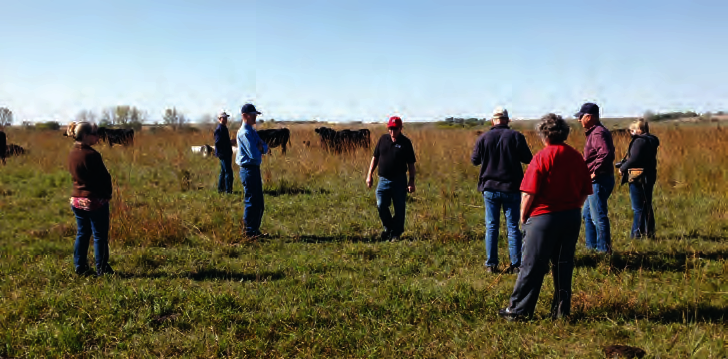
Farmers standing around a field talking with cows in the back.

Nebraska’s landscape is one of distant horizons, rolling plains, sandy hills, and acre after acre of agriculture. In a state where ninety-three percent of the state’s land is in production agriculture, cattle ranches span thousands of acres, and local food systems are on the rise, learning opportunities abounded for a group of educators like the Sustainable Agriculture Fellows. The Sustainable Agriculture Fellows program is a two-year training opportunity in sustainable agriculture for Extension workers. Supported by SARE and the National Association of County Agricultural Agents (NACAA), the program enhances understanding of sustainable agriculture and provides broad based, national exposure to successful and unique sustainable agriculture programs.

This fall, the fellows embarked on an agricultural tour of Nebraska and took an in-depth look at one Nebraska family farm. Tour stops included Nebraska farms, ranches and educational institutions, including the Horticulture Department and the Institute for the Culinary Arts at Metro Community College in Omaha, the University of Nebraska Lincoln’s Innovation Campus, Shadowbrook Farm’s high tunnels and creamery near Denton, the McLean family farm and feedlot near Benedict, Jim Knopik’s mob grazing ranch near Fullerton, The Grain Place (an organic farm and processing plant in Marquette), the Berns’ family farm and cover crop seed business near Bladen, and the Raising Nebraska Building at the Nebraska State Fair Grounds. Facilitated conversation kept the fellows engaged during locally sourced meals and van rides across the hills and plains of Nebraska.

The Fellows used a training tool developed by the Northeast SARE program called “Reading the Farm” to review detailed farm information, observe, and engage in facilitated discussion with Kevin Loth and Charuth Van Beuzekom Loth of Shadowbrook Farm and Dutch Girl Creamery near Denton, Nebraska. During the Reading the Farm exercise, the Fellows met with the Loth family and shared knowledge and insights within the context of the Loth’s vegetable farm and goat’s milk creamery businesses. After the tour, the fellows provided a written report summarizing their feedback for Shadowbrook Farm and Dutch Girl Creamery. That kind of engagement with producers and other Extension agents is one of the main draws to the Sustainable Agriculture Fellows program.

As we walked through pasture grasses at Jim Kopnik’s ranch the day after the Reading the Farm exercise, Utah State University Extension agent and 2013 Fellow, Matt Palmer, reflected on the program and explained how the Reading the Farm exercises have improved his interactions with farmers and have helped him better meet the needs of his local clientele. “It has been very valuable,” explained Palmer. “When I go back to the county that I’m from and I view farms, I understand how my recommendations interact with their other enterprises. I’m more apt to take a holistic view of their farm.”

Before sitting down to talk about cover crops with the Berns family at Green Cover Seed, University of Missouri Regional Horticultural Specialist and 2014 Fellow, Patrick Byers, echoed Palmer’s sentiments, saying that the Sustainable Agriculture Fellows program has fulfilled his expectations and more. “I’ve worked with farmers for many years,” said Byers. “This was a chance to delve more deeply into all aspects of sustainability and to build my skills as a person who is empathetic to the realities of sustainability for the farmers that I serve...I really can’t say enough things about what it has meant to me to be a Fellow.”

Curious about the Sustainable Agriculture Fellows program and the Reading the Farm tool? Learn about the people and the program online at sare.org/fellows.

Posted in 1

Growing the Field for Organic Conservation

As producers work to meet regulations under the National Organic Program (NOP) and become certified organic, they often apply conservation practices that align well with the Natural Resources Conservation Service’s (NRCS) conservation activities, such as green manures, buffer strips, and rotational grazing. NRCS assistance is being sought by both new and established organic farmers to help meet resource stewardship goals.

Yet, NRCS staff, as well as other ag professionals such as organic certifiers, need an improved understanding of natural resource conservation on organic and transitioning farms in Oregon and California, according to Oregon Tilth and the Wild Farm Alliance. In answer to a survey administered by the two organizations, the majority of organic certifiers stated that they did not work with NRCS.

Oregon Tilth and Wild Farm Alliance, through their project  Growing the Field for Organic Conservation, expanded NRCS’ knowledge of soil health and conservation on organic and transitioning farms with the goal of reducing  the barriers to organic certification and increasing organic and transitioning farmers' participation in conservation programs.

As the project leaders developed a toolkit to advance knowledge of organic conservation practices and how certification and conservation programs work together, a thirty-page resource was developed to support NRCS conservation planners and other agricultural professionals as they work with organic producers. The National Organic Farming Handbook describes organic systems and identifies key resources to guide conservation planning and implementation on organic farms. The handbook was developed with a team comprised of NRCS staff and partner organizations from across the country and from a range of disciplines. Producers and other audiences may also find the handbook useful, particularly the resources listed in various sections.

Sarah Brown, Oregon Tilth, was pleased with the results. “We are incredibly pleased to have supported the development of the National Organic Handbook. This document provides the first comprehensive resource focused on the intersect of conservation and organic agriculture. It serves as a guide for conservation professionals, farmers, and others interested in supporting conservation on organic lands.”

In addition to the handbook, resources for organic certifiers were also developed. The Biodiversity Conservation: An Organic Farmer’s and Certifier’s Guide was created to clarify the National Organic Program’s new Natural Resources and Biodiversity Conservation Guidance. This guide gives farmers and certifiers practical and effective information to not only be in compliance but also to take advantage of the ecosystem benefits related to biodiversity. According to Jo Ann Baumgartner, Wild Farm Alliance, “The Biodiversity Conservation: An Organic Farmer’s and Certifier’s Guide has been well received by organic certifiers and is stimulating many to update their Organic System Plans.”

One clear outcome of the project, according to Al Kurki, Western SARE PDP Associate Coordinator, was that it catalyzed institutional change. “Not only did the project reach a lot of ag professionals and farmers, it also helped spur more frequent, regular dialogue and interaction between the National Organic Program and NRCS,” states  Kurki.

Posted in 1

Vegetable and Weed Degree-day Models

Pest managers are familiar with the concept of using degree days to predict pest outbreaks. Insects, like many other organisms, develop according to the temperature around them and degree days are a way to measure accumulated temperature.

Plants – at least in part – also develop based on temperature, so a team in Oregon is adapting a degree-day modeling system built for pest management to make a tool for vegetable growers to better plan their planting and harvesting dates.

“The problem is when you’re trying to schedule a harvest, seed catalogs all give an expected maturity date in calendar days,” explained Oregon State University Small Farms Extension Agent Nick Andrews, who is spearheading the project. “Calendar days are pretty inaccurate, and growers recognize that.”

One seed catalog for example might say a broccoli variety needs 65 days to mature, while another claims the same variety requires 90 days. That range makes it tough to pick a planting day in May to hit a desired harvest date in August. And using calendar days ignores local temperature, which is a huge factor in how fast plants mature.

“Lots of things influence vegetable development rates so degree-day models aren’t perfect,”Andrews said. “But they seem to be more accurate than calendar days, and degree-day models are especially useful when crops are planted early or late, or when the weather is unusual.”

With a $203,000 grant from the Western Sustainable Agriculture Research and Education program – Western SARE – the Oregon team created a website called Croptimeto predict the time-to-maturity for a number of vegetable varieties important to Willamette Valley growers. Croptime was built on the backbone of the USPest.org pest-management degree-day modeling site, which was itself supported by another U.S. Department of Agriculture regional program, the Western Integrated Pest Management Center.

The combination is not a stretch, explained Len Coop, the associate director of the Integrated Plant Protection Center at Oregon State and architect of USPest.

“Temperature integrates everything. It drives the development of everything,” said Coop, who is a contributor to the new project. “It was never a foreign idea to merge crop models with degree-day models.” 

Maximizing Profits

Here’s why it matters. For fresh vegetable growers, harvest timing is critical. Processors want a consistent supply of produce throughout a growing season, not a glut followed by a shortage then another glut. And growers want to time their harvest when labor is available and demand is high so they can maximize profits.Harvest-timing helps ensure a consistent supply of fresh produce for local restaurants and for community-supported agriculture operations that deliver fresh produce to customers.

“We plan for each week's (CSA) share very carefully,”said Tanya Murray from Sauvie Island Organics in Oregon. “The dramatically different weather we’ve had this spring, and last, makes it hard to know what to expect. Using degree days to predict days to maturity would be very helpful.”

Crop timing can also be a way growers avoid pests, an important integrated pest management principle. In fact, the Croptime model includes certain weed species to help growers – especially organic producers – pick varieties and planting dates to minimize weed issues.

Grower workshops identified the initial varieties to include in the Croptime system: 34 varieties of fruiting crops like beans, squash and sweet corn, seven varieties of carrots and parsnips, 15 varieties of broccoli, cabbage, cauliflower and kale, and seven varieties of spinach and lettuce.

The team has more than a dozen of those models up on the Croptime site now, and plans to have 50 loaded by spring 2017. The number of models it will take for the site to become widely used is an open question.

“Vegetable growers typically grow several varieties of the same crop, so we might have to get close to 200 models for it to really be noticed,” Coop said. “It’ll take a lot of effort to get to that.”

One way the system might be most useful is helping growers choose unfamiliar varieties to meet unexpected needs.

“When we have a couple weeks of wet weather in spring, we could use Croptime to choose varieties we might not be familiar with but that would help keep our production up,” explained Bob Egger of the Pumpkin Patch farm in Sauvie Island, Oregon.

To help build the number of models, the team is looking at the idea of developing a standard for each crop, then indexing individual varieties to that standard, Coop said. So one carrot variety might develop 10 percent faster than the standard carrot and another 10 percent slower, and Croptime could automatically make the adjustment.

Local Conditions

The whole system is based on using local weather conditions and forecasts, so growers can select the weather station nearest their farm. They then select from a number of different forecasts, including the 30-year historical average, 10-year historical average, last year’s weather, two years ago’s weather, and a new forecast by the National Oceanic and Atmospheric Administration built from several different climate models.

“The default is the NOAA model, but if a grower thinks conditions are a lot like last year, or two years ago, they can select those instead,” Andrews said.

Once they’ve chosen a weather station and forecast to use, growers select the vegetable variety they are interested in and enter up to four different planting dates. Croptime then displays a report showing the dates that crop will go through critical stages – first leaves, flowering and reaching maturity for harvest.

Growers testing the site quickly pointed out a way to make it more useful.

“They want to enter a harvest date and have it display the planting date,” Andrews said. “It’s a really good feature and we thought, ‘Huh, we should have thought of that.’”

The team is also looking to add resources to the system, such as an irrigation scheduler developed by Washington State University. They also want to share Croptime models with other states and verify models indifferent climate zones to expand its usefulness beyond the Willamette Valley.

“It’s a long-term project,” Coop said. “We need to keep finding funding, and then we can expand it regionally, expand the database of varieties and focus on different crop types, such as winter vegetables and cover crops.”

Learn more on the Croptime website

Posted in 1

Innovative Assessment Helps Farmers in the Northeast Improve Soil Health

Improving soil health without understanding the soil's condition is not easy and traditional soil tests, though important management tools, don't provide information on the physical structure or microbial life living in the soil. That is why a multidisciplinary team at Cornell University created a soil health assessment, which measures physical, chemical and biological indicators as well as pH and nutrient levels in the soil. The soil health assessment received early funding from multiple SARE grants as well as other sources.

The need for the assessment was born out of a survey of Northeastern farmers, many of whom used traditional soil tests but “felt there was something more going on with their soils,” says Bianca Moebius-Clune, director of the soil health division at USDA’s Natural Resources Conservation Service. “There were erosion issues, they had weed issues, they had decreasing yields even though they needed to irrigate more, put on more fertilizer, more pesticides. And they really didn’t have good diagnostic tools for all of these issues.”

The Cornell lab currently receives about 2,000 samples per year, and interest in the assessment continues to grow in the Northeast and across the country.

Posted in 1

Lessons Learned During SARE/NACAA Fellows Tour

LITTLE ROCK, Arkansas – Central Arkansas was the location for the spring 2015 tour for the SARE/NACAA Sustainable Agriculture Fellows program, where Cooperative Extension agents from across the country spent several days learning more about sustainable agriculture concepts.

The program, sponsored by Sustainable Agriculture Research and Education (SARE) and the National Association of County Agricultural Agents (NACAA), challenges county agents to assess strengths, weaknesses, and relevant sustainable agriculture applications in current agricultural systems. A major component involves tours aimed at exposing agents to the huge diversity of sustainability in practice.

This spring’s program brought participants to farms in Arkansas and was hosted by the University of Arkansas.

“Even though I’m an Extension livestock specialist, on our SARE Fellows tour I could see how the concepts of sustainability apply across all types of agricultural enterprises,” said SARE Fellows Susan Kerr, northwest livestock and dairy regional specialist at Washington State University. “We saw excellent examples of IPM (Integrated Pest Management) on a berry farm; a vegetable farm with high social capital but production challenges; a grazing operation that was under utilizing its grass resources; and a tree nut farm where the savvy owner kept close track of international market trends so he could capture a high price for his product.”

During the tour, SARE Fellows used the Reading the Farm training tool to conduct in-depth analyses on North Pulaski Farm, an organic vegetable and fruit farm north of Little Rock. Reading the Farm looks at farms as whole systems; participants learn to assess how economic, environmental, and social factors interconnect and influence farmer decision-making.

"The Reading the Farm exercise completely changed my perspective relative to assessing the social and economic aspects of farming sustainability,” said SARE Fellows Patrick Byers, regional horticulture specialist with University of Missouri Extension. “This tool has already benefited me in my programming efforts with farmers in Missouri, and would without a doubt benefit my MU Extension colleagues.”

Fellows also toured several other agricultural production systems in Arkansas. These farms and systems included Wye Mountain Flowers and Berries, which grows flowers and U-pick blueberries and blackberries; Heifer Ranch; a pecan orchard; and rice production on an agronomic farm.

They also met with the co-chair of the University of Arkansas' Arkansas Discovery Farms program to learn how the university is working with farms to collect data and make recommendations.

About the SARE/NACAA Sustainable Agriculture Fellows program. The two-year Fellows program provides a training opportunity that enhances understanding of sustainable agriculture and provides broad-based, national exposure to successful and unique sustainable agriculture programs. Participating Fellows are better able to create new programs that meet the needs of their local clientele. Learn more about the Sustainable Agriculture Fellows program, including biographies of current Fellows.

--30—

Published by the Southern Region of the Sustainable Agriculture Research and Education (SARE) program. Funded by the USDA National Institute of Food and Agriculture (NIFA), Southern SARE operates under cooperative agreements with the University of Georgia, Fort Valley State University, and the Kerr Center for Sustainable Agriculture to offer competitive grants to advance sustainable agriculture in America's Southern region.

Posted in 1

Improving Nutrient Use Efficiency in Montana Wheat

"This was a landmark study because we knew we were losing nitrogen, we just didn't know how we were losing it," says farmer Curtis Hershberger.

When nitrogen fertilizers are applied to the soil surface using certain application practices, a significant amount can be lost when the nitrogen converts to ammonia gas and enters the atmosphere. This process, known as volatilization, represents an economic loss for farmers and is a source of atmospheric pollution.

An on-farm study lead by Montana State University Soil Scientist Richard Engel and funded by SARE has shed light on the urea fertilization practices that are most susceptible to nitrogen volatilization. The team also studied nutrient losses from a green manure cover crop. They developed recommendations that have improved the sustainability of wheat farms across Montana. As a result of this work, farmers statewide are saving an estimated $5 million per year in improved nutrient use efficiency and crop yield.

For the study, the research team determined the fraction of applied urea fertilizer lost as ammonia gas when applied to winter wheat from late fall to early spring (see ammonia gas collectors in the field at the video's 2:30 mark). Based on their findings, they recommend against surface-applying fertilizer to frozen or wet ground, particularly in the winter, and instead to apply it in the spring on dry ground a day or two before significant rain. They also recommend subsurface applications and the use of urease inhibitors.

Posted in 1

For Vegetable Farmers, a New No-Till Tool in Forage Radish

Vegetable farmers who want the myriad benefits of winter cover crops may be setting themselves up for a hectic spring schedule, when the challenge of planting during a narrow window of good weather becomes more complicated by the need to first terminate that winter crop.

To make their lives a little easier, University of Maryland (UMD) researchers are exploring the benefits of forage radish, a relatively new cover crop species that they have found fits well with no-till spring planting, and boosts farmers’ yields and profits.

In a SARE-funded trial in 2012, an early-season, organic spinach crop planted after forage radish yielded 17,000 pounds per acre—worth $34,000 at a conservative $2 per pound. The spinach was raised without tillage, fertilizers or herbicides. “Not a whole lot of work,” says UMD soil scientist Ray Weil, who conducted this research with UMD graduate student Natalie Lounsbury. “I don’t usually think of silver bullets, but for planting early spinach I think we have one.”

A second year of trials saw wetter weather and somewhat lower yields, but spinach grown in plots following forage radish continued to outperform plots using both an oat cover crop and no cover crop.

For more practical information, visit the Cover Crop Topic Room.

Forage radish shows particular promise for organic farmers as an alternative to tillage, a time-consuming process used to control weeds, loosen compacted soil and prepare beds prior to planting. When seeded in August in the mid-Atlantic, forage radish suppresses winter weeds because of its quick growth and broad leaves. Its large taproot loosens the soil and helps the plant capture excess nutrients from deep in the ground, which keeps them from leaching into waterways and makes them available to spring crops when the radish decomposes.

“Right now, forage radish seems to be the only cover crop that does all these things we need it to do,” Lounsbury says.

One of forage radish’s main advantages over other popular cover crop species is that it dies in winter and leaves little residue in spring. This gives the soil a chance to dry out and warm up, two conditions that are essential for timely planting and successful germination of cash crop seeds. This played a major role in the UMD team’s positive results.

Dave Liker was one of a handful of farmers who collaborated with Lounsbury and Weil on their SARE project. A diversified organic farmer on 25 acres in Laurel, Md., Liker typically relies on spring tillage to manage his heavy, wet soils, and he has difficulty with high-biomass cover crops like rye and vetch because of the time it takes to terminate them. “Cover cropping is really difficult to manage organically,” he says. “The following season, when we need to work the ground, we need to work the ground.”

But when Liker tried a forage radish cover crop before a spring crop of no-till peas, he was happy with the result. “It was the best crop of peas I’ve ever had,” he says.

While forage radish is proving its value, Lounsbury cautions that it is not a cure-all. To avoid pest problems, farmers should not include it too frequently in rotations with other brassicas. Also, they need to pay attention to fertility before seeding forage radish.

“There is amazing weed suppression if you get a good cover crop stand, but if you don’t have enough fertility when you plant in August, then you’re not going to get a good stand,” she says.

Posted in 1