Showing 61-70 of 89 results

New Book: Farming With Soil Life: A Handbook for Supporting Soil Invertebrates and Soil Health on Farms

Smart farmers know that healthy soil hosts a flourishing and diverse ecosystem of bacteria, fungi and invertebrates. But the complex relationships between soil life, productivity and resilience are not well understood. Now available from the Xerces Society and SARE, Farming with Soil Life: A Handbook for Supporting Soil Invertebrates and Soil Health on Farms is a user-friendly guide to identifying, understanding and better managing soil life to improve the sustainability of your farming system.

Written by the Xerces Society and published by SARE Outreach, Farming with Soil Life features photograph-filled profiles that outline how to observe and identify 73 soil organisms. Each profile includes the identification, description, ecological role, habitat, diet and life cycle of the highlighted species.

Farming with Soil Life also examines how producers can boost life in the soil using buffers, no-till cropping, cover cropping, crop rotations and other practices that encourage soil flora and fauna communities to thrive. Minimizing tillage, synthetic fertilizer use, and some pesticides and insecticides may also benefit soil biology.

Understanding the relationships between soil, soil life and crop production is key to defining and achieving goals within a sustainable production system. “Soil is a living, dynamic habitat for a great diversity of animals and plants. It supports the global carbon and nitrogen cycles. Healthy soils sequester carbon, helping to mitigate climate change. The more we learn, the more we understand that soil is an irreplaceable part of life."

Farming with Soil Life: A Handbook for Supporting Soil Invertebrates and Soil Health on Farms was written by Jennifer Hopwood, Stephanie Frischie, Emily May and Eric Lee-Mader. Download for free or order a print copy at https://www.sare.org/soil-life. Print copies can be ordered online for $28 each, plus shipping and handling. Call (301) 779–1007 for telephone, tax-free, rush or purchase orders. Discounts apply for orders of 10 or more copies.

Posted in 1

USDA Invests Over $46M in Sustainable Agriculture Research and Education

The University of Maryland has been selected to serve as the National Reporting, Coordinating, and Communications Office (NRCCO) for the Sustainable Agriculture Research and Education (SARE) program. This 10-year investment is being made as part of the USDA's National Institute of Food and Agriculture (NIFA) selection of four regional host institutions to manage SARE's regional granting programs.

“This investment in sustainable agriculture underscores USDA’s ongoing commitment to transforming our food and agricultural systems,” said Chavonda Jacobs-Young, USDA Chief Scientist and Under Secretary for Research, Education and Economics (REE). “Through this investment, SARE will continue to provide competitive grants and education programs that foster farmer-driven innovation to promote climate-smart practices, make sustainable producers more profitable, and improve local economies and the quality of life in rural communities.”

"Since its authorization in the 1990 Farm Bill, SARE has supported farmers in four regions (North CentralNortheastSouth, and West), with each regional program hosted by a Land-grant Institution and guided by volunteer Administrative Councils that make grants and set regional priorities. These councils include farmers and ranchers along with representatives from universities, government, agribusiness and nonprofit organizations. Technical reviewers, also volunteers, lend professional and practical experience to help councils evaluate project proposals."

For more information, visit the USDA release USDA Invests Over $46M in Sustainable Agriculture Research and Education.

Posted in 1

America's Heartland "Leaders in Sustainable Agriculture" Now Available on YouTube

SARE recently partnered with PBS KVIE to produce an episode of RFD-TV's America's Heartland featuring four farmers describing their commitment to sustainability, how they plan to overcome modern farming challenges, and how SARE has impacted their farming and ranching practices. 

The full 24-minute episode titled Leaders in Sustainable Agriculture is now available at https://www.sare.org/resources/leaders-in-sustainable-agriculture/.

Watch:

  • Bryce Wrigley of Delta Junction, Alaska, discuss how soil health, cover crops and barley flour play an important role in improving food security in Alaska.
  • Pennsylvania's Hannah Smith-Brubaker and Debra Brubaker share how diversification and new marketing opportunities have benefited their farm.
  • Dr. Reagan Noland and rancher Chad Raines explore whether running sheep in organic cotton can help manage weeds and reduce tillage in west Texas.
  • Erin and Drew Gaugler explain how bale grazing, multi-species grazing and keyline cultivation improve soil health and range quality on their 4,000 acre ranch in South Dakota.

Videos featuring each farm's individual segment are also available for sharing. 

Visit https://www.rfdtv.com for more information about America's Heartland and other RFD-TV programming.

Posted in 1

RFD-TV Episode to Highlight Sustainable Innovations

Tune in to RFD-TV on March 29 at 5:30pm EDT for the premiere of a new “America’s Heartland” episode showcasing farmers and ranchers from across the country who are leaders in sustainability. 

SARE partnered with PBS KVIE to produce this episode, which features farmers describing their commitment to sustainability, how they plan to meet farming challenges of today and tomorrow, and how SARE has impacted their farming practices. 

Watch as Bryce Wrigley of Delta Junction, Alaska, discusses the importance of soil health and how cover crops have improved his overall operation. He addresses the need for building food security in Alaska as well as how his farm is working to address this issue at the local level. Lastly, see how Wrigley works to share his newfound knowledge with other farmers. 

In North Dakota, brother and sister Drew and Erin Gaugler run a 4,000-acre ranch. The Gauglers have received several SARE grants over the years to test out new farming methods on their land. They’ll talk about their grant projects that focused on bale grazing as a way to improve soil health. By prioritizing the health of the land, they know they’ll be able to pass it down to future generations. 

Pennsylvania farmer Hannah Smith-Brubaker’s story is unique because she not only received a SARE grant but also served as a leader on the SARE committee that decides how the grant programs will address agricultural needs throughout the Northeast. She and her wife Debra have been farming in Cuba Mills, Penn., on land that has been in the family for 40 years. They’ll share how diversification and new marketing opportunities have benefited their farm. 

Lastly, the episode features a collaboration between farmers and researchers: an important component of many SARE grants that allows innovative ideas to be tested in real-world farming conditions. In west Texas, Dr. Reagan Noland is working with rancher Chad Raines to see if running sheep in organic cotton can be an effective method of weed management that allows a farmer to reduce their use of tillage. 

Watch the episode on RFD-TV, March 29, at 5:30pm EDT. RFD-TV is carried nationwide on DISH and DIRECTV (satellite), and many cable systems: https://www.rfdtv.com/find-us-on-tv.

If you miss the broadcast, stay tuned! SARE Outreach will share a link to the episode online in the near future.

Posted in 1

New SARE Video: Managing Weeds in an Organic Almond Orchard

Many organic and conventional farmers are seeking ways to eliminate or reduce their use of synthetic herbicides. Understanding weeds is the first step towards managing them efficiently and ecologically. Now, two new videos in SARE’s Manage Weeds on Your Farm series explore organic almond grove weed control on Burroughs Family Farm’s 1,200-acre orchard in Denair, Calif.

In Ecological Weed Management at Burroughs Family Orchards, Benina Montes, who manages the property with her parents, shares how consistent vegetative cover paired with seasonal sheep grazing is used to provide effective almond orchard weed control. From late fall to mid spring, sheep are rotated through the orchards to reduce vegetative cover. Flame weeding suppresses ungrazed grasses and cleans the strips underneath the trees prior to harvest. Grazing both improves soil and provides a salable product: lambs. It also means they mow fewer times in a season.

At this point, Montes views the system more as pasture management than as weed control. “I think we’ve done a good job of thinking outside the box, coming up with tools that are doable on a large scale and make economic sense,” she says.

The second new video, Soil Health at Burroughs Family Orchards, explores the orchard’s regenerative soil improvement practices. “Ground cover has helped us dramatically,” says farm manager Nick Hibma. “When we do get rain, the grass and root system helps hold the water.” A diversified cover crop mix of mustard, clover, peas and vetch provides spring blooms that support the pollinators that are essential to California almonds. Triticale or forages are seeded at a heavier rate in areas requiring additional cover to improve soil and increase water retention.

All videos in this series may be used with attribution for fair use purposes. Other producers featured in the series include:

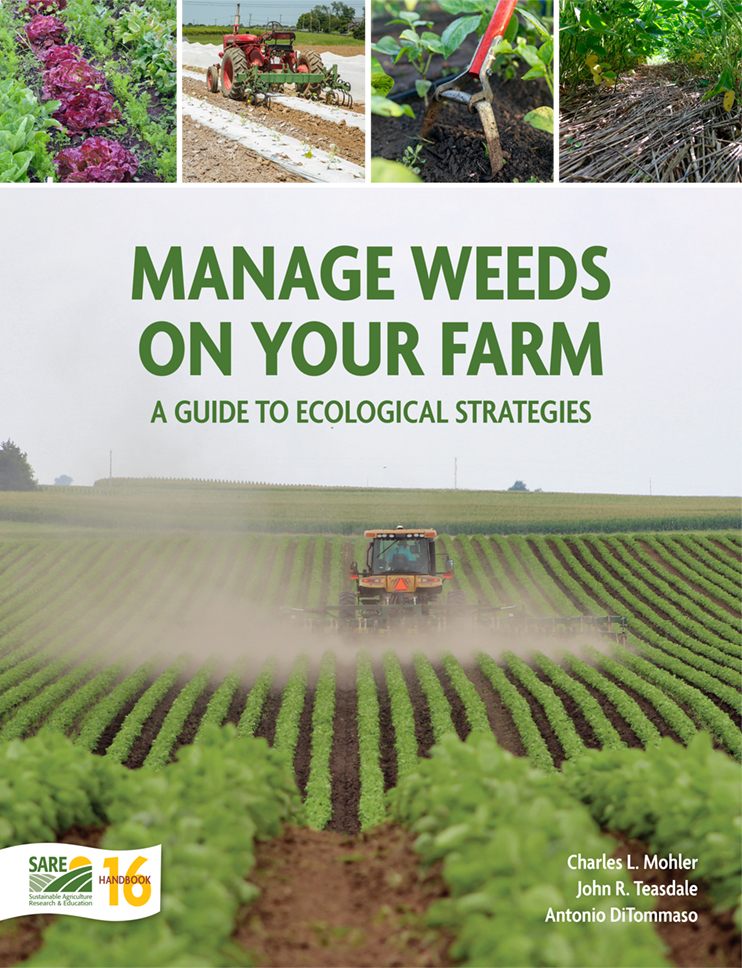
Cover of Manage Weeds on Your Farm featuring a tractor in a field.

The Manage Weeds on Your Farm Video Series is a companion to SARE’s Manage Weeds on Your Farm, a definitive guide to understanding agricultural weeds and how to manage them efficiently, effectively and ecologically. Manage Weeds on Your Farm shows you how to outsmart your weeds by identifying the right tactic for the right weed at the right time, which will reduce as much as possible the labor required, while ensuring your weeds don’t impact crop yields. Download your free copy or order it in print today at www.sare.org/weeds.

Posted in 1

Farmers: Share Your Thoughts on Cover Crops in the National Cover Crop Survey!

Farmers are invited to share their thoughts on cover crops in an online survey at bit.ly/CoverCrop23. Why do you plant cover crops...or why don't you? What do you want to know? Your insight will help guide research, communications, seed development, and more.

This National Cover Crop Survey is the seventh since 2012 conducted by the USDA-NIFA Sustainable Agriculture Research and Education (SARE) program, Conservation Technology Information Center (CTIC) and the American Seed Trade Association (ASTA), with the help of Informa/Farm Progress.

"Since 2012, the National Cover Crop Survey has been extremely valuable in helping guide research priorities, direct communications and education efforts, provide data to researchers, and illustrate the effects of policy on cover crop use and adoption," says Dr. Rob Myers, regional director of extension programs for North Central SARE and director of the University of Missouri Center for Regenerative Agriculture. "Data from previous surveys have been used in scientific papers, business planning, extension efforts, media coverage of cover crops, and even included in testimony to Congress."

Please take a few minutes to contribute your voice at bit.ly/CoverCrop23. After completing the questionnaire, you may enter a drawing for one of three $100 Visa gift cards.

Posted in 1

The Biggest Asset Is You

Utah State University (USU) Extension professor Josh Dallin had just wrapped up a presentation about livestock before an audience of farmers and ranchers, and he asked if there was any other information his listeners needed. The response was surprisingly out of the ordinary. “One of our largest cattle producers raised his hand and said, ‘I’m worried about my friends and their mental health,’” Dallin recalls. The producer had heard several ranching friends say they had thought about suicide.

The cattle producer’s insights into the personal lives of his friends and neighbors showed the USU Extension staff the need for wider mental health outreach in their county. “We jumped into action,” says Dallin. In the ensuing months they applied for and received a grant from Western SARE’s Professional Development Program. The funds helped them conduct a mental health needs assessment across the state. Informed by the survey results, the Extension staff formed an Ag Wellness Team. Also supported by the grant, the team soon developed a mental health training titled “The Biggest Asset is You.”

The most important asset on your farm or ranch is you. For more information on agriculture and mental health, watch "The Biggest Asset Is You." USU Extension's Ag Wellness website, created in partnership with the Utah Department of Agriculture and Food, provides additional mental health resources for farmers.  

This story is part of a series highlighting SARE projects using innovative strategies to help farmers and ranchers manage rural stress. Visit https://www.sare.org/resources/managing-stress/ for more information.

If you or someone you know is in crisis, please contact the 988 Suicide & Crisis Lifeline.

Posted in 1

Sustaining the Human Spirit in Farm Country

A course in skills-based suicide alertness prepared Ruth Linkenmeyer-Meirick for a desperate call from a friend. “She was going through a divorce, and she was so overcome by grief and sadness it was hard to talk with her,” says Meirick. “Had I not taken the course, I wouldn’t have known what to do.” Meirick was able to ask her friend a difficult but important question: “You’re not thinking about death by suicide, are you?” Her friend replied that she was not, and from there, Meirick listened and offered crisis-intervention suggestions.

Meirick understood how to help her friend because she had recently attended the skills-based suicide-prevention training called safeTALK. The training sessions were adapted to address the unique characteristics of agricultural communities. Through her work as the foundation director of the Minnesota Farm Bureau, Meirick has helped to make similar workshops available to Farm Bureau agents and others throughout the state.

The adapted trainings, called safeTALK: Preventing Suicide in Agricultural Communities, resulted from a multi-pronged Minnesota project titled Trying Times: Tools to Understand and Alleviate Farm Stress. The USDA Sustainable Agriculture Research and Education (SARE) program funded the two-year project. The Minnesota Department of Agriculture (MDA) managed the grant, which involved multiple partners in the public sector and nonprofit community.

The SARE funding permitted project organizers to refine a previously developed workshop called Down on the Farm: Supporting Farmers in Stressful Times. They collaborated with AgCentric, which is part of the Minnesota State college system, to create a curriculum enabling people in and beyond Minnesota to adapt and deliver it themselves.

The refined curriculum is available for download at mnfarmstress.com at no cost, and the MDA encourages users to adapt for their own state, region and audience.

This story is part of a series highlighting SARE projects using innovative strategies to help farmers and ranchers manage stress. Visit https://www.sare.org/resources/managing-stress/ for more information.

Posted in 1

New SARE Video: Managing Weeds in Organic Row Crops

Farmers have long relied on herbicides to control weeds in row cropping systems. But as consumer preferences change, many farmers are seeking to eliminate or reduce their use of synthetic herbicides where possible. Managing weeds without herbicides can be daunting, and it requires producers to understand the biology and behavior of problem weeds in order to develop control strategies that exploit their weaknesses.

In two new videos from SARE, Charlie Johnson shares how he and his family control weeds on 1,600 acres of organic corn and soybeans in Madison S.D. Ecological Weed Management at Johnson Farms and Managing Weeds in Organic Corn and Soybeans are the first in a series of new SARE videos featuring farmers who use various strategies to control weeds without herbicides. 

In Ecological Weed Management at Johnson Farms, Johnson explains how late planting, patience, diversity and a six year crop rotation all play a role in managing weeds on his farm. “There is no such thing as a weed-free organic field, and there’s no such thing as a weed-free farm,” says Johnson. But using alfalfa as a smother crop has largely eliminated Canada thistle, and planting later in the season has allowed him to control early flushes of weeds and to encourage quick emergence that helps corn and beans outcompete weeds.

Managing Weeds in Organic Corn and Soybeans illustrates how a custom rotation leverages diversity to manage weeds. 1,600 acres of corn, soybeans, oats and alfalfa are divided into six equal portions. Oats are planted as a nurse crop, followed by two years of alfalfa hay. Row crops follow, with a year of soybeans followed by corn and then a final year of soybeans. Cover crops, pre- and post-emergence tillage and manual field monitoring helps control weeds throughout the cycle.

All videos in this series may be used with attribution for fair use purposes. Other producers featured in the series include:

Cover of Manage Weeds on Your Farm featuring a tractor in a field.

The Manage Weeds on Your Farm Video Series is a companion to SARE’s Manage Weeds on Your Farm, a definitive guide to understanding agricultural weeds and how to manage them efficiently, effectively and ecologically. Manage Weeds on Your Farm shows you how to outsmart your weeds by identifying the right tactic for the right weed at the right time, which will reduce as much as possible the labor required, while ensuring your weeds don’t impact crop yields.

Posted in 1

New SARE Bulletin: Transitioning to Organic Production

Since the 1990 Organic Foods Production Act passed, the market for organic products has steadily risen. In 2020, organic sales skyrocketed to an all-time high, motivating many farmers to consider transitioning their farms to organic production. While organic production can help farmers gain access to new markets, improve soil and increase profits, the transition process can be both challenging and risky.

SARE’s newest bulletin, Transitioning to Organic Production, explains how many farmers adopt organic production to increase profits while improving the resilience and environmental impact of their production systems. Long-term success requires patience, flexibility, good record-keeping and a commitment to stewardship. 

Transitioning to Organic Production lays out basic transition strategies for livestock, field crop and horticultural systems, including a summary of the certification process and the National Organic Program standards. Practices common to all organic systems are also addressed, including:

  • crop rotation
  • cover cropping
  • addition of organic fertility sources
  • disease prevention
  • integrated pest and weed management
  • conservation tillage

Transitioning to Organic Production also outlines how these research-based practices, paired with sound transition strategies such as flexible timelines, using alternative labels and coordinating with NRCS programs, can help farmers successfully navigate the transition process. Download or order your free print copy of Transitioning to Organic Production at https://www.sare.org/transition-to-organic or by calling (301) 779–1007. Transitioning to Organic Production is available in quantity for free to educators for use in educational workshops, classes or tours.

Posted in 1