Today, erratic prices and soaring costs for labor and inputs make it difficult for American farmers to stay profitable. Since it was established, Northeast SARE has funded over $129 million in farmer-driven research and education exploring sustainable strategies to improve profitability and help farmers thrive in today’s uncertain markets.
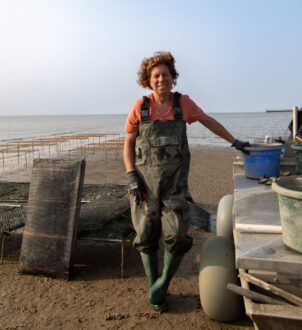
One of those projects was led by Lisa Calvo of Sweet Amalia Oyster Farm, located in New Jersey on the Delaware Bay. Calvo wanted to find a better way to manage mud worms, a costly shellfish pest common to the coastal Northeast. Mud worms settle on the outside of oyster shells and reduce growth or cause blemishes that make the oysters unmarketable.
With support from a Northeast SARE Farmer grant, Calvo examined how changing the height of oyster racks in the commonly used “rack and bag” system would affect her system’s performance. Calvo experimented with raising the standard 15” rack to 20” or 30”, increasing the oysters’ exposure to air while reducing their exposure to mud worm damage.
The results? Calvo found that multiple rack heights could work financially, giving oyster farmers new options for minimizing losses due to mud worms. While higher racks increased labor costs and required more time to bring the oysters to market, they produced higher yields and improved overall profits. Since finishing her project, Calvo has begun converting more of the racks in her system to 20”.
“The project was eye opening and exceeded our expectation of how it will inform our future farm operations,” said Calvo.
Visit Reducing Pest Damage and Increasing Profitability for Delaware Bay Oyster Farmers for more information on this project.
Reducing Pest Damage and Increasing Profitability for Delaware Bay Oyster Farmers is just one of 12 stories featured in SARE’s 2025/2026 Report from the Field. Download or order your free print copy at https://sare.org/report or by calling (301) 779–1007. 2025/2026 Report from the Field is available in quantity for free to educators for use in educational workshops, classes or tours.
For information on grants and resources available from SARE, visit www.sare.org.