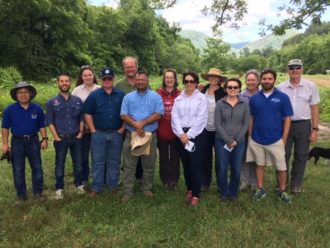
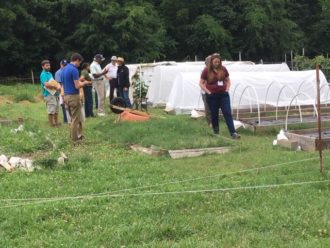
The 2014-2016 cadre of SARE Fellows visited numerous farms in Arkansas, Nebraska, Idaho, and West Virginia to study sustainable agricultural practices. The Fellows themselves were from Florida, Maine, Missouri, and Washington; they overlapped with eight other Fellows who were either starting or ending their two-year study period.
The various locations visited, diverse enterprises studied, and range of farming practices employed ensured exposure to a cross section of agricultural business with varying degrees of sustainability. The Fellows learned to use the “Reading the Farm” assessment tool, which provides a framework for holistic evaluation of farms using the strengths, weaknesses, opportunities, and threats (SWOT) approach.
Sharing some of the lessons learned from farms visited during the SARE Fellows program in this article may be useful to prospective small-scale producers, beginners, and even experienced producers who are considering making changes to their enterprise(s). These reflections are shared using the categories of the Reading the Farm process: production and processing; social and quality of life; environmental; and marketing and economics. Major take-away messages and a farm example is included for each.
Production and Processing
By far, the most important lesson learned regarding production and processing was how important it was for farms to focus on profit centers and what they did well. Although diversification is wise and can help reduce risk of the loss of single crops, many farms overdiversified and ended up doing few things well (or even profitably). For long-term success, enterprises that are sustainable environmentally, socially, and economically are a must.
Regardless of the crop produced, farmers must be knowledgeable about and employ best management practices (BMPs) for that crop. Irrigation, pest control, fertilization, season extension, and harvesting practices used should be state-of-the-art for that crop, applying the results of relevant research for optimal production efficiency. The differing levels of efficiency between farms was remarkable and mostly depended on the operator’s knowledge and use of BMPs.
Farm A: More is Less
Farm A did not lack for start-up capital. This second-career farmer had a very lucrative first career and used his extensive savings to fund his new passion for farming. However, he did not limit production to crops he grew well and were profitable—he kept expanding and experimenting as additional crops caught his interest. He did not abandon previous crops, just kept adding more and more, delighting his CSA customers but overwhelming his limited labor force. Some crops were poorly-suited to local conditions, not profitable, had no local market, or required too much labor to be feasible. Due to poor crop performance and inefficiencies, more and more savings had to be pumped into the operation to keep it solvent. Long-term sustainability was doubtful without re-focusing efforts on profit centers and abandoning production “whims” that were hard to justify for this new operation.
Social and Quality of Life
Nearly every farm mentioned something about family dynamics. On the most successful farms, the families had a shared vision and were working toward a common goal. Other farms were struggling, often due to the loss of passion and enthusiasm for the work by one or more partners, or conflicting goals. Some partners are open to and excited by new opportunities and want to explore them and others say NO to trying anything new or different. As is true in all relationships, compromise on both sides is often needed to keep a farm moving forward.
Working conditions are important for employers and employees. Employee turnover is very costly, so anything reasonable that can be done to prevent loss of trained employees is a good investment. Adding simple mechanization wherever possible to decrease labor and increase efficiency is warranted. Keeping worker comfort in mind, particularly in processing areas, will pay dividends through fewer injuries and less worker dissatisfaction. Working conditions become a larger consideration for owners as they age, too.
Many farmers mentioned the need for work-life balance for the entire family. Everyone needs time off the farm or doing something they enjoy not related to work. It is easy to become isolated and insular on a farm due to the sheer amount of work to do, but it is wise to make time to network with others to learn, share, and decompress.
Do you have a succession plan? Several farmers mentioned the importance of a farm succession plan but said they just hadn’t gotten around to creating one yet. If you care about the future of your farm and would like to have a say in its future, a farm succession plan is essential. Make it a priority to meet with an attorney experienced in drawing up farm succession plans.
Farm B: Beauty is in the Eye of the Bee-holder
Farm B was beautiful. Located a reasonable distance from several population centers, it is a popular destination for family day trips. The farm offers on-farm and off-farm sales of cut flowers and berries, including U-pick options. Its pest management practices are well-received by the public: bats, hummingbirds, swallows, and purple martins are attracted for insect control; roses and other strategically-placed flowers attract pollinators; and motion-detector lights deter raccoons.
Environmental
Weed, disease, and insect pest management was most effective when integrated methods were used. Some farms used row covers to protect specific crops from pests of concern at certain times. Beneficial insects were attracted by providing habitat in targeted areas. Scouting for insect pests each day helped producers get early notice of pest trends so decisions about control could be made early. Whether they were certified organic or not, most producers wanted to avoid the use of chemicals to control pests.
Farms prospered when proper attention was paid to soil health and nutrient management. Using mulch, cover crops with varying root depths, quantified compost/ fertilizer, and soil test results, good managers were able to improve fertility and farm production over time. Cover crops promoted soil retention and nutrient cycling; they were often missing on farms with gaps in BMPs.
Farm C: Underutilizing Resources
This farm was a surprising disappointment. Established as a working farm to promote education about livestock production, it was not employing practices that encouraged soil health, nutrient cycling, plant vigor, or optimal animal performance. Pastures were noticeably understocked. Also, cattle were not rotated through smaller paddocks but instead kept in one large field they did not utilize uniformly. This resulted in a great accumulation of over-mature forage that became senescent instead of being used as animal feed.
Marketing and Economics
The major lesson learned from the farm visits was the crucial need to know the profitability of each farm enterprise. Sometimes growers had only a vague sense of profitability or what their costs of production were. Professional farmers need to conduct an enterprise analysis for each crop to identify profit centers and losers and then use the results of the analysis to make critical decisions. Unprofitable endeavors should be carefully evaluated: can expenses be decreased or revenue increased? Should the enterprise be mothballed for a while or forever? If a market cannot be found that will meet the cost of production plus a reasonable profit margin, an enterprise should be retired. Successful fulltime diversified produce growers who direct market try to realize ~$20,000 per acre in gross income. The importance of financial recordkeeping is underscored during any discussion of cost of production determination or profitability assessment.
The pressure for success selects for innovation. Innovative growers have identified and pursued numerous opportunities such as marketing for other growers for a fee; creating value-added products to reduce waste and increase profits; using season extension or unique crops to help cash flow through year-round sales; specializing in niche crops identified by market analyses; conducting marketing plans for each product; and determining whether wholesaling or retailing is best for them. CSAs help finance farms before crops are available to sell each season, but CSAs are not for everyone. Some of the most successful farms are successful because one or more of the partners has secured steady income and benefits from a full- or part-time job off the farm.
Methods to foster a dedicated customer base pay off over years. Having a well-deserved reputation for product quality and consistency is paramount. Being located close to an urban center may reduce marketing expenses somewhat, help customers feel connected to a farm, and make agritoursim opportunities realistic. Advertising in local/regional agriculture marketing efforts will reach the target audience and help a farm stay connected with local farm events and fellow producers. Developing an attractive logo and including it on products, in advertising, and at the farm strengthens brand recognition by new and returning customers.
Farm D: The Early Nut Gets the Worm
The owner of Farm D used to raise row crops and cotton but had difficulty making a profit on limited acreage. He researched alternative crops and decided to try pecans. He planned meticulously, devised optimal tree spacing, and provided irrigation to every tree. As trees came into production, the producer found a way to get to market sooner (and therefore at a higher price) than competitors: he harvests pecans before they are fully dry, dries them in the bag, then sells to a wholesaler who expo exports for international holiday markets. This farmer shrewdly “recruits” neighbors with gifts of pecans to help keep an eye on the farm and reduce losses due to theft.
Conclusions
The 11 lessons learned by the 2014-2016 SARE Fellows shared above are key concepts worthy of being embraced by producers who hope to manage farms into sustainability. Valuable information can be gleaned from both highly successful and struggling farms. In any arena, learning from the successes and failures of others saves time, money, and aggravation and makes the road to sustainability shorter and less rocky.
Adapted from "Reflections of a SARE Fellow" Oregon State University Extension Service