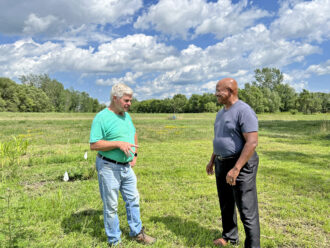
Farmers and ranchers know that their livelihoods depend on managing soil health to protect the long-term productivity of their land. Since 1988, SARE’s Farmer/Rancher grant program has followed their lead by investing over $38 million dollars in producer-led research to sustain American agriculture and those who rely on it.
North Central SARE’s Farmer Rancher grant program has supported nearly 1,500 projects exploring producer innovations in sustainability. One of those projects started when Bob Recker, a farmer and consultant in Iowa, challenged conventional thinking by asking whether wider corn rows could allow cover crops to thrive without sacrificing farm profitability.
Recker was interested in understanding how significantly widening corn rows might affect yields, soil health and overall system performance. While wider spacing runs counter to standard practice, he believed that increased sunlight could unlock new benefits from inter-row plantings. To test this idea, he partnered with other farmers willing to experiment with a nontraditional approach.
With support from two SARE Farmer/Rancher grants, Recker collaborated with three farmers near Waterloo, Iowa, to compare corn planted in 60- and 90-inch rows with standard 30-inch rows. They tested a range of inter-row plantings, from single cover crop species to diverse mixes, as well as farmer-designed treatments that included grazing cover crops or adding marketable vegetables. Plant populations per acre were kept consistent across treatments, and data were collected on crop growth, weed suppression, biomass, runoff and yield.
The results showed that wider-row systems can deliver meaningful benefits when paired with clear management goals. Yields in some treatments were slightly lower but resulted in improved water infiltration, rapid gains in soil organic matter and new income opportunities. In one case, a farmer still turned a profit during a crop failure year by harvesting turnips grown between rows. The project demonstrated that, with thoughtful planning, wider corn rows can support innovative cover cropping strategies that enhance resilience and profitability.
“There are a number of growers and landowners who have taken a great interest in my work. It is intriguing to them because it is so different from their traditional practices,” says Bob Recker.
Visit Utilizing Cover Crops in Wide Row Corn for more information on this project.
Utilizing Cover Crops in Wide Row Corn is just one of 12 stories featured in SARE’s 2025/2026 Report from the Field. Download or order your free print copy at https://sare.org/report or by calling (301) 779–1007. 2025/2026 Report from the Field is available in quantity for free to educators for use in educational workshops, classes or tours.
For information on grants and resources available from SARE, visit www.sare.org.