• WebStore |
  • Advanced Search |
  • MySARE Login |
  • SARE Social Media |
  • Contact Us |
  • SANET Listserv |
  • Low Bandwidth |
Search MySARE Reports
  • Grants
    • Apply for a Grant
    • Funded Grants in Your State
  • Project Reports
    • Submit a Report
    • Search the Database
    • Project Search Tips
    • About Project Reports
    • About Search Results
    • Project Products
  • Learning Center
    • Books
    • Bulletins
    • Fact Sheets
    • Topic Rooms
    • From the Field
    • Newsletters
    • Multimedia
    • Courses and Curricula
    • Project Products
    • SARE Biennial Reports
    • SANET Listserv
    • SARE Program Materials
    • Conference Materials
    • WebStore
  • Professional Development
    • PDP Overview
    • Fellows & Search for Excellence Programs
    • Sample PDP Grant Projects
    • Educator Curriculum Guides
    • National Continuing Education Program
    • State Coordinator Contact Information
  • State Programs
    • State Coordinator Program Overview
    • State Coordinator Contact Information
    • State Program Webpages
    • Funded Grants in Your State
  • Events
    • Event Calendar
    • Past Conferences
  • Newsroom
    • Press Releases
    • SARE in the News
    • Media Contacts
    • Newsletters
    • Media Toolkit
    • A Guide To This Site
    • SARE and Social Media
  • About SARE
    • SARE's Four Regions
    • Join Our Mailing List
    • SARE Grants
    • Learning Center
    • Professional Development
    • SARE Outreach
    • Historical Timeline
    • Staff
    • Vision & Mission
    • What is Sustainable Agriculture?
  • Home»
  • Learning Center»
  • Books»
  • Steel in the Field»
  • Text Version»
  • Row Crop Tools»
  • Introduction To Cultivators
facebook
Twitter
YouTube
- + Font Size
Print
Share

Text Version

  • Acknowledgments
  • Publisher's Foreword
  • Cultivation In Context
  • How to Use This Book
  • Introduction to Tools for Agronomic Row Crops
  • Row Crop Tools
    • Rotary hoe, standard
    • Rotary hoe, high-residue
    • Rotary hoe accessories
    • Flex-tine weeder
    • Spike-tooth harrow
    • Hoes and Harrows to the Rescue
    • Introduction To Cultivators
    • Cultivator, low-residue
    • Cultivar, moderate-residue
    • Cultivator, high-residue
    • Cultivator, maximum-residue
    • Cultivator, rolling
    • Cultivator, horizontal disk
    • Cultivator sweeps, knives and wings
    • Cultivator shields
    • Cultivator components
    • Hot-Tips for Flame Weeding
    • Row-crop flamer
    • Guidance Systems
    • Guidance mirrors
    • Guidance, furower/wheel
    • Guidance, ridge mechanical
    • Hitch-steer guidance
    • Side-shift guidance
    • Tool-pivoting guidance
    • Disk-steer guidance
    • Ridge-till planter
  • Row Crop Farmer Profiles
  • Introduction to Tools for Horticultural Crops
  • Horticultural Crop Tools
  • Horticultural Crop Farmer Profiles
  • Introduction to Tools for Dryland Crops
  • Dryland Crop Tools
  • Dryland Crop Farmer Profiles
  • The Toolshed
  • Printable Version

Can't find something? Ask or send feedback.

SARE's mission is to advance—to the whole of American agriculture—innovations that improve profitability, stewardship and quality of life by investing in groundbreaking research and education. SARE's vision is...

Introduction To Cultivators

Agronomic Row Crops
Cultivators

Innovations in the past 30 years have made cultivators more farmer-friendly, crop sensitive and soil-conserving compared with earlier models. Consider

 Three-point hitch, front or rear mounts. If you remember cumbersome mid-tractor 'belly' mount corn cultivators, today's models are a lot less hassle. Rear three-point hitches are standard. Quick-hitches make connecting and dropping off cultivators as easy as backing up, making contact, and locking on. Front-mount three-point hitches give clean visibility and quicker steering response.

 Soil-conserving designs. Flexing linkages, residue-cutting coulters, wide undercutting sweeps, greater clearance between components, narrow-profile shanks, and tall box crop shields have moved cultivation into high-residue, no-till systems. These components retain 50 to 90 percent of residue and minimize soil disruption in conservation tillage fields.

 Precision and control. Stronger toolbars and attachments that are more rigidly secured serve to reduce the 'wobble factor,' allowing operators to run tools within 3 inches of crops at high speed, a feat that demands tight conformity front to back. Tool gang members - mounting frames set at right angles to the main toolbar - can hold a set of tools that work between rows. Most are attached to the toolbars by parallel linkage - assemblies of pins, hinges and springs that consistently keep each sweep moving independently at its desired depth in uneven terrain. A range of guidance systems can provide constant tool alignment without a backward glance. They are described here after row-crop tools.

 Adjustment. A generation of farmers with skinned knuckles prompted the 'wrenchless adjustment' cultivators, cranked screw-jack depth controls, single wrench systems, spring-pin adjustments and re-positioning of adjusting nuts in more accessible locations.

Crops, soils, weed species and tillage all influence the tooling of a cultivator and what it needs to do to manage weeds. This book presents four general cultivator types, categorized by their capacity to handle crop residue. Groups are titled 'low residue,' for conventional and reduced tillage that leaves up to 20 percent residue; 'moderate residue' for up to 30 percent residue; 'high residue' for up to 60 percent residue with minimum tillage of 120-160 bu/A corn; and 'maximum residue' for 90 percent residue or more with no tillage of highest-yielding corn. Categories are further defined in each entry.

Cultivating loose, residue-free soils is the forte of multi-sweep vibrating S-tine units. These tines shake weed roots free from clinging soil. In firmer soils that resist sweep movement or in higher residue levels that plug close-set shanks, rigid single shank cultivators pull sharp sweeps that slice weeds just beneath the soil surface. Sweep profile, design style and wing angle determine whether soil is lifted unbroken, turned over, or moved into the row. Rolling cultivators are highly adjustable, aggressive, soil-stirring tools that can handle moderate residue and effectively work angled beds or flat fields.

TIPS: Run coulters 0.5' to 1' below point of sweep to effectively cut residue. Use disk hillers (where residue allows) to cut weeds and push them away from the row, or (when crops are established) to throw soil back onto the row to smother small weeds.

Next section
Agronomic Tool Index

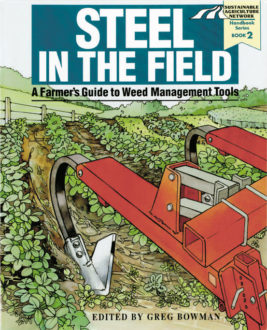
You are reading the SARE book Steel in the Field.

Order this publication.

Sare 25 Years

1122 Patapsco Building | University of Maryland | College Park, MD 20742-6715

This Web site is maintained by the national outreach office of the SARE program, supported by the National Institute of Food and Agriculture, U.S. Department of Agriculture.

North Central SARE | Northeast SARE | Southern SARE |  Western SARE

Sustainable Agriculture Research & Education ©2012

  • Help |
  • RSS Feeds |
  • A Guide To This Site