• WebStore |
  • Advanced Search |
  • MySARE Login |
  • SARE Social Media |
  • Contact Us |
  • SANET Listserv |
  • Low Bandwidth |
Search MySARE Reports
  • Grants
    • Apply for a Grant
    • Funded Grants in Your State
  • Project Reports
    • Submit a Report
    • Search the Database
    • Project Search Tips
    • About Project Reports
    • About Search Results
    • Project Products
  • Learning Center
    • Books
    • Bulletins
    • Fact Sheets
    • Topic Rooms
    • From the Field
    • Newsletters
    • Multimedia
    • Courses and Curricula
    • Project Products
    • SARE Biennial Reports
    • SANET Listserv
    • SARE Program Materials
    • Conference Materials
    • WebStore
  • Professional Development
    • PDP Overview
    • Fellows & Search for Excellence Programs
    • Sample PDP Grant Projects
    • Educator Curriculum Guides
    • National Continuing Education Program
    • State Coordinator Contact Information
  • State Programs
    • State Coordinator Program Overview
    • State Coordinator Contact Information
    • Funded Grants in Your State
  • Events
    • Event Calendar
    • Past Conferences
  • Newsroom
    • Press Releases
    • SARE in the News
    • Media Contacts
    • Newsletters
    • Media Toolkit
    • A Guide To This Site
    • SARE and Social Media
  • About SARE
    • SARE's Four Regions
    • SARE Grants
    • Learning Center
    • Professional Development
    • SARE Outreach
    • Historical Timeline
    • Staff
    • Vision & Mission
    • Join Our Mailing List
    • What is Sustainable Agriculture?
  • Home»
  • Learning Center»
  • Books»
  • Steel in the Field»
  • Text Version»
  • Row Crop Tools»
  • Cultivator, rolling
facebook
Twitter
YouTube
- + Font Size
Print
Share

Text Version

  • Acknowledgments
  • Publisher's Foreword
  • Cultivation In Context
  • How to Use This Book
  • Introduction to Tools for Agronomic Row Crops
  • Row Crop Tools
    • Rotary hoe, standard
    • Rotary hoe, high-residue
    • Rotary hoe accessories
    • Flex-tine weeder
    • Spike-tooth harrow
    • Hoes and Harrows to the Rescue
    • Introduction To Cultivators
    • Cultivator, low-residue
    • Cultivar, moderate-residue
    • Cultivator, high-residue
    • Cultivator, maximum-residue
    • Cultivator, rolling
    • Cultivator, horizontal disk
    • Cultivator sweeps, knives and wings
    • Cultivator shields
    • Cultivator components
    • Hot-Tips for Flame Weeding
    • Row-crop flamer
    • Guidance Systems
    • Guidance mirrors
    • Guidance, furower/wheel
    • Guidance, ridge mechanical
    • Hitch-steer guidance
    • Side-shift guidance
    • Tool-pivoting guidance
    • Disk-steer guidance
    • Ridge-till planter
  • Row Crop Farmer Profiles
  • Introduction to Tools for Horticultural Crops
  • Horticultural Crop Tools
  • Horticultural Crop Farmer Profiles
  • Introduction to Tools for Dryland Crops
  • Dryland Crop Tools
  • Dryland Crop Farmer Profiles
  • The Toolshed
  • Printable Version

Can't find something? Ask or send feedback.

SARE's mission is to advance—to the whole of American agriculture—innovations that improve profitability, stewardship and quality of life by investing in groundbreaking research and education. SARE's vision is...

Cultivator, rolling

Agronomic Row Crops
Rolling Cultivator

Intended for low-residue (spider gangs) or moderate residue (notched disk gangs) conditions.

Overview: A rolling cultivator tills with gangs of three to five spiders - wheels of strong, curved, cutting teeth radiating from a center hub - or notched disks. Disks are more aggressive than spider gangs and are more effective in residue. Gangs adjust three ways on round standards: to throw soil away from or toward the row; to move back or forward to align with other tools; and to change pitch to conform to the sides of raised beds. Can be used to build ridges. Heavy residue or larger rocks reduce the tool's effectiveness.

rolling cultivator

Design Features: The sharpened, angled ends aggressively slice through soil, uprooting and cutting weeds and leaving a fine surface soil mulch in loose soils. Split-row gangs position two spider wheels on each side of the row. They can operate very close to rows of crops up to 10" tall. Slicer tines run very close to a stationary bar to cut viny weeds.


Model for comparison: 15' rigid toolbar for six rows on 30" centers (6R30)
Rec. PTO HP: 70 to 90
Speed:
5 to 10 mph
List price:
$6,000 to $6,600
Width range (all makers/all models): 8' to 30'

Sources: 12, 22, 41
Farmers: Bennett, Chambers, Foster, Gemme, Hattaway, Haines, Harlow, Muller

Next section
Agronomic Tool Index

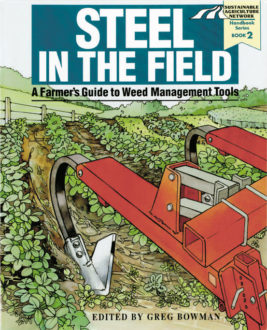
You are reading the SARE book Steel in the Field.

Order this publication.

25th SARE logo USDA Logo

1122 Patapsco Building | University of Maryland | College Park, MD 20742-6715

This Web site is maintained by the national outreach office of the SARE program, supported by the National Institute of Food and Agriculture, U.S. Department of Agriculture.

North Central SARE | Northeast SARE | Southern SARE | Western SARE

Sustainable Agriculture Research & Education ©2012

  • Help |
  • RSS Feeds |
  • A Guide To This Site