• WebStore |
  • Advanced Search |
  • MySARE Login |
  • SARE Social Media |
  • Contact Us |
  • SANET Listserv |
  • Low Bandwidth |
Search MySARE Reports
  • Grants
    • Apply for a Grant
    • Funded Grants in Your State
  • Project Reports
    • Submit a Report
    • Search the Database
    • Project Search Tips
    • About Project Reports
    • About Search Results
    • Project Products
  • Learning Center
    • Books
    • Bulletins
    • Fact Sheets
    • Topic Rooms
    • From the Field
    • Newsletters
    • Multimedia
    • Courses and Curricula
    • Project Products
    • SARE Biennial Reports
    • SANET Listserv
    • SARE Program Materials
    • Conference Materials
    • WebStore
  • Professional Development
    • PDP Overview
    • Fellows & Search for Excellence Programs
    • Sample PDP Grant Projects
    • Educator Curriculum Guides
    • National Continuing Education Program
    • State Coordinator Contact Information
  • State Programs
    • State Coordinator Program Overview
    • State Coordinator Contact Information
    • State Program Webpages
    • Funded Grants in Your State
  • Events
    • Event Calendar
    • Past Conferences
  • Newsroom
    • Press Releases
    • SARE in the News
    • Media Contacts
    • Newsletters
    • Media Toolkit
    • A Guide To This Site
    • SARE and Social Media
  • About SARE
    • SARE's Four Regions
    • Join Our Mailing List
    • SARE Grants
    • Learning Center
    • Professional Development
    • SARE Outreach
    • Historical Timeline
    • Staff
    • Vision & Mission
    • What is Sustainable Agriculture?
  • Home»
  • Learning Center»
  • Books»
  • Steel in the Field»
  • Text Version»
  • Row Crop Farmer Profiles»
  • Nelson Hattaway, Blakely, GA
facebook
Twitter
YouTube
- + Font Size
Print
Share

Text Version

  • Acknowledgments
  • Publisher's Foreword
  • Cultivation In Context
  • How to Use This Book
  • Introduction to Tools for Agronomic Row Crops
  • Row Crop Tools
  • Row Crop Farmer Profiles
    • Dick and Sharon Thompson, Boone, IA
    • Peter Kenagy, Albany, OR
    • Carmen Fernholz, Madison, MN
    • Rich Bennett, Napoleon, OH
    • Jack Erisman, Pana, IL
    • Rex and Glenn Spray, Mount Vernon, OH
    • Gary Thacker, Tucson, AZ
    • Nelson Hattaway, Blakely, GA
    • Steve McKaskle, Kennett, MO
  • Introduction to Tools for Horticultural Crops
  • Horticultural Crop Tools
  • Horticultural Crop Farmer Profiles
  • Introduction to Tools for Dryland Crops
  • Dryland Crop Tools
  • Dryland Crop Farmer Profiles
  • The Toolshed
  • Printable Version

Can't find something? Ask or send feedback.

SARE's mission is to advance—to the whole of American agriculture—innovations that improve profitability, stewardship and quality of life by investing in groundbreaking research and education. SARE's vision is...

Nelson Hattaway, Blakely, GA

Agronomic Row Crops: The Farmers

Single-Sweep Shines in Georgia Cotton

Nelson Hattaway
Blakely, Georgia

1,500 acres cotton
700 acres peanuts
oats as cover crop
strip tillage

Weed management highlights

Strategies: Banding in-row herbicides... cultivators for escape weeds in row middles... winter cover crops… full-rate herbicides

Tools: single-sweep, maximum-residue cultivator... low-residue cultivator

Mechanical cultivation never went out of style in southwest Georgia, but a surge of interest in single-sweep, heavy-duty cultivators followed the advent of no-till cotton in the early '90s.

'Even where I haven't got much residue, my Buffalo 6300 keeps straight going down the row,' says Nelson Hattaway. The high-residue cultivator's rigid single sweeps travel through in his hard, red clay soils better than his S-tine multi-sweep. He uses the older unit, however, for repeat passes in severe weed infestations, and for herbicide banding. It's equipped with a gauge wheel for each gang of three sweeps.

The heavy-duty Buffalo cultivator with its residue-cutting coulter earns its pay, especially in slicing easily through heavy debris and patches of nutgrass that used to plug Hattaway's rolling cultivator. 'The single no-till sweep basically takes care of anything in its path,' he's found after two years of using it. He reports his units (he bought a second eight-row a year after the first one) work effectively without plugging, even in wet soils.

Hattaway runs 24-inch, single-piece sweeps between rows that are 36 inches apart. He runs disk hillers to within 6 inches of the row on his first pass in cotton and within 4 inches of peanuts. He keeps flat-panel crop shields on for all cultivations to prevent loose soil from interfering with herbicide in the crop rows (called the 'drill' in cotton country). His challenging weeds include morning-glory species, nutsedge, buffalo grass, coffee weed and sand bur.

Hattaway fall-plants oats - at 2 bushels per acre, drilled in 7-inch rows, then harrowed lightly - to protect his soil and keep down winter weeds. He chemically burns down the cover crop when it's 6 to 10 inches tall. This is usually late March or early April, about a month before he strip-till plants cotton. He uses a six-row KMC no-till planter with residue-cutting coulters, heavy subsoiler shanks, fluted coulters, row-openers, gauge wheels and a soil crumbler roller ahead of a seeder unit. Seed is placed in a tilled, firmed and leveled 8- to 12-inch strip. (See Kelley Mfg. Co. in 'Tool Sources' section.)

Hattaway bands a grass and broadleaf herbicide mixture over the foot-wide tilled strip at planting and broadcasts a second mix postemergence. He's still improving parts of the system but observes that it works best under irrigation so he can be sure to stimulate seeds and activate herbicides.

While hand-hoeing weeds is seldom done in his area, Hattaway wants to learn more about in-row mechanical weeding tools. 'If it kills weeds,' he admits, 'I'm open to about anything."

Next farmer
All Farmer Profiles

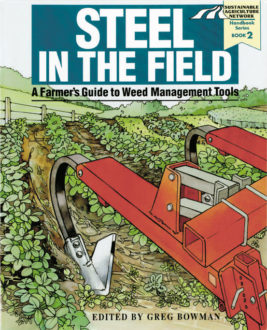
You are reading the SARE book Steel in the Field.

Order this publication.

Sare 25 Years

1122 Patapsco Building | University of Maryland | College Park, MD 20742-6715

This Web site is maintained by the national outreach office of the SARE program, supported by the National Institute of Food and Agriculture, U.S. Department of Agriculture.

North Central SARE | Northeast SARE | Southern SARE |  Western SARE

Sustainable Agriculture Research & Education ©2012

  • Help |
  • RSS Feeds |
  • A Guide To This Site