• WebStore |
  • Advanced Search |
  • MySARE Login |
  • SARE Social Media |
  • Contact Us |
  • SANET Listserv |
  • Low Bandwidth |
Search MySARE Reports
  • Grants
    • Apply for a Grant
    • Funded Grants in Your State
  • Project Reports
    • Submit a Report
    • Search the Database
    • Project Search Tips
    • About Project Reports
    • About Search Results
    • Project Products
  • Learning Center
    • Books
    • Bulletins
    • Fact Sheets
    • Topic Rooms
    • From the Field
    • Newsletters
    • Multimedia
    • Courses and Curricula
    • Project Products
    • SARE Biennial Reports
    • SANET Listserv
    • SARE Program Materials
    • Conference Materials
    • WebStore
  • Professional Development
    • PDP Overview
    • Fellows & Search for Excellence Programs
    • Sample PDP Grant Projects
    • Educator Curriculum Guides
    • National Continuing Education Program
    • State Coordinator Contact Information
  • State Programs
    • State Coordinator Program Overview
    • State Coordinator Contact Information
    • Funded Grants in Your State
  • Events
    • Event Calendar
    • Past Conferences
  • Newsroom
    • Press Releases
    • SARE in the News
    • Media Contacts
    • Newsletters
    • Media Toolkit
    • A Guide To This Site
    • SARE and Social Media
  • About SARE
    • SARE's Four Regions
    • SARE Grants
    • Learning Center
    • Professional Development
    • SARE Outreach
    • Historical Timeline
    • Staff
    • Vision & Mission
    • Join Our Mailing List
    • What is Sustainable Agriculture?
  • Home»
  • Learning Center»
  • Books»
  • Steel in the Field»
  • Text Version»
  • Publisher's Foreword
facebook
Twitter
YouTube
- + Font Size
Print
Share

Text Version

  • Acknowledgments
  • Publisher's Foreword
  • Cultivation In Context
  • How to Use This Book
  • Introduction to Tools for Agronomic Row Crops
  • Row Crop Tools
  • Row Crop Farmer Profiles
  • Introduction to Tools for Horticultural Crops
  • Horticultural Crop Tools
  • Horticultural Crop Farmer Profiles
  • Introduction to Tools for Dryland Crops
  • Dryland Crop Tools
  • Dryland Crop Farmer Profiles
  • The Toolshed
  • Printable Version

Can't find something? Ask or send feedback.

SARE's mission is to advance—to the whole of American agriculture—innovations that improve profitability, stewardship and quality of life by investing in groundbreaking research and education. SARE's vision is...

Publisher's Foreword

Publisher's Foreword

Controlling weeds with reduced reliance on herbicides is one of the main challenges facing farmers interested in moving toward a more sustainable agriculture. Some are concerned about the potential health implications of handling herbicides. Others worry about groundwater contamination. Still more farmers and ranchers have seen the escalating costs of bringing new, less environmentally harmful chemicals to market and have witnessed the development of “super weeds” that are resistant to commonly used herbicides. Therefore, finding alternative weed control strategies remains of great practical importance.

In some ways, cultivating for weed control is almost a lost art. Herbicides seemed to work so well for so long that many farmers abandoned mechanical means of control. But now, with new implements and improved versions of the basic rotary hoes, basket weeders and flame weeders of 50 years ago, we are seeing improved efficiency and renewed interest in mechanical cultivation.

Farmers are employing many techniques to control weeds, including careful selection of crops in rotations, using cover crops to compete with and smother weeds and, of course, mechanical cultivation.

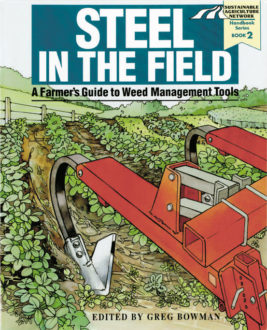
This book will provide you with information about how each implement works in the field in sustainable weed management systems. It also rates each tool’s usefulness in certain conditions, what problems other farmers have identified with that tool and where to obtain more information.

First published in 1997, this revised 2002 version of Steel in the Field includes updated tool sources with World Wide Web sites, updated contact information for our list of experts and current tool prices. Thanks to SAN’s Jennifer Butler for leading the revision effort.

You may want to travel to farms or research sites to see these implements in use. (See the list of experts.) We hope this book will help reduce the legwork in finding the right set of implements that works well on your farm.

After you read the book, let us know what you think! Did this bulletin prompt you to make any changes to your farming operation? This and other feedback is greatly appreciated!

Andy Clark, Coordinator
Sustainable Agriculture Network
April 2002


You are reading the SARE book Steel in the Field.

Order this publication.

25th SARE logo USDA Logo

1122 Patapsco Building | University of Maryland | College Park, MD 20742-6715

This Web site is maintained by the national outreach office of the SARE program, supported by the National Institute of Food and Agriculture, U.S. Department of Agriculture.

North Central SARE | Northeast SARE | Southern SARE | Western SARE

Sustainable Agriculture Research & Education ©2012

  • Help |
  • RSS Feeds |
  • A Guide To This Site