• WebStore |
  • Advanced Search |
  • MySARE Login |
  • SARE Social Media |
  • Contact Us |
  • SANET Listserv |
  • Low Bandwidth |
Search MySARE Reports
  • Grants
    • Apply for a Grant
    • Funded Grants in Your State
  • Project Reports
    • Submit a Report
    • Search the Database
    • Project Search Tips
    • About Project Reports
    • About Search Results
    • Project Products
  • Learning Center
    • Books
    • Bulletins
    • Fact Sheets
    • Topic Rooms
    • From the Field
    • Newsletters
    • Multimedia
    • Courses and Curricula
    • Project Products
    • SARE Biennial Reports
    • SANET Listserv
    • SARE Program Materials
    • Conference Materials
    • WebStore
  • Professional Development
    • PDP Overview
    • Fellows & Search for Excellence Programs
    • Sample PDP Grant Projects
    • Educator Curriculum Guides
    • National Continuing Education Program
    • State Coordinator Contact Information
  • State Programs
    • State Coordinator Program Overview
    • State Coordinator Contact Information
    • Funded Grants in Your State
  • Events
    • Event Calendar
    • Past Conferences
  • Newsroom
    • Press Releases
    • SARE in the News
    • Media Contacts
    • Newsletters
    • Media Toolkit
    • A Guide To This Site
    • SARE and Social Media
  • About SARE
    • SARE's Four Regions
    • SARE Grants
    • Learning Center
    • Professional Development
    • SARE Outreach
    • Historical Timeline
    • Staff
    • Vision & Mission
    • Join Our Mailing List
    • What is Sustainable Agriculture?
  • Home»
  • Learning Center»
  • Books»
  • Steel in the Field»
  • Text Version»
  • Introduction to Tools for Horticultural Crops
facebook
Twitter
YouTube
- + Font Size
Print
Share

Text Version

  • Acknowledgments
  • Publisher's Foreword
  • Cultivation In Context
  • How to Use This Book
  • Introduction to Tools for Agronomic Row Crops
  • Row Crop Tools
  • Row Crop Farmer Profiles
  • Introduction to Tools for Horticultural Crops
  • Horticultural Crop Tools
  • Horticultural Crop Farmer Profiles
  • Introduction to Tools for Dryland Crops
  • Dryland Crop Tools
  • Dryland Crop Farmer Profiles
  • The Toolshed
  • Printable Version

Can't find something? Ask or send feedback.

SARE's mission is to advance—to the whole of American agriculture—innovations that improve profitability, stewardship and quality of life by investing in groundbreaking research and education. SARE's vision is...

Introduction to Tools for Horticultural Crops

Horticultural Crops
Introduction

The economics of weed management are strikingly different in 'high-value crops' than they are in larger fields of soybeans or grain. With gross income of more than $1,000 per acre, some tools make sense for vegetables or fruit that don't in a 200-acre corn field grossing less than half that much.

Yet costs are 'high-value,' too. Growers often need virtually weed-free fields for efficient harvesting. Weeds missed at early stages may cost $600 to $2,000 per acre to hand-weed later. Several aspects of vegetable systems favor cultivation:

Tools for shallow cultivation in clean fields are lighter and less expensive than those that have to handle residue or move more soil.
Irrigation allows 'pre-watering' that sprouts surface weed seeds so they can be flame weeded or cultivated. This is a popular application of the 'stale seed bed' technique. Tractor passes for reforming irrigation furrows or to use 'crust busters' (rolling basket harrows run between rows) provide a cultivation opportunity without added tractor time.
Well-made raised beds (to improve row drainage), with uniform shape and straight alignment, can be the cornerstone for efficient planting and cultivating passes. Bed sleds and cone guide wheels provide accurate guidance for planters and cultivators simply by hugging the bed sides. They are inexpensive to buy and operate.

Intensive crop rotations make herbicide use more troublesome in vegetable crops than in field crops. But that same complexity can be daunting to a grower investigating greater reliance on mechanical weed control. The grower may need to buy several unfamiliar implements, then learn how to operate, maintain, calibrate and adjust them to suit variable field conditions and plant sizes. To be effective, all the tools have to run 'in synch,' with some quite close to the row.

Once weed prevention steps begin to reduce weed pressure, basic vegetable implements can quickly pay their way in reduced labor costs. To get the most from these weed-fighters

Simplify row spacing and bed width to minimize adjustments.
Make sure each crop's income covers its need for specialized weed-control steps.
Select tools you can alter to work at many depths, widths or crop sizes.
Visit farmers to see how they create or adapt tools to kill more weeds with fewer trips.

In-the-row tools work well in loose, fairly dry soil without large clods or rocks. When used effectively, they can pre-empt tedious in-row hand weeding. Keep in mind the speed and residue limitations of these tools.

Specialized tractors for cultivating were made through the '70s. They had offset seats and engines to improve the operator's view of the center row, and usually had higher clearance. 'Cultivator tractors' like the Allis G have a rear-mount engine and an open front frame design. See the Appendix for locator lists.

Also used in vegetable fields and orchards are 'broadcast tillage' tools such as harrows and rotary hoes (see Section I), and the disk harrow and field cultivator, presented in Section III.

Next section

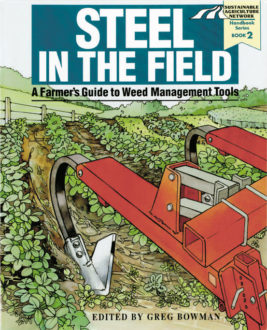
You are reading the SARE book Steel in the Field.

Order this publication.

25th SARE logo USDA Logo

1122 Patapsco Building | University of Maryland | College Park, MD 20742-6715

This Web site is maintained by the national outreach office of the SARE program, supported by the National Institute of Food and Agriculture, U.S. Department of Agriculture.

North Central SARE | Northeast SARE | Southern SARE | Western SARE

Sustainable Agriculture Research & Education ©2012

  • Help |
  • RSS Feeds |
  • A Guide To This Site