• WebStore |
  • Advanced Search |
  • MySARE Login |
  • SARE Social Media |
  • Contact Us |
  • SANET Listserv |
  • Low Bandwidth |
Search MySARE Reports
  • Grants
    • Apply for a Grant
    • Funded Grants in Your State
  • Project Reports
    • Submit a Report
    • Search the Database
    • Project Search Tips
    • About Project Reports
    • About Search Results
    • Project Products
  • Learning Center
    • Books
    • Bulletins
    • Fact Sheets
    • Topic Rooms
    • From the Field
    • Newsletters
    • Multimedia
    • Courses and Curricula
    • Project Products
    • SARE Biennial Reports
    • SANET Listserv
    • SARE Program Materials
    • Conference Materials
    • WebStore
  • Professional Development
    • PDP Overview
    • Fellows & Search for Excellence Programs
    • Sample PDP Grant Projects
    • Educator Curriculum Guides
    • National Continuing Education Program
    • State Coordinator Contact Information
  • State Programs
    • State Coordinator Program Overview
    • State Coordinator Contact Information
    • State Program Webpages
    • Funded Grants in Your State
  • Events
    • Event Calendar
    • Past Conferences
  • Newsroom
    • Press Releases
    • SARE in the News
    • Media Contacts
    • Newsletters
    • Media Toolkit
    • A Guide To This Site
    • SARE and Social Media
  • About SARE
    • SARE's Four Regions
    • Join Our Mailing List
    • SARE Grants
    • Learning Center
    • Professional Development
    • SARE Outreach
    • Historical Timeline
    • Staff
    • Vision & Mission
    • What is Sustainable Agriculture?
  • Home»
  • Learning Center»
  • Books»
  • Steel in the Field»
  • Text Version»
  • Introduction to Tools for Dryland Crops
facebook
Twitter
YouTube
- + Font Size
Print
Share

Text Version

  • Acknowledgments
  • Publisher's Foreword
  • Cultivation In Context
  • How to Use This Book
  • Introduction to Tools for Agronomic Row Crops
  • Row Crop Tools
  • Row Crop Farmer Profiles
  • Introduction to Tools for Horticultural Crops
  • Horticultural Crop Tools
  • Horticultural Crop Farmer Profiles
  • Introduction to Tools for Dryland Crops
  • Dryland Crop Tools
  • Dryland Crop Farmer Profiles
  • The Toolshed
  • Printable Version

Can't find something? Ask or send feedback.

SARE's mission is to advance—to the whole of American agriculture—innovations that improve profitability, stewardship and quality of life by investing in groundbreaking research and education. SARE's vision is...

Introduction to Tools for Dryland Crops

Dryland Crops
The Tools

Cornbelt farmers can expect adequate rainfall in most years. They cultivate in ways that minimize the risk of erosion when the expected precipitation comes.

Dryland farmers just grin when asked about excess precipitation at planting-time. 'Usually not a problem 'round here,' they say. Some have to leave their fields unplanted for a year (fallowed) just to build up soil moisture. They evaluate every weeding event for its moisture impact.

Weed control implements have been used traditionally to manage the fallow season, the months when volunteer vegetation is managed to reduce moisture withdrawal from fields. 'Clean fallow' - keeping soil weed-free - is tillage-intensive, leaves little residue on the soil surface and makes soils vulnerable to wind and water erosion. Residue management tools that reduce that threat grew from Charles Noble's observation in the 1930s that Alberta prairie pastures held top soil while clean fallowed fields were losing it. He introduced undercutting blades up to 12 feet wide for working vast prairies. The sharp V-blades slice through weed roots and lightly disturb the soil surface without burying the above-ground portion. Residue is virtually undiminished.

'Stubble-mulch' implements include a range of lighter-framed tools also designed to undercut weeds and maintain surface residue. These include implements with smaller V-blades, as well as C-shank units with wide sweeps. Chisel plows and field cultivators with increased vertical and fore-to-aft clearance and wide, flat sweeps are also now widely used to manage fallow fields.

Rod weeders were developed to work in loose and low-residue soils. A rotating rod pulls up weeds. Now most units have soil-loosening field cultivator shanks ahead of the rod to aid in weeding and extend the rod weeder's use to higher residue fields. Rod weeders also serve a moisture-managing role during fallow and just prior to planting, as well as a weed-control role in the postplant, preemergence window.

Less familiar is postemergence use of flex-tine weeders, rotary hoes, spike-tooth harrows and skew treaders in young standing grain or dryland row crops. (See 'Hoes and harrows to the rescue,') Skew treaders resemble rotary hoes, but skew arms are straight and there are fewer arms radiating from the wheel hub.

Like other broadcast postemergence cultivation, success depends on timing, using the right tool wisely and relative depths. Tools that scratch the surface need to have ground-engaging parts that have enough muscle to kill shallow-rooted weeds but be elegant enough not to shear off young crop plants. The parts must penetrate deeply enough to get the weeds but not so deep as to damage crop roots. Weeds usually emerge following rainfall, thus timing is complicated by the usual tension: the need for soil dry enough to avoid compaction during the time when weeds are still small enough to control.

Managing weeds in some regions in the mid-'90s was complicated by drought, weed shifts due to no-till herbicide-fallow and invasions of new weeds. Farmers are exploring new tools, new uses of old tools, new crops, new crop sequences and new mixes of tillage, herbicide and cultural options.

Next section

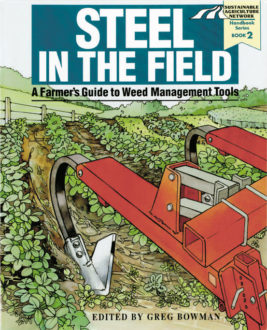
You are reading the SARE book Steel in the Field.

Order this publication.

Sare 25 Years

1122 Patapsco Building | University of Maryland | College Park, MD 20742-6715

This Web site is maintained by the national outreach office of the SARE program, supported by the National Institute of Food and Agriculture, U.S. Department of Agriculture.

North Central SARE | Northeast SARE | Southern SARE |  Western SARE

Sustainable Agriculture Research & Education ©2012

  • Help |
  • RSS Feeds |
  • A Guide To This Site