• WebStore |
  • Advanced Search |
  • MySARE Login |
  • SARE Social Media |
  • Contact Us |
  • SANET Listserv |
  • Low Bandwidth |
Search MySARE Reports
  • Grants
    • Apply for a Grant
    • Funded Grants in Your State
  • Project Reports
    • Submit a Report
    • Search the Database
    • Project Search Tips
    • About Project Reports
    • About Search Results
    • Project Products
  • Learning Center
    • Books
    • Bulletins
    • Fact Sheets
    • Topic Rooms
    • From the Field
    • Newsletters
    • Multimedia
    • Courses and Curricula
    • Project Products
    • SARE Biennial Reports
    • SANET Listserv
    • SARE Program Materials
    • Conference Materials
    • WebStore
  • Professional Development
    • PDP Overview
    • Fellows & Search for Excellence Programs
    • Sample PDP Grant Projects
    • Educator Curriculum Guides
    • National Continuing Education Program
    • State Coordinator Contact Information
  • State Programs
    • State Coordinator Program Overview
    • State Coordinator Contact Information
    • State Program Webpages
    • Funded Grants in Your State
  • Events
    • Event Calendar
    • Past Conferences
  • Newsroom
    • Press Releases
    • SARE in the News
    • Media Contacts
    • Newsletters
    • Media Toolkit
    • A Guide To This Site
    • SARE and Social Media
  • About SARE
    • SARE's Four Regions
    • Join Our Mailing List
    • SARE Grants
    • Learning Center
    • Professional Development
    • SARE Outreach
    • Historical Timeline
    • Staff
    • Vision & Mission
    • What is Sustainable Agriculture?
  • Home»
  • Learning Center»
  • Books»
  • Steel in the Field»
  • Text Version»
  • Introduction to Tools for Agronomic Row Crops
facebook
Twitter
YouTube
- + Font Size
Print
Share

Text Version

  • Acknowledgments
  • Publisher's Foreword
  • Cultivation In Context
  • How to Use This Book
  • Introduction to Tools for Agronomic Row Crops
  • Row Crop Tools
  • Row Crop Farmer Profiles
  • Introduction to Tools for Horticultural Crops
  • Horticultural Crop Tools
  • Horticultural Crop Farmer Profiles
  • Introduction to Tools for Dryland Crops
  • Dryland Crop Tools
  • Dryland Crop Farmer Profiles
  • The Toolshed
  • Printable Version

Can't find something? Ask or send feedback.

SARE's mission is to advance—to the whole of American agriculture—innovations that improve profitability, stewardship and quality of life by investing in groundbreaking research and education. SARE's vision is...

Introduction to Tools for Agronomic Row Crops

Agronomic Row Crops
The Tools

A flexible combination of tools, timing and technique to suppress early season weeds is the foundation of an integrated row-crop weed management program. Broadcast weeding tools, used in conjunction with cover crops and primary tillage, offer an alternative to herbicides at planting to control weed competition.

Rotary hoes, flex-tine weeders, spike-tooth harrows and rolling bar baskets all provide shallow, thorough stirring of the soil that kills sprouting and emerging weeds the full width of the tool. The action knocks soil from weed roots, causing them to die. Control is best when field conditions are hot, dry and sunny.

Flame weeding just prior to and just after crop emergence is also effective in establishing early control in some crops. Of the entire group of broadcast tillage or flaming tools, only specially designed rotary hoes work well in fields with appreciable crop residue.

Post-plant treatment for weed control before crop emergence is a delicate, time sensitive maneuver. It depends on the ability of an implement to kill surface weeds without mortally disturbing the germinating crop. For preemergent treatments to be effective, the crop must be planted deeper than the working depth of the broadcast tillage tool. Postemergence, the crop must be more firmly rooted than competing weeds to survive the weeding pass.

Years of crusted spring soils boost rotary hoe sales. In these times, the tool’s flicking and shattering of soil particles to kill weeds takes second place to its ability to aerate a rain-packed soil surface. Extra weight helps crust penetration but makes gauge wheels a necessity. A pair of these supporting tires, one under either side of the rotary hoe toolbar, maintains even penetration by the hoe points. On rough fields, the tires prevent gouging by the hoe wheels on one end of the toolbar.

Rotary hoes are not good weeders in tilthy, soft soils. In these conditions, the dragging action of soil-stirring harrows and tine weeders tend to be more effective.

The rotary hoe is an effective and efficient tool within a sharply limited window of weed size. Once weeds form true leaves or you can see them while driving by from your tractor seat, many will survive. Doubling back to cover the same field a second time—in the same or opposite direction immediately, or in several days when re-rooting of weeds begins—often boosts effectiveness if weed pressure is strong, residue interferes, or cloudy, humid conditions slow weed kill.

Crops at large vary in their tolerance of rotary hoeing, with species having a strong but flexible center stem surviving best. Row crops—and even tomatoes—can survive rotary hoeing at 8 to 12 inches tall if an emergency pass is needed to control small weeds before a cultivator is available.

Note: This book presents tools in three categories by crop type where they are commonly used. Many tools are employed effectively in diverse systems. The farmer narratives show how the same tool works well in different crops and for different purposes.

Next section

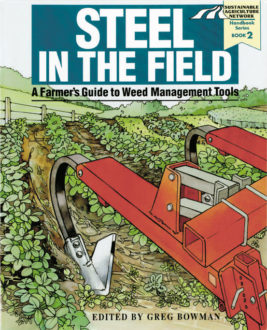
You are reading the SARE book Steel in the Field.

Order this publication.

Sare 25 Years

1122 Patapsco Building | University of Maryland | College Park, MD 20742-6715

This Web site is maintained by the national outreach office of the SARE program, supported by the National Institute of Food and Agriculture, U.S. Department of Agriculture.

North Central SARE | Northeast SARE | Southern SARE |  Western SARE

Sustainable Agriculture Research & Education ©2012

  • Help |
  • RSS Feeds |
  • A Guide To This Site