• WebStore |
  • Advanced Search |
  • MySARE Login |
  • SARE Social Media |
  • Contact Us |
  • SANET Listserv |
  • Low Bandwidth |
Search MySARE Reports
  • Grants
    • Apply for a Grant
    • Funded Grants in Your State
  • Project Reports
    • Submit a Report
    • Search the Database
    • Project Search Tips
    • About Project Reports
    • About Search Results
    • Project Products
  • Learning Center
    • Books
    • Bulletins
    • Fact Sheets
    • Topic Rooms
    • From the Field
    • Newsletters
    • Multimedia
    • Courses and Curricula
    • Project Products
    • SARE Biennial Reports
    • SANET Listserv
    • SARE Program Materials
    • Conference Materials
    • WebStore
  • Professional Development
    • PDP Overview
    • Fellows & Search for Excellence Programs
    • Sample PDP Grant Projects
    • Educator Curriculum Guides
    • National Continuing Education Program
    • State Coordinator Contact Information
  • State Programs
    • State Coordinator Program Overview
    • State Coordinator Contact Information
    • State Program Webpages
    • Funded Grants in Your State
  • Events
    • Event Calendar
    • Past Conferences
  • Newsroom
    • Press Releases
    • SARE in the News
    • Media Contacts
    • Newsletters
    • Media Toolkit
    • A Guide To This Site
    • SARE and Social Media
  • About SARE
    • SARE's Four Regions
    • Join Our Mailing List
    • SARE Grants
    • Learning Center
    • Professional Development
    • SARE Outreach
    • Historical Timeline
    • Staff
    • Vision & Mission
    • What is Sustainable Agriculture?
  • Home»
  • Learning Center»
  • Books»
  • Steel in the Field»
  • Text Version»
  • Cultivation In Context»
  • Cultivation In Context, Page 5
facebook
Twitter
YouTube
- + Font Size
Print
Share

Text Version

  • Acknowledgments
  • Publisher's Foreword
  • Cultivation In Context
    • Cultivation In Context, Page 2
    • Cultivation In Context, Page 3
    • Cultivation In Context, Page 4
    • Cultivation In Context, Page 5
    • Cultivation In Context, Page 6
  • How to Use This Book
  • Introduction to Tools for Agronomic Row Crops
  • Row Crop Tools
  • Row Crop Farmer Profiles
  • Introduction to Tools for Horticultural Crops
  • Horticultural Crop Tools
  • Horticultural Crop Farmer Profiles
  • Introduction to Tools for Dryland Crops
  • Dryland Crop Tools
  • Dryland Crop Farmer Profiles
  • The Toolshed
  • Printable Version

Can't find something? Ask or send feedback.

SARE's mission is to advance—to the whole of American agriculture—innovations that improve profitability, stewardship and quality of life by investing in groundbreaking research and education. SARE's vision is...

Cultivation In Context, Page 5

ABCs of Mechanical and Cultural Weed Management

In a sustainable farm plan, each type of implement is only one part of a long-term weed management strategy. Any tool will disappoint when it's asked to do more than it was designed to do. A successful strategy distributes weed-limiting and weed-killing roles into complementary parts. The benefits of crop diversity and soil improvements in lowering weed pressure increase over time. This trend lessens the economic hit when weed control steps face difficulty.

Critical principles of sustainable, integrated weed control using steel or flame include:

A. Give the crop the advantage.
Steel tools succeed best when you focus on weed prevention, lessening the vigor and number of weeds that need to be killed. Delayed planting is a key here. Crops germinate quicker in warmer soil. They spend fewer days in the ground before they begin to outgrow weeds or form a shady canopy that sets back weeds.

Intensive, early season weeding is a second distinguishing feature of a system based on mechanical weed control (MWC). It keeps crops ahead by hitting weeds as soon after germination as possible - long before they are a physical threat to the crop. Causing weeds to die by physical means (tearing, cutting, root drying or flaming) is much easier and more efficient when the weeds are tiny and vulnerable. By the time they threaten the crop with shading and competition for soil moisture and fertility, they are much more difficult to kill with cultivation. Postemergent herbicide application gives a little more leeway.

Page: 1 | 2 | 3 | 4 | 5 | 6

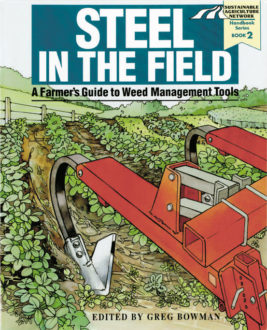
You are reading the SARE book Steel in the Field.

Order this publication.

Sare 25 Years

1122 Patapsco Building | University of Maryland | College Park, MD 20742-6715

This Web site is maintained by the national outreach office of the SARE program, supported by the National Institute of Food and Agriculture, U.S. Department of Agriculture.

North Central SARE | Northeast SARE | Southern SARE |  Western SARE

Sustainable Agriculture Research & Education ©2012

  • Help |
  • RSS Feeds |
  • A Guide To This Site