• WebStore |
  • Advanced Search |
  • MySARE Login |
  • SARE Social Media |
  • Contact Us |
  • SANET Listserv |
  • Low Bandwidth |
Search MySARE Reports
  • Grants
    • Apply for a Grant
    • Funded Grants in Your State
  • Project Reports
    • Submit a Report
    • Search the Database
    • Project Search Tips
    • About Project Reports
    • About Search Results
    • Project Products
  • Learning Center
    • Books
    • Bulletins
    • Fact Sheets
    • Topic Rooms
    • From the Field
    • Newsletters
    • Multimedia
    • Courses and Curricula
    • Project Products
    • SARE Biennial Reports
    • SANET Listserv
    • SARE Program Materials
    • Conference Materials
    • WebStore
  • Professional Development
    • PDP Overview
    • Fellows & Search for Excellence Programs
    • Sample PDP Grant Projects
    • Educator Curriculum Guides
    • National Continuing Education Program
    • State Coordinator Contact Information
  • State Programs
    • State Coordinator Program Overview
    • State Coordinator Contact Information
    • Funded Grants in Your State
  • Events
    • Event Calendar
    • Past Conferences
  • Newsroom
    • Press Releases
    • SARE in the News
    • Media Contacts
    • Newsletters
    • Media Toolkit
    • A Guide To This Site
    • SARE and Social Media
  • About SARE
    • SARE's Four Regions
    • SARE Grants
    • Learning Center
    • Professional Development
    • SARE Outreach
    • Historical Timeline
    • Staff
    • Vision & Mission
    • Join Our Mailing List
    • What is Sustainable Agriculture?
  • Home»
  • Learning Center»
  • Books»
  • Steel in the Field»
  • Text Version»
  • Cultivation In Context»
  • Cultivation In Context, Page 4
facebook
Twitter
YouTube
- + Font Size
Print
Share

Text Version

  • Acknowledgments
  • Publisher's Foreword
  • Cultivation In Context
    • Cultivation In Context, Page 2
    • Cultivation In Context, Page 3
    • Cultivation In Context, Page 4
    • Cultivation In Context, Page 5
    • Cultivation In Context, Page 6
  • How to Use This Book
  • Introduction to Tools for Agronomic Row Crops
  • Row Crop Tools
  • Row Crop Farmer Profiles
  • Introduction to Tools for Horticultural Crops
  • Horticultural Crop Tools
  • Horticultural Crop Farmer Profiles
  • Introduction to Tools for Dryland Crops
  • Dryland Crop Tools
  • Dryland Crop Farmer Profiles
  • The Toolshed
  • Printable Version

Can't find something? Ask or send feedback.

SARE's mission is to advance—to the whole of American agriculture—innovations that improve profitability, stewardship and quality of life by investing in groundbreaking research and education. SARE's vision is...

Cultivation In Context, Page 4

Cultivation in Context: Renewed tools for better farming

Maximizing The Benefits

MWC that works offers clear advantages for sustainable farming. These include four opportunities.

Develop weed control customized to your farm. Remember, tools are only part of a site-specific, self-sufficient system. Their highest use comes mixed with years of on-farm observation of your soils, crops and weather. Start where you are, learning from other farmers with related tools, crops, soils, weeds and farming goals. As you work with more of these variables, your system becomes more flexible and more adapted to your farm—in sum, more site-specific and more sustainable.

Reduce annual expense for consumable purchased inputs. Yearly costs for herbicides can be reduced as tool use increases. Most weed tools work years after they’re paid for. Spray equipment does, too. Herbicides you buy every growing season.

Reasonable maintenance and appropriate use lets you run cultivators for many seasons. Sweep wear is gauged in thousands of acres, with replaceable blades minimizing the new steel needed for a clean cut. Moving parts in some weed tools increase soil action as well as maintenance needs, but still give long service.

Mesh weed management with crop rotation and soil tilth improvement. Tillage that replaces herbicides uncouples crop selection from any limits of chemical carryover. This freedom maximizes cropping opportunities. It increases options when you are re-planting an alternative crop in the event of a crop failure or a weather catastrophe. You can interplant crops or use narrow-strip tillage of several crops without concern about herbicide drift causing damage.

Adding small grains or forage crops to a rotation reduces the size of the niche for annual weeds by shifting the seasonal opening for weed growth. Plus these crops can add biomass to the soil when residue is unharvested. Pre-plant tillage can serve dual purposes of incorporating covers and preparing a seed bed. Rotating warm- and cool season crops is another way to put weeds on the defensive.

Innovative farmers are exploring no-till planting into cover crops left on the surface. These operators use chemical or mechanical means to kill covers, then plant seed or vegetable transplants with tools that create openings just big enough for the job. This route suppresses weeds, preserves moisture and creates habitat for beneficial insects. Carefully incorporating sufficient cover crops with tillage can significantly improve soil water retention, which reduces surface run off with its erosive tendency. Extra organic matter added over time also increases a soil’s tendency to flow better when tilled because it becomes more granular and less cloddy. Covers can suck up moisture as they mature, which can be a problem in dry years.

Profit from new, high-value markets for non-chemically produced crops. A MWC-based, non-herbicide system often offers relief from pesticide applicator’s licensing; incurring new environmental liability from chemical surface runoff, groundwater contamination or spray drift; health risks to applicators or family members; and any accidental contact with livestock or non-target crops.

Opportunities are increasing for food crops grown under more ecologically sustainable management. More buyers—local, regional and national—pay premium prices for vegetables, fruits and grains grown under integrated pest management systems, or even from fields that receive no herbicides for the current cropping season. Organic dairies need grains and hay—and prefer them to be regionally grown. Exporters need high quality, specially grown grains and soybeans for customers in Europe and Japan. Local food buyers, from families to restaurants, seek out vegetables, grains and livestock raised in ways that seem to be more ecologically safe.

Even without a market that rewards a shift to lower pesticide use, you gain a positive conversation starter with consumers and neighbors. You have new chances to win support for your farming operation from local non-farmers interested in environmental issues. Explain the alternative measures you’re taking to produce profitable crops. Highlight the extra effort you give to understanding your farm’s complex ecological balance.

Every farmer has a unique range of skills, economic situations and natural resources. Choosing the most sustainable mix—for weed management and for an overall, whole-farm approach—is a privilege and a responsibility that should stay as close to home as possible. When your tools fit your system, you’re the one in charge.

Page: 1 | 2 | 3 | 4 | 5 | 6

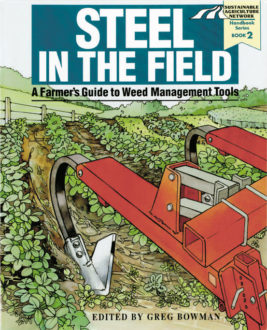
You are reading the SARE book Steel in the Field.

Order this publication.

25th SARE logo USDA Logo

1122 Patapsco Building | University of Maryland | College Park, MD 20742-6715

This Web site is maintained by the national outreach office of the SARE program, supported by the National Institute of Food and Agriculture, U.S. Department of Agriculture.

North Central SARE | Northeast SARE | Southern SARE | Western SARE

Sustainable Agriculture Research & Education ©2012

  • Help |
  • RSS Feeds |
  • A Guide To This Site