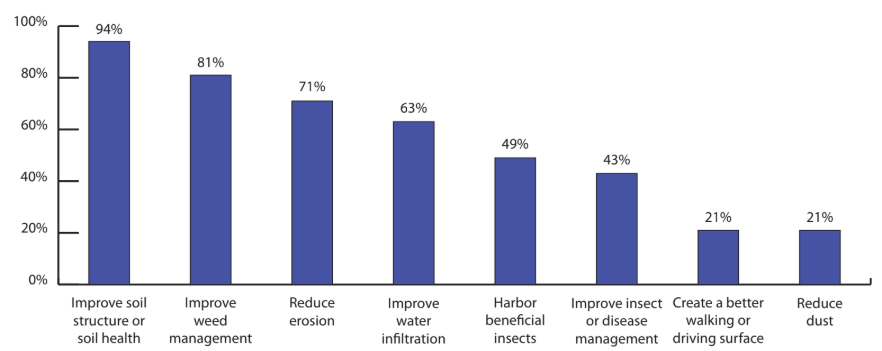
While cover crops are often associated with large-scale row crops like corn and soybeans, in the modern farming era they first gained traction among horticulture producers, especially vegetable farmers. For vegetable producers, cover crops have served not only to help hold soil in place and improve organic matter, but also as a key method of weed control. With expanded use of cover crops in recent years, their benefits for pollinators, soil health, and rainfall infiltration are also becoming driving forces in adoption. As shown in the figure below, there are a wide range of reasons that horticulture producers use cover crops.
The species of cover crops used, timing of planting and termination, and relative use of cover crop mixes all vary widely by horticulture crop, farm, and region. For example, a vegetable farm may use cereal rye mixed with vetch as winter cover crops, while also making use of warm season cover crops like buckwheat and millets after early vegetables are harvested. If a farmer anticipates not using a plot of ground for a long period of time, it s becoming increasingly common to use high biomass mixes of cover crops to improve soil health and restore soil fertility.
Termination of cover crops in horticulture operations often introduces different wrinkles than with large-scale row crops. For vegetable operations that may have many different vegetable species growing next to each other, spraying a herbicide to terminate a cover crop may not be an option due to the potential for drift to affect nearby vegetables. For perennial crops, herbicide drift is also a serious concern, leading to most orchards, vineyards, and berry crop operations to use perennial cover crops that don t need termination.
In general, horticultural use of cover crops can be split into annual cash crops on farms with vegetables and/or annual fruits, and perennial horticultural crops like apples, grapes, nut trees, berries, and even perennial herbaceous crops like herbs, asparagus, etc. In most cases, the annual horticulture crops get used with annual cover crops, and perennial horticulture crops get used with perennial cover crops. The remainder of this chapter discusses cover crops in these annual and perennial systems as separate topics and approaches.
Horticulture operations with annual crops
With the wide range of annual horticultural crops that one may grow on a farm, considering plant families and the overall crop rotation is a good place to start in planning for cover crops. For example, if Brassica cash crops are being grown, like lettuce, cabbage, or cauliflower, it s best to avoid using a Brassica cover crop like radishes right before the cash crop. Using a grass and/or legume cover would be a better choice. Since most vegetables are broadleaves, using some grass cover crops in the rotation can be helpful to break up certain disease and insect cycles.
Matching up the timing of when the cover crop needs to be winding down before planting an annual horticultural crop is also a key factor. Regional cover crop councils have cover crop selector tools, such as from the Midwest Cover Crop Council, that can be used to help plan out timing of cover crop growth in the rotation. As noted in Chapter 5 on cover crop selection, evaluating when to use cool-season cover crops versus warm-season cover crops should be part of the planning process.
A good starting point is to fall-plant an overwintering cover crop, either a single winter cereal species (e.g., rye, wheat, triticale, or barley) or add in a legume with that winter cereal. For early planted vegetables like potatoes, peas and salad greens, early termination of the winter cover crop will limit spring growth of the legume, but the added plant diversity can help promote diversity in the soil microbial community. Where later planting dates are used for vegetables like green beans, tomatoes, and pumpkins, legume cover crops can become more helpful. Providing a longer spring growing season for legume cover crops can allow them to contribute in a meaningful way to the nitrogen fertility needs of a summer vegetable. In those situations, cutting back on the seeding rate of a winter cereal mixed with legumes will allow the legume to achieve adequate growth in spring.
Caution on cereal rye
Cereal rye, while a workhorse cover crop in many situations, needs to be used with a degree of caution where small-seeded vegetable crops are part of the rotation. The allelochemicals produced by rye are particularly impactful on small-seed broadleaf plants like lettuce and carrots. To reduce this problem, terminate the rye as early as possible in the spring, or better yet, use a different winter cereal like wheat. For other vegetable crops that have larger seed, like peas and beans, there may be no issue with the rye as long as it doesn’t dry out the soil too much in late spring or tie up nitrogen in a way that affects non-legume vegetables (a potential issue with mature rye).
Seeding cover crops in annual horticulture operations
The size of the cover crop area to be planted will have a big impact on choosing a seeding method. If planting an acre or more, some method of mechanical seed distribution is best, either a small grain drill or broadcast seeder. Drones are getting more common for cover crop seeding and can be used in much smaller areas than planes or larger fertilizer spreaders. In plots under an acre in size, it becomes more viable to seed cover crops with some sort of hand broadcast spreader, such as the type of hand crank spreaders sold in many hardware stores for broadcasting fertilizer or lawn seed.
Getting good seed-to-soil contact is important for germination. Light tillage may be needed before or after broadcasting cover crop seed, especially larger seed such as winter peas or oats; following up the broadcasting with a weighted roller can help press the seed into the soil. Smaller seeded cover crops like radishes or clovers can more easily be broadcast-established with no soil disturbance, but timing the broadcasting before rain or applying moisture with irrigation will really help with establishment.
Use of a grain drill on larger plots is recommended to get the best establishment with cover crops. For those who have a tractor but don t have a drill, it may be possible to rent one at low cost from a local soil and water district office (some of those offices have drills and others do not, so check around).
Temporary in-season covers in vegetable operations
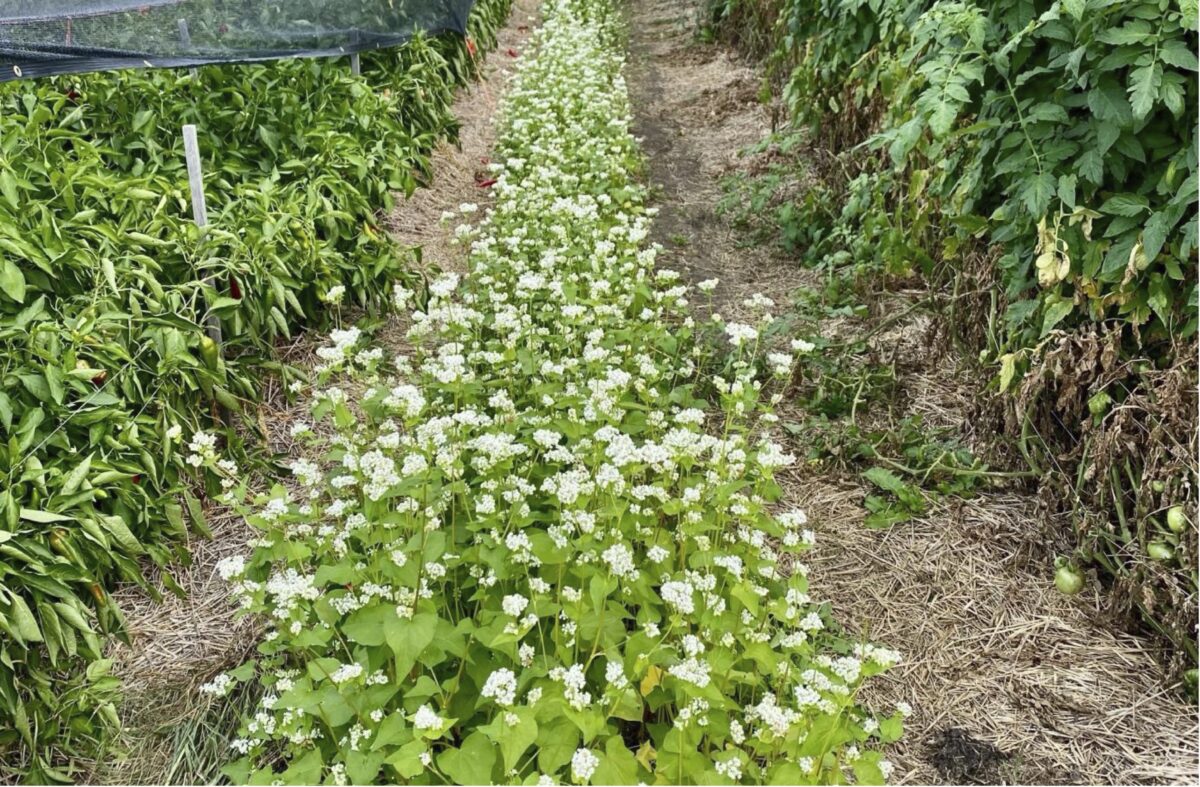
Cover crops are used in a variety of ways in horticultural operations, especially vegetable production, but one of the most common uses is as a temporary cover during the growing season. For example, after an early harvest of potatoes, vegetables, or greens, it s common to see fast growing summer covers like buckwheat or foxtail millet planted. Both are easy to establish and manage, and do a reasonably good job of suppressing weeds while providing some soil protection and improvement. Buckwheat s prolonged flowering period is especially advantageous for pollinators.
When a cover crop is needed in spring before planting a summer vegetable, there are a variety of quick-growing cool season cover crops that can be used. Particularly favored are some of the annual legume cover crops like crimson clover and Austrian winter peas. Both do well when planted in early spring and can produce a reasonable amount of nitrogen with two months of growth before making way for summer vegetables. Crimson clover is more easily broadcast-established than Austrian winter peas, but the latter can be broadcast if they are worked into the soil with a rake, a tractor roller or other method. All legume cover crops should be seed treated with inoculum to ensure nitrogen fixation takes place.
Terminating cover crops in annual horticulture operations
As with seeding, the termination approach for cover crops depends in part on the size of the area to be terminated. The species of cover crops is also a factor. Of course, any species that winter kill don t need termination, and perennial cover crops like white clover or red clover are planted for a multi-year period and shouldn't need termination. For annual cover crops that do need termination, most mid-sized to larger-scale horticulture operations are using tractor-mounted mechanical control methods. Many of these termination approaches are outlined in the chapter on cover crop termination, but in the context of horticulture production, they are also briefly described here (and similar termination information is provided in the chapter on organic cover crop use).
Tillage. While less popular as a termination method than it used to be, tillage remains the most common way cover crops are terminated within vegetable operations and selected other horticulture operations. Rototilling is often used as a quick way to both terminate and incorporate cover crop residue, allowing faster incorporation of cover crop biomass into the soil rootzone. The tillage also serves the purpose of helping prepare a seedbed for planting vegetables or other crops. Unlike other mechanical control methods, tillage usually controls cover crops in a variety of growth stages. However, such tillage has a negative impact on soil health and leaves the soil much more subject to erosion until the next horticultural crop is well established. Thus, tillage has gradually become less common as a method of cover crop termination, although it is still frequently used. Besides rototilling, disks, small plows, and other tillage instruments are sometimes used for tillage termination. When opting for tillage, give consideration to how much residue will be left on the soil surface by the chosen tillage method. The longer it will be until the next crop is planted, the more residue should be left on the surface (if possible). If there is concern on small scale plots that tillage will leave lumps of cover crops in the way of the next cash crop planting, some form of mowing can be done to chop up residue before tilling.
Roller crimping. While tillage has declined in importance for cover crop termination, the use of roller crimpers has been gradually increasing. Roller crimpers are generally an effective termination tool, performing best when the soil is dry and biomass is moderate. Cover crops usually need to be in the flowering or heading stage for effective termination by a roller crimper. For example, winter cereals only a few inches tall will not be consistently controlled by roller crimpers. Roller crimpers are available in a variety of widths for use on either the front or back of tractors. At least one manufacturer has made a small crimper for use with a walk-behind BCS tiller that can be used in smaller plots or even in high tunnels.
Mowing. The use of a mower is a common method of cover crop termination in horticulture operations, and perhaps is the most versatile across a range of operation sizes, since you can use anything from a push mower to a large tractor-mounted mower. Flail mowers make for the most effective tractor-mounted mowers, as they are able to chop up cover crop residue more finely and leave a more even layer of residue. Less expensive brush hog (rotary) mowers can be used but are likely to leave the cover crop residue lumpy, creating problems for seeding the horticulture crop. Sickle bar mowers can be used but may leave lumpy residue in high biomass situations. Regardless of the mowing method, waiting until the cover crop is flowering and then mowing as close to the ground as possible is often necessary to getting a complete kill of the cover crop. A cover crop that is still vegetative when mowed will typically rebound and keep growing, much like mowing a lawn. Other advantages to letting the cover crop grow longer before mowing are getting flowers that benefit pollinators, better weed control, and of course more cover crop biomass to improve the soil.
Spray termination. Terminating cover crops with herbicides is occasionally done in horticulture operations, but usually only large-scale ones due to the risk of herbicide drift onto adjacent crops, and from a desire to reduce herbicide use in many of these farming operations. If a herbicide is to be used, paying attention to wind direction and speed is critical to avoid any herbicide drift issues that could damage other crops or have effects on nearby people and animals.
Tarping. For small-scale cover crop termination (plots with hundreds but not thousands of square feet), some horticulture operations have gone to using tarps, cardboard, or other temporary covers that can terminate a cover crop in 2 to 3 weeks time. Light-blocking fabrics or other materials are normally used. If clear plastic is used, the cover crop will still receive enough light to keep growing, unless temperatures are particularly high under the plastic. An advantage of using such fabrics, besides saving money on equipment and dealing with sprays, is the ability to do no-till planting (also possible with mower termination or roller crimpers). Managing any plastics in a way that minimizes environmental impacts is advised.
Impact of cover crops on use of tillage in horticulture operations
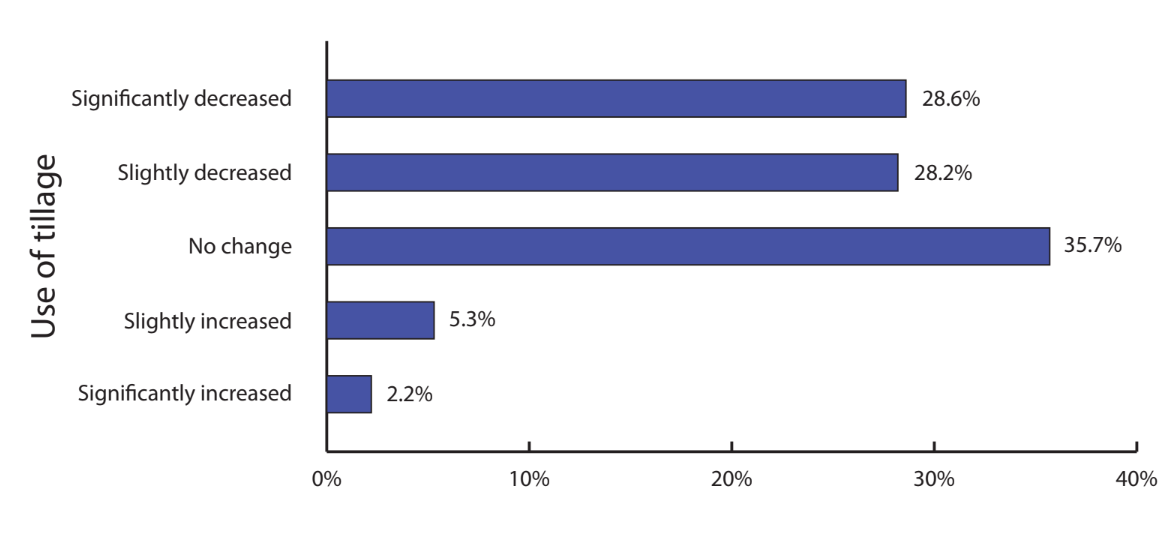
About a quarter of horticulture producers responding to the 2019-2020 SARE/CTIC National Cover Crop Survey said that they terminated cover crops with tillage. While the majority of producers used other methods of termination, the use of tillage by some farmers for cover crop termination has created an impression among some that tillage increases with cover crop use. This is actually not the case, as shown in the figure below. The same 2019-2020 SARE/CTIC survey showed very clearly that over half of horticulture producers reported reducing tillage after adoption of cover crops, while only 7% said they increased tillage (and most of those had just a slight increase in tillage).
Horticulture operations with perennial crops
A different set of considerations comes into play when using cover crops with the many types of horticultural crops that are perennial in nature, such as orchards, vineyards, berry plantings, etc. Most often, farmers will use perennial cover crops, so a cover crop planting may be in place for at least a few years if not several, and termination of the cover crop is not needed unless the ground cover is being rejuvenated.
Two big questions to consider with perennial cover crops are finding species that are not overly competitive with the adjacent horticultural plants, and finding species that have a growth habit suited to the management and harvest needs of that operation. For example, if nuts or other products that fall to the ground need to be harvested, then a cover crop that can tolerate mowing or is very low growing will be needed to avoid impeding the harvest of the nut crops. In a berry or vineyard situation, cover crops that are climbing, such as crown vetch, could become a problem by interfering with pruning and harvest of the horticulture species.
Ideally, a mix of two or more perennial covers would be used to improve biodiversity and functionality of the cover crop, but that may not be practical from a maintenance standpoint. Most often, perennial horticulturalists default to some type of perennial grass ground cover that can tolerate mowing as well as regular foot and machine traffic. Some grasses used in orchard and vineyard settings are cool season species but a few, such as native buffalograss, are warm season plants. It may be best to find a species that is not overly competitive when the horticultural crop is at the peak of its needs for water and nutrients. Other considerations are how the cover crop impacts populations of certain pests that could affect the horticultural crop, ranging from diseases and insects to voles and mice. Voles particularly like legumes but can still thrive in pure grass stands, especially if there is additional cover like mulch around fruit trees or grape plants.
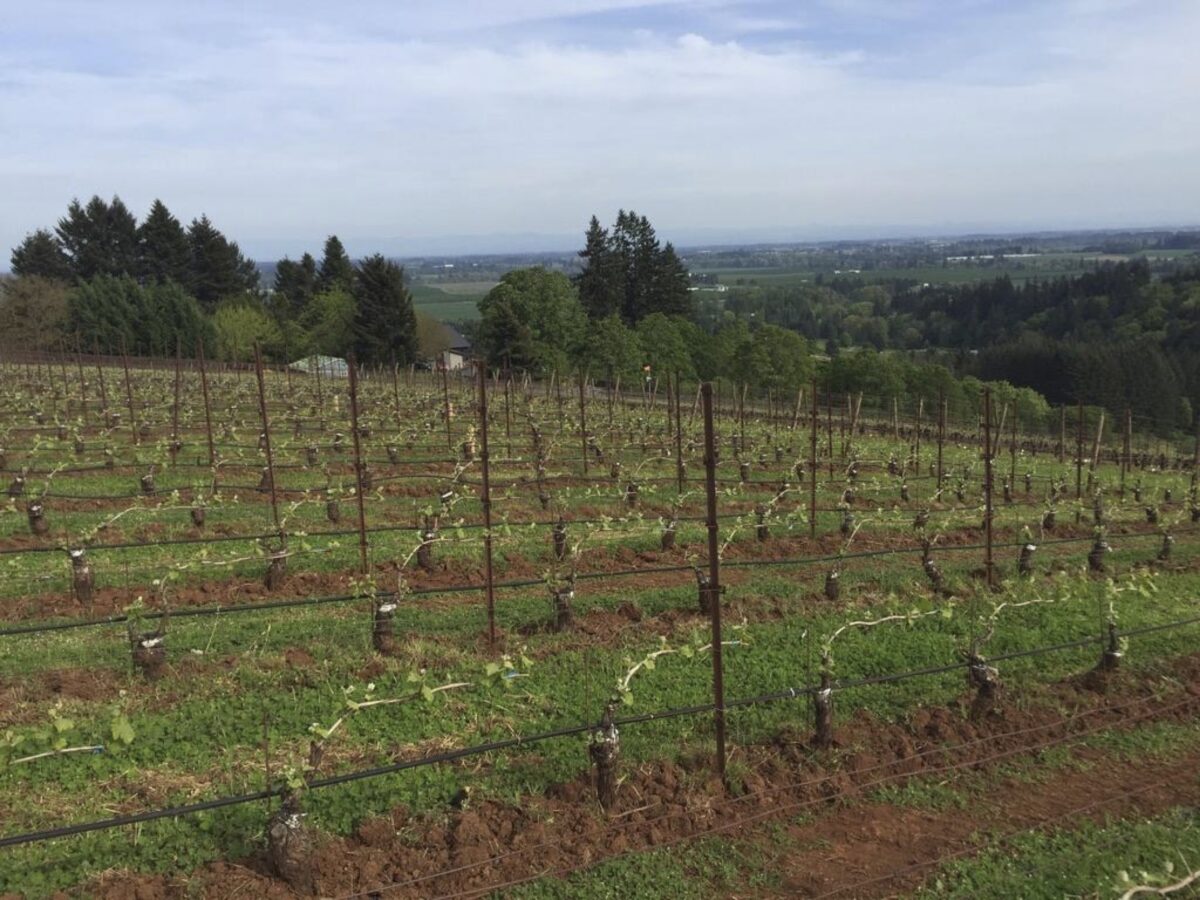
Plant competition is a significant concern when choosing ground covers around perennial plants. The species best suited for foot and mechanical traffic and frequent mowing are of course the common turfgrass species, but most of these are quite competitive with other plants. Tall fescue and Kentucky bluegrass, both commonly used in lawns, orchards, and vineyards, are likely to slow the growth of any perennial plants they are adjacent to due to competition for water and nutrients. They can still be used, but it s best to keep these grasses several feet away from the perennial crops being grown.
Another consideration is native versus non-native species. Unfortunately, in most parts of the U.S., there are relatively few native species that are both readily available and well-suited for ground covers in orchards, vineyards, or berry production. Across the Corn Belt, one native option is a mix of buffalograss and blue grama grass; sometimes sideoats grama grass is added. A mix of 40% buffalograss and 30% of each of the other two species can be used. Sideoats grama grass is a somewhat taller species, so if a shorter ground cover is desired it is typically left out of the mix.
Shade tolerance of potential cover crop ground covers should also be evaluated. While ground covers in vineyards and berry crops generally receive plenty of sun, for plantings in tree orchards, consider more shade tolerant species, or at least a mix of sun and shade tolerant species, with the shade tolerant species becoming more important as the trees mature.
Below is a table of some of the more common species used in orchards, vineyards, and berry plantings in the temperate areas of the U.S. (excluding the most moisture-limited areas). Some areas of the west and the Deep South will have other options that are better suited to local conditions. For example, subterranean clover (adapted to hardiness zones 7 10) has viability as a legume mixed with grass for more southern areas or California.
Plant species used as perennial cover crops (ground covers) in orchards and vineyards*
| Species | Hardiness zone** | Sun/shade | General notes |
|---|---|---|---|
| Buffalograss | 3-10 | Sun | Drought tolerant warm-season native |
| Blue grama grass | 3-10 | Sun | Drought tolerant warm-season native |
| Sideoats grama grass | 3-10 | Sun/some shade | Drought tolerant warm-season native |
| Orchardgrass | 3-9 | Sun/shade | Clump type grass, dwarf types available |
| Perennial ryegrass | 3-8 | Sun/some shade | Suited to wetter conditions |
| Redtop grass | 3-8 | Sun/some shade | Tolerates a range of soil moistures |
| Red fescue | 2-7 | Sun/some shade | Relatively drought tolerant |
| Sheep fescue | 3-8 | Sun/some shade | Relatively drought tolerant |
| Tall fescue | 3-8 | Sun/some shade | Drought tolerant, highly competitive |
| Kentucky bluegrass | 3-9 | Sun | Not as drought or shade tolerant |
| White clover | 3-10 | Sun/some shade | Low growing, not very traffic tolerant |
| Red clover | 3-9 | Sun/some shade | Mid-height, may only persist a few years |
| Alfalfa | 2-9 | Sun | May only persist a few years |
*This list is not all-inclusive, as other species are sometimes used in certain areas, but it represents many of the more common cover crops used with woody horticultural crops. Other than the first three grasses listed, all the other species are cool-season plants that are not native to the U.S., but are well adapted to many growing regions.
**Plant hardiness zones listed are for the species as a whole; specific varieties may have more or less hardiness than what is listed here, so be sure to research traits of any named variety being considered.
Herbaceous perennial crops
Whereas woody crops can generally compete relatively well against herbaceous cover crops for water and nutrients, herbaceous horticulture crops may be less likely to do so, especially if the cover crops are taller than the perennial horticulture crop or if the cover crop is a perennial. Designing the right combination of perennial cover crop and cash crop is all about managing that competition and finding plants that are complementary with each other. Many of the ground covers listed in the table above can be considered, but keeping an adequate distance between the ground cover and the herbaceous perennial crop is important.