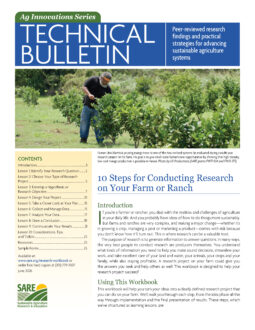
This workbook will help you turn your ideas into a clearly defined research project that you can do on your farm. We’ll walk you through each step, from the idea phase all the way through implementation and the final presentation of results. These steps, which we’ve structured as learning lessons, are:
- Lesson 1: Identify Your Research Question
- Lesson 2: Choose Your Type of Research Project
- Lesson 3: Develop a Hypothesis or Research Objective
- Lesson 4: Design Your Project
- Lesson 5: Take a Closer Look at Your Plan
- Lesson 6: Collect and Manage Data
- Lesson 7: Analyze Your Data
- Lesson 8: Draw a Conclusion
- Lesson 9: Communicate Your Results
- Lesson 10: Considerations, Tips, and Tidbits1
We recommend you read through all 10 lessons before getting started on your own research project. This will give you a clear idea of what to expect from the process. Each lesson also contains a set of assignments and self-assessments that you should come back to and complete when you’ve arrived at that step in your project. These prompts are designed to keep you on track to achieve your research objectives and provide actionable, robust solutions for your operation.
Dig Deeper Into On-Farm Research
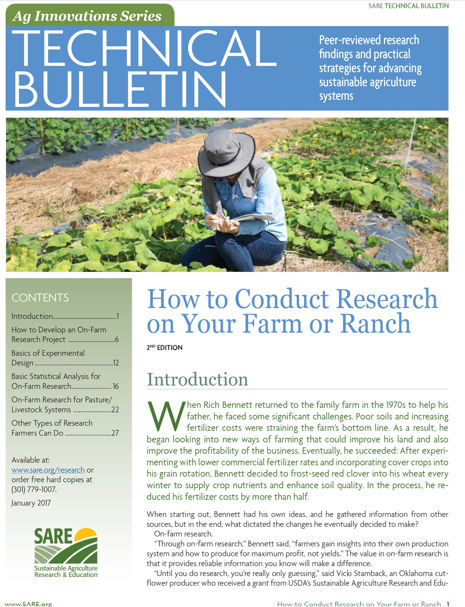
This workbook will help you create a plan for your own research project. It’s a companion to SARE’s technical bulletin How to Conduct Research On Your Farm Or Ranch (www.sare.org/research), which provides more detailed information on some of the key lessons outlined in this workbook. For example, we recommend you refer to How to Conduct Research On Your Farm Or Ranch when learning about complex topics such as experimental design and statistical analysis of data.
The Project Journal
By their nature, research projects are usually complex to manage, and keeping yourself organized is critical to success. That’s why we recommend starting a project journal. This is an excellent practice that will greatly improve your analysis, interpretations and reporting. Starting this journal now will help you stay organized with your ideas, plans, notes and sources of key information as you go along. Also, you can use it for the assignments in this workbook. Later on in the project you can use the same journal for recording data and any trends, insights, or observations.
Additional Resources
We provide examples where appropriate, and Lesson 10 includes some advice from people who have experience managing SARE’s Farmer/Rancher Grant programs. This workbook won’t teach you everything you need to know about experimental design, statistics, and other complex topics, but it’ll help you find the additional resources you need.
We’ve also included a short section of additional on-farm research resources, and a Sample Forms section with templates of important documents that you may need during your project.
Grant Considerations
If your research involves external funding, the exercises in this workbook will help you prepare grant proposals and fulfill program requirements. The document templates in the Sample Forms section may be especially useful if you plan to apply for a grant as part of your research project. Please be aware that using this workbook doesn’t guarantee success in competitive grant programs, including those offered by SARE.
About the Photos in This Guide
All of the photos we included in this workbook were taken from SARE-funded projects, either farmer-led projects or ones that took place on farms through collaboration with state Extension specialists. If you’re interested in learning more about a project, visit projects.sare.org and search by the grant number(s) we include with each caption.
- While not addressing a required step in the research process, this lesson discusses important topics such as where to look for expert support and applying for a grant for your project. ↩︎