Congratulations on forming a research question that will provide the foundation for your project! The next step is to decide how best to approach that question. Let’s look at three common types of research that farmers use to learn and contribute to the body of knowledge in different ways.
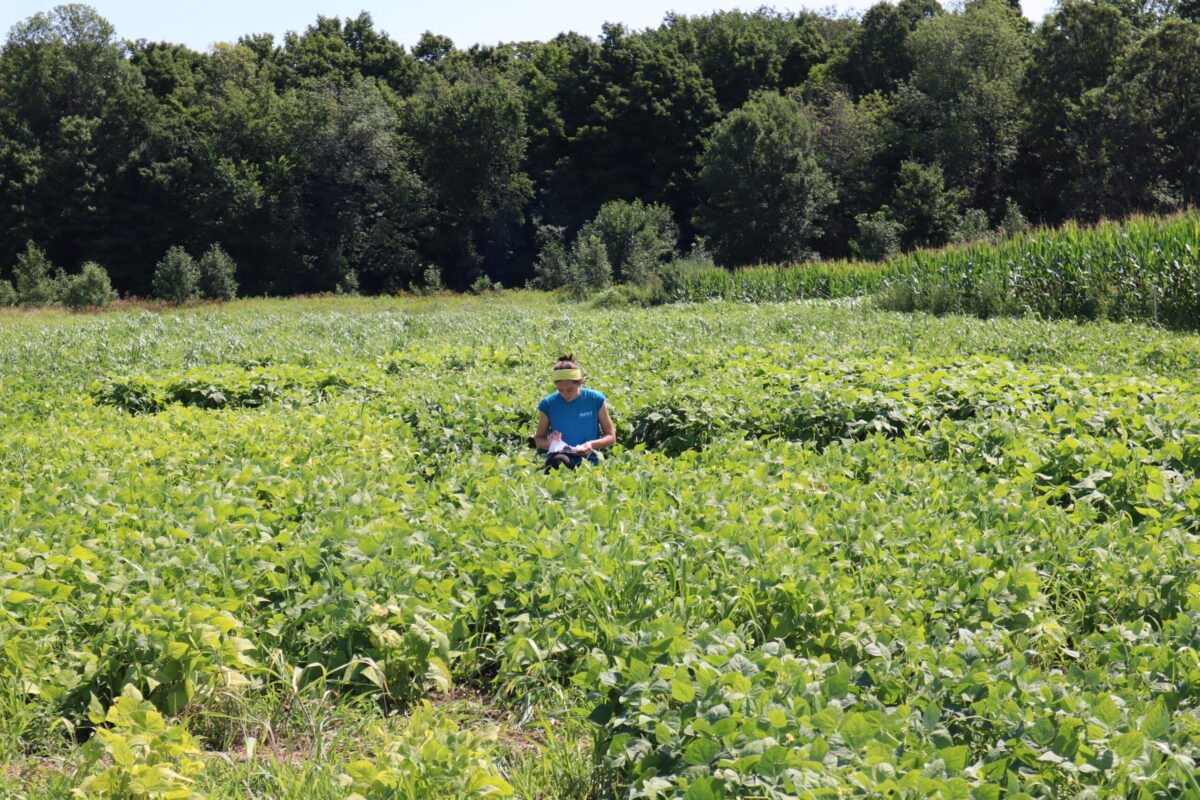
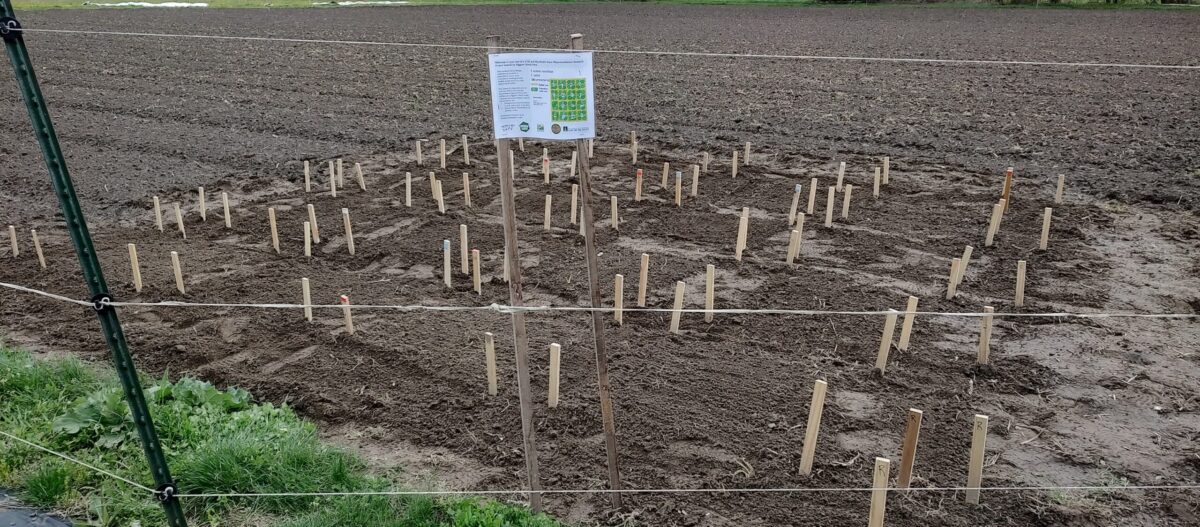
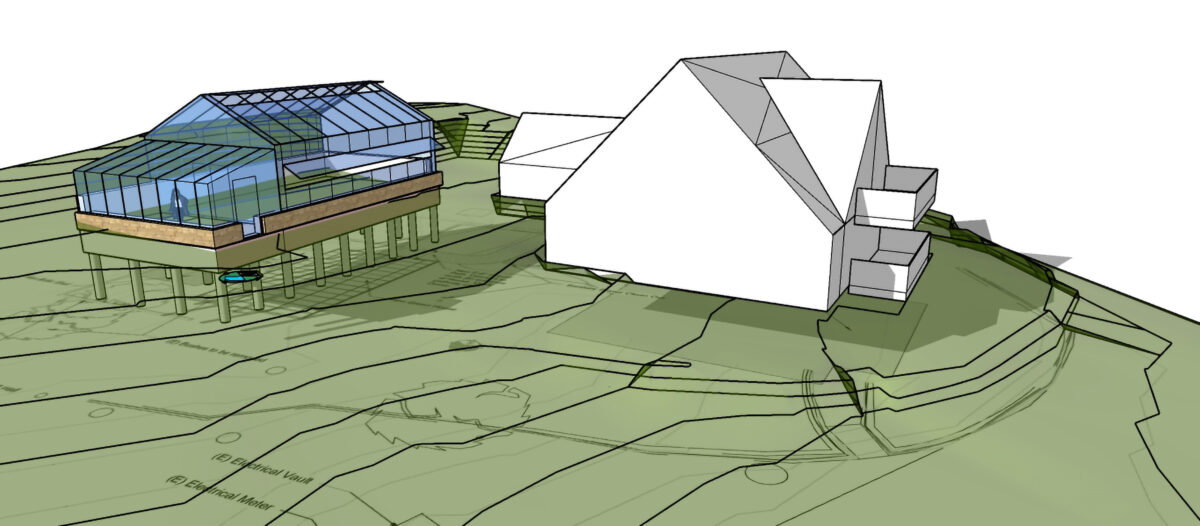
Three types of research commonly used on farms to solve different kinds of problems or answer questions include an observational study (left), an experiment (middle), and an engineering project (right). From left, photos courtesy of Kristen Loria (SARE grant LNE22-444), Josef Görres (SARE grant ONE21-391), and Derek Lowstuter (SARE grant FNC20-1234).
Observation
Observation is the most basic type of research. All farmers and ranchers rely on observations to inform their day-to-day actions and long-term decision-making. While it’s something we can do casually, observation becomes a useful research tool when you enhance the process by recording detailed data in a meaningful and careful way. For example, this can include quantitative weather observations, water quality measurements or soil test results.
Often, observational research can make a big difference to farmers by showing how trends in the larger world apply at the local scale. For example, as new crop varieties and livestock breeds enter the market, understanding how they perform with specific soil types, local climates or markets can make a real difference. You can gain these insights through on-farm testing and observation. Cultural, social and economic trends in local communities and markets can also be different compared to global or national trends.
Getting the most out of observational research requires that you carefully select your methods for collecting data and keeping records.
Engineering
Farmers work very closely with technology, machinery and other equipment, and can often solve production problems through engineering. For example, you might be able to improve farm operations by adapting harvest equipment to better handle a specialty crop, modifying a facility to reduce livestock stress, or redesigning a process to use less water or energy. When you have an engineering idea, you can figure out whether it is proving successful by describing the challenge you’re trying to solve, documenting the design solution, and measuring its performance. This also allows you, the inventor, to bring the benefits of your engineering solution to others.
Experiments
Scientists use experiments to advance our understanding of natural processes. Maybe your research question involves an idea about how to improve something, or is about what's causing a particular problem. An experiment could help you to test your idea or explanation.
Experiments are structured around formal methods to test a hypothesis: a concise statement of what will happen under carefully controlled conditions if your guess about the process is correct.For example, the causes of food spoilage were mysterious until the mid-19th century, when Louis Pasteur began conducting experiments. Bacteria were unknown at that time; Pasteur was the first to think that something in the environment was causing food to spoil. To test his guess about the role of contamination, he set up experiments involving sterile food samples. Some of these samples were exposed to the outside environment and others remained sealed. His hypothesis, based on the theory of contamination, was that the food samples stored openly would spoil, while the sealed samples would not. Pasteur’s experiments supported his hypotheses and changed the world. You may recognize his name as the root of the word “pasteurize.”
Making Decisions About Your Type of Project
Whether your research topic relates to crop or livestock production, marketing, social trends, ecological impacts, consumer preferences or any other topic in sustainable agriculture, you’ll now need to decide whether your project will consist of observation, engineering, or experimental research.
You’ll also need to start thinking about what data you want to collect. We go deeper into this topic in Lesson 4. For each research type, you can use many kinds of data, such as:
- physical and chemical measurements (such as soil texture or nutrient levels)
- biological measurements (such as plant growth, or pest and disease levels)
- surveys and questionnaires (such as customer taste preferences or buying habits)
- descriptions of animal behaviors (such as feeding preferences, grazing patterns, or temperament )
- inventory, marketing, and other economic data (such as input costs, sales records, customer feedback, or labor costs)
The lessons that follow will be useful no matter if your project is based on observation, engineering, or an experiment.
Assignment
The questions in this assignment include example answers from two different scenarios. We carry these examples through each of the questions here to illustrate how you can use them to identify a research approach for your situation.
- What is the problem you want to address?
Example 1: I’m a mushroom grower, and I use my spent mushroom growing medium as a soil amendment in my garden. I’d like to know if it would be worth making biochar from this medium; would it help my garden more?
Example 2: I see studies that say consumers are unwilling to pay extra for labels like “pesticide free” or “climate smart” on their food. I wonder how much of that is because of a lack of knowledge about environmental risks in our food system. I also wonder what information consumers want, to help them make informed buying choices.
- What sort of solution do you need?
Example 1: I’d like to have a comparison of garden yields when adding mushroom medium versus biochar, just to see which gives me the better yields.
Example 2: I want to understand what people know about how their food choices affect the environment and their health. I want to know the level of knowledge people have about the connections between environmental issues and food.
- What do you think might be the best research approach to try to solve this problem? Why do you think this approach will provide the best solutions for you? (Remember you’ll have a chance to change this later if needed).
Example 1: An experiment. I have an existing practice and an idea for a new approach to it. Also, I have an idea which approach might be better, so I can use this as my hypothesis. I would like to know if it really will work out as I predict. Whether it does or doesn’t, I think this might be useful for both me and other growers to know.
Example 2: I don’t have a preconceived notion of people’s level of knowledge about environmental issues or interest in them, but I think it’s important to understand this when communicating with the public about sustainable food products. How can I describe the health and environmental benefits of my products in a way that makes sense to people? I think I would get a clearer answer if I don’t start with too many assumptions, so I don’t think it makes sense to test a hypothesis. An observational study would be a better choice.
- Briefly describe a general plan for how you might go about this research. This plan doesn’t need to provide a lot of detail, as that will come in later lessons.
Example 1: I could make some biochar and use it in part of the garden while just using the spent growth medium in the other part. I would keep records and compare yields.
Example 2: I could create a quiz about environmental issues related to food, and ask people to take it. I could offer it in person or via social media, or both. I’m interested in learning about good methods for this type of project.
Assignment Self-Evaluation
- Think about the problem you’ve identified and the research approach you’ve chosen. Imagine working through the project with everything going perfectly. Will the answers you find enable you to improve your operation in a meaningful way? Will this information help others as well?
- Now imagine that your project encounters unexpected difficulties and doesn’t go as planned. What might you learn? Sometimes, great information comes from “failed” projects!