Showing 71-80 of 87 results

Manage Weeds on Your Farm: An Ecological Approach

Sustainable weed management is essential for improving crop yield and increasing farm and ranch profitability. SARE’s newest book, Manage Weeds on Your Farm: A Guide to Ecological Strategies, examines the biology and behavior of common weeds and provides an integrated set of non-chemical control strategies that exploits their weaknesses. Manage Weeds on Your Farm will help organic and conventional farmers alike better understand and manage weeds efficiently, effectively and ecologically.

Manage Weeds on Your Farm features profiles of five farmers who use the physical, ecological and biological factors of common weeds to develop science-based management strategies appropriate for their operations. “In my opinion, this book has the best information on weed management that is available today,” says Klaas Martens of Lakeview Organic Grain of Penn Yan, N.Y. “Our understanding of weed control is still growing rapidly, and this book will certainly become an invaluable tool for every farmer who wants to control their weeds sustainably.” 

Manage Weeds on Your Farm: A Guide to Ecological Strategies is written by the late Charles L. Mohler, John R. Teasdale and Antonio DiTommaso; it is published by SARE. 

Manage Weeds on Your Farm: A Guide to Ecological Strategies is free to read online or to download as a PDF at www.sare.org/weeds. Print copies can be ordered online for $24 each, plus shipping and handling. Call (301) 779–1007 for telephone, tax-free, rush or purchase orders. Discounts apply for orders of 10 or more copies.

Posted in 1

SARE Welcomes New Associate Director Dr. Kristy Borrelli

The Sustainable Agriculture Research and Education (SARE) program is pleased to announce that Dr. Kristy Borrelli has been hired to serve as its new associate director. Borrelli will lead SARE’s National Reporting, Coordination and Communications Office at the University of Maryland effective November 1, 2021.

As SARE’s associate director, Borrelli will manage communication with regional SARE offices, assist with grant administration and reporting, and facilitate interaction with other programs. The associate director also leads SARE’s national communication team and coordinates the evaluation and communication of SARE’s national impact. She succeeds Dr. Kim Kroll, who is retiring after serving as SARE’s associate director since 1996.

Borrelli, a Penn State University Extension educator specializing in agronomy, currently serves as SARE’s Pennsylvania coordinator and previously served on the Northeast SARE Administrative Council. Prior to her time in Pennsylvania, she was an Extension specialist at the University of Idaho, where she collaborated with a multi-state, NIFA-funded project that examined approaches to climate change in the Pacific Northwest.

Borrelli grew up on a family farm in Upstate New York, received her bachelor’s in environmental biology from SUNY ESF, and her master’s and doctorate in soil science from Washington State University. Her main research and extension focus has been on soil organic matter dynamics in grain-based cropping systems, especially for specialty market crops. She has received multiple SARE grants examining the maintenance of agroecosystem functions, farmer engagement in sustainable agriculture research and service provider networking.

Posted in 1

Updated Building Soils for Better Crops Focuses on Soil Health Fundamentals

Now more than ever, it is abundantly clear that healthy soils play an essential role in productive agricultural systems. Soils are foundational to the food we eat and fundamental to life on earth. Focusing on sustainable soil management has shown to increase farm and ranch profitability, improve crop yield and provide other critical services related to water, air and climate. SARE’s newest book, the fourth edition of Building Soils for Better Crops, provides rich detail on ecologically sound practices for developing and maintaining healthy soils. It is a must-read for farmers, educators and students alike.

The new edition of this highly regarded book provides critical updates to reflect the new science and many new, exciting developments in soil health over the past 12 years. Building Soils for Better Crops includes detailed information on soil-improving practices as well as in-depth background, from what soil is to the importance of organic matter. Along with providing practical strategies for achieving agricultural sustainability with high-quality soil, the book presents readers with a holistic appreciation of the importance of soil health.

Building Soils for Better Crops is written by Fred Magdoff (University of Vermont emeritus professor of plant and soil science) and Harold van Es (Cornell University professor of soil science); it is published by the Sustainable Agriculture Research and Education (SARE) program. 

Building Soils for Better Crops is free to read online or to download as a PDF. Print copies can be ordered online for $23 each, plus shipping and handling. Call (301) 779-1007 for tax free, rush or purchase orders. Discounts for bulk orders apply.

Posted in 1

New SARE Bulletin Highlights Best Practices for Adult Learning

Studies show that farmers learn best through in-person, face-to-face educational programs. But learning opportunities often miss the mark due to content choice, disorganization or lack of understanding of participants' learning styles. Educators that use best adult learning practices have a greater effect on participants’ learning and retention, and empower farmers to make sustainable changes to their operations. 

SARE’s newest free bulletin, Sustainable Agriculture Through Sustainable Learning, presents five best practices educators can use to facilitate effective learning among farmers and thus improve agricultural sustainability. 

Incorporating effective learning practices before, during and after educational programs is crucial to encouraging learning among farmers. Educators can maximize the impact of learning opportunities by:

  • making the content relatable
  • engaging positive emotions
  • giving learners choice
  • identifying mental models and
  • providing opportunities for practice and application

Sustainable Agriculture Through Sustainable Learning examines the science behind each practice and examines how it aids in adult learning. The guide also provides strategies for incorporating best practices to improve educators' teaching or their own professional development outcomes.

Download or order your free print copy of Sustainable Agriculture Through Sustainable Learning at https://www.sare.org/resources/sustainable-agriculture-through-sustainable-learning/ or by calling (301) 779–1007. Sustainable Agriculture Through Sustainable Learning is available in quantity for free to educators for use in educational workshops, classes or tours.

Posted in 1

SARE Seeks Applications for Associate Director Position

The University of Maryland seeks an Associate Director for the National Reporting, Coordination and Communications Office (NRCCO) of the Sustainable Agriculture Research and Education (SARE) program. 

This Associate Director position is appropriate for both experienced and early career professionals. See https://ejobs.umd.edu/postings/82240 for a full job description, responsibilities, qualifications and application guidelines. Submit applications by the best consideration date of 05/14/2021.

The Associate Director for the NRCCO works directly with the SARE National Director to manage many aspects of SARE program coordination and communication. The Associate Director works with the regional offices to ensure project reports are completed and project information is publicly available. The NRCCO also works with national staff to aggregate, evaluate and communicate project results and programmatic impact for the national SARE program. Job responsibilities include communication with regional offices, assisting with grant administration, producing reports, representing SARE at local and national meetings, and facilitating interaction with other programs relevant to sustainable agriculture. The Associate Director also provides leadership for an experienced staff (content coordinator, outreach and promotions coordinator, IT coordinator, multimedia coordinator and a business manager). 

This is a 12-month, full-time professional staff position with a full benefits package provided by the University of Maryland with funding from the USDA. Questions regarding this position should be directed to kkroll@sare.org.

SARE is funded and administered at the national level by the USDA National Institute of Food and Agriculture (NIFA), headquartered in Kansas City, MO. NIFA works cooperatively with four universities that serve as competitively selected regional host institutions. These host institutions fund competitively selected sustainable agriculture research, education, and extension programs in their respective regions. NIFA also funds the competitively selected NRCCO through a cooperative agreement with the NRCCO’s host institution. This office serves a core role to help administer the SARE program, support research and educational functions, and perform program outreach. 

The University of Maryland, College Park, an equal opportunity/affirmative action employer, complies with all applicable federal and state laws and regulations regarding nondiscrimination and affirmative action; all qualified applicants will receive consideration for employment. The University is committed to a policy of equal opportunity for all persons and does not discriminate on the basis of race, color, religion, sex, national origin, physical or mental disability, protected veteran status, age, gender identity or expression, sexual orientation, creed, marital status, political affiliation, personal appearance, or on the basis of rights secured by the First Amendment, in all aspects of employment, educational programs and activities, and admissions.

Posted in 1

Updated Guide to USDA Programs Opens Door to Millions of Dollars of Available Funding

It can be difficult for farmers and ranchers to navigate the wide range of USDA resources and stay up to date with program changes after each Farm Bill. Thanks to the newly updated Building Sustainable Farms, Ranches and Communities, producers, researchers, nonprofits and landowners can easily find USDA programs that can help them achieve their goals. 

Download Building Sustainable Farms, Ranches and Communities

The 101-page guide covers 62 government programs and has been updated to include program updates from the 2018 Farm Bill. Each program listing provides a description of the program’s available resources, information on how to apply, and in some cases, examples of how the funding has been used. The guide also includes basic information on how to design sound projects, find appropriate programs and write grant applications.

“Farmers are hungry for resources to help them get started or answer specific questions. Building Sustainable Farms, Ranches and Communities provides a comprehensive, one-stop-shop to many helpful programs,” says Kerri Ebert, coordinator of the Kansas Center for Sustainable Agriculture and Alternative Crops. 

Building Sustainable Farms, Ranches and Communities is now available as a free download. Free print copies are also available from the National Center for Appropriate Technology’s ATTRA program. To order, email pubs@ncat.org with your request. Don’t forget to include your shipping address. Building Sustainable Farms, Ranches, and Communities was produced through the collaboration of SARE, the Michael Fields Agricultural Institute (MFAI), the National Center for Appropriate Technology (NCAT), and the National Sustainable Agriculture Coalition (NSAC). Funding was provided by SARE, the Agricultural Marketing Service (AMS) and the McKnight Foundation.

Posted in 1

New SARE Bulletin Addresses Ecological Approach to Managing Pests

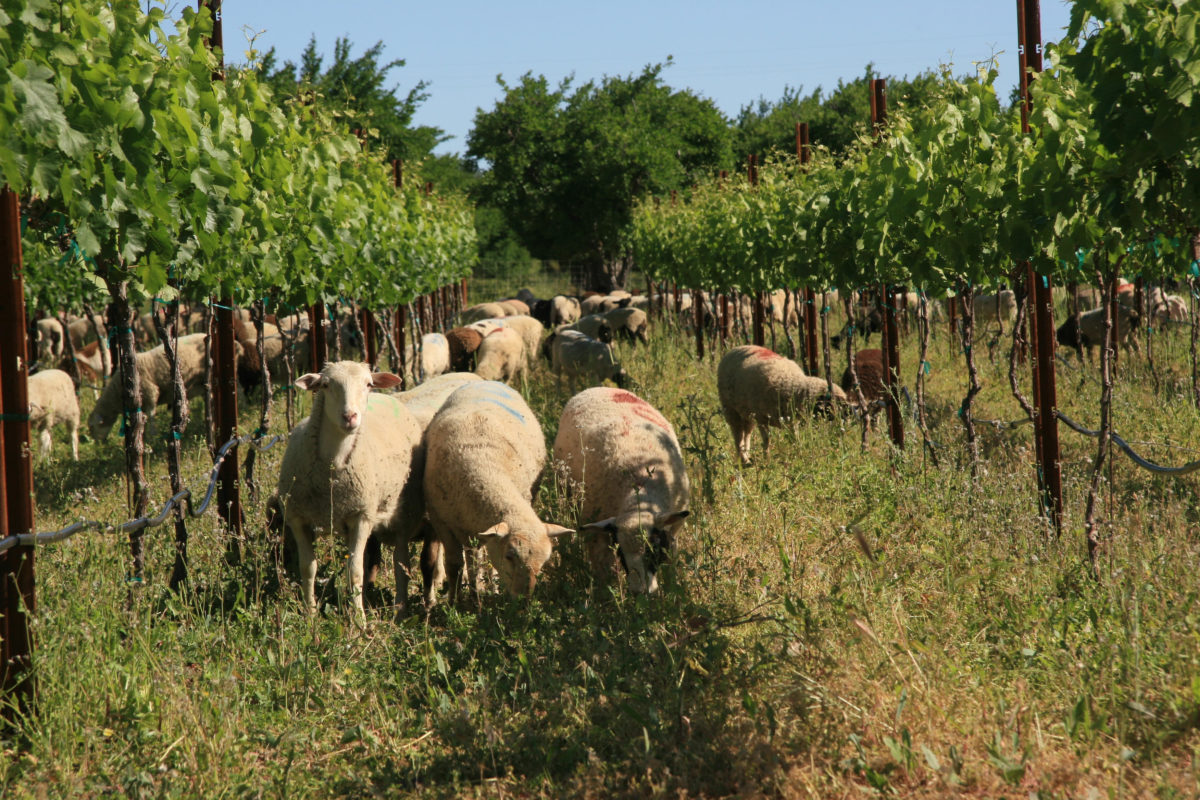
A flock of sheep is vital to the success of one particular vineyard in Winters, California. While many operations struggle to manage weeds, this vineyard used a SARE-funded grant to test grazing sheep as a pest management practice, and they are seeing many whole-farm benefits. The sheep were trained to avoid the grape crop’s leaves and to instead graze only on weeds and other cover crops. Rather than apply potentially harmful pesticides or do time-intensive mowing, the vineyard uses the sheep to manage its weeds. Producers using methods based on ecology to manage pests, like sheep grazing weeds in vineyards, are finding improvements and benefits across their farms. SARE's newly revised A Whole-Farm Approach to Managing Pests bulletin discusses ecological approaches to pest management and highlights cases in which farmers are using innovative methods to manage pests.

A Whole-Farm Approach to Managing Pests is available for free in print and for download, and is useful to farmers and educators alike. 

Sheep Grazing Vineyard
These sheep, at a vineyard in Winters, Calif., were trained to ignore grape leaves while grazing on vegetation such as weeds and cover crops. Photo courtesy University of California Extension

A Whole-Farm Approach to Managing Pests describes ecological pest management strategies that focus on strengthening natural relationships throughout the farm to reduce pest pressures. These holistic strategies emphasize knowledge of cropping systems, biodiversity and farm resource management. Practices that produce healthy crops and keep insects, weeds and diseases away focus on:

  • promoting biodiversity
  • creating healthy crop habitat
  • reducing disturbance to soil and non-crop vegetation , and
  • minimizing off-farm inputs.

This newly updated technical bulletin is broken down into two parts. Part one examines how biodiversity and biological control drive management practices that can boost the natural defenses of your farm. The second part puts those tools into practice by providing reliable and profitable strategies to successfully manage pests.

Focusing on the farming system rather than on each individual pest can make pest control across the whole farm more effective and sustainable. Ecological strategies can be adopted incrementally to meet the unique pest management needs of every operation while providing other benefits such as improved soil health and biodiversity maintenance.

Download or order your free print copy of A Whole-Farm Approach to Managing Pests at https://www.sare.org/resources/a-whole-farm-approach-to-managing-pests/ or by calling (301) 779-1007. A Whole-Farm Approach to Managing Pests is available in quantity for free to educators for use in educational workshops, classes or tours.

Posted in 1

SARE Funding in Your State

Since 1988, the Sustainable Agriculture Research and Education (SARE) program has helped farmers, ranchers, researchers and educators develop cutting edge innovations that improve farm profitability, protect water and land, and revitalize communities. Funded by the United States Department of Agriculture's National Institute for Food and Agriculture, SARE has awarded nearly $300 million to more than 7,300 projects that improve profitability, stewardship and quality of life by investing in groundbreaking research and education. Learn more about funded grants, project highlights and a breakdown of funding in your state using our newly updated portfolio summaries and grant lists.

SARE Grants Funded In Your State

Highlights of SARE-funded projects include:

Download the updated grants lists and portfolio summaries, and find links to state webpages at sare.org/Grants/Funded-Grants-in-Your-State. Search the SARE projects database to explore funded projects by topic, region, year or grant types.

Posted in 1

The Future of Agriculture Depends on New Faces and New Ideas

"I grew up on this farm and had no desire to become a farmer,” says Liz Brownlee, talking about a 250-family property near Crothersville, Ind. But eventually, Brownlee and her husband Nate came to see farming as the ideal way to combine a passion for food with an ethic of environmental stewardship.

SARE’s 2019/2020 Report from the Field shares how the Brownlees and other SARE grantees are shaping the future of agriculture.

Download SARE's 2019/2020 Report from the Field now.

In 2013, the Brownlees moved back to the family property and started Nightfall Farm, where they graze hogs, turkeys, chickens and sheep for sale through a 50-share CSA, farmers’ markets and local chefs. Recently, the Brownlees identified access to quality meat processing as a barrier to meeting their goals.

So they teamed up with Indiana University specialists and another farmer to obtain a SARE Farmer/Rancher grant to conduct a study on the feasibility of creating a butcher shop to improve direct sales. “We’re trying to be useful to our community here in Indiana,” says Brownlee, who plans to share the business planning documents from their study with other farmers.

Other stories in Report from the Field that demonstrate how SARE grantees are improving the sustainability of U.S. agriculture include:

Download or order your free print copy of 2019/2020 Report from the Field at https://www.sare.org/Report-from-the-Field or by calling (301) 779-1007. 2019/2020 Report from the Field is available in quantity for free to educators for use in educational workshops, classes or tours.


Posted in 1

SARE Fellows Tour Sustainability in North Carolina

SARE Fellows Tour Sustainability in North Carolina

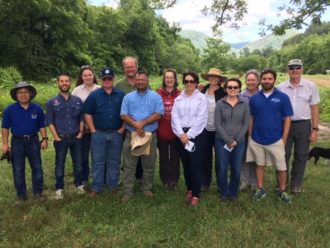
SARE Fellows 2019

RALEIGH, North Carolina – Organic sweet potatoes are in high demand in North Carolina, but growers face two major hurdles: weeds and wireworms. North Carolina State University researchers think cover crops might be a solution, and that would make third generation farmer Kelvin Bass a happy man.

“I’m tremendously concerned about soil health,” said Bass, owner of Bass Plant Farm in Nashville, N.C., who grows 80–100 acres of organic sweet potatoes. “It’s key to what we are trying to accomplish organically. Soil is very important.”

Bass expressed frustration over having to till his sweet potato fields to manage weeds and control wireworm, a pest that likes grass roots as a host. If NCSU research of a cereal rye/vetch mix incorporated with organic sweet potatoes is successful, Bass will have a means of curtailing tillage while boosting soil organic matter, which is historically low in eastern North Carolina.

Organic sweet potatoes are the most profitable crop on Bass’ farm. A group of county extension agents from across the country visited recently to learn more about the farm’s diverse production of tobacco, cut flowers, U-pick strawberries, vegetables, and organic crops such as soybeans, wheat and cucumbers. The visit was part of the Sustainable Agriculture Research & Education (SARE) Fellows Tour, a program hosted by SARE and the National Association of County Agricultural Agents (NACAA) to introduce county agents to sustainable agriculture practices outside their region.

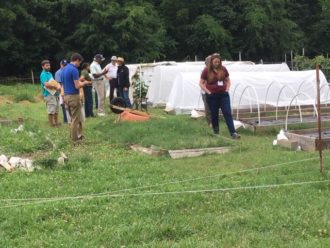
low tunnels with people standing outside them

This year’s tour took the group to farms and NCSU and North Carolina A&T research stations across the state’s Eastern, Piedmont, and Mountain regions. NCSU SARE state coordinator Chris Reberg-Horton praised SARE for laying the foundation of sustainability in the state, which has been progressive in its sustainable practices for decades. “NCSU and NC A&T have a great history with SARE,” said Horton. “SARE has been transformative when it comes to where growers are at in terms of sustainable agriculture, our training programs, statewide conferences, and other activities, such as the Fellows Tour.”

For several days, tour participants got a glimpse of some of the diverse farms across the state, and what makes each so unique in the world of sustainable agriculture. Examples included:

  • Allied Organic Farms in Hurdle Mills, N.C.: A diverse vegetable and agritourism operation, whose owners Tom Savage and wife, Linda, pride themselves on community relationships. Their biggest event, a free-of-charge Christmas light show, draws several hundred residents. “We are not a giant moneymaker,” said Savage, “but I believe it’s a good way of life.”
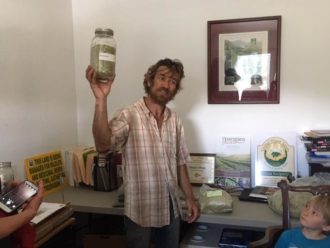
  • Pangaea Plants in Lake Lure, N.C.: A biodynamic farm specializing in certified organic medicinal herbs. Nestle in the mountains of western North Carolina near Asheville, owner Gabriel Noard looks upon his farm as an ecosystem with the neighbors and environment around him.
  • Flying Cloud Farm, Fairview, N.C.: A diverse operation of vegetables, berries and cut flowers sold via direct marketing, through a CSA, or to local markets. Managers Isaiah and Annie Louise Perkinson are tuned in to the lifestyle of their community. Their biggest money maker is a self-serve farm stand that allows passersby to pay for their items via Paypal, accessible through the farm’s website.

“I thought that farm stand at Flying Cloud Farm was pretty innovative,” said Jessica Kelton, a farm and agribusiness management extension agent at Auburn University. “Flying Cloud Farm was one of the best stops. They seemed to grasp every aspect of sustainability and they were meeting the social demand through their CSA.”

medicinal herbs in a jar

Like the other SARE Fellows on the tour, Kelton hopes to apply what she learned on the tour in her own sustainable agriculture efforts.

“Learning to work with other Extension personnel with different specialties really helps to get a better overall picture of the sustainable agriculture efforts of a particular farm,” said Kelton. “Thanks to everyone who worked to make this trip a great experience.

Other SARE Fellows who participated included: Amanda Sears, horticulture agent with University of Kentucky; Anthony Bly, soils field specialist with South Dakota State University; FNU Naveen Kumar, assistant professor of horticulture and extension specialist with University of Maryland; Claire Strader, organic vegetable educator, University of Wisconsin; Kathleen Painter, assistant professor and agriculture extension educator, University of Idaho; Kurt Jones, 4-H county director, Colorado State University; and Nicole Santangelo, agronomy extension educator, Penn State University.

The next SARE Fellows Tour will take place in Kansas next year.
Posted in 1