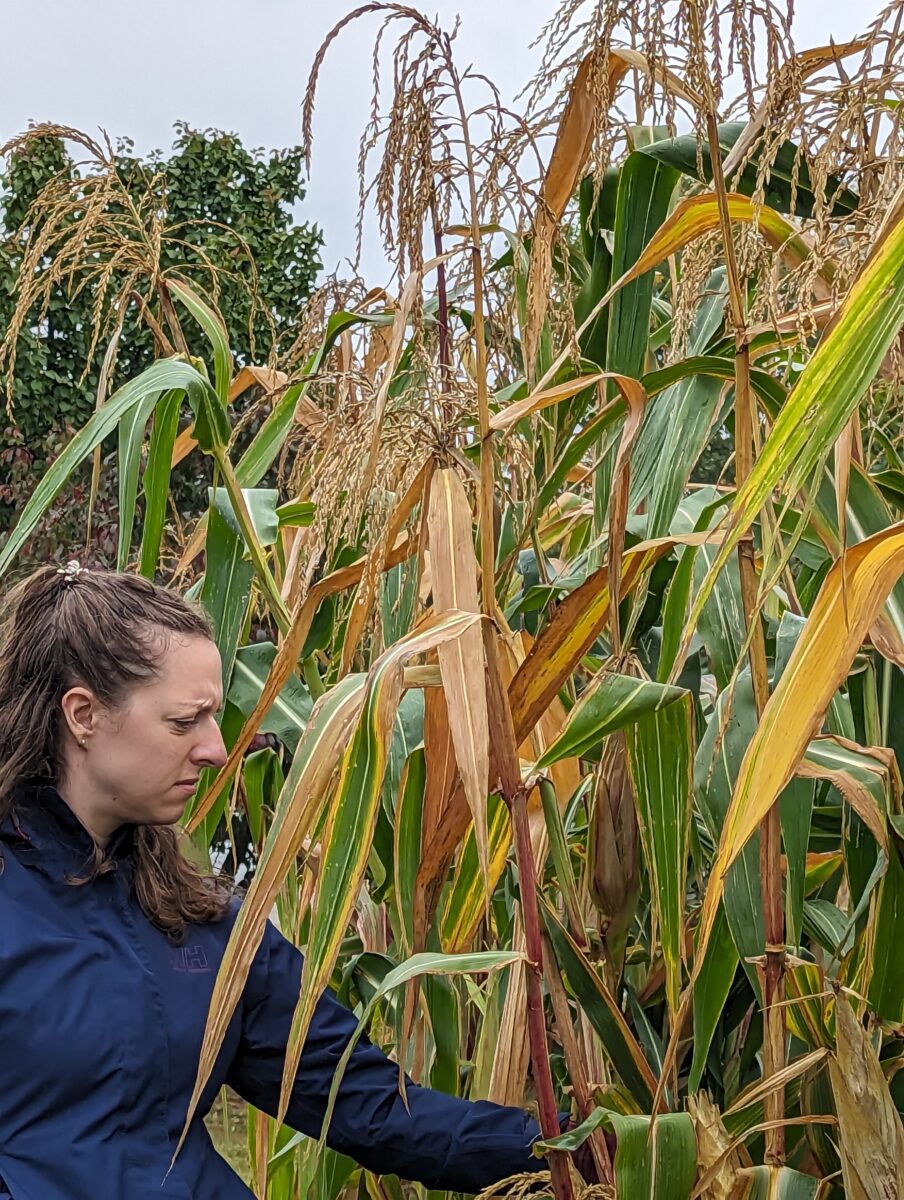
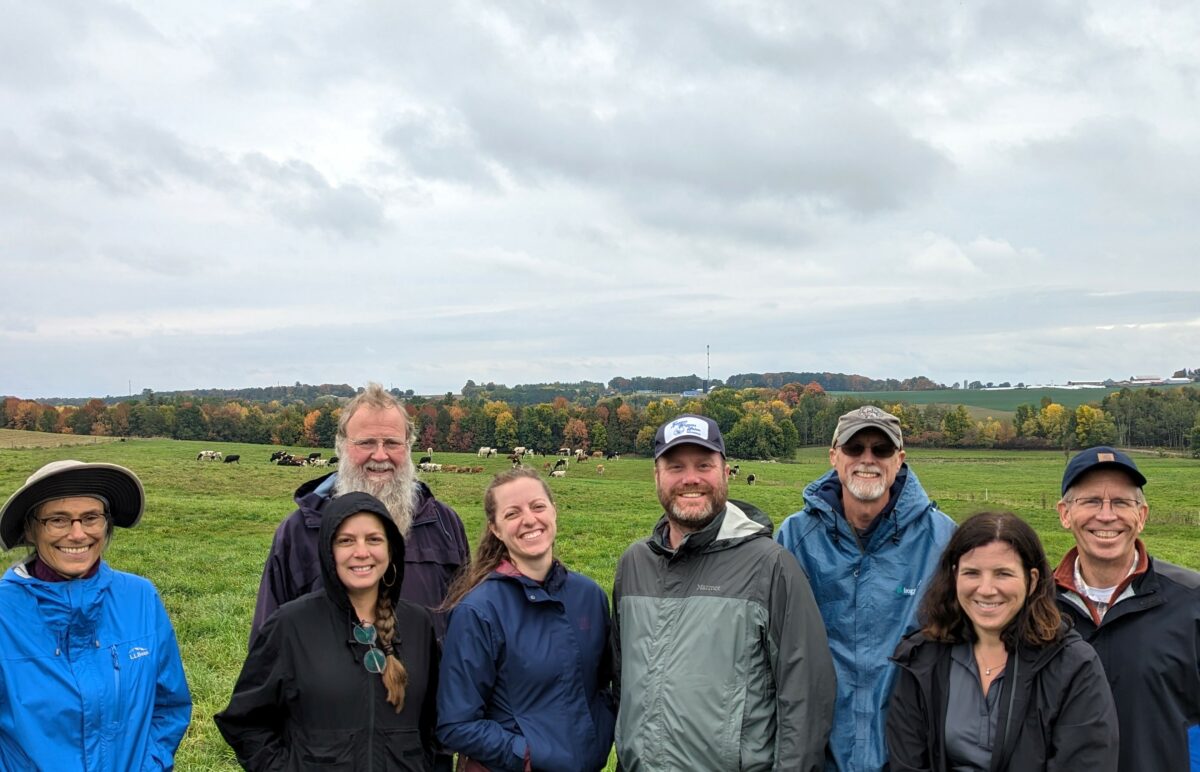
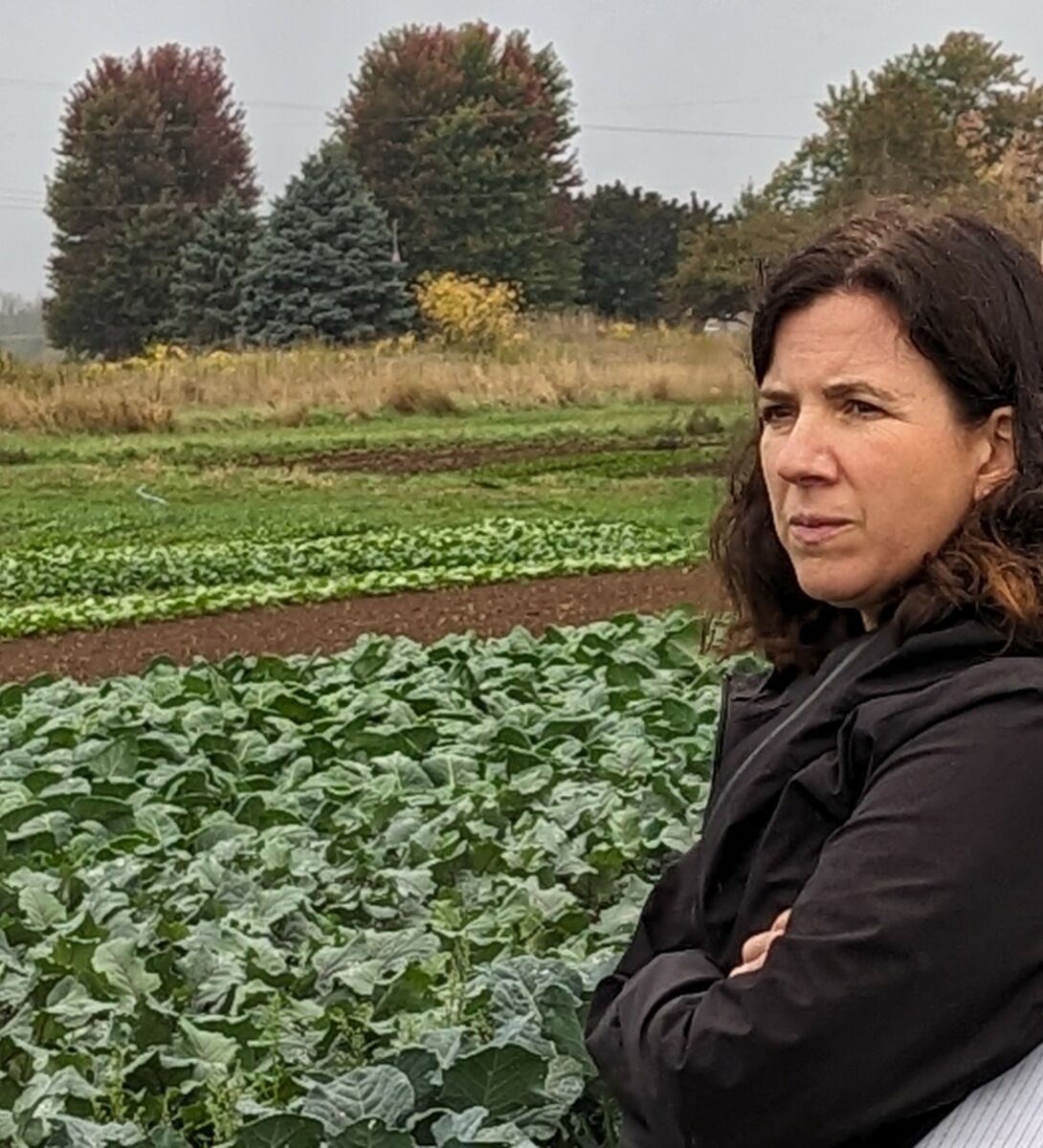
Farmers, like all of us, need time and strength to focus on relationships, health, healing and a sense of belonging, yet many agriculture service providers are unable to give wellness the attention it needs. A recent Cornell Small Farms project, Reconnecting with Purpose, aimed to provide farmers with additional support to cope with the hard work, unpredictability and economic stresses of modern day agriculture.
With support from Northeast SARE, a mixed group of 25 educators, farmers and activists gathered in retreat to name barriers and burdens, reclaim their strengths, and listen to and support one another. Drawing from the principles of the Center for Courage and Renewal, facilitators listened attentively and asked honest questions to create a safe space for participants to speak their truths.
Participant and Deep Roots Project founder Mara Marie said, "I'm passionate about the work I do and the folks I get to work with, but this program has supported my journey in taking a look at myself outside of productivity and external expectations."
Although the Reconnecting with Purpose project has drawn to a close, it will flow into a new three-year program called "Growing Benevolent Agricultural Communities.” The Cornell Small Farms Program expects to offer many additional programs through the new project. Want more information? Learn more about Reconnecting with Purpose at https://smallfarms.cornell.edu/projects/reconnecting-with-purpose/.
They gathered from their respective home waters—the Yahara, Shenendoah, Black Root, Vermillion, Marias, from Kansas, and all the way to the Delta and Everglades Basin—in fellowship to learn from the foodsheds of the dairy state and each other.
State-based study tours are the current that charts the course for participants of the SARE Fellows program. The tours feature a mix of farm visits and deep dives into reading the farm landscapes and are held every spring and fall throughout the United States. I had the good fortune to journey from my backyard up Bear Creek and join the cohort of SARE Fellows in NE Wisconsin for the day. Water, the ever-present current in Wisconsin but largely absent and erratic from the sky this season, guided our inquiry.
SARE Fellow Marissa Schuh, University of Minnesota. Photo: Erin Schneider
"I’m here, in part, to learn perspectives from other educators and different ways they interact with farmers," shared Mary Love Tagert, with Mississippi State University Extension. Our site visits featured water and climate change adaptations that farmers were puzzling through and adapting to. Our first stop at the heart of the Duck Creek watershed, we navigated different histories of land management that sprouted from the (re)establishment of White Corn at Tsyunhehkwa (Joon-hey-qwa) Farm. There, alongside the heady breath of tobacco plants releasing the soil’s secrets—a mix of sweet ferment, remnant heat and rot—we learned how different food sovereignty efforts can coexist within a Tribe and broader community. The Oneida Nation in Wisconsin has several farm and food security initiatives, from 4-H programs, Farm-to-School, Elder Food Boxes to a Commercial Beef and Bison Farm, canneries and co-ops. Discussion centered on the cultural aspect of food and the importance food plays in many of the traditional Oneida ceremonies. We also learned about the various product lines and education programs in development and the future aspirations of the Oneida Nation.
SARE Fellows touring Tauchen Pastures. Photo: Erin Schneider
Sated, our fleet drove upriver to witness water management and waste’s potential at different scales at Tauchen Harmony Valley Dairy. The farm is a multigenerational dairy operation, started in 1975 by Herb and Marlys Tauchen, that is a typical mid-size Wisconsin confinement operation. Right now, the Tauchens are working on integrating grazing, seeding cover crops and filtering leachate through sand/swales before water is discharged to nearby wetlands. We waded further afield from the main milking barns to tour the grazing-based heifer-raising farm developed by Al Tauchen. After his passing, the other family members have continued that operation. We listened to the riff and rip of cows on grass.
We ruminated at the pasture's edge. "I never thought about manure management or had much exposure to cattle," reflected Romina Gazis, a horticulture Extension educator and plant pathologist with Florida State, as she pauses from admiring a spattering of spores settling in the fall fescues. Romina spends much of her work among tropical fruits and horticulturists in South Florida.
SARE Fellow Mary Love on tour at Full Circle Community Farm. Photo by Erin Schneider.
Like the ebb and flood of waterways, a dairy farm and a farmer's needs remain fluid. This was evident at Full Circle Community Farm, a fifth-generation family farm in the process of transforming into a community-based organic vegetable and meat farm with shared ownership and a cooperative mindset to support the next flock of livestock, crops and farmers on the land. In Wisconsin, it's hard not to think about water and cows. The next day, the SARE Fellows would gather near Lake Michigan’s shorelines and work with the Saxon Homestead Farm, a fifth-generation family partnership operated by the Klessig family. This would be the Fellows’ "Reading the Farm" stop.
Our bellies full, our minds flooded and new knowledge moored in our hearts, a lone killdeer cried, and it was time to part. I drove home thinking of water (too much or too little), cows, cropping systems, conservation and culture. I thought about how they can coexist at varying scales and intensities, support different clientele and remain threaded together by a culture of care as the climate for farmers everywhere continues to change.
As an agriculture educator, you can continue to adapt and learn concurrently with the farms and land in your care through SARE. To learn more about the SARE Fellows program, how to apply, and ways to grow in your sustainable agriculture career, visit https://www.sare.org/Professional-Development/Fellows-Program.
If you’re curious about new opportunities in tree fruit production for your farm, listen in on this episode of ATTRA’s Voices from the Field podcast, where Ohio farmer Weston Lombard talks about his experience with mulberries. In it, Lombard and NCAT Sustainable Horticulture Specialist Guy Ames discuss the commercial possibilities and challenges mulberries present, along with different cultivars and growing strategies.
Lombard was a SARE Farmer/Rancher Grant recipient in 2016 for the project Field Testing the Mulberry for Commercial Production in the Midwest. He has successfully incorporated mulberries into the agroforestry system on his farm, where harvested leaves and dropped fruit provide excellent forage for chickens and hogs. His main income streams are through u-pick events and by propagating and selling nursery stock.
This episode of Voices from the Field is one in a series co-produced by ATTRA and SARE that explores the different ways farmers are working to create new local markets for specialty and niche crops. Each partner episode will address a different production system or crop–from endives to small-grain value chains–and will feature farmers sharing their production and marketing strategies, challenges and successes along the way.
Farmers nationwide are tackling the challenge of using ecological principles to manage weeds using fewer herbicides. Understanding the biology of weeds is key to helping producers adopt innovative strategies that achieve strong yields while adapting to changing consumer preferences. Three new videos from SARE illustrate how Klaas and Mary-Howell Martens manage weeds without chemicals on their 2,000-acre organic grain farm near Penn Yan, New York.
In Ecological Weed Management at the Martens Farm, Klaas Martens explains how careful and flexible crop rotation disrupts the growth and reproduction cycles of pigweed, Palmer amaranth, lambsquarters and velvetleaf, helping his crops outcompete. “This farm has the same weeds everyone else does; it is a matter of degree and distribution,” Martens says.
Blind Cultivation at the Martens Farm addresses how carefully timed and calibrated “blind cultivation” with a tine weeder can control newly germinated, shallow-rooted weeds when the crop is less vulnerable to tillage disturbance.
In Finger Weeders at the Martens Farm, Martens discusses how blind cultivation can create a size differential between weeds and the crop that improves the effectiveness of managing weeds in the row. Martens also demonstrates how skillful driving and a finger weeder can pull weeds from the row while controlling weeds between the rows. “If you want perfectly clean fields, you have to have the cultural practices right. You have to do some blind cultivation, and you have to do a good job with your tool. It’s fatal to take one high tech tool and use it as a substitute for the whole package,” says Martens.
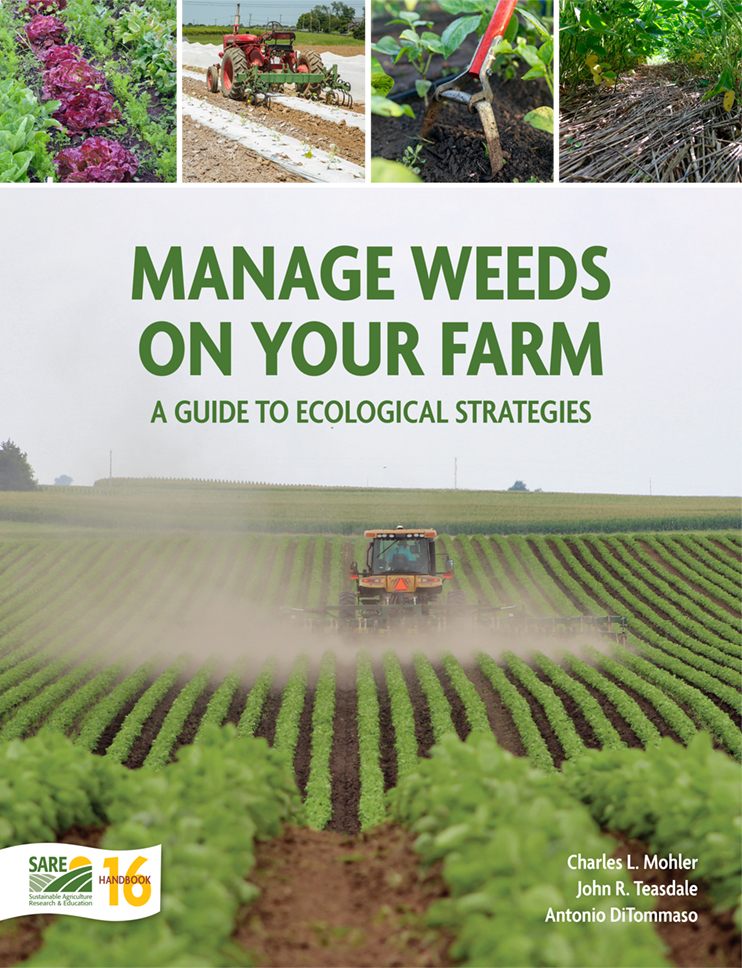
The Manage Weeds on Your Farm Video Series is a companion to SARE’s Manage Weeds on Your Farm, a definitive guide to understanding agricultural weeds and how to manage them efficiently, effectively and ecologically. Manage Weeds on Your Farm shows you how to outsmart your weeds by identifying the right tactic for the right weed at the right time, which will reduce as much as possible the labor required, while ensuring your weeds don’t impact crop yields. Download your free copy or order it in print today at www.sare.org/weeds.
The Sustainable Agriculture Research and Education (SARE) program announces the addition of four new members to the SARE Fellows program. Each member represents a different region of the United States. SARE Fellows is a two year professional development experience that helps agricultural educators enhance their understanding of sustainable agriculture and build relationships with farmers and their communities. Participants learn through a series of training and networking opportunities that feature diverse sustainable farming and ranching operations nationwide.
Selected through a competitive national process, the new Fellows represent a variety of backgrounds and disciplines and include both nonprofit and university educators:
Northeast: Ñawi K. Flores, Soil Health Institute: Ñawi is a soil health educator at the Soil Health Institute and is a passionate advocate of agricultural.
North Central: Molly Sowash, Rural Action: As the sustainable agriculture manager for Rural Action and as a beginning farmer, Molly works 9–5 supporting farmers in Appalachian Ohio to launch and sustain their farm businesses and 5–9 raising grass-fed beef on her own operation, MoSo Farm.
Southern: Dr. Trey Malone, University of Arkansas: Dr. Malone is an assistant professor in the department of agricultural economics and agribusiness at the University of Arkansas Division of Agriculture. His research focuses on the intersection of agricultural economics and sustainable food systems, leading to more than 50 publications in peer-reviewed journals.
Western: Daniel Elisara Helsham, American Samoa Community College:Daniel is a media specialist at the American Samoa Community College. For the past ten years, he has served the people of American Samoa by developing media and communications strategies to raise awareness of, promote and educate the community on the importance of agriculture and natural resources.
“We are excited to welcome these talented and dedicated individuals to the SARE Fellows program,” said SARE Associate Director Kristy Borrelli. “They understand the current demands facing sustainable agriculture, and we are confident that they will make a significant impact on the field.”
For more information about the SARE Fellows program, including eligibility, application and past and current SARE Fellow experiences, please visit https://www.sare.org/fellows.
Adapted from the Conservation Technology Information Center: A new national survey report has found that the vast majority of farmers who use cover crops don't need incentive payments to continue with the practice because of how much they appreciate its value to their land and business.
According to the National Cover Crop Survey, incentives play a key role in getting some farmers started on cover crops—49% of the cover crop users participating in the survey reported receiving some sort of payment for cover crops in 2022, and 77.8% of cover crop non-users said incentive payments would be helpful. However, 90.3% of the farmers who were receiving cover crop incentives reported that they would definitely or probably continue planting cover crops after the payments ended, while only 3.3% said they definitely or probably would drop cover crops at the end of the incentive program.
In all, just 15.6% of cover crop users said receiving incentive payments was one of their goals for cover cropping.
These findings were among many conclusions drawn in a report, issued jointly by SARE, the Conservation Technology Information Center (CTIC) and the American Seed Trade Association (ASTA), based on insights from nearly 800 farmers in 49 states.
"Cover crop incentive payments are an important factor in encouraging and helping farmers to transition into cover cropping, but once they see the soil health improvements and other cover crop benefits, most stick with cover crop planting long after the incentives end," says Dr. Rob Myers of SARE, lead researcher on the 2022-2023 National Cover Crop Survey Report. "Insights like these make the National Cover Crop Survey such a valuable tool in understanding the impacts of cover crops, the motivations of users and non-users, and needs for additional information and incentives."
At its heart, sustainable agriculture is simple. In practice, it’s much more complicated. Farmers and ranchers who value sustainability embrace three common goals for a successful production system:
Profit over the long term
Stewardship of our nation’s land, air and water
Quality of life for farmers, ranchers, farm employees and communities
SARE’s newly revised What is Sustainable Agriculture?publication provides a primer to practices that can help farmers and ranchers improve the sustainability of any complex, integrated production and marketing system.
Soil Health: Healthy soil provides a strong foundation for the vitality of any crop or forage. Cover crops, conservation tillage and effective compost and pasture management can help producers improve soil quality.
Biological Diversity: Crop rotation and integrated crop and livestock systems are proven approaches for managing water quality, cycling nutrients and interrupting the life cycles of pests.
Health and Wellbeing of People: Safe and humane working conditions and fair compensation for producers and farmworkers are essential components of a sustainable production system.
Ecological Pest Management: Understanding insect, weed and disease pests can help producers improve control through scouting, reduced applications, biodiversity and other tools.
Smart farmers know that healthy soil hosts a flourishing and diverse ecosystem of bacteria, fungi and invertebrates. But the complex relationships between soil life, productivity and resilience are not well understood. Now available from the Xerces Society and SARE, Farming with Soil Life: A Handbook for Supporting Soil Invertebrates and Soil Health on Farms is a user-friendly guide to identifying, understanding and better managing soil life to improve the sustainability of your farming system.
Written by the Xerces Society and published by SARE Outreach, Farming with Soil Life features photograph-filled profiles that outline how to observe and identify 73 soil organisms. Each profile includes the identification, description, ecological role, habitat, diet and life cycle of the highlighted species.
Farming with Soil Life alsoexamines how producers can boost life in the soil using buffers, no-till cropping, cover cropping, crop rotations and other practices that encourage soil flora and fauna communities to thrive. Minimizing tillage, synthetic fertilizer use, and some pesticides and insecticides may also benefit soil biology.
Understanding the relationships between soil, soil life and crop production is key to defining and achieving goals within a sustainable production system. “Soil is a living, dynamic habitat for a great diversity of animals and plants. It supports the global carbon and nitrogen cycles. Healthy soils sequester carbon, helping to mitigate climate change. The more we learn, the more we understand that soil is an irreplaceable part of life."
The University of Maryland has been selected to serve as the National Reporting, Coordinating, and Communications Office (NRCCO) for the Sustainable Agriculture Research and Education (SARE) program. This 10-year investment is being made as part of the USDA's National Institute of Food and Agriculture (NIFA) selection of four regional host institutions to manage SARE's regional granting programs.
“This investment in sustainable agriculture underscores USDA’s ongoing commitment to transforming our food and agricultural systems,” said Chavonda Jacobs-Young, USDA Chief Scientist and Under Secretary for Research, Education and Economics (REE). “Through this investment, SARE will continue to provide competitive grants and education programs that foster farmer-driven innovation to promote climate-smart practices, make sustainable producers more profitable, and improve local economies and the quality of life in rural communities.”
"Since its authorization in the 1990 Farm Bill, SARE has supported farmers in four regions (North Central, Northeast, South, and West), with each regional program hosted by a Land-grant Institution and guided by volunteer Administrative Councils that make grants and set regional priorities. These councils include farmers and ranchers along with representatives from universities, government, agribusiness and nonprofit organizations. Technical reviewers, also volunteers, lend professional and practical experience to help councils evaluate project proposals."
SARE recently partnered with PBS KVIE to produce an episode of RFD-TV's America's Heartland featuring four farmers describing their commitment to sustainability, how they plan to overcome modern farming challenges, and how SARE has impacted their farming and ranching practices.
Bryce Wrigley of Delta Junction, Alaska, discuss how soil health, cover crops and barley flour play an important role in improving food security in Alaska.
Pennsylvania's Hannah Smith-Brubaker and Debra Brubaker share how diversification and new marketing opportunities have benefited their farm.
Dr. Reagan Noland and rancher Chad Raines explore whether running sheep in organic cotton can help manage weeds and reduce tillage in west Texas.
Erin and Drew Gaugler explain how bale grazing, multi-species grazing and keyline cultivation improve soil health and range quality on their 4,000 acre ranch in South Dakota.
Videos featuring each farm's individual segment are also available for sharing.
Visit https://www.rfdtv.com for more information about America's Heartland and other RFD-TV programming.