Showing 1-10 of 15 results

National Farmer Survey Documents a Wide Range of Cover Crop Benefits as Acreage Continues to Expand

Despite the crippling rainfall that significantly delayed planting across much of the country in 2019, more than 90% of farmers participating in a national cover crop survey reported that cover crops allowed them to plant earlier or at the same time as non-cover-cropped fields. Among those who had "planted green," seeding cash crops into growing cover crops, 54% said the practice helped them plant earlier than on other fields.

Those findings were among several new insights from the 2019-2020 National Cover Crop Survey, conducted by the nonprofit Conservation Technology Information Center (CTIC), with financial support from SARE and the American Seed Trade Association (ASTA). These organizations have worked together on several past national cover crop surveys, with the first survey dating back to the 2012 crop year.
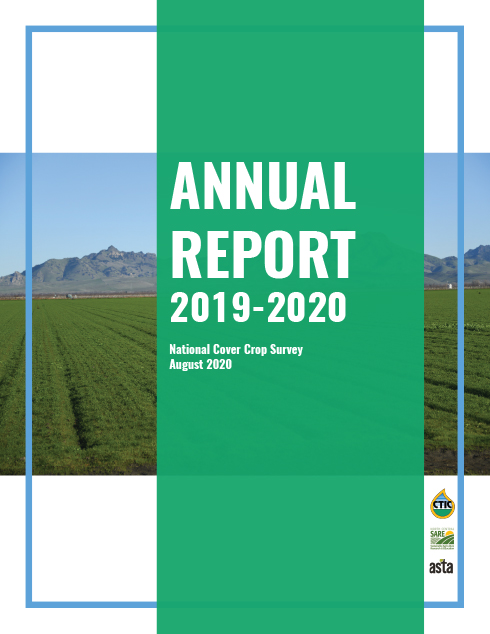
The 2019-2020 survey, which included perspectives from 1,172 farmers representing every state, was the first by SARE, CTIC and ASTA to include detailed exploration of planting green—a tactic employed by 52% of the respondents—as well as crop insurance use among cover croppers and the impact of cover crops on the profitability of horticultural operations.

"Many U.S. farmers have turned to cover crops as part of their strategy to improve soil health while reducing input costs and maintaining yields," stated Mike Smith, who managed the national survey for CTIC. Survey participants averaged 465 acres in cover crops in 2019, an increase of 38% in four years. The USDA Census of Agriculture found a 50% increase in cover crop acreage over the five-year period between 2012 and 2017.

 “Farmers are using cover crops for a variety of reasons and many have tried new approaches to cover cropping,” Smith said. "This year's survey also indicated that some of the concerns that many growers have had about the effects of cover crops on planting dates in a wet year turned out not to be true—in fact, in many cases, cover crops helped farmers plant earlier in the very wet spring of 2019."

According to Rob Myers, Regional Director of Extension Programs for North Central SARE, “many farmers are finding that cover crops improve the resiliency of their soil, and the longer they use cover crops, the greater the yield increases and cost savings that are reported by producers.”

“We are pleased to see farmers appreciate the expertise of cover crop seed companies with 46% saying they buy from them and another 42% buying from retailers,” said Jane DeMarchi, VP Government & Regulatory Affairs, ASTA. “Professionally produced cover crop seed is grown for seed from the start and has been selected, harvested, cleaned and tested for performance. The study shows farmers are using a range of cover crop seed and mixes to address their individual needs with 46% paying $15 or under per acre.”

Among the 1,172 farmers who provided responses in the 2019-2020 National Cover Crop Survey, 81% were commodity producers (corn, soybeans, wheat, cotton, etc.) and 19% categorized themselves as horticultural producers.

Here are some highlights from the survey. Download the full report.

Yields

The previous five national cover crop surveys sponsored by SARE, CTIC and ASTA have all reported yield boosts from cover crops, most notably in the drought year of 2012 when soybean yields were 11.6% improved following cover crops and corn yields were 9.6% better. In 2019, when wet early conditions prevailed across much of the corn and soybean regions, yield gains were more modest but still statistically significant. Following the use of cover crops, soybean yields improved 5% and corn yields increased 2% on average, while spring wheat yields improved 2.6%.

Saving on farming costs

Many farmers reported economic benefits from cover crop beyond just yield improvements. Of farmers growing corn, soybeans, spring wheat, or cotton, the following percent had savings on production costs with fertilizers and/or herbicides:

  • Soybeans – 41% saved on herbicide costs and 41% on fertilizer costs
  • Corn – 39% saved on herbicide costs and 49% on fertilizer costs
  • Spring wheat – 32% saved on herbicide costs and 43% on fertilizer costs
  • Cotton – 71% saved on herbicide costs and 53% on fertilizer costs

While cover crop seed purchase and planting do represent an extra cost for farmers, it was notable that most producers are finding ways to economize on cover crop seed costs. Whereas earlier surveys from 2012 and 2013 reported on a median cover crop seed cost of $25 per acre, most farmers reported paying less in 2019. Of the responding farmers, 16% were paying only $6-10 per acre for cover crop seed, 27% were paying $11-15 per acre, 20% were paying $16-20 per acre, and 14% were paying $21-25 per acre. Only about one-fourth were paying $26 or more per acre.

Planting green

Planting green refers to planting a cash crop like corn, soybeans or cotton into a still-living cover crop, then terminating it soon after with herbicides, a roller-crimper, or other methods. In this year’s survey, 52% of farmers planted green into cover crops on at least some of their fields. (In the 2016-2017 report, the most recent prior survey by SARE, CTIC and ASTA, 39% of the respondents had planted green.)

  • Of the farmers planting green, 71% reported better weed control
  • 68% reported better soil moisture management, particularly valuable in a wet spring

Horticulture producers also benefit

For the first time, the survey queried horticulture producers about how cover crops have impacted their profit. Of the 184 horticulture producers responding to that question, 35% reported a moderate increase in net profit (defined as an increase of 5% or more), and another 23% reported a minor increase in net profit (2-4% increase). Even after factoring in the purchase and planting cost of cover crops seed, only 4% observed a minor (2-4%) reduction in net profit, and none reported a moderate loss in net profit.

Available online

"The 2019-2020 National Cover Crop Survey shows that an ever-growing number of farmers of all types and in all regions of the U.S. continue to find advantages to using cover crops," says Myers at SARE. "While the first survey in 2012 showed the benefits of cover crops in a drought year, this year’s survey showed that cover crops helped farmers in wet weather as well, with many of them being able to plant in wet spring weather when conventional neighbors couldn’t. The survey showed farmers are figuring out how to make cover crops work for them economically, while using them as a tool to address challenging issues such as herbicide-resistant weeds."

Download the full survey report.

For more information:

Rob Myers, SARE | myersrob@missouri.edu | (573) 882-1547

Mike Smith, CTIC | smith@ctic.org | (812) 661-2407

Kaitlin Crawford, ASTA | kcrawford@betterseed.org | (571) 431-7331
Posted in 1

Cover Crop Economics Report Now Available in Print

Cover Crops Offer Options in Wet Soil

As more farmers across the nation begin to incorporate covers into their rotations, they find that this valuable conservation practice pays in more ways than one. Many farmers in states suffering from oversaturated fields that prevented or delayed planting are considering cover crops. To help farmers evaluate the benefits of incorporating cover crops into their production systems, USDA-SARE released an important new report that examines the big question: “When do cover crops pay?”   

Cover Crop Economics: Opportunities to Improve Your Bottom Line in Row Crops is now available for free in print and for download, and is great for farmers and educators alike. 

Download or order Cover Crop Economics now. 

Using data gathered from five years of national cover crop surveys, Cover Crop Economics addresses the economic returns that can be expected from cover crops under various management scenarios and as cover crops improve soil health over time. This report takes a comprehensive approach by identifying seven different management situations when cover crops pay off faster. They are when:

  • Herbicide-resistant weeds are a problem
  • Cover crops are grazed
  • Soil compaction is an issue
  • Cover crops are used to speed up and ease the transition to no-till
  • Soil moisture is at a deficit or irrigation is needed
  • Fertilizer costs are high or manure nutrients need to be sequestered
  • Incentive payments are received for using cover crops

Download or order your free print copy of Cover Crop Economics: Opportunities to Improve Your Bottom Line in Row Crops at sare.org/cover-crop-economics or by calling (301) 779-1007. Cover Crop Economics is available in quantity for free to educators for use in educational workshops, classes or tours.

Posted in 1

SARE/NACAA Fellows Visit the Cornhusker State

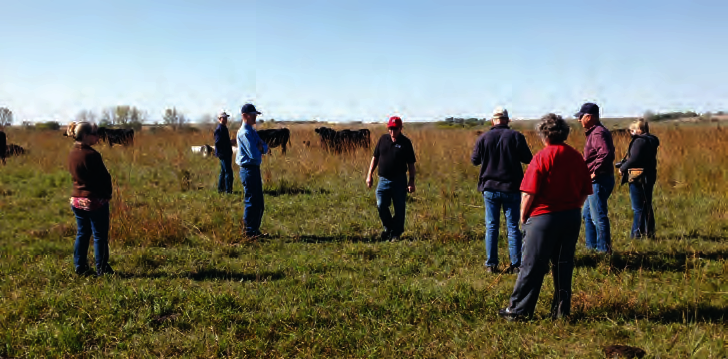
Farmers standing around a field talking with cows in the back.

Nebraska’s landscape is one of distant horizons, rolling plains, sandy hills, and acre after acre of agriculture. In a state where ninety-three percent of the state’s land is in production agriculture, cattle ranches span thousands of acres, and local food systems are on the rise, learning opportunities abounded for a group of educators like the Sustainable Agriculture Fellows. The Sustainable Agriculture Fellows program is a two-year training opportunity in sustainable agriculture for Extension workers. Supported by SARE and the National Association of County Agricultural Agents (NACAA), the program enhances understanding of sustainable agriculture and provides broad based, national exposure to successful and unique sustainable agriculture programs.

This fall, the fellows embarked on an agricultural tour of Nebraska and took an in-depth look at one Nebraska family farm. Tour stops included Nebraska farms, ranches and educational institutions, including the Horticulture Department and the Institute for the Culinary Arts at Metro Community College in Omaha, the University of Nebraska Lincoln’s Innovation Campus, Shadowbrook Farm’s high tunnels and creamery near Denton, the McLean family farm and feedlot near Benedict, Jim Knopik’s mob grazing ranch near Fullerton, The Grain Place (an organic farm and processing plant in Marquette), the Berns’ family farm and cover crop seed business near Bladen, and the Raising Nebraska Building at the Nebraska State Fair Grounds. Facilitated conversation kept the fellows engaged during locally sourced meals and van rides across the hills and plains of Nebraska.

The Fellows used a training tool developed by the Northeast SARE program called “Reading the Farm” to review detailed farm information, observe, and engage in facilitated discussion with Kevin Loth and Charuth Van Beuzekom Loth of Shadowbrook Farm and Dutch Girl Creamery near Denton, Nebraska. During the Reading the Farm exercise, the Fellows met with the Loth family and shared knowledge and insights within the context of the Loth’s vegetable farm and goat’s milk creamery businesses. After the tour, the fellows provided a written report summarizing their feedback for Shadowbrook Farm and Dutch Girl Creamery. That kind of engagement with producers and other Extension agents is one of the main draws to the Sustainable Agriculture Fellows program.

As we walked through pasture grasses at Jim Kopnik’s ranch the day after the Reading the Farm exercise, Utah State University Extension agent and 2013 Fellow, Matt Palmer, reflected on the program and explained how the Reading the Farm exercises have improved his interactions with farmers and have helped him better meet the needs of his local clientele. “It has been very valuable,” explained Palmer. “When I go back to the county that I’m from and I view farms, I understand how my recommendations interact with their other enterprises. I’m more apt to take a holistic view of their farm.”

Before sitting down to talk about cover crops with the Berns family at Green Cover Seed, University of Missouri Regional Horticultural Specialist and 2014 Fellow, Patrick Byers, echoed Palmer’s sentiments, saying that the Sustainable Agriculture Fellows program has fulfilled his expectations and more. “I’ve worked with farmers for many years,” said Byers. “This was a chance to delve more deeply into all aspects of sustainability and to build my skills as a person who is empathetic to the realities of sustainability for the farmers that I serve...I really can’t say enough things about what it has meant to me to be a Fellow.”

Curious about the Sustainable Agriculture Fellows program and the Reading the Farm tool? Learn about the people and the program online at sare.org/fellows.

Posted in 1

Improving Nutrient Use Efficiency in Montana Wheat

"This was a landmark study because we knew we were losing nitrogen, we just didn't know how we were losing it," says farmer Curtis Hershberger.

When nitrogen fertilizers are applied to the soil surface using certain application practices, a significant amount can be lost when the nitrogen converts to ammonia gas and enters the atmosphere. This process, known as volatilization, represents an economic loss for farmers and is a source of atmospheric pollution.

An on-farm study lead by Montana State University Soil Scientist Richard Engel and funded by SARE has shed light on the urea fertilization practices that are most susceptible to nitrogen volatilization. The team also studied nutrient losses from a green manure cover crop. They developed recommendations that have improved the sustainability of wheat farms across Montana. As a result of this work, farmers statewide are saving an estimated $5 million per year in improved nutrient use efficiency and crop yield.

For the study, the research team determined the fraction of applied urea fertilizer lost as ammonia gas when applied to winter wheat from late fall to early spring (see ammonia gas collectors in the field at the video's 2:30 mark). Based on their findings, they recommend against surface-applying fertilizer to frozen or wet ground, particularly in the winter, and instead to apply it in the spring on dry ground a day or two before significant rain. They also recommend subsurface applications and the use of urease inhibitors.

Posted in 1

For Vegetable Farmers, a New No-Till Tool in Forage Radish

Vegetable farmers who want the myriad benefits of winter cover crops may be setting themselves up for a hectic spring schedule, when the challenge of planting during a narrow window of good weather becomes more complicated by the need to first terminate that winter crop.

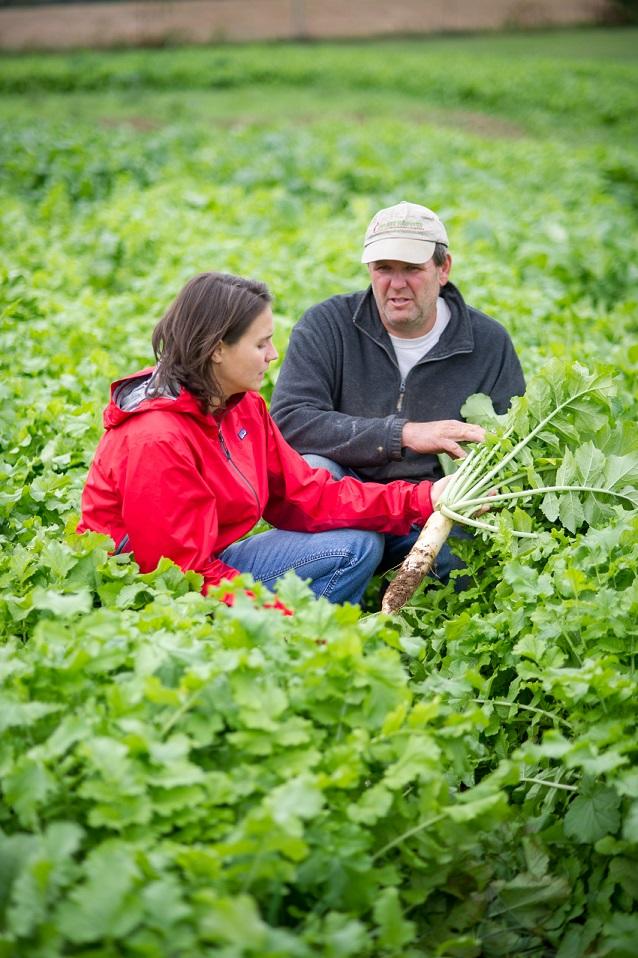
To make their lives a little easier, University of Maryland (UMD) researchers are exploring the benefits of forage radish, a relatively new cover crop species that they have found fits well with no-till spring planting, and boosts farmers’ yields and profits.

In a SARE-funded trial in 2012, an early-season, organic spinach crop planted after forage radish yielded 17,000 pounds per acre—worth $34,000 at a conservative $2 per pound. The spinach was raised without tillage, fertilizers or herbicides. “Not a whole lot of work,” says UMD soil scientist Ray Weil, who conducted this research with UMD graduate student Natalie Lounsbury. “I don’t usually think of silver bullets, but for planting early spinach I think we have one.”

A second year of trials saw wetter weather and somewhat lower yields, but spinach grown in plots following forage radish continued to outperform plots using both an oat cover crop and no cover crop.

For more practical information, visit the Cover Crop Topic Room.

Forage radish shows particular promise for organic farmers as an alternative to tillage, a time-consuming process used to control weeds, loosen compacted soil and prepare beds prior to planting. When seeded in August in the mid-Atlantic, forage radish suppresses winter weeds because of its quick growth and broad leaves. Its large taproot loosens the soil and helps the plant capture excess nutrients from deep in the ground, which keeps them from leaching into waterways and makes them available to spring crops when the radish decomposes.

“Right now, forage radish seems to be the only cover crop that does all these things we need it to do,” Lounsbury says.

One of forage radish’s main advantages over other popular cover crop species is that it dies in winter and leaves little residue in spring. This gives the soil a chance to dry out and warm up, two conditions that are essential for timely planting and successful germination of cash crop seeds. This played a major role in the UMD team’s positive results.

Dave Liker was one of a handful of farmers who collaborated with Lounsbury and Weil on their SARE project. A diversified organic farmer on 25 acres in Laurel, Md., Liker typically relies on spring tillage to manage his heavy, wet soils, and he has difficulty with high-biomass cover crops like rye and vetch because of the time it takes to terminate them. “Cover cropping is really difficult to manage organically,” he says. “The following season, when we need to work the ground, we need to work the ground.”

But when Liker tried a forage radish cover crop before a spring crop of no-till peas, he was happy with the result. “It was the best crop of peas I’ve ever had,” he says.

While forage radish is proving its value, Lounsbury cautions that it is not a cure-all. To avoid pest problems, farmers should not include it too frequently in rotations with other brassicas. Also, they need to pay attention to fertility before seeding forage radish.

“There is amazing weed suppression if you get a good cover crop stand, but if you don’t have enough fertility when you plant in August, then you’re not going to get a good stand,” she says.

Posted in 1

From Fruit to Fuel

As tree fruit growers know well, annual harvests do not remove all the fruit from the orchard. A great deal is left behind littering the orchard floor. While pondering his fruit waste problem, Dan West of Macon, Mo., who grows apples, peaches, apricots, nectarines, plums and pears, hit upon a novel approach: Why not turn the waste into energy?

West already had been distilling the waste fruit into natural wine using a still he designed out of a beer keg. (West received a distilling permit from the Bureau of Alcohol, Tobacco, Firearms and Explosives.) Then, driven by an over-supply of waste fruit, coupled with his growing concern about the supply and cost of fossil fuel, West decided to produce ethanol from his fruit wine by heating it and removing the alcohol, at a rate of about 1.5 gallons per hour.

“Using waste was the main thing,” recalled West, who has been running an orchard on 10 acres since 1995, and received a SARE grant in 2003 to experiment with ethanol production. “I also thought it would be nice to be self-sufficient, using our ethanol to power our mower and tractor.”

West built a second still from a 500-gallon propane tank, in which he heats his fruit wine to just below boiling, gathers steam in a fractionating column, and distills the alcohol portion of that steam to 190 proof. This still should easily produce 4–5 gallons per hour, although he expects to speed up the distillation as he improves the second still.

“Even at $2-a-gallon fuel prices, my ethanol distillation process is well worth doing,” West said. Discounting the labor to gather and crush fruit — now his most time-consuming task — distillation costs only 65 cents per gallon in electricity costs. Those gallons of ethanol, however, now power his farm engines at a higher octane than gasoline and provide a cleaner burn.

“It’s exciting,” he said, reflecting on the first time he powered up his lawn tractor with homemade ethanol.

Others have been similarly fired up. At least 1,000 people per year visit West’s orchard, about 120 miles from Kansas City, in part to see his energy-saving invention.

West never stops thinking up innovative ways to get the most from his farm. Since gathering waste fruit is time consuming, he has focused his keen inventor’s mind on finding a better way. With a second SARE grant, West is designing a machine that gathers up waste fruit, then crushes it into pulp, some of which is spread back on the orchard floor as fertilizer, and some of which is squeezed into juice and then fermented into wine.

West also received another SARE grant to design a closed-loop energy production system using a solar concentrating method that reduces electricity needed to heat the still. The prototype has produced 170-proof ethanol. “When it worked after three or four tweaks, I was jumping up and down,” he recalled. “Winning the initial grant opened up many doors for me.”

Posted in 1

Testimonials from Past Fellows

Each year, four Extension agents are selected to participate in the SARE Sustainable Agriculture Fellows program. The following are reflections from a few Fellows on their experiences in the program.

Walt Bumgarner, Penn State Extension (2007 Fellow)

As part of the first class of SARE Fellows, I want to tell my fellow NACAA members that their participation in the SARE Fellows Program could possibly be the highlight of their career in Extension....To be offered the chance to travel the country and experience different aspects of sustainability is invaluable.

Ronnie Barentine, University of Georgia Cooperative Extension (2007 Fellow)

To gain further knowledge of sustainable agriculture systems, I had the highest honor to be chosen as a member of the 2008-2010 SARE and NACAA Fellows Program....The trainings were held in the states of Arizona, Georgia, South Carolina, New Jersey, Pennsylvania, Wisconsin, and Iowa. While visiting these states, I studied organic fruit and vegetable production, livestock production in arid lands, endangered species of desert lands, illegal entry of non U.S. citizens on ranch operations, grass fed all natural beef and organic beef production, dairy modernization, conservation tillage, farmers markets, and conservation of soil and riparian water resources.

Richard Brzozowski, University of Maine Cooperative Extension (2008 Fellow)

My Extension programming with farmers and growers has benefited greatly on account of my participation [in the SARE/NACAA Fellows Program]....I learned a great deal about sustainable agriculture and its components as I met farmers and Extension workers from different regions of the country. I have cultivated working relationships and friendships with many of these individuals. As a result of my experience, I have integrated many of these ideas and methods into my programming.

Stephen Komar, Rutgers New Jersey Cooperative Extension (2009 Fellow)

The SARE Fellowship provides a unique opportunity for agricultural educators, producers and others to interact with individuals that they may not normally deal with in their respective specialties....Since participating in this program, I have personally worked with some of the other fellowship awardees on grant projects, articles and other educational programs....I highly recommend that NACAA members, regardless of experience, participate in this program.

Mark Blevins, North Carolina Cooperative Extension (2009 Fellow)

My agricultural awareness and understanding has exploded during the SARE Fellows program! I come from a horticultural background and was searching for ways to gain a broader sense of agriculture with a focus on sustainability, but received so much more....This has been a remarkable experience for me as an agent in my first 5 years, but this program could benefit any agricultural educator at any point in their career.

Joran Viers, New Mexico State University Cooperative Extension (2009 Fellow)

When I applied in 2009 for the SARE Fellows program, I thought it would be fun and mildly educational. After all, I had a strong background in organic production, having spent six years running our state’s organic certification program....It has been fun, extremely fun, but much more than “mildly” educational. Through trips to various regions of the country, looking at all kinds of agriculture at all sizes, I have learned far more than I imagined I would....This program has been one of the best professional development opportunities I’ve had, by far.

Suzanne Mills-Wasniak, Ohio State University Extension (2010 Fellow)

My first year as a SARE Fellow has greatly changed the way I analyze a client’s operations. Working in a two-thirds urban / one-third rural county, often more emphasis in the rural areas is placed on economic viability while the urban areas focus on social responsibility. Now instead of zeroing in on what the client perceives as the problem, I look at the operation as three equal components, socially responsible, environmentally sustainable, and economically viable; all of which must be in equilibrium to be totally sustainable.

Lauren Hunter, University of Idaho Extension (2010 Fellow)

The SARE Fellows program has increased my knowledge on sustainable agricultural practices used across the US. The knowledge gained thus far has been incorporated and used in grower presentations as well as current research projects....The SARE Fellows program has also given me more national recognition as an Educator specialized in sustainable and organic farming. I also value the networking opportunities it has provided with other Extension Educators from across the US.

Posted in 1

Grant Puts (Good) Crimp in Farm Operations

It all began in 2002 with a $6,500 SARE grant and the seed of an idea. Today, that idea has grown into hundreds of research projects around the country, an international business and a new, effective no-till tool that farmers are adding to the ways they suppress weeds in cash-crop fields.

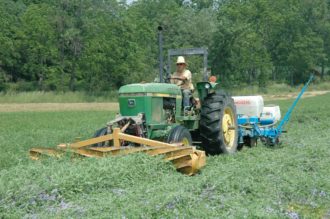
The tool is the roller crimper, a drum with blades mounted to the front- or back-end of a tractor and used to roll down, crimp and kill cover crops, creating thick, weed suppressing mulch. Until the crimper, farmers were largely left with two weed-control options: cultivate the weeds into submission or spray herbicides. The former disturbs the soil and allows for erosion; the latter is often expensive for conventional farming, and unusable for organic.

“I had the idea for the tool,” says Jeff Moyer, director of farm operations at the Rodale Institute in Kutztown, Penn. “But without SARE’s help, it might not have happened. That first grant started a whole tidal wave of looking at cover crops differently and it allowed us to build the very first roller crimper.”

A picture of a tracker in a field

Today, the roller crimper is a common sight on land-grant university research plots, according to Moyer, who leveraged that first SARE grant into a larger USDA grant to further refine the tool. One Pennsylvania company, I&J Manufacturing, saw opportunity in the burgeoning technology and now has a thriving business building and shipping roller crimpers domestically and overseas.

Farmers across the country are starting to add the tool to their arsenal of weed control options. Kentucky farmer Joel Armistead, who is collaborating on an EPA-funded project with the nonprofit Cumberland River Compact to explore ways to reduce chemical inputs, says while he ran into problems with the weather, he was able to reduce his spraying considerably by first using the crimper and then spraying just enough to take down the rest of the cover crop.

SARE is continuing to fund other crimper research around the country to explore how the tool works in different climates, geography, and with different cash and cover crops. The crimper, while not a fix-all, has shown promise in using about 40 percent less energy than cultivating or spraying; reducing erosion; retaining moisture; and allowing for more flexibility, since roll downs do not need to be timed to dry conditions.

Tim Bock, who runs a 100-acre certified organic farm outside Kutztown, has tried the roller on more than 20 acres for another SARE-funded project. After two years of success, he plans to completely switch his soybean production to rolled rye. “The results have been outstanding,” Bock says. “I’ve really reduced my weed pressure and drastically reduced the number of trips across the field. I eliminated a complete tillage cycle.”

Moyer cautions that roller crimpers are not for farming 101. A farmer must be quite experienced with the nuances of their fields and work on rotations that match cover crops to the cash crop. “One must grow the cover crop with the same attention paid to the cash crop.”

Want more information? Visit SARE's database of projects and search for the term "roller crimper."

Posted in 1

Cutting Edge Research: Helping Bees Help Themselves

Diseases, pests and the mysterious phenomenon of colony collapse disorder pose a dire threat to the U.S. beekeeping industry and, in turn, to the $20-billion-a-year crop industry that relies on insect pollination. Because of these increasing pressures, the ranks of managed bee colonies have plummeted in recent years: On average, beekeepers are losing 30 percent of their colonies every growing season.

While the exact cause of colony collapse disorder is unknown, researchers believe it to be the result of a combination of factors, one of which is the Varroa destructor (V. destructor) mite, a pest introduced to the country in the late 1980s. V. destructor, difficult to control because it has become pesticide resistant, attacks bees by sucking their blood, thus spreading viruses among colonies and weakening individual bees, making them susceptible to pesticides not intended to harm them.

Rather than relying on pesticides and antibiotics to control V. destructor and related diseases—a method that has become part of the problem—University of Minnesota Entomologist Marla Spivak is advancing effective strategies that help bees help themselves.

Spivak and her team have received six SARE grants since 1997 to support their work showing beekeepers how to identify and breed for hygienic bees—bees that are adept at spotting infected immature bees (larvae and pupae) and quickly removing them from the nest before a disease or pest can get out of control in a colony. “We mostly research ways for bees to keep themselves healthy, using their own natural defenses so we can avoid chemical inputs,” Spivak says.

Their research—now supported by a $500,000 MacArthur Foundation “genius” grant—has demonstrated that colonies bred for hygienic behavior have good resistance to chalkbrood and American foulbrood diseases, and partial resistance to V. destructor. Over time, the establishment of disease-resistant bees has the potential to save commercial-scale beekeepers thousands of dollars each year in treatment costs while reducing the environmental impact of pesticide use.

Spivak’s SARE-funded research also includes innovative sampling strategies for beekeepers to determine the extent of an infection in a colony, and therefore how much of a treatment might be needed.

After helping three commercial-scale beekeepers in Minnesota establish hygienic disease resistance in their colonies, Spivak and her team are now working closely with some of the country’s largest bee breeders to adopt the sustainable pest management strategies that make sense for them, including breeding and sampling strategies. Many of the breeders with whom they are collaborating sell queen bees throughout the country, giving Spivak’s team the opportunity to have widespread impact.

“We need genetically diverse bees,” Spivak says. “That is the impetus for me to work with bee breeders to help them select for hygienic behavior from among their genetically diverse, and tried-and-true lines of commercial bees.”

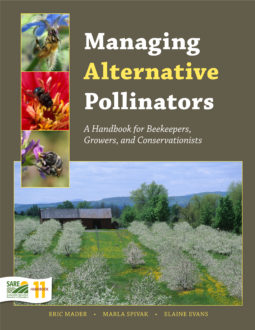
While much of Spivak’s research focuses on the European-imported honey bee—the primary victim of colony collapse disorder—she and her colleagues have also turned their attention to the wide range of native bee species that are also embattled, yet serve an important role in crop pollination. In 2010, Spivak co-authored and SARE published Managing Alternative Pollinators, a first-of-its-kind technical guide for rearing and managing key alternative species.

Posted in 1

Dryland Cover Cropping Boosts Yields

Every drop of water counts for farmers who practice dryland cultivation, a practice that relies on rainfall without the benefit of irrigation. So, when it comes to incorporating cover crops into a dryland rotation, many farmers hesitate, wondering: “How much moisture is the cover crop going to demand, and will I pay for it later in lost cash-crop yields?”

This is the “first question and major concern any dryland farmer has about cover crops,” says Bladen, Neb., farmer Keith Berns. But thanks to SARE-funded research he and his brother conducted on their 2,000-acre farm—about two-thirds of it dryland—they now have an answer to share with their peers.

Keith and Brian Berns found that, in fact, cover crops can significantly boost corn yields in a non-irrigated setting. In one trial, they planted corn after a cover crop mix of grasses, legumes and brassicas, and saw a corn yield that was about 10 percent better than planting straight into wheat stubble.

“The results of this project have made us firm believers in cover crops,” says Keith Berns, who raises corn, soybeans and wheat, and has been practicing full continuous no-till for 12 years.

In their trials, conducted in 2008 and 2009, the Bernses tested cover-crop monocultures as well as mixes—including sunflowers, soybeans and oilseed radish—but found that mixes were the best performers, in part because they were the most frugal with water. Although a wet season skewed some of their moisture data collection, they found that the cover-crop mixes used far less water than the cover-crop monocultures, and were on par with water use in wheat stubble alone.

They acknowledge that they are not done exploring cover crops. “We will continue to experiment with different mixes, seeding rates and plant species,” says Keith. “We also hope to continue to monitor water usage of cover crops, and also measure yield in the crop following our cover crops.”

Additionally, they are experimenting with putting livestock on cover crops—looking at grazing intensities, regrowth periods and nutritional quality.

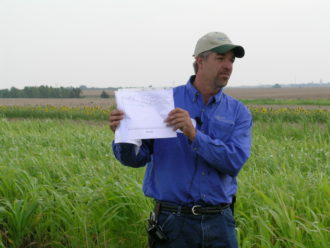
Brian Berns holding a data chart during a field day.

In the meantime, the brothers are busy spreading the word about their findings and helping others adopt cover crops. During the course of their SARE research, they hosted two on-farm field days and spoke at nearly 25 public events, to a total of about 1,500 people. They also host an annual one-day cover-crop school in Bladen.

The SARE grant has yielded even more benefits: The Berns brothers have launched a new cover-crop seed business, and now maintain a website—www.greencoverseed.com—that contains practical information on their research. A highlight is their SmartMix Calculator, an online spreadsheet that calculates seed quantities and cost, carbon-to-nitrogen ratio (C:N), nitrogen-fixation potential and other factors for mixes of nearly 40 cover-crop species, including legumes, brassicas, grasses and broadleaf crops.

Posted in 1