The educational materials listed on this page are about Soil Management.
Soil management encompasses a number of strategies used by farmers and ranchers to protect soil resources, one of their most valuable assets. By practicing soil conservation, including appropriate soil preparation methods, they reduce soil erosion and increase soil stabilization. These soil conservation methods allow for healthy soil formation, soil fertility and favorable soil composition, including soil permeability and soil porosity, which lead to increased soil health. Soil organic matter is a critical component of soil health. Cover crops can help maintain or increase soil organic matter. By using a variety of soil management practices, soil organic matter will increase while soil erosion will decrease, keeping soil nutrients on the farm. Farmers typically use a soil analysis, or soil sampling procedure, to determine what inputs are needed. Key practices include composting, soil chemistry, nutrient mineralization, soil quality/health, organic matter, cover crops, green manures, soil analysis, soil microbiology, soil physics.
Showing 1-10 of 106 results
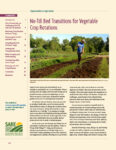
No-Till Bed Transitions for Vegetable Crop Rotations
A guide on transitioning from one vegetable crop to the next without the use of tillage.
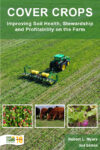
Cover Crops
An in-depth book on how to use cover crops with success.
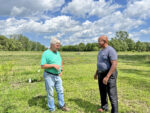
Using Cover Crops in Wide Row Corn
Iowa farmer Bob Recker challenged conventional thinking by asking whether wider corn rows could allow cover crops to thrive without sacrificing farm profitability.
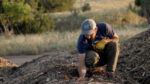
Ranchers Turn to Compost to Improve Soils and Boost Forage Production
Zachary Withers used a Western SARE Farmer/Rancher grant to examine whether applying compost could help his soil retain more rainfall, reduce erosion and improve forage production.
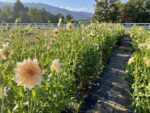
Promoting Soil Health for Cut Flower Production
With support from a Western SARE Partnership grant, Melanie Stock of Utah State University partnered with cut flower farmers to explore sustainable fertilization practices for dahlia production.
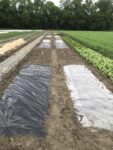
Impacts of Silage Tarps on Soil Arthropods, Soil Properties and Crop Yields
Tarps dramatically reduced weed cover (around 30% weed cover in tarped plots versus 90% in control plots) and doubled crop yields.

Farmers and Ranchers Are at the Core of SARE’s Research Investments
SARE provides grants directly to producers, which removes the financial risk of testing new ideas for making their operations more profitable, productive and sustainable. And all of SARE’s grant programs require producer engagement throughout their project activities.
2025–2026 Report from the Field
In Recognition of Farmers and Ranchers SARE has been around for nearly 40 years, and the impacts that our grant and outreach programs have had on the sustainability of U.S. agriculture are because of one simple thing: Farmers and ranchers are at the center of everything we do. SARE is afunding sourcefor producers.It’s designed forproducers, […]
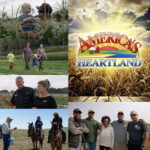
Farming Strategies for Adapting to Extreme Weather
SARE partnered with PBS KVIE to produce an episode of RFD-TV's America's Heartland that highlights how farmers and ranchers across the United States are using sustainable and regenerative practices to adapt to increasingly challenging and unpredictable weather conditions. Adapting to Flooding and Drought on Hurricane Flats Farm in South Royalton, Vermont Ashley Loehr and Antoine […]
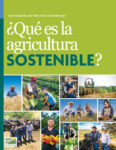
SARE's What is Sustainable Agriculture? Now Available in Spanish
SARE’s What is Sustainable Agriculture? bulletin and companion animated series are now available in Spanish! ¿Qué es la Agricultura Sostenible? features short, translated primers of proven sustainable practices that can be used to complement more detailed training materials. The companion animation series highlights some common practices farmers and ranchers use to improve profitability, quality of […]