Showing 111-120 of 123 results

From Fruit to Fuel

As tree fruit growers know well, annual harvests do not remove all the fruit from the orchard. A great deal is left behind littering the orchard floor. While pondering his fruit waste problem, Dan West of Macon, Mo., who grows apples, peaches, apricots, nectarines, plums and pears, hit upon a novel approach: Why not turn the waste into energy?

West already had been distilling the waste fruit into natural wine using a still he designed out of a beer keg. (West received a distilling permit from the Bureau of Alcohol, Tobacco, Firearms and Explosives.) Then, driven by an over-supply of waste fruit, coupled with his growing concern about the supply and cost of fossil fuel, West decided to produce ethanol from his fruit wine by heating it and removing the alcohol, at a rate of about 1.5 gallons per hour.

“Using waste was the main thing,” recalled West, who has been running an orchard on 10 acres since 1995, and received a SARE grant in 2003 to experiment with ethanol production. “I also thought it would be nice to be self-sufficient, using our ethanol to power our mower and tractor.”

West built a second still from a 500-gallon propane tank, in which he heats his fruit wine to just below boiling, gathers steam in a fractionating column, and distills the alcohol portion of that steam to 190 proof. This still should easily produce 4–5 gallons per hour, although he expects to speed up the distillation as he improves the second still.

“Even at $2-a-gallon fuel prices, my ethanol distillation process is well worth doing,” West said. Discounting the labor to gather and crush fruit — now his most time-consuming task — distillation costs only 65 cents per gallon in electricity costs. Those gallons of ethanol, however, now power his farm engines at a higher octane than gasoline and provide a cleaner burn.

“It’s exciting,” he said, reflecting on the first time he powered up his lawn tractor with homemade ethanol.

Others have been similarly fired up. At least 1,000 people per year visit West’s orchard, about 120 miles from Kansas City, in part to see his energy-saving invention.

West never stops thinking up innovative ways to get the most from his farm. Since gathering waste fruit is time consuming, he has focused his keen inventor’s mind on finding a better way. With a second SARE grant, West is designing a machine that gathers up waste fruit, then crushes it into pulp, some of which is spread back on the orchard floor as fertilizer, and some of which is squeezed into juice and then fermented into wine.

West also received another SARE grant to design a closed-loop energy production system using a solar concentrating method that reduces electricity needed to heat the still. The prototype has produced 170-proof ethanol. “When it worked after three or four tweaks, I was jumping up and down,” he recalled. “Winning the initial grant opened up many doors for me.”
Posted in 1

Testimonials from Past Fellows

Each year, four Extension agents are selected to participate in the SARE Sustainable Agriculture Fellows program. The following are reflections from a few Fellows on their experiences in the program.

Walt Bumgarner, Penn State Extension (2007 Fellow)

As part of the first class of SARE Fellows, I want to tell my fellow NACAA members that their participation in the SARE Fellows Program could possibly be the highlight of their career in Extension....To be offered the chance to travel the country and experience different aspects of sustainability is invaluable.

Ronnie Barentine, University of Georgia Cooperative Extension (2007 Fellow)

To gain further knowledge of sustainable agriculture systems, I had the highest honor to be chosen as a member of the 2008-2010 SARE and NACAA Fellows Program....The trainings were held in the states of Arizona, Georgia, South Carolina, New Jersey, Pennsylvania, Wisconsin, and Iowa. While visiting these states, I studied organic fruit and vegetable production, livestock production in arid lands, endangered species of desert lands, illegal entry of non U.S. citizens on ranch operations, grass fed all natural beef and organic beef production, dairy modernization, conservation tillage, farmers markets, and conservation of soil and riparian water resources.

Richard Brzozowski, University of Maine Cooperative Extension (2008 Fellow)

My Extension programming with farmers and growers has benefited greatly on account of my participation [in the SARE/NACAA Fellows Program]....I learned a great deal about sustainable agriculture and its components as I met farmers and Extension workers from different regions of the country. I have cultivated working relationships and friendships with many of these individuals. As a result of my experience, I have integrated many of these ideas and methods into my programming.

Stephen Komar, Rutgers New Jersey Cooperative Extension (2009 Fellow)

The SARE Fellowship provides a unique opportunity for agricultural educators, producers and others to interact with individuals that they may not normally deal with in their respective specialties....Since participating in this program, I have personally worked with some of the other fellowship awardees on grant projects, articles and other educational programs....I highly recommend that NACAA members, regardless of experience, participate in this program.

Mark Blevins, North Carolina Cooperative Extension (2009 Fellow)

My agricultural awareness and understanding has exploded during the SARE Fellows program! I come from a horticultural background and was searching for ways to gain a broader sense of agriculture with a focus on sustainability, but received so much more....This has been a remarkable experience for me as an agent in my first 5 years, but this program could benefit any agricultural educator at any point in their career.

Joran Viers, New Mexico State University Cooperative Extension (2009 Fellow)

When I applied in 2009 for the SARE Fellows program, I thought it would be fun and mildly educational. After all, I had a strong background in organic production, having spent six years running our state’s organic certification program....It has been fun, extremely fun, but much more than “mildly” educational. Through trips to various regions of the country, looking at all kinds of agriculture at all sizes, I have learned far more than I imagined I would....This program has been one of the best professional development opportunities I’ve had, by far.

Suzanne Mills-Wasniak, Ohio State University Extension (2010 Fellow)

My first year as a SARE Fellow has greatly changed the way I analyze a client’s operations. Working in a two-thirds urban / one-third rural county, often more emphasis in the rural areas is placed on economic viability while the urban areas focus on social responsibility. Now instead of zeroing in on what the client perceives as the problem, I look at the operation as three equal components, socially responsible, environmentally sustainable, and economically viable; all of which must be in equilibrium to be totally sustainable.

Lauren Hunter, University of Idaho Extension (2010 Fellow)

The SARE Fellows program has increased my knowledge on sustainable agricultural practices used across the US. The knowledge gained thus far has been incorporated and used in grower presentations as well as current research projects....The SARE Fellows program has also given me more national recognition as an Educator specialized in sustainable and organic farming. I also value the networking opportunities it has provided with other Extension Educators from across the US.

Posted in 1

Researchers and Educators Collaborate to Teach Youth about Cover Crops

Across the region, farmers are planting cover crops, a method of revitalizing soil, curbing erosion, and managing pests. Steve Sutera, an Extension educator at South Dakota State University (SDSU), saw an opportunity to bring together Bon Homme County’s Extension service, FFA Chapter, 4-H Club, and ongoing research at SDSU.

In 2008, Sutera submitted a proposal and was awarded a $2,000 grant from the NCR-SARE Youth Educator Grant Program to educate students about cover crops, both in the field and in the classroom.

“The Dean of Agriculture and Biological Sciences at SDSU encourages Extension Educators to get youth involved in our research projects,” explained Sutera. “I felt this was an excellent opportunity to involve, educate, and empower local youth to assist with this sustainable agriculture project. It provided an opportunity for youth to take on leadership and responsibility roles. Also, the work they accomplished could be reported in their FFA or 4-H project work.”

Gary Kriz, a local farmer who was producing winter wheat, helped Sutera and area youth prepare 1½ acres for their test plots. Starting in July, with assistance from a technician from the SDSU Plant Science Department, Sutera and a dozen students staked out the plots, planted 10 different crops with 12 repetitions throughout, and put up signs and markers. Crops included oats, barley, triticale, cowpeas, soybeans, turnips, radishes and millets. The students labeled the harvest bags and did all the harvesting. Over the course of three fall harvests, they submitted close to 40 samples to SDSU to be weighed, dried, and analyzed for feed quality. In addition to the hands-on field work, Sutera provided 2½ hours of classroom instruction for 24 Bon Homme High School students. Several of the students who had assisted with the plot shared information and observations.

“The teamwork and cooperation from the FFA students and 4-H members was outstanding,” said Sutera. “Doing a hands-on project such as the research plot was really a great way for them to connect and understand the whole concept of how cover crops can help us sustain and improve our environment and our land as a resource.”

Sutera sent the samples to SDSU to be evaluated for feed quality based on total dry matter production, crude protein content, acid detergent fiber content, and neutral detergent fiber content. The data from the samples gathered by these students will contribute to an ongoing, multi-state, USDA Special Grant project called “Five States Ruminant Consortium.” This ongoing $563,000 special grant is supporting research and Extension faculty and stakeholder cooperators who are examining opportunities within the ruminant livestock industry for economic development in western South Dakota, southwestern North Dakota, southeastern Montana, eastern Wyoming, and northwestern Nebraska.

“The incorporation of cover crops into our farming practices is a concept that will take time to implement,” said Sutera. “The information and data from this research Researchers and Educators Collaborate to Teach Youth about Cover Crops project will be used to help producers make good decisions when they select the cover crops and mixes that will benefit them, primarily for grazing alternatives. By providing our youth with a positive educational hands-on experience, they can now assist us in promoting cover crops as a part of the sustainable agriculture efforts in our area.”

Posted in 1

Researchers Study Forage Chicory for Parasite Reduction in Sheep

Sheep and goat production is a growing enterprise for small and limited resource farmers in the North Central region. While small ruminants (sheep and goats) are adaptable to many different production systems and can be raised with relatively few inputs, they present production challenges. For instance, control of internal parasites, especially gasrointestinal nematodes including Haemonchus contortus (barberpole worm, stomach worm), is a primary concern for many sheep and goat producers and is particularly challenging in humid regions. In Ohio, researchers are examining the use of forage chicory as part of a gastrointestinal nematode parasites control strategy for sheep.

“Sheep farms that utilize managed grazing are both economically profitable and environmentally sustainable,” said Bill Shulaw, professor and Extension Veterinarian and at the College of Veterinary Medicine at Ohio State University. “In our region, perhaps the greatest threat to this production system is gastrointestinal parasites, especially the blood feeding Haemonchus contortus. Loss of productivity associated with parasite infections is usually more costly to the farmer than animal deaths, although mortality attributed to parasite infection can be significant too.”

In 2008, Shulaw, together with Ohio State Extension Educators Rory Lewandowski and Jeff McCutcheon, applied for a NCR-SARE Research and Education grant, and was awarded $137,150 to measure animal performance and the potential of plant secondary metabolites found in forage chicory to reduce the impact of parasite infections in sheep.

“Research reports describing plants with possible activity against internal parasites in sheep and goats have been appearing for several years,” said Shulaw. “Here in the U.S., much of the work has focused on Sericea lespedeza and the role of condensed tannins (CT). However, this plant is not particularly desirable in our region, and other reports, mostly from outside the U.S., have suggested that forage chicory might also be useful.”

As the team began investigating forage chicory as a parasite control strategy, they learned that Dr. Joyce Foster and her colleagues at the USDA’s Agricultural Research Service Appalachian Farming Systems Research Center had conducted research with several varieties of forage chicory studying its nutritional value and palatability for small ruminants. They contacted Foster, and together the team of four had collective expertise in sheep management, management intensive grazing techniques and forage production, internal parasite biology and control, and in forage chicory, including the biochemistry that might be involved. The team worked with farmers John Anderson, of Shreve, OH, Curt Cline of Albany, OH, and Bruce Rickard of Fredericktown, OH.

The two-year, on-farm, research project sought to determine the usefulness of a non-traditional forage, forage chicory (Cichorium intybus L.), in controlling gastrointestinal nematode parasites (GIN) in grazing sheep. A comparison forage, brown mid-rib (BMR) forage sorghum (Sorghum bicolor (L.) Moench.) x sudangrass (Sorghum sudanense Piper) hybrid was used to provide a comparable forage to provide a low, or no, parasite challenge. SARE’s Agricultural Innovations fact sheet, Sustainable Control of Internal Parasites in Small Ruminant Production, provides basic information on each parasite approach and cites resources for training and further information. It’s available online at sare.org/SmallRuminant

“Chicory contains sesquiterpene lactone (SL) and small amounts of condensed tannins, and it has been shown to have negative effects on the survival of adult and larval stages of internal parasites of sheep and farmed deer in research conducted in other countries,” said Shulaw. “Published research suggests that the SL concentration is likely the principal factor affecting parasite numbers although this is still incompletely studied.”

Statistical analysis of the data collected over the two-year period revealed that during the respective grazing periods, lambs grazing the BMR gained slightly more weight than the lambs grazing the chicory, but the fecal egg count (FEC) of the lambs grazing the chicory increased less than those grazing the BMR. Shulaw believes that this suggests that the antiparasitic effect of chicory was attributable to a direct effect on GIN. Given the slightly superior weight gain in the BMR lamb groups, Shulaw thinks there was an antiparasitic effect on the GIN in the lambs grazing chicory, at least with regard to their egg output, and that this was likely due to a direct effect of chicory on the worms (as opposed to merely an effect of improved nutrition for chicory, as has been suggested in other studies).

The team disseminated project results to farmers, students, veterinarians and researchers using face-to-face workshops, web programming, field days, presentations at forage and grazing conferences and publication in professional journals.

“Our project examined just one piece of a very large problem in the sheep and goat industries,” said Shulaw. “Going into it, I don’t think any of us, farmers included, believed that forage chicory would be the ‘silver bullet’ that solved the parasite control problem. But we all learned a great deal about various forages, grazing techniques, and the complexities of internal parasite control. I believe that it is this continual questioning and learning process, coupled with applying what we learn, that contributes to sustainability in agriculture.”

Bill Shulaw’s research team created a multi-page fact sheet that describes basic parasite biology for gastrointestinal worms acquired by sheep and goats on pastures, and provides several strategies for managing internal parasitism. It’s available online.

Posted in 1

Grant Puts (Good) Crimp in Farm Operations

It all began in 2002 with a $6,500 SARE grant and the seed of an idea. Today, that idea has grown into hundreds of research projects around the country, an international business and a new, effective no-till tool that farmers are adding to the ways they suppress weeds in cash-crop fields.

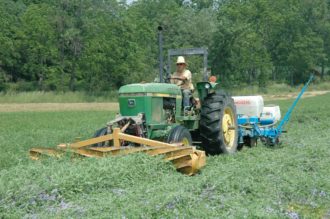
The tool is the roller crimper, a drum with blades mounted to the front- or back-end of a tractor and used to roll down, crimp and kill cover crops, creating thick, weed suppressing mulch. Until the crimper, farmers were largely left with two weed-control options: cultivate the weeds into submission or spray herbicides. The former disturbs the soil and allows for erosion; the latter is often expensive for conventional farming, and unusable for organic.

“I had the idea for the tool,” says Jeff Moyer, director of farm operations at the Rodale Institute in Kutztown, Penn. “But without SARE’s help, it might not have happened. That first grant started a whole tidal wave of looking at cover crops differently and it allowed us to build the very first roller crimper.”

A picture of a tracker in a field

Today, the roller crimper is a common sight on land-grant university research plots, according to Moyer, who leveraged that first SARE grant into a larger USDA grant to further refine the tool. One Pennsylvania company, I&J Manufacturing, saw opportunity in the burgeoning technology and now has a thriving business building and shipping roller crimpers domestically and overseas.

Farmers across the country are starting to add the tool to their arsenal of weed control options. Kentucky farmer Joel Armistead, who is collaborating on an EPA-funded project with the nonprofit Cumberland River Compact to explore ways to reduce chemical inputs, says while he ran into problems with the weather, he was able to reduce his spraying considerably by first using the crimper and then spraying just enough to take down the rest of the cover crop.

SARE is continuing to fund other crimper research around the country to explore how the tool works in different climates, geography, and with different cash and cover crops. The crimper, while not a fix-all, has shown promise in using about 40 percent less energy than cultivating or spraying; reducing erosion; retaining moisture; and allowing for more flexibility, since roll downs do not need to be timed to dry conditions.

Tim Bock, who runs a 100-acre certified organic farm outside Kutztown, has tried the roller on more than 20 acres for another SARE-funded project. After two years of success, he plans to completely switch his soybean production to rolled rye. “The results have been outstanding,” Bock says. “I’ve really reduced my weed pressure and drastically reduced the number of trips across the field. I eliminated a complete tillage cycle.”

Moyer cautions that roller crimpers are not for farming 101. A farmer must be quite experienced with the nuances of their fields and work on rotations that match cover crops to the cash crop. “One must grow the cover crop with the same attention paid to the cash crop.”

Want more information? Visit SARE's database of projects and search for the term "roller crimper."

Posted in 1

Cutting Edge Research: Helping Bees Help Themselves

Diseases, pests and the mysterious phenomenon of colony collapse disorder pose a dire threat to the U.S. beekeeping industry and, in turn, to the $20-billion-a-year crop industry that relies on insect pollination. Because of these increasing pressures, the ranks of managed bee colonies have plummeted in recent years: On average, beekeepers are losing 30 percent of their colonies every growing season.

While the exact cause of colony collapse disorder is unknown, researchers believe it to be the result of a combination of factors, one of which is the Varroa destructor (V. destructor) mite, a pest introduced to the country in the late 1980s. V. destructor, difficult to control because it has become pesticide resistant, attacks bees by sucking their blood, thus spreading viruses among colonies and weakening individual bees, making them susceptible to pesticides not intended to harm them.

Rather than relying on pesticides and antibiotics to control V. destructor and related diseases—a method that has become part of the problem—University of Minnesota Entomologist Marla Spivak is advancing effective strategies that help bees help themselves.

Spivak and her team have received six SARE grants since 1997 to support their work showing beekeepers how to identify and breed for hygienic bees—bees that are adept at spotting infected immature bees (larvae and pupae) and quickly removing them from the nest before a disease or pest can get out of control in a colony. “We mostly research ways for bees to keep themselves healthy, using their own natural defenses so we can avoid chemical inputs,” Spivak says.

Their research—now supported by a $500,000 MacArthur Foundation “genius” grant—has demonstrated that colonies bred for hygienic behavior have good resistance to chalkbrood and American foulbrood diseases, and partial resistance to V. destructor. Over time, the establishment of disease-resistant bees has the potential to save commercial-scale beekeepers thousands of dollars each year in treatment costs while reducing the environmental impact of pesticide use.

Spivak’s SARE-funded research also includes innovative sampling strategies for beekeepers to determine the extent of an infection in a colony, and therefore how much of a treatment might be needed.

After helping three commercial-scale beekeepers in Minnesota establish hygienic disease resistance in their colonies, Spivak and her team are now working closely with some of the country’s largest bee breeders to adopt the sustainable pest management strategies that make sense for them, including breeding and sampling strategies. Many of the breeders with whom they are collaborating sell queen bees throughout the country, giving Spivak’s team the opportunity to have widespread impact.

“We need genetically diverse bees,” Spivak says. “That is the impetus for me to work with bee breeders to help them select for hygienic behavior from among their genetically diverse, and tried-and-true lines of commercial bees.”

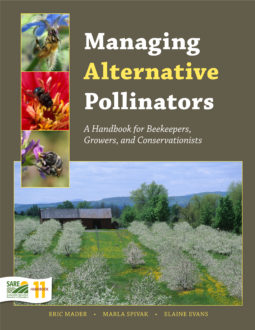
While much of Spivak’s research focuses on the European-imported honey bee—the primary victim of colony collapse disorder—she and her colleagues have also turned their attention to the wide range of native bee species that are also embattled, yet serve an important role in crop pollination. In 2010, Spivak co-authored and SARE published Managing Alternative Pollinators, a first-of-its-kind technical guide for rearing and managing key alternative species.

Posted in 1

Dryland Cover Cropping Boosts Yields

Every drop of water counts for farmers who practice dryland cultivation, a practice that relies on rainfall without the benefit of irrigation. So, when it comes to incorporating cover crops into a dryland rotation, many farmers hesitate, wondering: “How much moisture is the cover crop going to demand, and will I pay for it later in lost cash-crop yields?”

This is the “first question and major concern any dryland farmer has about cover crops,” says Bladen, Neb., farmer Keith Berns. But thanks to SARE-funded research he and his brother conducted on their 2,000-acre farm—about two-thirds of it dryland—they now have an answer to share with their peers.

Keith and Brian Berns found that, in fact, cover crops can significantly boost corn yields in a non-irrigated setting. In one trial, they planted corn after a cover crop mix of grasses, legumes and brassicas, and saw a corn yield that was about 10 percent better than planting straight into wheat stubble.

“The results of this project have made us firm believers in cover crops,” says Keith Berns, who raises corn, soybeans and wheat, and has been practicing full continuous no-till for 12 years.

In their trials, conducted in 2008 and 2009, the Bernses tested cover-crop monocultures as well as mixes—including sunflowers, soybeans and oilseed radish—but found that mixes were the best performers, in part because they were the most frugal with water. Although a wet season skewed some of their moisture data collection, they found that the cover-crop mixes used far less water than the cover-crop monocultures, and were on par with water use in wheat stubble alone.

They acknowledge that they are not done exploring cover crops. “We will continue to experiment with different mixes, seeding rates and plant species,” says Keith. “We also hope to continue to monitor water usage of cover crops, and also measure yield in the crop following our cover crops.”

Additionally, they are experimenting with putting livestock on cover crops—looking at grazing intensities, regrowth periods and nutritional quality.

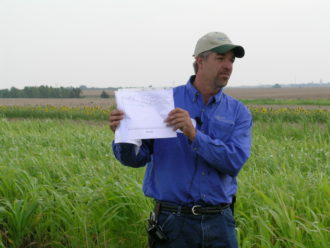
Brian Berns holding a data chart during a field day.

In the meantime, the brothers are busy spreading the word about their findings and helping others adopt cover crops. During the course of their SARE research, they hosted two on-farm field days and spoke at nearly 25 public events, to a total of about 1,500 people. They also host an annual one-day cover-crop school in Bladen.

The SARE grant has yielded even more benefits: The Berns brothers have launched a new cover-crop seed business, and now maintain a website—www.greencoverseed.com—that contains practical information on their research. A highlight is their SmartMix Calculator, an online spreadsheet that calculates seed quantities and cost, carbon-to-nitrogen ratio (C:N), nitrogen-fixation potential and other factors for mixes of nearly 40 cover-crop species, including legumes, brassicas, grasses and broadleaf crops.

Posted in 1

The Lucrative Sweet Potato Takes Root

Small-scale tobacco farmers in eastern Kentucky who are looking for alternatives due to changes in the tobacco market are discovering that a relatively easy, often profitable transition lies in sweet potatoes. With relatively low input and capital costs and a short learning curve, they are able to earn gross returns of up to $7,000 per acre, mostly through local sales.

“Sweet potatoes are a pretty good alternative, at least for our growers, because a lot of the equipment they used for tobacco can be used for sweet potatoes, particularly the transplanters. So they don’t have to buy a lot of new equipment,” says University of Kentucky Extension Vegetable Specialist Tim Coolong. “Economically, it’s been very good for them.”

Coolong received a 2009 SARE grant to research and demonstrate sweet potato growing on several farms and has helped about 15 farmers—most, but not all former tobacco producers—grow the highly nutritious vegetable.

Meanwhile, in Mississippi—the country’s third largest producer of sweet potatoes—SARE-funded research helps the state’s growers adopt sustainable practices and cash in on organic sales by showing them how they can better manage their soil with cover crops and conservation tillage.

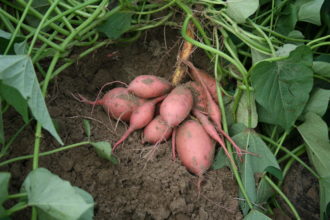
Harvested sweet potatoes on the ground

Only one grower in Mississippi currently produces organic sweet potatoes, yet organic can fetch a premium at fresh markets and through sales to processors, particularly for baby food, says Mississippi State University researcher Ramon Arancibia. “Companies like Gerber don’t want pesticides, or even a lot of fertilizers.”

Working with three farmers around Vardaman, Miss., and others in Arkansas, Arancibia’s trials found that an organically grown crop suffered far less pest damage than a conventionally grown one. In addition, he focused on showing the soil building qualities of cover crops. “Sweet potatoes are root vegetables, so they need a very healthy soil. Also, the soil structure needs to be very good so the potatoes can grow in a nice shape,” Arancibia says, referring to cover crops’ ability to improve organic matter and loosen hard-packed soils.

To help get the word out, Arancibia is sharing his findings with the 104-member Mississippi Sweet Potato Council, which represents nearly all the state’s growers. One farmer who collaborated with Arancibia is planning to plant a brassica cover crop on 50 acres next season, to see if it will combat nematodes.

Back in Kentucky, Coolong’s on-farm trials showed that aside from using pesticides to control wireworm damage, sweet potatoes require few inputs—and some growers are, in fact, pesticide free. Sweet potatoes have low nitrogen needs, and, in eastern Kentucky, do not require irrigation except in the case of extreme drought.

“There are a lot of nuances with sweet-potato production that this grant really allowed us to look at,” says Coolong, whose work translated into a detailed handbook and the formation of a regional grower’s association.

Two areas that require more work, he says, are establishing overwinter storage facilities and production of slips—the sprouts that come off a potato and turn into new plants. Slips are not grown locally and are expensive to buy from out of state, so showing local growers how to produce their own represents another opportunity.

Download Sweetpotato Production for Kentucky, a 16-page comprehensive guide on all aspects of growing and marketing sweet potatoes.

Posted in 1

Low-Till Forage Production

To fill their need for year-round, inexpensive forages, California dairy producers typically plant and harvest a series of forage crops: small grains, corn for silage, milo and sorghum sudan.

While this requires considerable tillage and seed-bed preparation ahead of each successive crop, the production systems lend themselves to conservation tillage approaches developed in other regions. Adopting these approaches could:

  • Reduce the time between the harvest of one crop and the planting of the next
  • Lower costs
  • Lessen dust by as much as two-thirds

To address these issues, Jeff Mitchell of the University of California Kearny Agricultural Center, was awarded a Western SARE Professional + Producer Grant for $9,400 to evaluate and refine strip-till and no-till planting systems for corn forage production and no-till drill winter forage planting at the San Joaquin Valley in terms of crop establishment, weed control and profitability (Conservation Tillage Forage Production in California‘s San Joaquin Valley, FW06-308).

The work, conducted on the Larry and Daniel Soares dairy in Hanford, also sought to determine whether conservation tillage practices could enhance the quality of life of dairy producers as measured by profitability and the easing of time and labor requirements.

The project team evaluated strip-till silage corn production following wheat for-age at the 600-cow dairy. In 2006, the trials evaluated conventional, no-till and strip-till in replicated strips, each 10 acres, in an 80-acre field. After the 2005–06 winter wheat forage crop was chopped in April 2006, a 6-row 30-inch Case DMI Ecolo-Till strip-tiller was used to subsoil to 12 inches and clear soil for planting. The traditional tillage strips were disked and listed before planting.

In 2007, because of irrigation pump challenges, the demonstration was moved to two fields, where an 8-row 30-inch Schlagel strip-tiller was used for the strip-till comparison.

The results for 2006 were compromised by irrigation challenges, but in the 2007 demonstration, corn plant populations were higher in the strip-tilled fields, and weed populations and yields were roughly equal in both fields.

On the whole, said Mitchell, the results were positive and encouraging.

Indeed, since the project started in 2005, interest in conservation tillage has increased markedly in the San Joaquin Valley. Growers have learned that strip-tillage involves less intercrop tillage than normally employed following winter wheat chopping in preparation for spring corn silage planting.

By converting to strip-tillage, a typical dairy producer could eliminate four to five tractor passes. With high fuel costs, fewer passes across the field are better not only for the field but also for the dairy producer.

It has also been shown that strip-tillage and no-tillage for forage production can reduce particulate matter emissions by 50-90% compared with traditional tillage.

“We estimate a reduction in costs of $50 an acre by using strip-tillage instead of traditional tillage,” said Mitchell. “However, it is important to understand that strip-tillage may not work in all soil types; heavier soils may be more difficult than coarser soils.”

Mitchell offers these thoughts for producers considering strip-tillage:

  • When strip-tilling, having some moisture in the soil precludes bringing up large clods
  • Timely weed management is needed – time herbicide applications close to planting (within a week)
  • Using the same GPS system for both the strip-tilling and planting operations will keep the planter on the strip-tilled area

Improved strip-tilling could enable triple-cropping—the sequential growing of three crops in a year—which could help San Joaquin dairy producers manage manure nitrogen with minimal risk of losses. Mitchell is currently assessing this in a Western SARE Research and Education Grant, Triple-Cropping Dairy Forage Production Systems through Conservation Tillage in California‘s San Joaquin Valley (SW08-060).

Posted in 1