Showing 11-20 of 87 results

New from SARE: Farmer-to-Farmer Manuals on Specialty Crop Production, Harvest and Storage in the Northeast

Farmers know that producing and marketing high-quality crops requires careful attention to detail, from planting through storage. Now available from SARE, the Northeast Crop Production Manual  and Northeast Harvest Manual are user-friendly guides offering step-by-step information on growing, harvesting and handling dozens of specialty crops, from arugula to watermelons. Developed by farmers themselves, these guides are ideal reference materials for beginning farmers, apprentices and crews based on years of on-the-ground experience. 

The Northeast Crop Production Manual covers soil preparation, planting and transplanting, pest management, and more. The Northeast Harvest Manual addresses harvest timing, best practices for picking, and post-harvest handling and storage guidelines.

These guides were originally written by New York farmer Jean-Paul Courtens to provide instructions to his own crews and apprentices on how to grow and handle crops on his farm. Seeing the popularity of the manuals with his peers, he used a Northeast SARE grant in 2020 to refine and broaden the information in them by incorporating insights from 60 other growers in the Northeast and Midwest, plus vegetable specialists from Cornell Cooperative Extension. (Learn more about the history of the guides in the letter from the author.)

To increase access to these valuable farmer-to-farmer resources, SARE is now pleased to make them available in both online and PDF formats on our website. Download or browse both the Northeast Crop Production Manual and Northeast Harvest Manual at https://www.sare.org/resources/northeast-crop-production-harvest-manual/.

Posted in 1

New SARE Video: Use Data to Drive Decision Making

For Handy Kennedy of HKJ Ranch in Cobbtown, Ga., sound data management was key to generational succession on his 200-head cattle operation. After taking over his family’s pasture-based operation after his father’s death, Kennedy set out to modernize their business by using data to make decisions about the efficiency and profitability of new technologies.

At first, bringing new ideas into a legacy family operation wasn’t easy. But Kennedy began small—testing pasture nutrient management strategies on limited acreage to better understand their impact on input costs.

He advises beginning farmers to experiment with new technologies and examine the resulting data to make informed business decisions. “Data-driven decisions will give you the competitive edge,” says Kennedy.

That gradual, practical approach has paid off on his own farm. Over time, his family has adopted many new tools and methods, enabling the ranch to operate more sustainably and efficiently. He also urges new farmers to be ready to adapt. “Yesterday’s best is today’s average,” he says. “We have to continue to get better.” 

This video is one in a series produced by SARE titled Practical Tips for Beginning Farmers. Based on their own experiences when starting out, farmers from across the country share advice about common challenges facing beginning farmers in today's agriculture. To view the entire series, visit www.sare.org/resources/practical-tips-for-beginning-farmers/.

For information on grants and resources available from SARE, visit www.sare.org.

Posted in 1

New Video: Create a Business Plan and Grow Intentionally 

Running a farm isn’t just about getting through the day—it’s about building a business model that can adapt and thrive for decades. At Flat Rock Dairy in Paulding, Ohio, Gretl Schlatter has seen her operation grow from 80 cows to 350. But she’s quick to point out that growth alone isn’t the goal. She emphasizes the importance of calculated growth and smart technology adoption to provide her operation with the resilience it needs to remain competitive as the industry evolves.

Each phase of farming brings unique challenges that require flexibility and a long-term perspective. “I don’t know that it was harder during the early years than it is today,” says Schlatter. In the beginning, farmers learn to adapt to the disappointment of interrupted plans due to unexpected market shifts—and those skills remain essential as the farm grows.

When deciding whether to scale up, or how, by making appropriate investments in labor, technology or facilities, Schlatter encourages farmers to ask hard questions about sustainability, relevance, and the expected return on chosen investment. Through training offered by Ohio State University Extension, she’s found valuable opportunities that helped her and others make decisions that strengthen their operations and weather tough seasons.

With thoughtful planning, responsible financial management, and a willingness to grow with intention, farmers can position their businesses to succeed for years to come.

This video is one in a series produced by SARE titled Practical Tips for Beginning Farmers. Based on their own experiences when starting out, farmers from across the country share advice about common challenges facing beginning farmers in today's agriculture. To view the entire series, visit www.sare.org/resources/practical-tips-for-beginning-farmers/.

For information on grants and resources available from SARE, visit www.sare.org.

Posted in 1

Advancing Walnut Syrup Production for Increased Profitability and Farm Income Diversification

In West Virginia, pioneering research into black walnut syrup production is creating new opportunities for landowners, strengthening community networks, and expanding the syrup industry by exploring new value-added agricultural products for forested rural economies.

Researchers at Future Generations University (FGU), led by Michael Rechlin and Sarah Collins-Simmons, collaborated with landowners and technical partners to develop innovations that improve the efficiency and feasibility of walnut syrup production. With support from a Northeast SARE Partnership Grant, the team refined walnut sap collection methods, enhanced sap flow using vacuum lines, and designed specialized tapping spouts to reduce tree impact. They also developed a small-scale sap evaporator to minimize barriers for new producers.

The project successfully increased the potential for environmental, economic, and social sustainability impacts in West Virginia’s agriculture, as well as production efficiency. The advancements from this research team encouraged landowners to explore black walnut syrup as a profitable non-timber product, opening opportunities for boosting rural incomes and providing an alternative to traditional crops.

"Walnut syrup is truly a novel product commercially," said Collins-Simmons. "We feel that we were part of the initial wave of taking it to the next step, making a commercially viable product and assessing market value…with the partner producers we worked with."

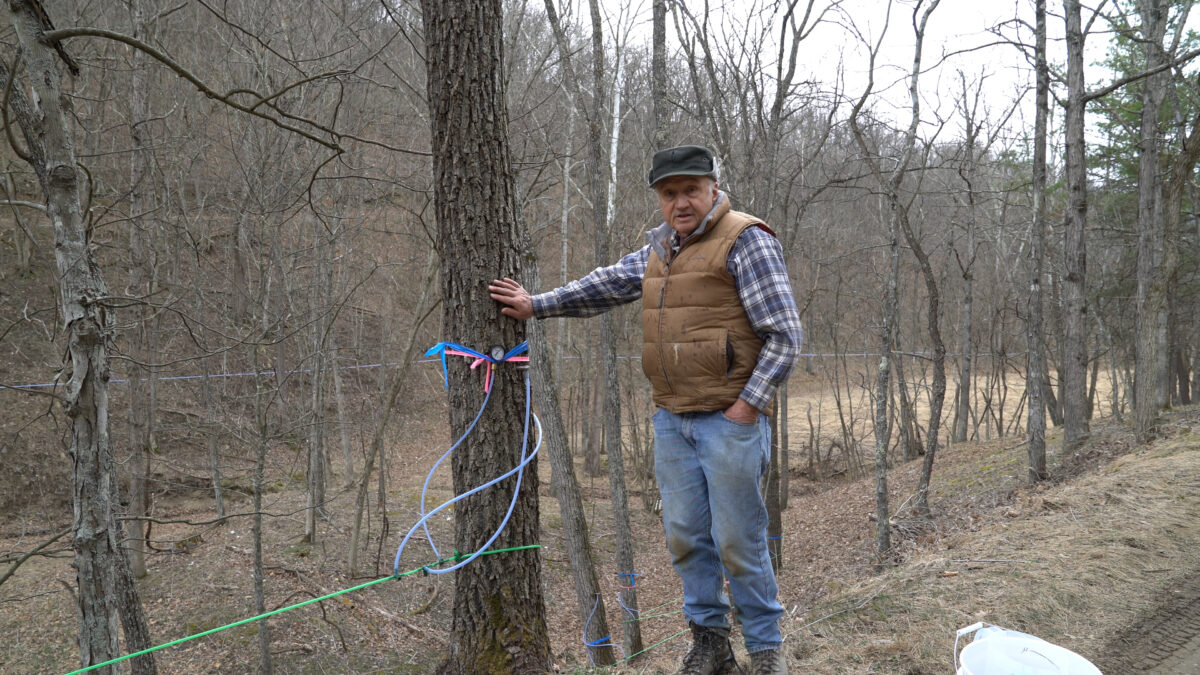
A man standing in front of a tree holding the tree thunk that has different color wires attached to it
Mike Rechlin (FGU maple research professor) showing a tapped walnut tree with a pressure gauge on one tap as part of field testing. Credit: Thomas Vandevander,

FGU’s outreach efforts extended to connecting producers with state resources, offering technical consultations, and supporting agrotourism initiatives. These efforts helped strengthen a resilient network of producers who now serve as ambassadors for this emerging market.

Visit https://www.sare.org/sare-impacts-ONE19-347 for more information on this project's impact.

Advancing Walnut Syrup Production for Increased Profitability and Farm Income Diversification is part of a series produced by Insight for Action as part of a post-project evaluation of SARE's regional grant programs. For more information visit https://www.sare.org/sare-impacts.

For information on grants and resources available from SARE, visit www.sare.org.

Posted in 1

New Video: Find Success Through Mentorship

After his father’s death, Warren Miller returned to the Palouse region of Washington state to assume the role of fifth generation steward of the family’s 1,200 acre wheat, barley and canola farm. Although he’d grown up helping out on the farm, his father had always handled operations like spraying, seeding and fertilizing. “My biggest challenge was I didn’t really have a mentor or someone I could go to and hit with questions,” Miller says.

But instead of giving up, he turned to his neighbors. A retired farmer up the road offered tips on timing and tillage practices to conserve moisture. Others encouraged him to try new approaches and crops, offering support when things didn’t go as planned. “Don’t be afraid to try that stuff,” Miller advises, “but if you are going to try it, definitely try to have resources in that area.”

Miller also encourages families to prioritize estate planning to ease generational transitions. Sitting down and making a plan can help clarify the intentions of all of the individuals involved in the operation. “You kind of have to re-buy the farm from your family,” he explains, noting that an intentional process helps finance retirement for one generation while preparing the next one to take over.

This video is one in a series produced by SARE titled Practical Tips for Beginning Farmers. Based on their own experiences when starting out, farmers from across the country share advice about common challenges facing beginning farmers in today's agriculture. To view the entire series, visit www.sare.org/resources/practical-tips-for-beginning-farmers/.

For information on grants and resources available from SARE, visit www.sare.org.

Posted in 1

Food Loss & Waste Program Event Planner/Workshop Coordinator Call for Applications

Sustainable Agriculture Research and Education (SARE) Food Loss & Waste Program
Event Planner/Workshop Coordinator Call for Applications
Application Deadline: September 1, 2025, 5 p.m. EST
Contract Funding Amount: $56,818
Project Timeline: October 1, 2025 – September 30, 2026
Call for Applications Link: SARE Grant Management System
For more information, contact: Lisa Johnson at ljohnson@sare.org

Application Timeline:

  • August 2025: Call for Applications Released
  • September 1, 2025 at 5 p.m. EST: Applications Due
  • September 2025: Applications Reviewed
  • October 1, 2025: Position Start Date

Introduction
The United States Department of Agriculture recognizes the impacts of food loss and food waste on food security and the environment. In response, USDA, in concert with agency partners, is working toward the goal of reducing food loss and food waste by 50 percent by 2030.

In the latest effort in reduction activities, Sustainable Agriculture Research and Education (SARE) has initiated a Food Loss and Waste Program, supporting projects that align with USDA activities aimed at reducing food loss and reducing food waste. The Southern region SARE program, based at the University of Georgia, serves as host institution for the Food Loss and Waste Program. SARE is a USDA grant-making program focusing on sustainable agriculture principles.

In addition to supporting Food Loss and Waste prevention and reduction projects through grant funding, USDA-NIFA has provided additional funding to convene state, city, county, and tribal stakeholders, along with non-profit partners, to identify local efforts needed and ongoing to further prevent food loss and waste. Recent research has identified the fact that many food loss and waste efforts fall into the recycling category, such as composting, rather than the prevention and reuse categories which can provide benefits beyond recycling. Immediate progress is necessary in order to reach national goals.

One-day Food Loss and Waste workshops in 10 U.S. states aim to connect local stakeholders, identify achievable goals, and leverage available staff and resources to spark immediate action. Virtual meetings including several states will follow in-person workshops.

In order to successfully hold 10 workshops around the U.S., Southern SARE is seeking one (1) Event Planner/Workshop Coordinator to assist in the planning, coordination, and execution of the workshops.

Scope of Work
The following include responsibilities of the Event Planner/Workshop Coordinator.

Collaborate with National SARE Food Loss and Waste (FLW) Program Manager to:

  1. Develop background information and list of invitees for each of ten states;
  2. Plan agenda, activities, and logistics for each workshop;
  3. Engage stakeholders to commit to attendance at workshops;
  4. Lead workshop activities including (but not limited to) leading sessions and activities, notetaking, sending invitations and registering attendees, reserving venues, ordering workshop meals and supplies, and set-up and take-down;
  5. Coordinate and execute virtual meetings that include stakeholders from several states;
  6. Summarize activities, outcomes, and findings in a comprehensive final report.

Who Can Apply
The Event Planner/Workshop Coordinator is a national seat open to qualified applicants in the contiguous U.S.; Alaska; Hawaii; the U.S. territories of Puerto Rico, U.S. Virgin Islands, Guam, American Samoa, Micronesia, and Northern Mariana Islands; and sovereign nations Republic of Palau and Marshall Islands. Individuals meeting qualifications are invited to apply.

The Event Planner/Workshop Coordinator will be funded through a one-time, cost reimbursement subaward agreement between University of Georgia and the individual to fulfill the listed responsibilities. The successful candidate will report to the National SARE FLW Program Manager as needed throughout the term of the contract.

Applicants should:

  • Have a strong understanding and familiarity with USDA and SARE programs;
  • Have previous experience and deep understanding of food loss and waste programs and policies across the spectrum of food systems (agriculture, businesses, consumers, schools);
  • Be skilled in program development, including, but not limited to, planning, leadership development, grantmaking, business management, evaluation and
    communications;
  • Have a proven track record of ability to work with diverse stakeholders;
  • Demonstrate strong governance and exhibit good research and critical thinking skills.

Application deadline is September 1, 2025, 5 p.m. EST. For more information on how to apply and review criteria, visit Event Planner/Workshop Coordinator Call for Applications at https://www.sare.org/wp-content/uploads/SARE-Call-for-Applications-FLW-Event-Planner.pdf.

Released by SARE Outreach on behalf of the Southern Region of the Sustainable Agriculture Research and Education (SARE) program. Funded by the USDA National Institute of Food and Agriculture (NIFA), Southern SARE operates under cooperative agreements with the University of Georgia, Fort Valley State University, and the Kerr Center for Sustainable Agriculture to offer competitive grants to advance sustainable agriculture in America’ Southern region. USDA is an equal opportunity employer and service provider.
Posted in 1

Can Cover Crops Improve Wine Grape Production Resilience?

Establishing a vineyard requires significant upfront costs, decades of careful management, and significant risk for the grower. Now, new SARE-funded research is helping growers learn how cover crops may stabilize production systems under varying weather conditions while having a limited impact on yields.

Suzanne Fleishman received a Northeast SARE graduate student grant–while studying at the time at Penn State University–to explore how root interaction between grapevines and cover crops impacts grapevines’ response to variable soil moisture availability. With support from advisor Michela Centinari, Fleishman examined the responses of vines on medium- or low-vigor rootstocks to competition from a fescue cover crop planted under the vines. The study revealed that young vine roots grow deeper in relationship to the grass to avoid competition, resulting in an increase in water filtration and soil carbon.

“Increasing species diversity in agriculture can lead to broad-scale environmental improvements, particularly around soil quality,” says Fleishman. “In vineyards, the cover crop grows alongside the grapevines, which means they compete for space, water, and nutrients. Our work was looking at how to better understand exactly how the grass species and grapevines interact belowground, with the goal that growers can still maintain productivity but also get all the environmental benefits.”

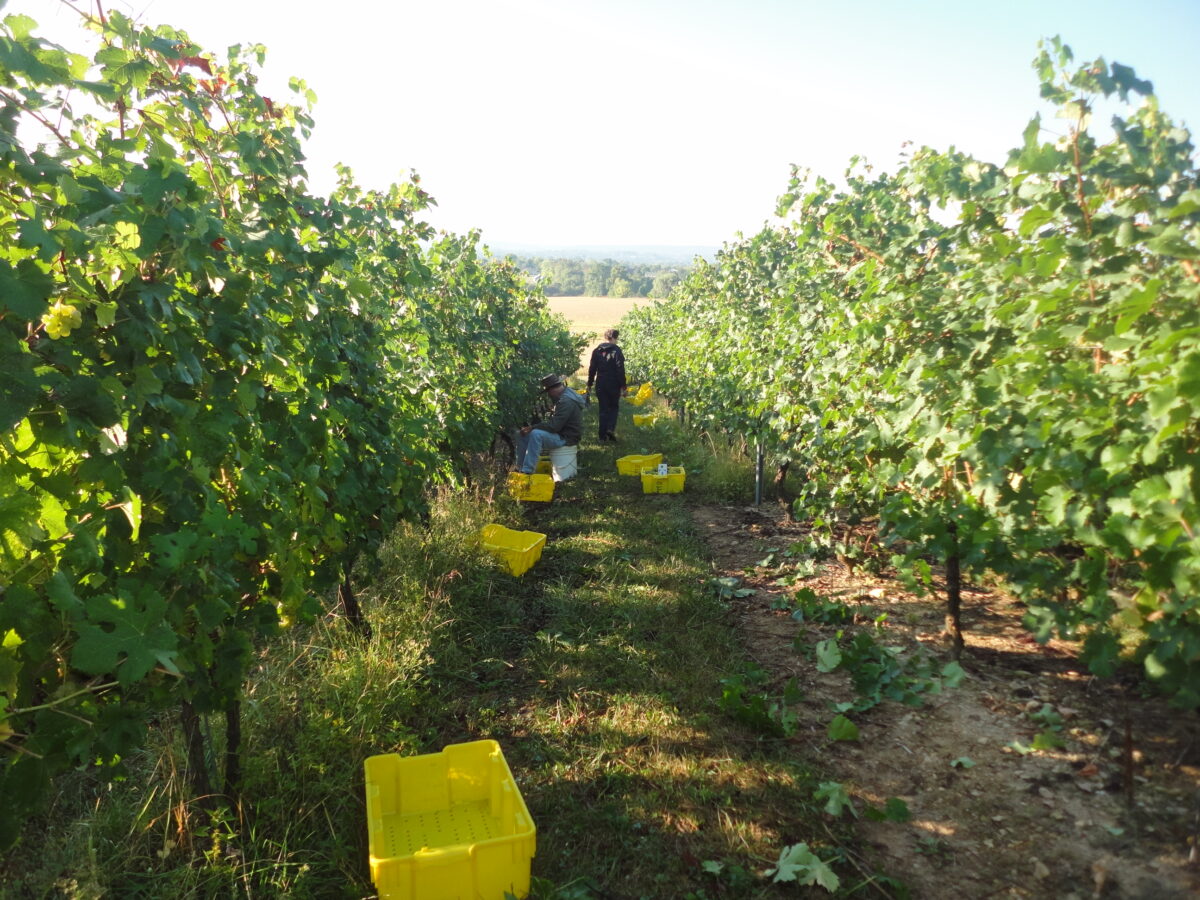
Two people in the field between crop rows
Harvesting grapes growing with under-vine grass (left) and on bare soil (right). Credit: Michela Centinari

While further research is needed, the project contributed to the environmental and economic sustainability of viticulture production in Pennsylvania by helping growers design systems which provide environmental services that can mitigate economic risks over the productive life of a vineyard. 

A recent evaluation of SARE projects awarded between 2016 and 2019 found that a long-term perspective within the context of a multispecies ecosystem is key to realizing the potential impact of the findings.

Visit https://www.sare.org/sare-impacts-GNE16-119 for more information on this project’s impact.

Do Cover Crops Stabilize Wine Grape Productivity in a Variable Climate? is part of a series produced by Insight for Action as part of a post-project evaluation of SARE's regional grant programs. For more information visit https://www.sare.org/sare-impacts.

For details on grants and resources available from SARE, visit www.sare.org.

Posted in 1

New Video: Building Customer Relationships at Brandon Family Farm

At Brandon Family Farm, Alby and Heather Brandon have learned that when it comes to growing sales, building relationships in the community matters as much as what they grow.

“Developing your markets first is important,” says Alby. Together, the Brandons grow 15 acres of organic vegetables, 4 acres of small fruits, and an acre of high tunnel tomatoes on their farm in West Kingston, R.I. Starting on just half an acre of leased land, they gradually expanded production capacity and eventually purchased their own farm in 2022. Along the way, they’ve sold directly to consumers, joined farmers’ markets, started a community supported agriculture (CSA) program and partnered with local grocery stores.

According to Alby, an early mentor’s words still guide the Brandons today: “It’s about the relationship, not the sale.” That means talking to store buyers, asking what was missing at local farmers’ markets, and reaching out to the community. “People aren’t going to come to you for your product,” says Heather. “Even though we’ve had plenty of ‘no’s,’ there have been enough ‘yes’s’ to get us to where we are today.”

Knowing what customers want has enabled the Brandons to build demand and reduce risk before expanding production and investing in new infrastructure with confidence. In the crowded and competitive market for fresh produce, the Brandons demonstrate that listening, adapting and connecting with customers can help a small business grow. 

This video is one in a series produced by SARE titled Practical Tips for Beginning Farmers. Based on their own experiences when starting out, farmers from across the country share advice about common challenges facing beginning farmers in today's agriculture. To view the entire series, visit www.sare.org/resources/practical-tips-for-beginning-farmers/.

For information on grants and resources available from SARE, visit www.sare.org.

Posted in 1

Farmer-Led Research Identifies Plants With the Power to Attract Pollinators

With many native pollinator populations on the decline, many farmers are striving to attract beneficial insects that ensure adequate pollination of key crops. Designing on-farm habitats to feature hardy plants that attract pollinators may be one practical method of boosting pollination and protecting yields. 

With support from a Western SARE Farmer/Rancher grant, Susan Fluegel of Colfax, Wa., set out to explore whether habitats featuring plant species of varying architectures could influence pollinator abundance and diversity. Plants were intentionally selected for traits such as drought tolerance, long blooming periods, and low maintenance, making them particularly suited to challenging conditions. Using time-lapse video surveillance, Fluegel identified plant species attractive to specific pollinators.

Her research demonstrated that while variety in plant architecture did not seem to make a difference in pollinator abundance, the variety of plant species did significantly influence both the diversity of visiting pollinators and their numbers. Just a few carefully chosen plants could sustain hundreds, sometimes thousands, of pollinator visits in a single 30-minute observation session. These findings reveal an opportunity to inform farmers about selecting plants that can improve both the economic and environmental sustainability of production in areas lacking adequate pollination.

“It’s been eye-opening that these different plants attract such a variety of insects, and that by combining different plants together we can tailor which insects we are attracting and feeding,” says Fluegel. “If I’m in an area where the leaf cutter bee is in danger of going extinct, I can look for plants that will help this particular native bee.”

Fluegel shared her findings in a short booklet, Increase Crop Yields by Managing Pollinator and Beneficial Insect Habitat in the Pacific Northwest. Fluegel also presented her work at pollinator summits, inspiring local farmers to adopt similar practices. Despite barriers such as the COVID-19 pandemic limiting in-person outreach, her efforts have motivated growers to plant native species that support pollinators and, in turn, their crops.

A recent post-project evaluation of SARE projects awarded between 2016–2019 found that the farmer-friendly approach of SARE grants was key to conducting the project. 

Visit https://www.sare.org/sare-impacts-FW18-030 for more information on this project's impact.

Does More Diverse Plant Architecture in Pollinator Habitats Influence Native Pollinator and Beneficial Insect Abundance and Diversity? is part of a series of 23 case studies produced by Insight for Action as part of a post-project evaluation of SARE's regional grant programs. Visit https://www.sare.org/sare-impacts for further details.

For information on grants and resources available from SARE, visit www.sare.org.

Posted in 1

New Video: Plan for Stressful Times

Starting or taking over a family farming operation is an inherently stressful enterprise. And failing to plan for the impact stress can have on mental health poses real risk for any small business. At Flat Rock Dairy in Paulding, Ohio, dairy farmer Gretl Schlatter and Ohio State University Extension educator Sarah Noggle are working to normalize conversations with farmers about stress, and offer support to those who need it.

Noggle, who focuses on farm stress in her Extension role, knows how hard it can be for farmers who value self-reliance and grit to ask for help. “By the time someone asks for help, it’s already serious,” she says.

“Sometimes you feel isolated and alone. Maybe your farm is going through a stressor that your neighbors are not,” says Schlatter. “When you're looking for resources and you're drawing a blank, Extension is a great place to turn. It connects you to your local community, mentor groups, peer groups, and other people who have either been there or are going through these stressors at the same time.”

In Ohio, OSU Extension launched Farm Stress Certified, a training series designed to help mental health professionals understand and assist rural communities. “We go out and interview farmers and then those counselors can make those connections,” says Noggle, who also serves as a state coordinator for the SARE program in Ohio.

Nationwide, programs like this are helping farmers reflect, plan ahead and find strength in connection. To learn more about successful SARE-funded projects that used innovative strategies to help farmers and ranchers manage stress, see Managing Stress. Find a cooperative extension office near you at https://landgrantimpacts.org/extension/.

“We have to address some of these issues,” says Noggle. “These stresses will come again...so how are we going to handle this better next time?”

This video is one in a series produced by SARE titled Practical Tips for Beginning Farmers. Based on their own experiences when starting out, farmers from across the country share advice about common challenges facing beginning farmers in today's agriculture. To view the entire series, visit www.sare.org/resources/practical-tips-for-beginning-farmers/.

For information on grants and resources available from SARE, visit www.sare.org.

Posted in 1