• WebStore |
  • Advanced Search |
  • MySARE Login |
  • SARE Social Media |
  • Contact Us |
  • SANET Listserv |
  • Low Bandwidth |
Search MySARE Reports
  • Grants
    • Apply for a Grant
    • Funded Grants in Your State
  • Project Reports
    • Submit a Report
    • Search the Database
    • Project Search Tips
    • About Project Reports
    • About Search Results
    • Project Products
  • Learning Center
    • Books
    • Bulletins
    • Fact Sheets
    • Topic Rooms
    • From the Field
    • Newsletters
    • Multimedia
    • Courses and Curricula
    • Project Products
    • SARE Biennial Reports
    • SANET Listserv
    • SARE Program Materials
    • Conference Materials
    • WebStore
  • Professional Development
    • PDP Overview
    • Fellows & Search for Excellence Programs
    • Sample PDP Grant Projects
    • Educator Curriculum Guides
    • National Continuing Education Program
    • State Coordinator Contact Information
  • State Programs
    • State Coordinator Program Overview
    • State Coordinator Contact Information
    • State Program Webpages
    • Funded Grants in Your State
  • Events
    • Event Calendar
    • Past Conferences
  • Newsroom
    • Press Releases
    • SARE in the News
    • Media Contacts
    • Newsletters
    • Media Toolkit
    • A Guide To This Site
    • SARE and Social Media
  • About SARE
    • SARE's Four Regions
    • Join Our Mailing List
    • SARE Grants
    • Learning Center
    • Professional Development
    • SARE Outreach
    • Historical Timeline
    • Staff
    • Vision & Mission
    • What is Sustainable Agriculture?
  • Home»
  • Learning Center»
  • Books»
  • How to Direct Market Your Beef»
  • Text Version»
  • Entrepreneurs»
  • Brownlee Family
facebook
Twitter
YouTube
- + Font Size
Print
Share

Text Version

  • Introduction
  • Starting Out
  • Entrepreneurs
    • Carver Family
    • Hodge Family
    • Brownlee Family
    • Elliott/Rude Family
    • Hatfield Family
    • James Family
    • Holder Family
  • Selling Product
  • Growing Profit
  • Resources
  • Printable Version

Can't find something? Ask or send feedback.

SARE's mission is to advance—to the whole of American agriculture—innovations that improve profitability, stewardship and quality of life by investing in groundbreaking research and education. SARE's vision is...

Brownlee Family

the Brownlee family near their family farm sign
The Brownlee Family uses direct marketing techniques to make more money from fewer hogs.

BROWNLEE FAMILY

For eight years, Bill and Denise Brownlee watched feed prices rise and pork prices fall, wondering all the while how they could make their Wil-Den Family Farms in Pennsylvania more profit-able. In 2002, they decided to exploit what they saw as a market advantage – for years they have perfected an outdoor production system where their hogs farrow and finish on pasture without growth stimulants and minimal antibiotic use. The Brownlees withdrew their pork from conventional sales and began trying to market their product directly to customers.

Given the time commitment involved in direct marketing, they scaled back their operation from 170 sows to 60 and began focusing on selling 900 to 1,000 animals per year, this time at a premium. Their broad efforts include developing a meat-oriented community agriculture project, running a subscription service, partnering with CSA farmers, selling at farmers markets and grocery stores, selling to institutions, and establishing an on-farm store.

With help from a grant from the Sustainable Agriculture Research and Education (SARE) program to a local non-profit organization that wanted to test the concept of a community-supported agriculture project focused on meat, the Brownlees began hosting meat sampling events. They hoped to capture 100 families interested in buying annual “shares” of their farm product. For between $400 and $800, depending on their choices, each member would receive a mix: bone-in center-cut chops, bacon, ground pork, breakfast sausage, Italian sausage and semi-boneless ham, throughout the year. The concept, however, failed to take hold.

“We tried to pattern it after how people are used to buying from vegetable farmers: paying up-front,” Denise said. “For whatever reason, they were hesitant to commit.” They changed their strategy to encourage people to buy a month’s supply of meat in a subscription service and hope their happy customers will begin buying for a full year. About 40 customers have subscribed for monthly meat deliveries.

Denise and Bill host meat sampling at a variety of venues. Denise’s first presentation at a local business gained a handful of customers, who are still receiving meat deliveries.

A local restaurant featured the Brownlees, a beef producer and a poultry farmer in a pastured meat tasting. And at a nearby conservatory, they took part in a “Green Eats” event, distributing tastes of pork to a well-heeled crowd.

Early successes include selling whole hogs, an inexpensive way to move the entire animal, to institutions such as a convent and ground pork to Washington and Jefferson College in Washington, Pa. Selling lower-end cuts remains one of their biggest challenges.

“We’ve doubled the pigs we slaughter under our label, but it’s not enough,” Denise said. “We have just 60 sows paying the bills and we need to make more money from those animals.”

Previous Section | Top | Next Section

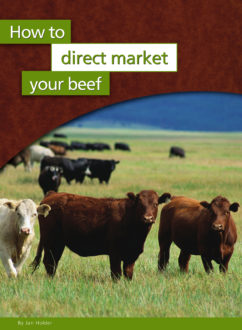
You are reading the SARE book How to Direct Market Your Beef.

Order this publication.

Sare 25 Years

1122 Patapsco Building | University of Maryland | College Park, MD 20742-6715

This Web site is maintained by the national outreach office of the SARE program, supported by the National Institute of Food and Agriculture, U.S. Department of Agriculture.

North Central SARE | Northeast SARE | Southern SARE |  Western SARE

Sustainable Agriculture Research & Education ©2012

  • Help |
  • RSS Feeds |
  • A Guide To This Site