Making sure that the soil is adequately fertilized for each crop is essential. At the same time, fertility management is complicated in any system, and this is especially true in a no-till system because you are not adding amendments to the soil when you are tilling.
In no-till management, growers must rely on soil biology to help pull nutrients in the soil, and some specific techniques are described below. A full discussion of soil fertility management is beyond the scope of this publication. Always consult with an agronomist and/or refer to soil test results before amending soil.
Fertilizing without tillage requires good planning, a couple basic tools, and some creativity. That said, it can be as simple as applying the desired nutrients in dry form before addressing the tilth, and then using a cultivation tool or shallow tillage tool to lightly work them in. In a situation where you don’t need to address the tilth, you can add amendments to the surface and then rake them in or run them over with a seeder to press them below the soil surface, where they won’t blow away or dehydrate in the sun (liquid fertilizers are discussed below).
There are also attachments for seeders, for example Earthway and Jang (among others), that allow you to “sow” dry, granular amendments into the soil without disturbing its surface. When you use this approach at planting, you’re able to add amendments near the seeds and deeper into the soil. You can also use it to sidedress a crop later on. These fertilizer attachments are also helpful when you’re using relay cropping or intercropping strategies, as a way to fertilize the soil without removing the previous crop. See the next section, “Relay Cropping and Intercropping.”
Fertigation is an option for amending soil in no- and low-till bed systems. Essentially, this technique involves adding amendments to your beds with your drip irrigation system during crop growth, as opposed to adding a dry form before planting. This approach allows you to avoid soil disturbance while also fertilizing a long-season crop throughout its life. Fertigation usually requires a special injection system, and it’s used most commonly for nitrogen, although you can apply many macro and micronutrients this way.
However, fertigation systems can be expensive, and may not make sense in every context or for every crop. As a result, growers use them most often in high tunnels, where regular fertilization is required for the intensively planted “heavy feeders” that we often grow in covered culture, such as tomatoes, cucumbers, peppers, and eggplants. Ultimately, if you’re considering a fertigation system, you’ll need to consult with a specialist on the details of system design and cost before moving ahead.
Many no- and low-till growers use thick layers of compost to act as a mulch, growing medium, and fertilizer. Weed pressure is generally low in deep compost mulch systems (sometimes called a “no dig” system), so the rules of a bed flip are generally the same—clear the previous crop, leave the roots in the soil, address compaction, and so on. However, the compost itself often provides the tilth and fertility, meaning that it acts as a mulch, a loose planting surface, and a hardy supply of nutrients all at once. Compost mulches can have their own complications, especially in terms of nutrient management, but they can also save time in both crop removal and replanting, as the tilth is built into the medium itself. Also, the compost will turn into healthy soil over time.
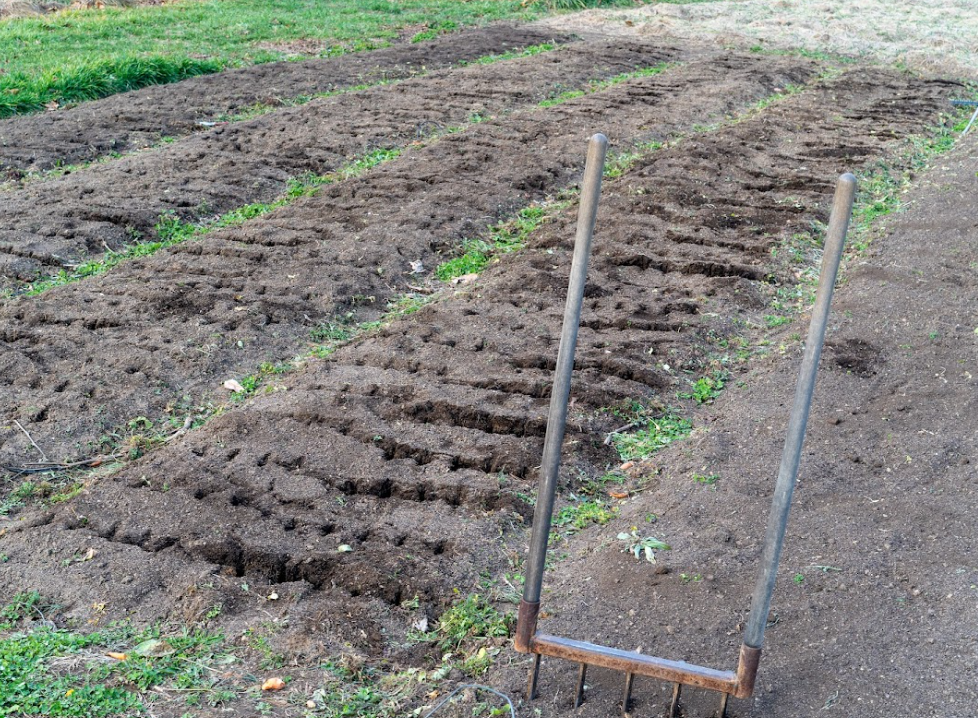
As outlined in the previous section, the process of decompacting the soil is another point where you can partly or fully address fertilization. Specifically, an option is to use a tool such as a broadfork to both loosen compacted soil and incorporate amendments at the same time. While this technique puts amendments deeper into the soil, it can also result in uneven distribution of nutrients. So when compaction isn’t an issue, it’s better to use one of the other incorporation techniques described above.