Without question, there are countless bed flip situations that growers could run into over the course of their careers. For that reason, the goal of this publication is not to give the answer to every situation, but to provide a framework you can use to find a solution in any situation. With that in mind, the room to innovate in this space is as infinite as the number of situations that could arise.
Take baby greens for example. Where many growers may resort to tilling in a crop of baby arugula once it has finished producing, growers like Ray Tyler of Rose Creek Farms in Selmer, Tenn., found that they could simply mow the crop, cover it with compost, saturate the bed with water, and leave it under a sheet of landscape fabric for 1–2 weeks and return to a clean and enriched planting surface. This approach might not get another crop into that space as quickly as, say, hoeing out all the tiny roots, but it’s a process that fits his farm’s system and clears the bed with less labor compared to a quick transition. Tarps and landscape fabrics not only keep the soil in place, they also germinate weed seeds while allowing organic matter to slowly decompose. Growers like Ben Hartman at Clay Bottom Farm in Goshen, Ind., have been experimenting with burlap as an alternative to plastic in some situations and although it doesn’t have the same suffocating effect of plastic, perhaps it could stand in for landscape fabric after the bed flip of baby arugula described above.
Of course, soil health is the goal, but you have to balance this against business health as well. For example, several years ago I visited Sage Hill Ranch Gardens in Southern California. While there, farmer Spencer Rudolf demonstrated for me a bed flip with his two employees. They twisted the lettuce out of the bed, with an equal focus on both speed and leaving as much root as they could. It was a compromise because twisting the crop out left behind less root matter than bringing a knife to the field, but it was faster. This technique met his needs as a business owner—to maximize the growing space while reducing the amount of time spent on removing the crop residue and not dramatically compromising soil health.
So, the hope is that this publication has provided you tools and techniques to utilize on your own farms that will speed up your production a little bit, create healthier soil, and hopefully add to both your overall profitability and production along the way.
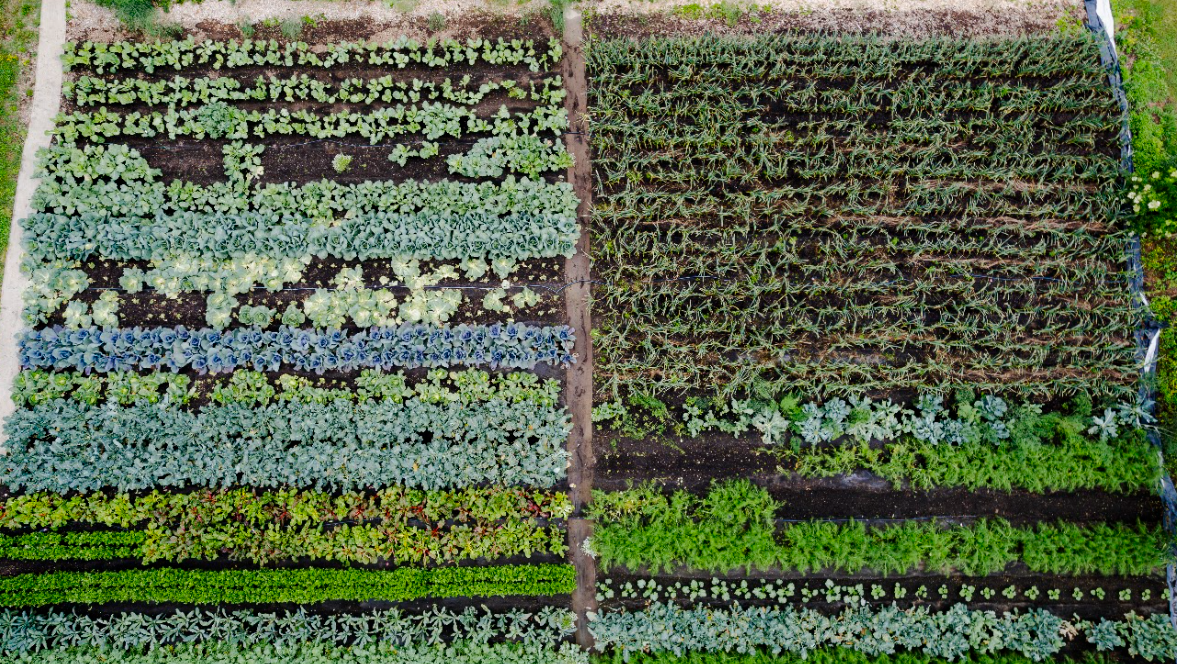
local consumers. Photo by LD Productions
Resources
This represents only a partial list of the many resources available online on the topic of no-till vegetable production. Consult with local Extension specialists and experienced farmers for more support.
The Living Soil Handbook: The No-Till Grower’s Guide to Ecological Market Gardening
This book offers an in-depth look at no-till practices in vegetable production, by the same author of this bulletin. The website also includes many stories about farmers’ experiences with no-till.
Building Soils for Better Crops, 4th Edition
This book includes comprehensive information on soil management, including soil fertility, cover crops, composting, and more.
Cover Crops for Sustainable Crop Rotations
An online collection of resources related to cover crops. From here you can find SARE books on the subject of cover crop management, as well as links to regional cover crop councils.
Crop Rotation on Organic Farms
www.sare.org/resources/crop-rotation-on-organic-farms
This manual provides an in-depth review of the applications of crop rotation-including improving soil quality and health, and managing pests, diseases, and weeds.