Showing 121-123 of 123 results

Rural Revitalization through Farm-Based Enterprise

The 10 U.S. counties with the greatest population losses between 2000 and 2003 are located in the western United States, and small towns are scrambling to save what is left of their communities. Like many other parts of the nation, western farmers are discovering that sustainably raised livestock and crops can help revitalize economies. And these farmers have an ally, John Allen, whose life's work is helping farmers develop the skills needed to build businesses that benefit the farm and also the surrounding community.

Allen, who works with the Western Rural Development Center at Utah State University, says the trick is to focus on farm-based businesses that produce and hire locally. "It's the multiplier effect. When I started in this business 20 years ago, if you spent one dollar in your community, it would get used two or three times around in the same town. But now, where everything is owned externally, the money goes straight to the shareholders, who live outside the community."

Allen founded the NebraskaEDGE program in 1993 at the University of Nebraska, Lincoln. The program has helped thousands of people explore business opportunities. In 2000, Allen and NebraskaEDGE Associate Director Marilyn Schlake - both SARE grant recipients - led a team effort to develop what is now considered one of the important national training programs for agricultural producers, Tilling the Soil of Opportunity: NxLeveL Guide for Agricultural Entrepreneurs. The course has been offered across 20 states at universities, small business development centers, and other educational facilities. More than 50 percent of the participants complete the course with a business plan.

Tim Nissen, born and raised in Cedar County, Neb., was one farmer who took the course. Industrial agriculture was squeezing his business and he needed to make changes. Tim enrolled in the 12-week intensive Tilling the Soil program, which opened his eyes to the potential of small-scale farming. In 2003, he turned his life around by opening a vineyard with his brother Dave in the grassy hills of Bow Valley.

Today, Westphalia Vineyards offers five varietals, one made with native wild plum. Nearly 60 percent of the customer base comes from outside the area.

Allen continues to find innovative ways to help rural communities, but now he is using SARE funds to develop workshops for western farmers and ranchers. By providing technical training in processing, packaging and labeling their products, along with Internet marketing strategies, Allen continues to help grow rural businesses and maintain rural communities.

"Our project draws upon SARE's historical values of matching farmers with educators. But this time we are moving into new territory by helping farmers break into the Internet and retail markets. That's the innovation."
Posted in 1

Farmer/Researcher Team Makes Organic Peanut Breakthrough

In 2007, Georgia organic grower Relinda Walker produced a historic crop of peanuts. The bounty—6,000 pounds grown on two acres—was significant because it represented the first crop of certified organic peanuts raised in the Southeast. Even though the Southeast produces 79 percent of the country’s peanuts, more than 99 percent of organic varieties are raised in Southwestern states.

Recognizing that Southeastern growers are missing out on a lucrative market, Mark Boudreau of Hebert Green Agroecology in Asheville, N.C., assembled a team of researchers and growers, including Walker, to focus on carving out an organic peanut industry for the region.

“The demand is high, and the price is premium,” says Boudreau, whose work has been funded by two SARE grants. “Most processers pay twice as much for organic peanuts, and I’ve seen it as high as five times as much.”

Since beginning their multi-state research in 2005, the team has made important strides toward overcoming the weed, disease and insect problems associated with organic peanuts. They are problems farmers do not generally face in the Southwest, where the climate is drier.

In its first three years of trials, the group found it could significantly reduce insect problems and post-emergence diseases. But weeds, seed rot and poor stand development have emerged as persistent problems, according to Boudreau. They are caused primarily by the region’s wet growing conditions, a short planting window and a lack of the right seeds. “If your peanuts aren’t up and running quickly, then they aren’t going to compete with the weeds,” he says.

Boudreau’s team is now focused on determining what organic seed treatments and planting conditions are ideal for rapid early growth and stand establishment, as well as outlining successful weed management strategies. The team includes agronomists, plant pathologists, weed scientists and others based in Georgia, North Carolina and South Carolina.

Along with building up a strong stand, cultivating with a tine weeder is emerging as the best weed-control strategy, according to Carroll Johnson, a USDA Agricultural Research Service weed scientist involved with the project.

Another major hurdle involves the lack of regional infrastructure to handle a large organic crop. For example, there are no organic peanut shellers in the Southeast.

When enough conventional and smallscale growers begin to appreciate the economic value of a local organic industry, then many infrastructure issues will get resolved, says Carroll. “I think there’s a lot interest in this. I think a lot of farmers want this to work.”

Boudreau admits that establishing an organic peanut industry in the Southeast will take more time, but he feels growers and researchers are on the right track. “We have a lot of information we can give farmers about what the problems are going to be and the best ways of tackling them.”

Posted in 1

Helping Appalachian Farmers Tap New Markets

Gary and Cindy Laws’ journey to successful organic farming started in the tobacco fields of western Virginia’s hill country. Both raised on tobacco farms, they saw the crop’s pitfalls firsthand: a declining market, health risks associated with smoking and, most importantly to the Laws, the myriad chemicals used in tobacco production.

But, like hundreds of other farmers in Appalachia interested in tapping the organic market, the Laws family needed help learning new methods. That is where Appalachian Sustainable Development (ASD) came in, an innovative rural development nonprofit that helps about 100 former tobacco growers and others make a living off sustainably grown food.

Now, the Laws family sells produce grown on four acres to local and regional grocery stores under the Appalachian Harvest label, an ASD organic marketing program that receives SARE support.

Don Kiser, another Appalachian Harvest grower, added $6,000 to his family’s income in 2008 by growing organic bell peppers on a quarter acre. Along with technical help, fellow program members shared equipment with him, keeping his costs low.

“That was something very refreshing about ASD—they recognize that if you don’t at least make a little money on it, you can’t keep it up,” says Kiser.

This is one of ASD’s key premises: Families in the economically depressed region of western Virginia and eastern Tennessee must have an alternative to tobacco production that benefits not only the environment but also profits. So they turned to certified organics, an industry worth $1.7 billion in 2007, according to the USDA.

Appalachian Harvest, one of ASD’s two signature “field to table” programs, removes two major barriers for growers who want to sell organic produce locally—the lack of value-adding infrastructure and access to local markets, says ASD Executive Director Anthony Flaccavento.

Along with technical assistance, Appalachian Harvest handles every aspect of marketing, from processing and transportation to contracting with area supermarkets, to public outreach. ASD’s other “field to table” program, Sustainable Woods, involves buying trees from landowners who practice ecological forest management and processing the wood into high-end furniture that is sold regionally. ASD owns a sawmill, and through

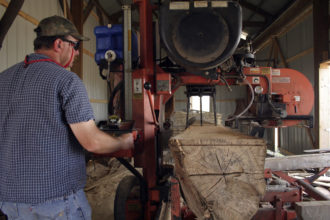
Sawyer Charles Fugate working at 3.5 acre facility that includes a log yard, sawmill, two dry kilns, a millworks manufacturing facility and storage.

Sustainable Woods pays loggers 20-30 percent more for their trees than other processers would.

ASD has received two SARE grants over the years: one in 1999 to recruit interested growers and conduct an educational campaign laying the foundation for a local organics market; and another in 2008 to expand Appalachian Harvest.

Appalachian Harvest now supplies produce to seven regional and national grocery chains that represent a combined 600 stores. Last year’s sales totaled more than $500,000. With lots of unmet demand remaining, the program continues to grow.

“Our whole effort is predicated on the idea that if we can get regular people to recognize the value of locally grown produce and pay a little more for it, it’ll create a market pull for farmers to make the transition,” Flaccavento says.

Posted in 1