Showing 91-100 of 123 results

SARE Funding in Your State

Since 1988, the Sustainable Agriculture Research and Education (SARE) program has helped farmers, ranchers, researchers and educators develop cutting edge innovations that improve farm profitability, protect water and land, and revitalize communities. Funded by the United States Department of Agriculture's National Institute for Food and Agriculture, SARE has awarded nearly $300 million to more than 7,300 projects that improve profitability, stewardship and quality of life by investing in groundbreaking research and education. Learn more about funded grants, project highlights and a breakdown of funding in your state using our newly updated portfolio summaries and grant lists.

SARE Grants Funded In Your State

Highlights of SARE-funded projects include:

Download the updated grants lists and portfolio summaries, and find links to state webpages at sare.org/Grants/Funded-Grants-in-Your-State. Search the SARE projects database to explore funded projects by topic, region, year or grant types.

Posted in 1

The Future of Agriculture Depends on New Faces and New Ideas

"I grew up on this farm and had no desire to become a farmer,” says Liz Brownlee, talking about a 250-family property near Crothersville, Ind. But eventually, Brownlee and her husband Nate came to see farming as the ideal way to combine a passion for food with an ethic of environmental stewardship.

SARE’s 2019/2020 Report from the Field shares how the Brownlees and other SARE grantees are shaping the future of agriculture.

Download SARE's 2019/2020 Report from the Field now.

In 2013, the Brownlees moved back to the family property and started Nightfall Farm, where they graze hogs, turkeys, chickens and sheep for sale through a 50-share CSA, farmers’ markets and local chefs. Recently, the Brownlees identified access to quality meat processing as a barrier to meeting their goals.

So they teamed up with Indiana University specialists and another farmer to obtain a SARE Farmer/Rancher grant to conduct a study on the feasibility of creating a butcher shop to improve direct sales. “We’re trying to be useful to our community here in Indiana,” says Brownlee, who plans to share the business planning documents from their study with other farmers.

Other stories in Report from the Field that demonstrate how SARE grantees are improving the sustainability of U.S. agriculture include:

Download or order your free print copy of 2019/2020 Report from the Field at https://www.sare.org/Report-from-the-Field or by calling (301) 779-1007. 2019/2020 Report from the Field is available in quantity for free to educators for use in educational workshops, classes or tours.


Posted in 1

SARE Fellows Tour Sustainability in North Carolina

SARE Fellows Tour Sustainability in North Carolina

SARE Fellows 2019

RALEIGH, North Carolina – Organic sweet potatoes are in high demand in North Carolina, but growers face two major hurdles: weeds and wireworms. North Carolina State University researchers think cover crops might be a solution, and that would make third generation farmer Kelvin Bass a happy man.

“I’m tremendously concerned about soil health,” said Bass, owner of Bass Plant Farm in Nashville, N.C., who grows 80–100 acres of organic sweet potatoes. “It’s key to what we are trying to accomplish organically. Soil is very important.”

Bass expressed frustration over having to till his sweet potato fields to manage weeds and control wireworm, a pest that likes grass roots as a host. If NCSU research of a cereal rye/vetch mix incorporated with organic sweet potatoes is successful, Bass will have a means of curtailing tillage while boosting soil organic matter, which is historically low in eastern North Carolina.

Organic sweet potatoes are the most profitable crop on Bass’ farm. A group of county extension agents from across the country visited recently to learn more about the farm’s diverse production of tobacco, cut flowers, U-pick strawberries, vegetables, and organic crops such as soybeans, wheat and cucumbers. The visit was part of the Sustainable Agriculture Research & Education (SARE) Fellows Tour, a program hosted by SARE and the National Association of County Agricultural Agents (NACAA) to introduce county agents to sustainable agriculture practices outside their region.

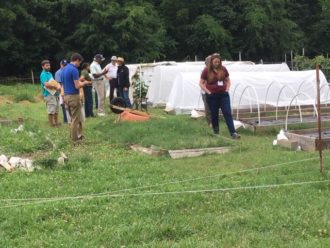
low tunnels with people standing outside them

This year’s tour took the group to farms and NCSU and North Carolina A&T research stations across the state’s Eastern, Piedmont, and Mountain regions. NCSU SARE state coordinator Chris Reberg-Horton praised SARE for laying the foundation of sustainability in the state, which has been progressive in its sustainable practices for decades. “NCSU and NC A&T have a great history with SARE,” said Horton. “SARE has been transformative when it comes to where growers are at in terms of sustainable agriculture, our training programs, statewide conferences, and other activities, such as the Fellows Tour.”

For several days, tour participants got a glimpse of some of the diverse farms across the state, and what makes each so unique in the world of sustainable agriculture. Examples included:

  • Allied Organic Farms in Hurdle Mills, N.C.: A diverse vegetable and agritourism operation, whose owners Tom Savage and wife, Linda, pride themselves on community relationships. Their biggest event, a free-of-charge Christmas light show, draws several hundred residents. “We are not a giant moneymaker,” said Savage, “but I believe it’s a good way of life.”
  • Pangaea Plants in Lake Lure, N.C.: A biodynamic farm specializing in certified organic medicinal herbs. Nestle in the mountains of western North Carolina near Asheville, owner Gabriel Noard looks upon his farm as an ecosystem with the neighbors and environment around him.
  • Flying Cloud Farm, Fairview, N.C.: A diverse operation of vegetables, berries and cut flowers sold via direct marketing, through a CSA, or to local markets. Managers Isaiah and Annie Louise Perkinson are tuned in to the lifestyle of their community. Their biggest money maker is a self-serve farm stand that allows passersby to pay for their items via Paypal, accessible through the farm’s website.

“I thought that farm stand at Flying Cloud Farm was pretty innovative,” said Jessica Kelton, a farm and agribusiness management extension agent at Auburn University. “Flying Cloud Farm was one of the best stops. They seemed to grasp every aspect of sustainability and they were meeting the social demand through their CSA.”

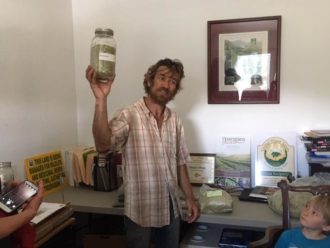
medicinal herbs in a jar

Like the other SARE Fellows on the tour, Kelton hopes to apply what she learned on the tour in her own sustainable agriculture efforts.

“Learning to work with other Extension personnel with different specialties really helps to get a better overall picture of the sustainable agriculture efforts of a particular farm,” said Kelton. “Thanks to everyone who worked to make this trip a great experience.

Other SARE Fellows who participated included: Amanda Sears, horticulture agent with University of Kentucky; Anthony Bly, soils field specialist with South Dakota State University; FNU Naveen Kumar, assistant professor of horticulture and extension specialist with University of Maryland; Claire Strader, organic vegetable educator, University of Wisconsin; Kathleen Painter, assistant professor and agriculture extension educator, University of Idaho; Kurt Jones, 4-H county director, Colorado State University; and Nicole Santangelo, agronomy extension educator, Penn State University.

The next SARE Fellows Tour will take place in Kansas next year.

Posted in 1

Free Fact Sheets Identify Broad Benefits of Cover Crops

Along with cutting costs and increasing crop productivity, cover crops provide various ecosystem services that benefit the environment both on and off the farm. For instance, adding cover crops to a rotation can significantly increase the portion of the year when living roots are present for soil organisms to feed on, which can have a significant impact on carbon sequestration. They also support wildlife and beneficial insects, and protect water quality by playing an important role in nutrient management. SARE’s Ecosystem Services from Cover Crops fact sheets explore the many ways cover crops can maintain soil and benefit the farm ecosystem, including:

Check out the fact sheets now

These free, downloadable and printable fact sheets are an excellent resource for educators, Extension service providers, farmers hosting field days and others. A great overview fact sheet is the “10 Ways Cover Crops Enhance Soil Health,” which addresses the four basic principles for maintaining and improving soil—and how cover crops support those principles.

If you want to dig deeper into the economics and profitability of cover crops, SARE’s newest bulletin, Cover Crops Economics, explores the economics of cover crops in corn and soybean rotations to help farmers answer that big question: “When do cover crops pay?” Download the PDF, view the online version, or order complimentary copies.

Posted in 1

Cover Crop Economics Report Now Available in Print

Cover Crops Offer Options in Wet Soil

As more farmers across the nation begin to incorporate covers into their rotations, they find that this valuable conservation practice pays in more ways than one. Many farmers in states suffering from oversaturated fields that prevented or delayed planting are considering cover crops. To help farmers evaluate the benefits of incorporating cover crops into their production systems, USDA-SARE released an important new report that examines the big question: “When do cover crops pay?”   

Cover Crop Economics: Opportunities to Improve Your Bottom Line in Row Crops is now available for free in print and for download, and is great for farmers and educators alike. 

Download or order Cover Crop Economics now. 

Using data gathered from five years of national cover crop surveys, Cover Crop Economics addresses the economic returns that can be expected from cover crops under various management scenarios and as cover crops improve soil health over time. This report takes a comprehensive approach by identifying seven different management situations when cover crops pay off faster. They are when:

  • Herbicide-resistant weeds are a problem
  • Cover crops are grazed
  • Soil compaction is an issue
  • Cover crops are used to speed up and ease the transition to no-till
  • Soil moisture is at a deficit or irrigation is needed
  • Fertilizer costs are high or manure nutrients need to be sequestered
  • Incentive payments are received for using cover crops

Download or order your free print copy of Cover Crop Economics: Opportunities to Improve Your Bottom Line in Row Crops at sare.org/cover-crop-economics or by calling (301) 779-1007. Cover Crop Economics is available in quantity for free to educators for use in educational workshops, classes or tours.

Posted in 1

When Do Cover Crops Pay? New USDA-SARE Report Addresses the Question

Farmers around the country are planting cover crops on millions of acres to protect and improve the soil, and the more that farmers use cover crops, the more they value this conservation practice. Cover Crop Economics, a new report published by USDA-SARE looks at the economics of cover crops to help farmers answer that big question: "When do cover crops pay?"

The key, says North Dakota farmer Justin Zahradka, who has been planting cover crops since 2011, is to “look at cover crops as an investment rather than a cost.”

Download or order Cover Crop Economics now. 

Based primarily on yield and economic data gathered through five years of national cover crop surveys, Cover Crop Economics: Opportunities to Improve Your Bottom Line in Row Crops addresses the kinds of economic returns that can be expected from cover crops, both under various management scenarios and as cover crops improve soil health over time. The report is timely, as the latest Census of Agriculture revealed that national cover crop acreage increased by 50% from 2012 to 2017.  It’s also timely due to the interest in cover crops for planting on fields that were flooded or otherwise unplanted (prevent plant situations) this spring, in order to suppress weeds while protecting and improving the soil.

“The five years of national cover crop surveys showed us that cover crops do improve commodity yields over time as farmers gain experience with cover crops and the soil is improved,” says lead author Rob Myers, of the University of Missouri and North Central SARE. “We saw this pattern in all five years of the survey for both corn and soybeans.”

Because there is no one-size-fits-all answer to when cover crops start paying for themselves, Cover Crop Economics: Opportunities to Improve Your Bottom Line in Row Crops takes a holistic look at the question. It explores seven common management situations for commodity farmers that can affect how quickly they receive a positive net return from cover crops. In reviewing national survey data and information from other studies and farmers experiences, the publication describes a number of situations in which cover crops may increase profitability within a year or two.

Prime examples of fast returns include when drought occurs when herbicide-resistant weeds are a challenge, or when cover crops are grazed. Other management situations which can speed up positive returns from cover crops include when a farmer is dealing with compacted soils or is transitioning to no-till, or when cover crops are contributing to a commodity crop’s nutrient needs. Also, receiving federal or state incentive payments while transitioning to cover crop use can make a major contribution to a quick economic return.

Some key findings from the report include (see the full report for details on the calculations and assumptions underlying these conclusions):

  • When herbicide-resistant weeds are a significant problem, cover crops can be profitable in the first year of use
  • When cover crops are grazed, they can provide a profit in the first year of use if fencing and water are already available
  • When soil compaction occurs, cover crops can provide a profit by the second year of use

The findings in Cover Crop Economics: Opportunities to Improve Your Bottom Line in Row Crops are based on an analysis of five years of data from the National Cover Crop Survey, conducted by the Conservation Technology Information Center (CTIC) and SARE in the 2012-2016 growing seasons. This survey provides the largest multi-year data set on cover crop yield response that has ever been assembled, according to Myers, with about 500 farmers providing yield data in most years of the survey.

In 2015 and 2016, the survey captured more detailed data on yield response in a given field based on the number of years cover crops had been planted in it. In those years, average corn and soybean yield increases in response to covers were:

  • After one year of cover crop use, corn yields increased 0.5% and soybean yields 2.1%
  • After three years of cover crops, corn yields increased 1.8% and soybeans yields 3.5%
  • After five years of cover crops, corn yields increased 3% and soybean yields 5%

In the drought year of 2012, there was a significantly bigger yield boost from cover cropping on the majority of farms responding to the survey. Corn yields increased by 6% and soybeans by 11.4% after one year of cover crop use due to impacts on rainfall infiltration, reduced soil evaporation from cover crop residue, changes to soil biology such as increased mycorrhizal fungi, and potentially deeper rooting of cash crops.”

Other smaller studies on yield response to cover crops have found a variety of results, some showing modest yield increases and some showing no yield response. “I think yield response to covers depends on how the farmer or researcher manages the cover crop and the soil types they have, but clearly there have been a range of yield impacts reported,” says Myers. “As with other crop management practices, it takes planning to get the best results, and mistakes can lead to a yield loss, particularly if cereal rye is used before corn without adjustments to fertilizer practices or without appropriate termination timing.”

For this report, the authors used $25 per acre as the cost of cover crop seed and $12 per acre as the cost of seeding (when hired), for a total of $37 per acre to establish cover crops. These figures are based on median data from the surveys.

Experienced cover crop users often find ways to use them for less. One large Iowa farmer grows his own cereal rye seed and plants a bushel of rye per acre as a cover, according to Myers. He finds his cost for seed is $9 per acre and his cost of seeding is $5 per acre by using a high capacity fertilizer spreader to broadcast the rye seed, making a total of $14 per acre for seed and seeding. Others may keep the cost of seeding to a minimum by seeding cover crops with a vertical tillage tool they would be operating in any case. Some farmers have termination costs for cover crops, but many do not, as they are already applying a spring burn down herbicide.

Alan Weber, an ag economist who has used cover crops on his own farm and who co-authored Cover Crop Economics: Opportunities to Improve Your Bottom Line in Row Crops, says, “One of our key takeaways from the review we did of data and farmer approaches is that when farmers start to adopt cover crops, they frequently start to determine other ways to make their cropping system more economically efficient, finding they can save costs in certain areas such as fertility or weed control. For some farmers those cost savings from cover crops can be significant, particularly in certain situations with herbicide-resistant weeds. In other cases, those cost savings will be more minor, but the input savings generally increase over time. Some aspects of soil health respond quickly to cover crops, such as more earthworms and mycorrhiza, while other soil changes take longer.”

In the longer term, as aggregate soil structure starts to improve, cover crops in combination with no-till can allow farmers to get into the field a little earlier for planting or harvest in wet years, which can be another way that cover crops provide a positive economic impact. Several years of cover crop use can gradually start to improve soil organic matter, which can improve soil water-holding capacity and help improve the inherent fertility of the soil.

As a bottom line, Myers says, “Thousands of farmers are finding the profitability benefits of cover crops on their farm do improve over time. Depending on circumstances specific to each field and farm, cover crops may provide a relatively quick profit, such as from grazing, or may take 2-3 years to provide a return. It’s not unlike how applying ag lime can take 2-3 years to pay, or buying a new piece of equipment can take a few years to cash flow. However, if producers use cover crops to address problems specific to their farm, such as weeds, fertility, erosion, or compaction, they can quickly gain cost efficiencies with their commodity cash crops. The cover crops also provide a management tool to make soils more resilient to excessively dry or wet weather while building towards long-term improvements in profit.”

Download or order your free print copy of Cover Crop Economics: Opportunities to Improve Your Bottom Line in Row Crops at sare.org/cover-crop-economics or by calling (301) 779-1007. Cover Crop Economics is available in quantity for free to educators for use in educational workshops, classes or tours.

Posted in 1

New Video: Building a Local Food Movement

When Congress ended its tobacco support programs in 2000, thousands of tobacco growers in western North Carolina who depended on them were left without a viable way to make a living. “There wasn’t a real future for the farms in our region if we didn’t come up with something new,” says Charlie Jackson, the executive director of the Appalachian Sustainable Agriculture Project (ASAP).

In this new video, see how the agricultural landscape of western North Carolina is transforming from one dependent on tobacco to one that is self-sustaining. Hear from Jackson, who has worked with farmers and businesses to advance this change with support from SARE.

Dig Deeper into Sustainable Agriculture

Explore how farmers and ranchers are improving profitability, stewardship and quality of life using innovations in production and marketing. Check out What is Sustainable Agriculture?  a 12-page sampler of best practices in sustainable agriculture, including profiles of the men and women who are putting them into practice.

Posted in 1

New Video: Bringing Independent Farmers into the Marketplace

Access to profitable retail and wholesale markets is a challenge for small- to mid-scale family farmers. “The days of showing up with your cantaloupes in the back of the pickup are no longer a way to make a living,” says Diana Endicott of Kansas City, Mo. “So you have to be willing to make a change.” A SARE grant helped Endicott and other area farmers launch a marketing cooperative that secured access for their all-natural beef products in 19 local supermarkets. A second SARE grant explored consumer demand for natural beef at the retail level, contributing to a 33 percent increase in sales.

In this new video, learn how Good Natured Family Farms (GNFF) has grown into a network of more than 100 farms that sells a range of products through 30 area supermarkets and which generated $4.5 million in sales in 2015.

Dig Deeper into Local Foods

Visit the Farm to Table: Building Local and Regional Food Systems Topic Room to learn more about farmers, ranchers, ag professionals, community organizers who are reconfiguring the nation's food system to retain more value in food-producing communities.

Posted in 1

New Video: How SARE Supports Farmer-Driven Sustainability

There is no universal vision for agricultural sustainability in the United States—every region, every farm may require a different approach to improving livelihoods, protecting the nation’s land and water resources, and strengthening communities. Since its inception in 1988, the SARE program has supported a broad range of innovations in sustainability through its grassroots, farmer-driven grants and education programs.

“SARE looks at the real issues farmers are faced with today, and invests in the people that can help them solve those issues,” says Heather Darby, an agronomy and soils specialist with University of Vermont Extension. 

In this new video, hear from Darby and other farmers and ranchers, educators and researchers as they describe how SARE’s strong emphasis on farmer leadership helps agricultural communities across the United States meet the challenges of today and tomorrow.

Spread the word about SARE’s innovative approach to advancing the sustainability of U.S. agriculture—consider sharing this video with members of your farm and ranch community today.

Posted in 1

Reflections of a SARE Fellow

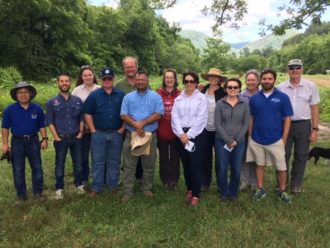
The 2014-2016 cadre of SARE Fellows visited numerous farms in Arkansas, Nebraska, Idaho, and West Virginia to study sustainable agricultural practices. The Fellows themselves were from Florida, Maine, Missouri, and Washington; they overlapped with eight other Fellows who were either starting or ending their two-year study period.

The various locations visited, diverse enterprises studied, and range of farming practices employed ensured exposure to a cross section of agricultural business with varying degrees of sustainability. The Fellows learned to use the “Reading the Farm” assessment tool, which provides a framework for holistic evaluation of farms using the strengths, weaknesses, opportunities, and threats (SWOT) approach.

Sharing some of the lessons learned from farms visited during the SARE Fellows program in this article may be useful to prospective small-scale producers, beginners, and even experienced producers who are considering making changes to their enterprise(s). These reflections are shared using the categories of the Reading the Farm process: production and processing; social and quality of life; environmental; and marketing and economics. Major take-away messages and a farm example is included for each.

Production and Processing

By far, the most important lesson learned regarding production and processing was how important it was for farms to focus on profit centers and what they did well. Although diversification is wise and can help reduce risk of the loss of single crops, many farms overdiversified and ended up doing few things well (or even profitably). For long-term success, enterprises that are sustainable environmentally, socially, and economically are a must.

Regardless of the crop produced, farmers must be knowledgeable about and employ best management practices (BMPs) for that crop. Irrigation, pest control, fertilization, season extension, and harvesting practices used should be state-of-the-art for that crop, applying the results of relevant research for optimal production efficiency. The differing levels of efficiency between farms was remarkable and mostly depended on the operator’s knowledge and use of BMPs.

Farm A: More is Less

Farm A did not lack for start-up capital. This second-career farmer had a very lucrative first career and used his extensive savings to fund his new passion for farming. However, he did not limit production to crops he grew well and were profitable—he kept expanding and experimenting as additional crops caught his interest. He did not abandon previous crops, just kept adding more and more, delighting his CSA customers but overwhelming his limited labor force. Some crops were poorly-suited to local conditions, not profitable, had no local market, or required too much labor to be feasible. Due to poor crop performance and inefficiencies, more and more savings had to be pumped into the operation to keep it solvent. Long-term sustainability was doubtful without re-focusing efforts on profit centers and abandoning production “whims” that were hard to justify for this new operation.

Social and Quality of Life

Nearly every farm mentioned something about family dynamics. On the most successful farms, the families had a shared vision and were working toward a common goal. Other farms were struggling, often due to the loss of passion and enthusiasm for the work by one or more partners, or conflicting goals. Some partners are open to and excited by new opportunities and want to explore them and others say NO to trying anything new or different. As is true in all relationships, compromise on both sides is often needed to keep a farm moving forward.

Working conditions are important for employers and employees. Employee turnover is very costly, so anything reasonable that can be done to prevent loss of trained employees is a good investment. Adding simple mechanization wherever possible to decrease labor and increase efficiency is warranted. Keeping worker comfort in mind, particularly in processing areas, will pay dividends through fewer injuries and less worker dissatisfaction. Working conditions become a larger consideration for owners as they age, too.

Many farmers mentioned the need for work-life balance for the entire family. Everyone needs time off the farm or doing something they enjoy not related to work. It is easy to become isolated and insular on a farm due to the sheer amount of work to do, but it is wise to make time to network with others to learn, share, and decompress.

Do you have a succession plan? Several farmers mentioned the importance of a farm succession plan but said they just hadn’t gotten around to creating one yet. If you care about the future of your farm and would like to have a say in its future, a farm succession plan is essential. Make it a priority to meet with an attorney experienced in drawing up farm succession plans.

Farm B: Beauty is in the Eye of the Bee-holder

Farm B was beautiful. Located a reasonable distance from several population centers, it is a popular destination for family day trips. The farm offers on-farm and off-farm sales of cut flowers and berries, including U-pick options. Its pest management practices are well-received by the public: bats, hummingbirds, swallows, and purple martins are attracted for insect control; roses and other strategically-placed flowers attract pollinators; and motion-detector lights deter raccoons.

Environmental

Weed, disease, and insect pest management was most effective when integrated methods were used. Some farms used row covers to protect specific crops from pests of concern at certain times. Beneficial insects were attracted by providing habitat in targeted areas. Scouting for insect pests each day helped producers get early notice of pest trends so decisions about control could be made early. Whether they were certified organic or not, most producers wanted to avoid the use of chemicals to control pests.

Farms prospered when proper attention was paid to soil health and nutrient management. Using mulch, cover crops with varying root depths, quantified compost/ fertilizer, and soil test results, good managers were able to improve fertility and farm production over time. Cover crops promoted soil retention and nutrient cycling; they were often missing on farms with gaps in BMPs.

Farm C: Underutilizing Resources

This farm was a surprising disappointment. Established as a working farm to promote education about livestock production, it was not employing practices that encouraged soil health, nutrient cycling, plant vigor, or optimal animal performance. Pastures were noticeably understocked. Also, cattle were not rotated through smaller paddocks but instead kept in one large field they did not utilize uniformly. This resulted in a great accumulation of over-mature forage that became senescent instead of being used as animal feed.

Marketing and Economics

The major lesson learned from the farm visits was the crucial need to know the profitability of each farm enterprise. Sometimes growers had only a vague sense of profitability or what their costs of production were. Professional farmers need to conduct an enterprise analysis for each crop to identify profit centers and losers and then use the results of the analysis to make critical decisions. Unprofitable endeavors should be carefully evaluated: can expenses be decreased or revenue increased? Should the enterprise be mothballed for a while or forever? If a market cannot be found that will meet the cost of production plus a reasonable profit margin, an enterprise should be retired. Successful fulltime diversified produce growers who direct market try to realize ~$20,000 per acre in gross income. The importance of financial recordkeeping is underscored during any discussion of cost of production determination or profitability assessment.

The pressure for success selects for innovation. Innovative growers have identified and pursued numerous opportunities such as marketing for other growers for a fee; creating value-added products to reduce waste and increase profits; using season extension or unique crops to help cash flow through year-round sales; specializing in niche crops identified by market analyses; conducting marketing plans for each product; and determining whether wholesaling or retailing is best for them. CSAs help finance farms before crops are available to sell each season, but CSAs are not for everyone. Some of the most successful farms are successful because one or more of the partners has secured steady income and benefits from a full- or part-time job off the farm.

Methods to foster a dedicated customer base pay off over years. Having a well-deserved reputation for product quality and consistency is paramount. Being located close to an urban center may reduce marketing expenses somewhat, help customers feel connected to a farm, and make agritoursim opportunities realistic. Advertising in local/regional agriculture marketing efforts will reach the target audience and help a farm stay connected with local farm events and fellow producers. Developing an attractive logo and including it on products, in advertising, and at the farm strengthens brand recognition by new and returning customers.

Farm D: The Early Nut Gets the Worm

The owner of Farm D used to raise row crops and cotton but had difficulty making a profit on limited acreage. He researched alternative crops and decided to try pecans. He planned meticulously, devised optimal tree spacing, and provided irrigation to every tree. As trees came into production, the producer found a way to get to market sooner (and therefore at a higher price) than competitors: he harvests pecans before they are fully dry, dries them in the bag, then sells to a wholesaler who expo exports for international holiday markets. This farmer shrewdly “recruits” neighbors with gifts of pecans to help keep an eye on the farm and reduce losses due to theft.

Conclusions

The 11 lessons learned by the 2014-2016 SARE Fellows shared above are key concepts worthy of being embraced by producers who hope to manage farms into sustainability. Valuable information can be gleaned from both highly successful and struggling farms. In any arena, learning from the successes and failures of others saves time, money, and aggravation and makes the road to sustainability shorter and less rocky.

Adapted from "Reflections of a SARE Fellow" Oregon State University Extension Service 
Posted in 1