• WebStore |
  • Advanced Search |
  • MySARE Login |
  • SARE Social Media |
  • Contact Us |
  • SANET Listserv |
  • Low Bandwidth |
Search MySARE Reports
  • Grants
    • Apply for a Grant
    • Funded Grants in Your State
  • Project Reports
    • Submit a Report
    • Search the Database
    • Project Search Tips
    • About Project Reports
    • About Search Results
    • Project Products
  • Learning Center
    • Books
    • Bulletins
    • Fact Sheets
    • Topic Rooms
    • From the Field
    • Newsletters
    • Multimedia
    • Courses and Curricula
    • Project Products
    • SARE Biennial Reports
    • SANET Listserv
    • SARE Program Materials
    • Conference Materials
    • WebStore
  • Professional Development
    • PDP Overview
    • Fellows & Search for Excellence Programs
    • Sample PDP Grant Projects
    • Educator Curriculum Guides
    • National Continuing Education Program
    • State Coordinator Contact Information
  • State Programs
    • State Coordinator Program Overview
    • State Coordinator Contact Information
    • State Program Webpages
    • Funded Grants in Your State
  • Events
    • Event Calendar
    • Past Conferences
  • Newsroom
    • Press Releases
    • SARE in the News
    • Media Contacts
    • Newsletters
    • Media Toolkit
    • A Guide To This Site
    • SARE and Social Media
  • About SARE
    • SARE's Four Regions
    • Join Our Mailing List
    • SARE Grants
    • Learning Center
    • Professional Development
    • SARE Outreach
    • Historical Timeline
    • Staff
    • Vision & Mission
    • What is Sustainable Agriculture?
  • Home»
  • Learning Center»
  • Fact Sheets»
  • Production and Marketing of Beach Plum, a Heritage Fruit Crop»
  • Text Version
facebook
Twitter
YouTube
- + Font Size
Print
Share

Text Version

  • General Description
  • Cultural Methods
  • Insects and Diseases
  • Marketing
  • Research Synopsis
  • References
  • Printable Version

Can't find something? Ask or send feedback.

SARE's mission is to advance—to the whole of American agriculture—innovations that improve profitability, stewardship and quality of life by investing in groundbreaking research and education. SARE's vision is...

Production and Marketing of Beach Plum, a Heritage Fruit Crop

beach plum plant
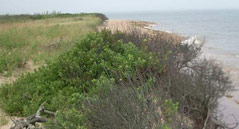
Wild beach plum, ‘on the edge,’ in the harsh coastal environment of Montauk Point State Park, New York.
Geographic Range: Northeastern U.S.

Introduction
Beach plum (Prunus maritima Marsh) is one of several shrubby plums native to North America. It produces small, distinctively flavored fruit that are collected from the wild along the Northeast coastline for small-scale jam production in home and commercial kitchens. The jams command premium prices at farm stands and specialty markets, even in comparison with jam made from other locally grown fruit. However, the wild-collected supply of fruit does not meet this niche market’s demand.

Beach plum naturally occurs on sandy, excessively drained, nutrient-poor sites. This habitat strongly suggests that beach plum has untapped potential as a low-input crop for marginal land. Under seaside conditions, the plant grows very slowly and does not bear fruit every year. However, the beach plum is not limited to sandy soil; it may be planted in any fertile, well-drained soil. Full sun is required for fruit production.

The market for many commodity crops has such low margin that growers struggle to stay profitable, especially in the urbanized Northeastern US. Some believe that the future of agriculture in this region lies in high-value, niche market crops, especially those with underserved regional markets, and the potential for value-added processing. The existing high value of beach plum products suggests economic sustainability, even at small scale.

Current demand for the fruit exceeds supply by a large margin, due in no small degree to the dwindling number of accessible natural stands and collectors willing to pick. Prior to our work,, cultural guidelines for beach plum production were not available. Improved selections have not been systematically tested and are not available in the nursery trade. Production of beach plum to supply a limited high-value niche market may be a viable component of a diversified farm operation. However, future profitability of large-scale production to accommodate the expansion of the market, as with any entrepreneurial venture, remains to be seen.

See Full Article

Top

You are reading the SARE fact sheet Production and Marketing of Beach Plum, a Heritage Fruit Crop.

Order this publication.

Sare 25 Years

1122 Patapsco Building | University of Maryland | College Park, MD 20742-6715

This Web site is maintained by the national outreach office of the SARE program, supported by the National Institute of Food and Agriculture, U.S. Department of Agriculture.

North Central SARE | Northeast SARE | Southern SARE |  Western SARE

Sustainable Agriculture Research & Education ©2012

  • Help |
  • RSS Feeds |
  • A Guide To This Site