The educational materials listed on this page are about Soil Quality/Health.
Farmers and ranchers use the term soil health to describe the condition of the soil. Scientists usually use the term soil quality, but both refer to the same idea — how good is the soil in its role of supporting the growth of high-yielding, high-quality, and healthy crops? Healthy soil generates higher crop yields, it absorbs and holds rainfall, and erosion is therefore reduced. The information here will show you how to improve soil fertility and build healthy soil. Two comprehensive books to consult are Building Soils for Better Crops and Managing Cover Crops Profitably.
Crop rotation, the use of diverse soil management practices, composting, and cover crops all contribute to healthy soil by conserving and building soil organic matter, absorbing rainfall, and retaining crop residues on the soil surface. Major conservation practices include conservation tillage, contour farming, strip cropping, terraces, diversions, and grassed waterways.
Soil consists of four parts: mineral solids, water, air, and soil organic matter. All four are important characteristics of fertile soil.
Soil organic matter consists of three parts: living organisms, fresh residues, and well-decomposed residues. The living part of soil organic matter includes a wide variety of microorganisms, such as bacteria, viruses, fungi, protozoa and algae. It includes plant roots as well as insects, earthworms, and larger animals in the soil. The fresh residues consist of recently deceased microorganisms, insects, earthworms, old plant roots, crop residues and recently added manures. This part of soil organic matter is the active, or easily decomposed, fraction. As soil organic matter is decomposed, many plant nutrients are released. The well-decomposed organic material in soil is called humus.The already well-decomposed humus is not a food for organisms, but its very small size and chemical properties make it an important part of a healthy soil. Humus holds on to some essential plant nutrients, storing them for slow release to plants. Good amounts of soil humus can both lessen drainage and compaction problems that occur in clay soils and improve water retention in sandy soils by enhancing aggregation, which reduces soil density, and by holding on to and releasing water.
The soil water, also called the soil solution, contains dissolved plant nutrients and is the main source of water for plants. Soil nutrients are made available to the roots of plants through the soil solution. The air in the soil provides roots with oxygen and helps remove excess carbon dioxide from respiring root cells. When mineral and organic particles clump together, soil aggregates are formed, resulting in a healthy soil with good soil structure and more spaces, or pores, for storing water.
Showing 1-10 of 74 results
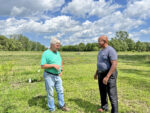
Using Cover Crops in Wide Row Corn
Iowa farmer Bob Recker challenged conventional thinking by asking whether wider corn rows could allow cover crops to thrive without sacrificing farm profitability.
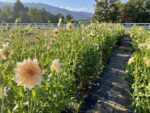
Promoting Soil Health for Cut Flower Production
With support from a Western SARE Partnership grant, Melanie Stock of Utah State University partnered with cut flower farmers to explore sustainable fertilization practices for dahlia production.
Farming Strategies for Adapting to Extreme Weather
SARE partnered with PBS KVIE to produce an episode of RFD-TV's America's Heartland that highlights how farmers and ranchers across the United States are using sustainable and regenerative practices to adapt to increasingly challenging and unpredictable weather conditions. Adapting to Flooding and Drought on Hurricane Flats Farm in South Royalton, Vermont Ashley Loehr and Antoine […]
Best Practices for the Sustainable Urban Farm
For decades, urban farms and community gardens have helped meet the demand for fresh, local produce. Urban farms are diverse and adaptable, ranging from small farms on repurposed vacant lots to multilevel vertical farms and rooftop gardens. Often, they combine ecological farming practices with some form of infrastructure. Urban growers make clever use of their […]
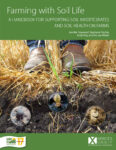
New Book: Farming With Soil Life: A Handbook for Supporting Soil Invertebrates and Soil Health on Farms
Smart farmers know that healthy soil hosts a flourishing and diverse ecosystem of bacteria, fungi and invertebrates. But the complex relationships between soil life, productivity and resilience are not well understood. Now available from the Xerces Society and SARE, Farming with Soil Life: A Handbook for Supporting Soil Invertebrates and Soil Health on Farms is […]
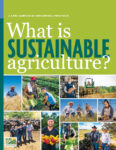
What is Sustainable Agriculture?
This award-winning report provides a sampler of best practices in sustainable agriculture—from marketing and community vitality to cover crops and grazing—as well as eight profiles of producers, educators and researchers who have successfully implemented them.

America's Heartland "Leaders in Sustainable Agriculture" Now Available on YouTube
SARE recently partnered with PBS KVIE to produce an episode of RFD-TV's America's Heartland featuring four farmers describing their commitment to sustainability, how they plan to overcome modern farming challenges, and how SARE has impacted their farming and ranching practices. The full 24-minute episode titled Leaders in Sustainable Agriculture is now available at https://www.sare.org/resources/leaders-in-sustainable-agriculture/. Watch: Videos featuring each […]

Leaders in Sustainable Agriculture Featured on America's Heartland
SARE partnered with PBS KVIE to produce an episode of RFD-TV's America's Heartland that features four farmers describing their commitment to sustainability, how they plan to meet farming challenges of today and tomorrow, and how SARE has impacted their farming and ranching practices. The full 24-minute video is available, as is each segment featuring the […]
RFD-TV Episode to Highlight Sustainable Innovations
Tune in to RFD-TV on March 29 at 5:30pm EDT for the premiere of a new “America’s Heartland” episode showcasing farmers and ranchers from across the country who are leaders in sustainability. SARE partnered with PBS KVIE to produce this episode, which features farmers describing their commitment to sustainability, how they plan to meet farming […]
Farming with Soil Life
This handbook, created by The Xerces Society, dives into soil biology. It provides a connection between healthy soils and healthy invertebrates found in temperate agricultural soils. Farming with Soil Life starts with a review of soil basics, including the functions, classifications and properties (physical, biological and chemical) of soil. It provides detailed methods on how […]