Jean-Marie Luginbuhl, North Carolina State University
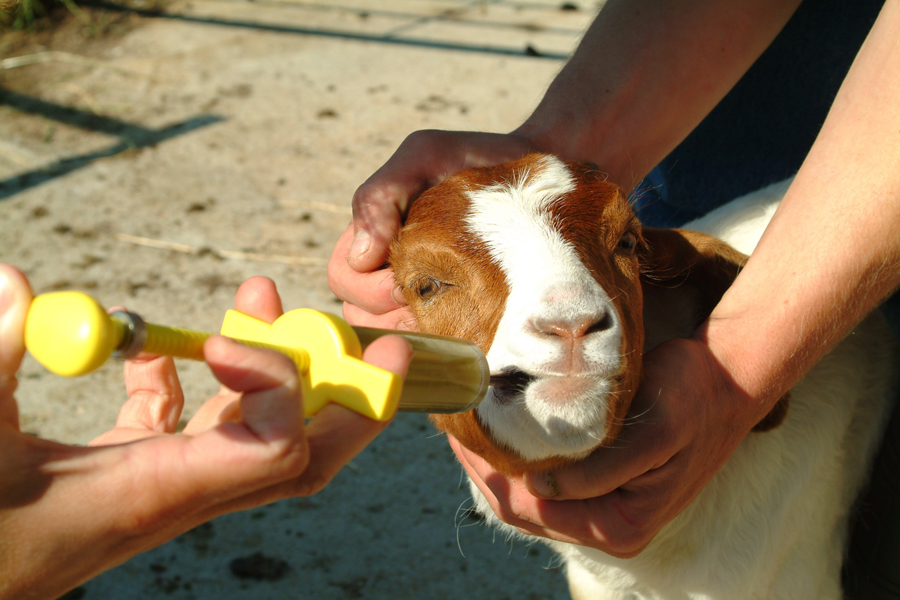
Most dewormers are drenches, or liquid medications given by mouth. Smart drenching is a method of parasite management that seeks to improve their effectiveness through selective use. Parasite populations build resistance to chemical dewormers over time, so one of the primary goals of smart drenching is to balance production needs of the animal with the need to preserve the efficacy of available dewormers for as long as possible, if indeed they are still effective.
Dewormers should only be administered to animals that actually need treatment. Identifying these animals easily and correctly can be problematic, but the FAMACHA© system (see next section) can dramatically improve this process when H. contortus is the primary parasite. Because there are other parasites, diagnosis should include other methods in addition to the FAMACHA© system. See discussion below of the five-point check.
The following smart drenching techniques should be used when administering dewormers:
- Identify which dewormers will work on your farm by performing a fecal egg count reduction test (see the text box). By comparing the fecal egg counts prior to and following treatment of animals, you can see how effective the deworming treatment was. An effective treatment should reduce the fecal egg count by 95%.
- Give the proper dose of dewormer to each animal. This will require knowing each animal’s weight. It’s important to note that sheep and goats require different dosages of dewormers. Goats need a dose that’s 1.5–2 more than what is recommended for sheep, depending on the dewormer used. The https://wormx.info website has handy dewormer charts for camelids, goats, and sheep. Withhold feed (except for late pregnant/lactating animals, young lambs or very sick animals) 12–24 hours prior to drenching with benzimidazoles (white dewormers such as fenbendazole and albendazole), ivermectin, doramectin and moxidectin. Benzimidazole efficacy may be enhanced by repeating the drench 12 hours after the first dose. Consult your veterinarian, the consortium or the package label for more specifics regarding proper dosage.
- Give the dewormer over the tongue and in the back of the throat with a drench tip or drench gun.
- Drench only the animals that need treatment, as described in the FAMACHA© section below. This reduces dewormer use and cost. Most importantly, untreated animals harbor worms that will stay more vulnerable to dewormers, prolonging dewormers’ effectiveness.
How to Do a Fecal Egg Count Reduction Test
Fecal egg count reduction tests can be performed by veterinarians or experienced producers. Individual or pooled fecal samples are collected before animals are treated with a dewormer and samples are taken again 12–14 days following the treatment. The fecal egg counts (a measure of infection) are determined on the two sets of samples, which are then compared. These can be submitted to a diagnostic lab. See the consortium’s website for low-cost lab options for determining fecal egg counts, or contact another veterinary diagnostic laboratory. At each collection, fresh fecal samples equally representing at least 10 animals should be placed in a plastic bag with the air removed. Insulate these bags with newspaper and ship them with an ice pack overnight. It’s okay to store the first fecal sample in the refrigerator—never frozen—and ship it with the second sample. It’s best to ship samples on a Monday so that they arrive in the lab well before the weekend and aren’t left in a warehouse over the weekend. If the samples get warm, the eggs will hatch and the counts won’t be true
Smart drenching also includes recommendations for stopping the parasite life cycle through pasture management, a vital component of an animal management system designed to reduce parasite problems. To ensure good pasture management:
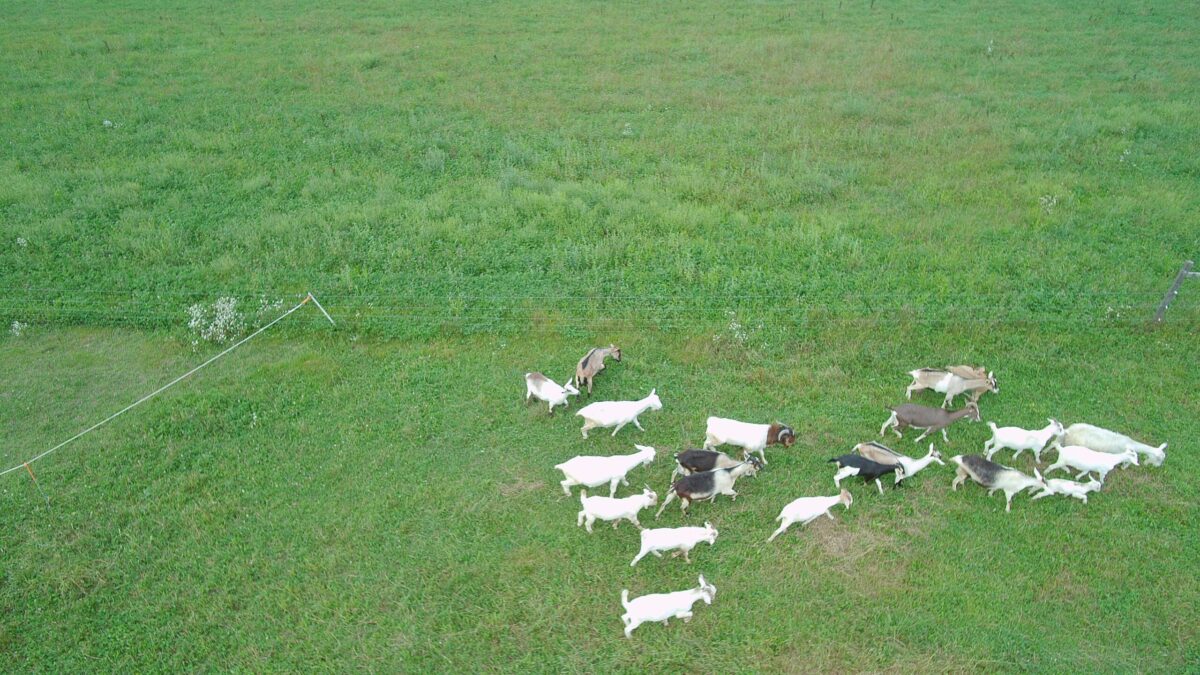
- Maintain forage height of at least 4 inches. Most parasite larvae migrate in water droplets on grass, but usually to heights no higher than 3 inches. When grazing cool-season forages, such as fescue or orchardgrass, move animals to a new paddock or section when the forage stubble height reaches 3–4 inches. This promotes faster regrowth. Also, maintaining grass at a greater height will provide forage above the infected zone, and thereby reduce the number of parasite larvae ingested by grazing animals. Contact your nearest Cooperative Extension office or Natural Resources Conservation Service (NRCS) office for advice on grazing management.
- To avoid increasing the infection load in the animal, move sheep or goats off the pasture before the eggs can hatch and become infective larvae. In the summer, this can happen as quickly as four days. A study in Arkansas showed that rotating once or twice a week and returning to the same pasture 28–35 days later was enough to reduce the amount of deworming required in lambs compared with continuous grazing.
- Remove small ruminants from pastures for 3–6 months to allow worm larvae on pasture to die off. This recommendation may not be feasible or practical under certain circumstances and will have to be balanced against available resources and forage quality.
- Cut grass for hay on heavily contaminated pastures to reduce the parasite population in the pasture. The hay will be safe to feed because the larvae will not survive the haying process.
- Plant winter and summer annual forages in a prepared (tilled or disked) seedbed to break the worm cycle and drastically reduce the worms’ population on the pasture.
- Alternate or co-graze pastures with horses or adult cattle, as these may not be affected by sheep and goat parasites. They may serve as dead-end hosts for the parasites, lowering the parasite population on the pasture.
- Maintain appropriate stocking rates for the pasture. High stocking rates will ultimately increase parasite loads on the pasture.
- Avoid over-grazing, which forces animals to feed close to the soil, where worm larvae live.
- Allow goats to browse upright plants rather than grasses, as goats are especially vulnerable to re-infection through close-to-the-ground grazing.
- Consider use of a nematode-trapping fungus fed to highly susceptible animals (pregnant/lactating or young lambs/kids) to reduce infective larvae on pasture as described below.
Resources to assist producers with fecal egg count reduction and smart drenching or use of dewormers:
- Smart Drenching and FAMACHA© (manual)
- Proper Use of Dewormers (fact sheet)
- Managing Dewormer Resistance (fact sheet)
Many other pasture management techniques can be used to reduce parasite problems. For more information see the consortium’s pasture management page. And see the consortium’s Best Management Practices series for titles on management, nutrition, and grazing management, as well as the ATTRA publication Grazing to Control Parasites.
FAMACHA©
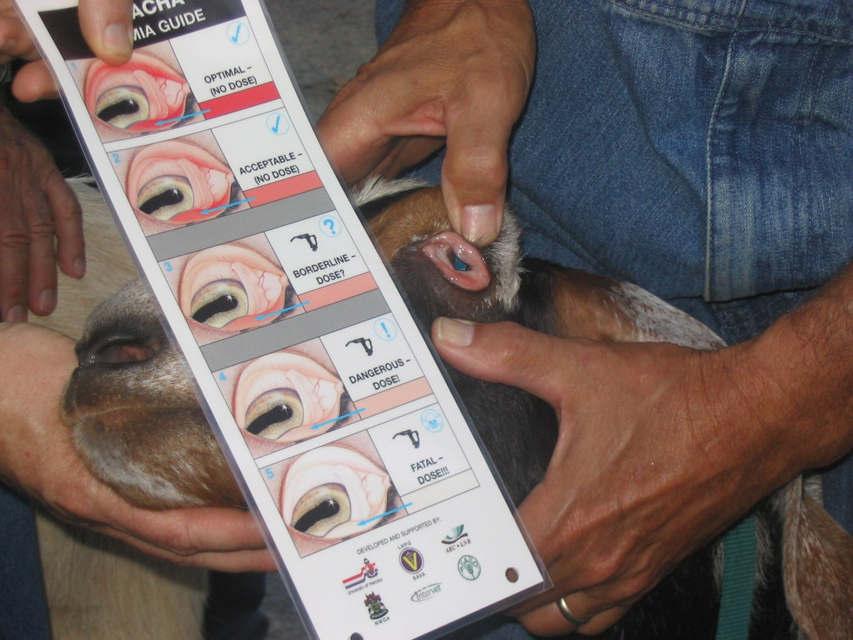
FAMACHA© was developed in South Africa as a method of identifying sheep and goats heavily infected with Haemonchus contortus (barber pole worm), a blood feeder that causes anemia. FAMACHA© involves examining the color of the inside of the lower eyelid, which can indicate anemia and thus the presence of H. contortus.
NCAT
FAMACHA© uses a color chart that shows five consecutive grades of goat or sheep eyelid pallor, ranging from 1 (red color; not anemic) to 5 (very pale; anemic). The eyelid is compared with the chart, and the animal is scored. Only animals in the palest categories are treated with dewormers.
Only animals that are anemic should be dewormed. Keep records to identify chronically wormy animals, which should be culled from the herd. Research has shown that 80% of a herd’s parasites are carried by 20% of the animals. Culling the heavily infested 20% will greatly reduce a herd’s parasite problem.
The use of FAMACHA© requires training, but ultimately it decreases the use of dewormers by as much as 90% and allows the producer to identify animals that need frequent deworming. The FAMACHA© system can even be used to select rams or offspring that are parasite resistant and/or resilient, which in turn produce offspring who are also more resistant and resilient.
Tens of thousands of FAMACHA© kits have been distributed to date. FAMACHA© kits are sold to producers only through veterinarians and other trained animal health specialists. Sheep and goat producers may obtain a card when they attend formal FAMACHA© training workshops, in person or virtual. For more, see the “Useful information” section on this FAMACHA© resources page.
Using FAMACHA© and culling problem animals will:
- strengthen the flock or herd through selection of the most infection-resistant animals for breeding
- reduce parasite levels on the pasture by culling heavily infected animals
- slow development of resistance to dewormers by reducing the number of internal parasites exposed to dewormers
- save money by reducing drug expenditures
The Five Point Check
Because there are other internal parasites that may impact the health of small ruminants (see The "Other Worms" That Infect Small Ruminants), FAMACHA© cannot stand alone. The same researchers who developed the FAMACHA© system recognized that fact and have developed additional screening procedures, collectively called the “Five Point Check”, that can be used to quickly decide which animals need to be dewormed. These five points include:
- The nose, checking for mucus which could indicate the presence of nose bots
- FAMACHA© eyes
- The jaw, looking for the presence of an accumulation of fluid called “bottle jaw,” which indicates anemia
- The body condition score (BCS), because thinner animals may be parasitized, or will be less able to battle parasites if they are too thin
- The tail, looking for the presence of diarrhea, because some parasites cause loose stools
Another valuable indicator is the condition of the coat. These indicators, used together, may also tell the producer whether nutrition is adequate for the flock or herd. For a fuller discussion, see the Consortium publication Targeted Selective Treatment, part of the Best Management Practices series on their website. Reading the 16 currently available publications in this series will give you a well-rounded view of the problem and how to tackle it.